Section
Telescopes and Stargazing
A telescope is a light bucket with an eyepiece on it. The width of its main lens or mirror decides most of what it can do, and the mount decides whether it gets used. This section covers both, plus binoculars, trackers and the gear around them. My son in Albuquerque once asked which telescope to buy. I sent him three paragraphs and a sketch. He called on Sunday anyway.
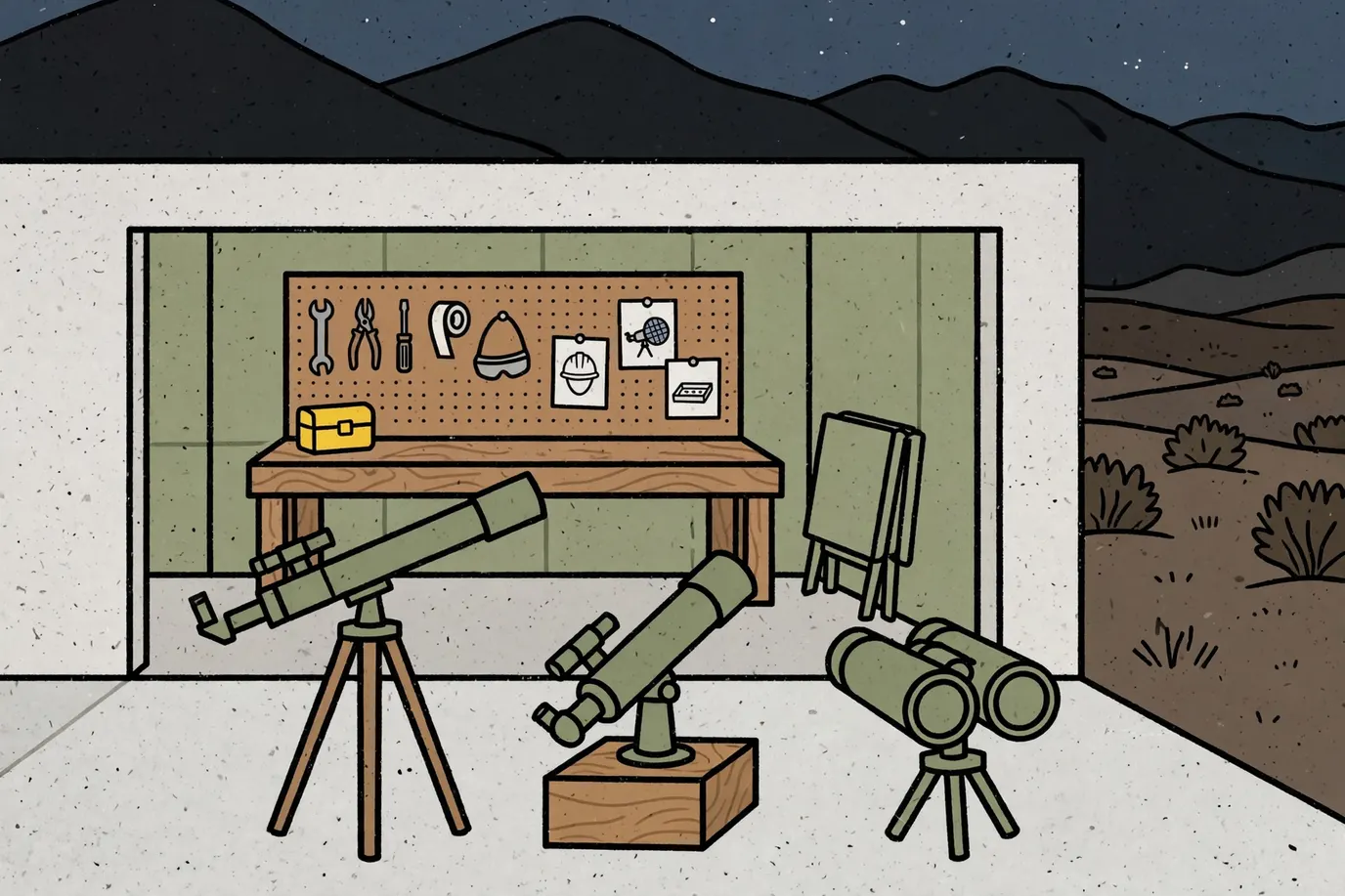
Gear in this section
Best-of lists
Best Telescope for Kids: Small Scopes for Family Nights
Makers rarely give an age for telescopes, so this list goes by size. Every pick has 50 to 90 mm of aperture (enough for the Moon's craters and Saturn's rings, small enough to carry) and a simple manual mount a child can point without help — as the maker or listing states. Where a starting age is stated, it's in the table.
Best Telescope to See Planets
Planets are small and bright, so this list wants a long focal length (900 mm or more) and at least 70 mm of aperture, both as stated by the maker or listing — longest focal length first.
Brands in this section
What a telescope does, in one paragraph
A telescope collects more light than your eye can and brings it to a focus. An eyepiece then magnifies that image. NASA's Space Place puts the first part simply: the bigger the lens or mirror, the more light the telescope gathers. Everything else on a listing, from the tripod to the phone adapter, either helps you aim that light or helps you hold it steady.
So this section is sorted the way I'd sort a survey: start from the fixed points, then measure everything else from them. Aperture is the first fixed point. The mount is the second. The rest is detail.
The main telescope designs
There are three optical designs, plus binoculars, plus a few tools for cameras. The Society for Popular Astronomy splits telescopes the same way: refractors, reflectors and catadioptrics.
Refractors: a lens at the front
A refractor uses a glass lens at the front of a long tube, and you look in at the back. The Society for Popular Astronomy calls them easy to use and sturdy. They hold their alignment and are ready to use quickly, because they're less bothered by the tube cooling down than reflectors are.
The trade-offs are honest ones. Large refractors get expensive. Basic achromatic refractors can show a fringe of false color around bright objects. Apochromatic (ED) refractors are nearly free of that fringe, but cost more. The eyepiece end can sit low and awkward, which is why most come with a star diagonal, a small mirror box that turns the view 90 degrees.
Most small first scopes are refractors. The refractor telescopes page lists them with aperture, focal length and mount side by side.
Reflectors and Dobsonians: a mirror at the back
A reflector uses a curved mirror at the bottom of the tube to gather light. NASA notes that mirrors can be made large without getting very heavy, which is why every big observatory telescope uses them. For a backyard, the Society for Popular Astronomy says large reflector apertures are not excessively expensive, and mirrors show no false color.
What you give up: a reflector's mirrors need lining up now and then. That's called collimation. The light path is also more sensitive to air currents inside the tube. A Dobsonian is a reflector on a simple swivel base you point by hand. No tripod to level, no counterweights.
Catadioptrics: a mirror and a lens, folded
Schmidt-Cassegrains and Maksutovs combine a mirror with a thin corrector lens at the front. The light bounces back and forth, so a long focal length fits in a short tube. The Society for Popular Astronomy gives typical focal ratios of about f/10 for Schmidt-Cassegrains and f/14 for Maksutovs, and calls them particularly suited to planets.
They're compact and they travel well. They also cost more than a reflector of the same aperture, and their front lens tends to dew up on damp nights. The telescopes for planets list has several of them, sorted by focal length.
Binoculars: the first instrument most people already own
Binoculars give a low-power, wide view with both eyes. That suits star fields, the Milky Way and the Moon. They need no setup beyond a strap, and a tripod adapter helps with the bigger ones. The stargazing binoculars page covers sizes and what the two numbers on the body mean.
Star trackers and astrophotography scopes: tools for cameras
Taking pictures is its own hobby inside this one. A long exposure needs a mount that follows the sky. The Society for Popular Astronomy notes that even a motorized up-down, side-to-side mount limits exposures to about 15 seconds, because the field slowly rotates. An equatorial mount, aligned with Earth's axis, fixes that, at the cost of more setup.
A star tracker is a small tracking mount that carries a camera and lens. The astrophotography telescopes page covers scopes built to carry a camera instead of an eyepiece.
Aperture, focal length and magnification in plain words
Three numbers do most of the work on any telescope listing. Here they are without the jargon.
- Aperture: the width of the main lens or mirror, in mm. More aperture gathers more light and shows finer detail. To convert, divide mm by 25.4. An "8-inch telescope" is about 203 mm.
- Focal length: the distance, in mm, the lens or mirror uses to bring light to a focus.
- Focal ratio: focal length divided by aperture, written f/10 or f/5. The Society for Popular Astronomy notes that scopes faster than about f/5 are harder to make well.
- Magnification: the scope's focal length divided by the eyepiece's focal length. A 10 mm eyepiece in a 1000 mm scope gives 100x.
The ceiling on magnification
The British Astronomical Association puts maximum magnification at about twice the aperture in millimeters. A 100 mm scope tops out near 200x. It adds that powers that high are rarely usable, and that half to two thirds of the maximum is a more useful limit. Celestron's knowledge base suggests most observing happens between 6 and 25 times the aperture in inches, and says to always start with the lowest-power eyepiece.
Theo checked my arithmetic on this section. His take: "If the box says 600x and the lens is 60 mm, the box failed math."
Aperture comes before magnification
This is the one strong opinion I'll put on this page. Magnification is cheap. Any eyepiece and a Barlow can multiply it, and Celestron's article notes that a 2x Barlow doubles whatever eyepiece you put in it. Aperture is the only number you can't add later. It sets how much light you have to spread across the view and where the ceiling sits.
So when a box leads with a big "x" number, look for the aperture in mm and double it. Anything above that is a promise the glass can't keep.
What small and large apertures show
Telescopes don't make deep-sky photos happen at the eyepiece. The Society for Popular Astronomy is plain about this. A 70 to 80 mm scope shows plenty of detail on the Moon and planets with patience, at up to about 75x or 100x. Star clusters look good in small scopes. Galaxies and nebulae look pale through any size of scope, and spiral arms need dark skies and something like 300 mm or more of aperture.
That's not a reason to skip a small scope. It's a reason to set your own benchmark before the first night. (I set mine in a notebook. The notebook has a tab for benchmarks. The tab is level.)
Mounts decide whether the scope goes outside
A wobbly mount ruins a good tube. At 100x, a small shake moves the view 100 times as far as it would to your bare eye. There are two families.
- Alt-az mounts move up-down and side to side, like a camera tripod head. The Society for Popular Astronomy calls them simple, stable and quick to set up, with no counterweights. Dobsonian bases are a type of alt-az mount.
- Equatorial mounts tilt to line up with Earth's axis, so one motion follows the stars. They track well for long-exposure photos. The same source calls them complicated for beginners: they need aligning on the Pole Star every session, and most need a counterweight.
- GoTo means a motorized mount that finds objects for you from a database. It needs power and an alignment routine first.
For a first scope, I'd pick the mount you can set up alone in the dark in five minutes. The telescopes for kids list is built around exactly that kind of manual mount.
Accessories that earn a place on the bench
Accessories pile up. Most scopes ship with one or two eyepieces and a finder, and that's enough for the first month. After that, these are the ones worth reading about.
- Eyepieces: swapping them changes magnification. A low-power one finds objects; a higher one looks at them.
- Barlow lens: multiplies an eyepiece's power, usually 2x.
- Star diagonal: turns the view 90 degrees so you aren't kneeling under a refractor.
- Finder: a small scope or red-dot sight on the tube for aiming.
- Dew shield: a tube extension that slows dew forming on the front lens.
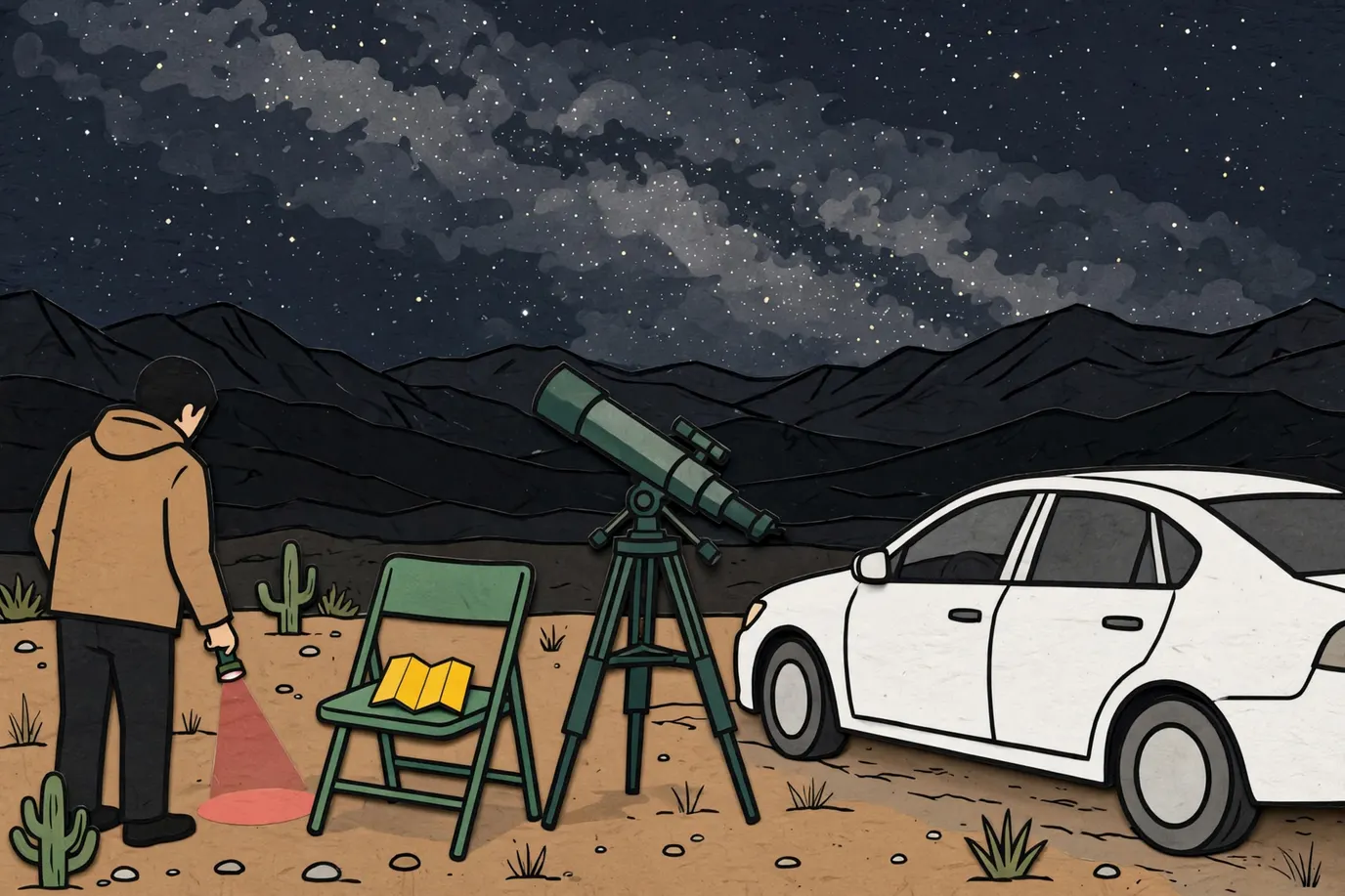
- Red flashlight: keeps your night vision while you read a chart.
- Phone adapter: holds a phone at the eyepiece for quick snapshots.
The red flashlight is the cheapest upgrade in astronomy and the easiest to lose in the dark. Mine is tied to the tripod leg with a spare bootlace. It has not wandered off since.
Dark skies matter as much as the telescope
The sky is half the instrument. NASA's stargazing guide explains that stray light from towns brightens the sky and hides faint stars. It rates sky darkness on the Bortle scale, from class 1 (darkest) to class 9 (brightest), and says class 3 or 4 is dark enough for a good evening. It suggests driving at least 20 to 30 miles beyond city limits when you can, using light-pollution maps, and scouting the spot in daylight. Make sure you're allowed to be there at night.
Then give your eyes time. The National Park Service says eyes take 20 to 30 minutes to adjust to low light. A phone screen or a white flashlight resets the clock, and red light does the least damage. The Moon matters too. The Park Service lists a new Moon, the time before moonrise or the time after moonset as the best windows.
On Piñon Loop we're lucky. The Organ Mountains block some of the glow, and the Milky Way shows from the driveway on a good night. The porch light across the loop is on a timer, though. I've asked politely. The timer has not changed its position.
Solar safety: never point a telescope at the Sun
Never look at the Sun through a telescope, binoculars, a finder or a camera, or with your eyes, without a certified solar filter made for that purpose and fitted correctly. Eye damage can be instant and permanent.
NASA and the American Astronomical Society agree on the rules.
- A solar filter for a telescope, binoculars or a camera goes securely on the front of the optics, never at the eyepiece end. The AAS warns that filters screwed into an eyepiece can be burned through by the concentrated sunlight.
- Eclipse glasses and handheld solar viewers are for your eyes only. Never use them with a telescope, binoculars or a camera. NASA says focused sunlight will burn through them.
- Handheld solar viewers should meet the ISO 12312-2 international standard. The AAS adds that a printed claim is not proof on its own.
- Cover the finder too. The AAS says to cap it, remove it or filter it like the main scope.
- Regular sunglasses are not safe for looking at the Sun, however dark they are.
On this site, a solar filter or solar viewer appears in a table only when its maker states ISO 12312-2 for that model. If you're unsure about a filter, NASA's advice is to ask an astronomer before you use it. Planet watching near sunset waits until the Sun is fully below the horizon.
Is a telescope a good gift?
It can be, if it matches the person and the place. A scope for a child should be one an adult can carry out and set up alone, and the telescopes for kids list starts there. For someone who wants to look at Jupiter and Saturn, telescopes for planets sorts by the numbers that matter for that job. For a city apartment with a balcony, binoculars may get used more than any tube.
If the gift is for a kid, the gifts for kids page covers other ways into science and building. Whatever you pick, put the solar rules in the box with it, written out.
How to read the rest of this section
Every page here works from the same fixed points. Aperture first, then the mount, then focal length and eyepieces, then everything else. Numbers come from the maker or the listing. A blank in a table means the maker didn't say, not that we guessed.
The brand pages below cover each maker's current listings on Amazon US. Pick a page, read the aperture, and carry the scope out on the next clear night with the Moon down.
Related
Questions people ask
What do I need to start stargazing?
Your eyes, a dark spot and about half an hour. The National Park Service says eyes take 20 to 30 minutes to adjust to low light, and red light protects that adjustment better than white. Go when the Moon is down or near new. Binoculars are a good first instrument. A telescope comes after you know which objects you want to look at.
What are the main types of telescopes?
Three optical designs. Refractors use a lens at the front. Reflectors use a curved mirror at the back. Catadioptrics, such as Schmidt-Cassegrains and Maksutovs, combine a mirror with a corrector lens to fold a long focal length into a short tube. A Dobsonian is a reflector on a simple swivel base. Mounts split into alt-az, which moves up-down and side to side, and equatorial.
How much does a telescope cost, and why are some so expensive?
This site never shows prices, so check the button for the current one. What drives the cost is clear. The Society for Popular Astronomy notes that refractors get expensive in large sizes, that apochromatic refractors cost more than achromatic ones, and that a catadioptric costs more than a Newtonian of the same aperture. A steadier mount and GoTo motors add to it too.
How do I choose a telescope?
Read four things, in this order. Aperture in mm, because it sets light and the magnification ceiling. Mount type, because it decides setup time and how you aim. Weight, if the listing gives it, because you carry it every night. Then the included eyepieces, so you can work out the magnifications. Ignore any magnification claim above twice the aperture in millimeters.
What does OTA mean on a telescope listing?
OTA stands for optical tube assembly. It's the telescope tube with its optics and focuser, sold without a mount or tripod. An OTA suits someone who already owns a mount that can carry it. If you don't have one, an OTA alone can't be pointed at anything, so count the mount as a second purchase.
Sources
- NASA Space Place: How Do Telescopes Work? — accessed 2026-10-23
- Society for Popular Astronomy (hosted by the British Astronomical Association): Introduction to equipment — accessed 2026-10-23
- British Astronomical Association: Eyepieces — accessed 2026-10-23
- Celestron Knowledge Base: What is magnification/power as it pertains to telescopes? — accessed 2026-10-23
- National Park Service: Astronomy — accessed 2026-10-23
- NASA Science: How to Find Good Places to Stargaze — accessed 2026-10-23
- NASA Science: Eclipse Safety — accessed 2026-10-23
- American Astronomical Society: Solar Filters for Optics — accessed 2026-10-23
- American Astronomical Society: About the ISO 12312-2 Standard — accessed 2026-10-23