Telescopes & Stargazing · Type
Astrophotography Telescopes
An astrophotography telescope has two jobs: hold a camera at focus, and follow the sky while the shutter is open. The second job belongs to the mount, so this page lists scopes by what they bring to it: ED or apochromatic refractors for clean color, and GoTo or smart telescopes that track. The sky turns about 15 degrees an hour. It doesn't slow down for a long exposure. I've asked.
We earn a commission if you buy through our links, at no cost to you. Disclosure
Telescopes
| Model | Optical design | Lens type | Aperture | Focal length | Amazon |
|---|---|---|---|---|---|
Celestron CGX 11"Telescopes More specs
| Schmidt-cassegrainlisting | — | 279 mmlisting | — | Check price |
Celestron CGEM II 11" SCTTelescopes More specs
| Schmidt-cassegrainlisting | — | 279 mmlisting | — | Check price |
Celestron NexStar 8SETelescopes More specs
| Schmidt-cassegrainlisting | — | 203 mmlisting | — | Check price |
Celestron NexStar Evolution 8Telescopes More specs
| Schmidt-cassegrainlisting | — | 203 mmlisting | — | Check price |
Celestron NexStar 8SETelescopes More specs
| Schmidt-cassegrainlisting | — | 203 mmlisting | 2,032 mmlisting | Check price |
Celestron NexStar 8SE with SkyPortal WiFi ModuleTelescopes More specs
| Schmidt-cassegrainlisting | — | 203 mmlisting | — | Check price |
Celestron NexStar 8SETelescopes More specs
| Schmidt-cassegrainlisting | — | 203 mmlisting | — | Check price |
Sky-Watcher S11800 GoTo Collapsible Dobsonian 8"Telescopes More specs
| Dobsonianlisting | — | 203 mmlisting | — | Check price |
Celestron NexStar 6SE bundleTelescopes More specs
| — | — | 152 mmlisting | — | Check price |
Sky-Watcher Virtuoso GTi 130PTelescopes More specs
| Dobsonianlisting | — | 130 mmlisting | 650 mmlisting | Check price |
Celestron NexStar 5SETelescopes More specs
| Schmidt-cassegrainlisting | — | 127 mmlisting | — | Check price |
Celestron NexStar 127SLTTelescopes More specs
| Maksutov-cassegrainlisting | — | 127 mmlisting | — | Check price |
Celestron NexStar 102SLTTelescopes More specs
| Refractorlisting | — | 102 mmlisting | — | Check price |
Celestron Astro Fi 102Telescopes More specs
| Maksutov-cassegrainlisting | — | 102 mmlisting | — | Check price |
Sky-Watcher AZ-GTe with StarTravel 102Telescopes More specs
| Refractorlisting | Achromaticlisting | 102 mmlisting | — | Check price |
Sky-Watcher Evostar 80EDX APO (S11135)Telescopes More specs
| Refractorlisting | Apochromaticlisting | 80 mmlisting | 600 mmlisting | Check price |
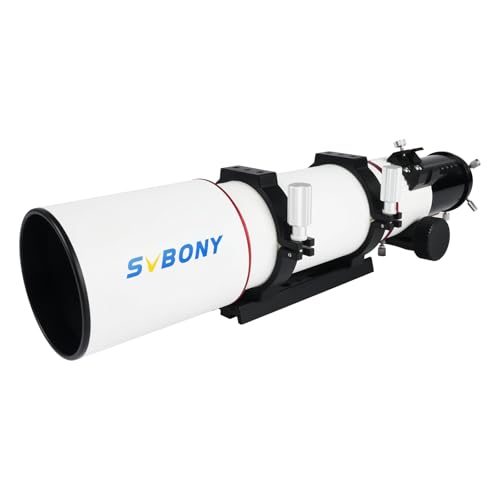
SVBONY SV503 80EDTelescopes More specs
| Refractorlisting | EDlisting | 80 mmlisting | — | Check price |
SVBONY SV550 80mm APOTelescopes More specs
| Refractorlisting | Apochromaticlisting | 80 mmlisting | — | Check price |
SVBONY SV530 80mm EDTelescopes More specs
| Refractorlisting | EDlisting | 80 mmlisting | 480 mmlisting | Check price |
National Geographic 70mm Refractor Telescope by Explore Scientific (Computerized)Telescopes More specs
| Refractorlisting | Achromaticlisting | 70 mmlisting | 350 mmlisting | Check price |
iOptron AstroboyTelescopes More specs
| Refractorlisting | — | 60 mmlisting | — | Check price |
Celestron 114LCMTelescopes More specs
| Reflector (Newtonian)listing | — | — | — | Check price |
Celestron NexStar Evolution 8 bundleTelescopes More specs
| Schmidt-cassegrainlisting | — | — | — | Check price |
Celestron NexStar 8SE bundleTelescopes More specs
| — | — | — | — | Check price |
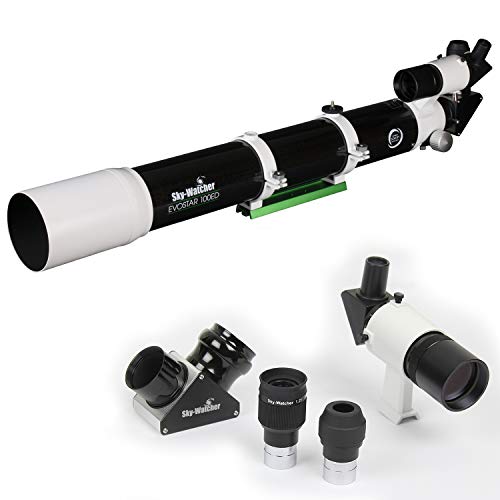
Sky-Watcher EvoStar 100 APOTelescopes More specs
| Refractorlisting | Apochromaticlisting | — | — | Check price |
SVBONY SV503 80ED visual kitTelescopes More specs
| Refractorlisting | EDlisting | — | — | Check price |





Smart & digital telescopes
| Model | Aperture | Control app | Camera sensor | Amazon |
|---|---|---|---|---|
Celestron Origin Intelligent Home ObservatorySmart & digital telescopes More specs
| 152 mmlisting | Origin applisting | — | Check price |
DWARFLAB Dwarf 3Smart & digital telescopes More specs
| — | DWARFLAB applisting | — | Check price |
DWARFLAB Dwarf miniSmart & digital telescopes More specs
| — | DWARFLAB applisting | Sony IMX662 (1/2.8-inch, 2.9μm pixels)listing | Check price |
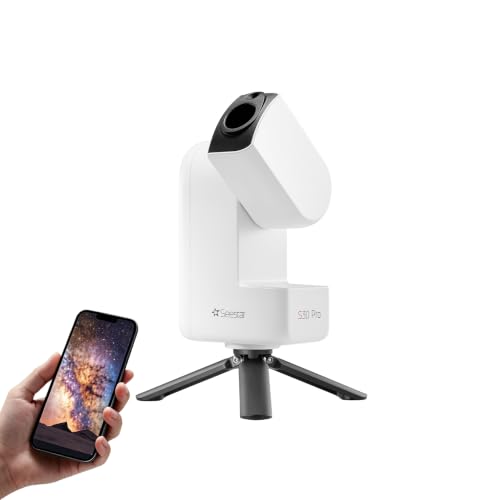
ZWO Seestar S30 ProSmart & digital telescopes More specs
| — | — | — | Check price |
ZWO Seestar S30 ProSmart & digital telescopes More specs
| — | — | — | Check price |
ZWO Seestar S30 Pro bundle with TH10 head & TC20 tripodSmart & digital telescopes More specs
| — | — | — | Check price |



What’s in this listTelescopes suited to photography by spec: ED or apochromatic refractors, and GoTo or smart telescopes that track the sky — as the maker or listing states it. “—” means neither the maker nor the Amazon listing states it.
What makes an astrophotography telescope different
A telescope for looking and a telescope for photos share most parts. The difference is time. Your eye takes in the view as it comes. A camera collects light for seconds or minutes, and the sky moves the whole time.
So an astrophotography telescope needs three things a visual scope can live without:
- Tracking: a mount that turns with the sky so stars stay points, not streaks.
- Clean color across the frame: a camera records the false color and edge blur that your eye forgives.
- A way to attach a camera at focus: the right adapter and enough focus travel.
The table above lists scopes from our data that bring at least one of these, as the maker or listing states it: ED or apochromatic refractors, and GoTo or smart telescopes that track the sky. It's a mixed group on purpose. Some are camera tubes waiting for a mount. Some are mounts with a tube on top. A few are the whole system in one box.
Astrophotography equipment: the mount comes first
This is my one opinion on the page, and it has a reason you can check. The mount is the astrophotography purchase. The tube is the accessory.
The Society for Popular Astronomy (SPA) explains why. A computerized alt-az mount, the up-down and side-to-side kind, can follow an object, but the field slowly rotates in the frame. That limits exposures to about 15 seconds, although stacking many short frames is possible. An equatorial mount tilts to line up with Earth's axis. It allows extended tracking, and the SPA calls it particularly useful for long-exposure imaging. The same source is honest about the price in patience: equatorial mounts are complicated for beginners, need aligning on the Pole Star every session, and most need a counterweight.
That splits our data neatly.
- Computerized equatorial (GoTo): the Celestron CGX 11" and CGEM II 11" SCT. Both list 279 mm Schmidt-Cassegrain tubes on equatorial GoTo mounts.
- Computerized alt-az (GoTo): the Celestron NexStar 8SE, 6SE bundle, 5SE, 127SLT, 102SLT and Astro Fi 102, the NexStar Evolution 8, the Sky-Watcher AZ-GTe with StarTravel 102, the iOptron Astroboy and others. These track, within the 15-second field-rotation limit the SPA describes.
- No mount (OTA only): the ED and APO refractors. OTA means optical tube assembly, the tube by itself. You add the mount.
An expensive tube on a shaky mount gives you expensive streaks. A modest tube on a steady, tracking mount gives you points. I'd rather buy the steady part first.
What to look at on an astrophotography listing
Mount type and GoTo
Start here. The listing's mount field tells you whether it tracks at all, and whether it tracks in the way long exposures need. GoTo means a motorized mount that finds objects from a database, then follows them. Several listings add WiFi app control: the NexStar Evolution 8, the 8SE with SkyPortal WiFi Module, the Astro Fi 102, the Sky-Watcher S11800 GoTo Collapsible Dobsonian 8", the Virtuoso GTi 130P and the AZ-GTe with StarTravel 102.
If the mount field says "none (OTA only)", count a mount as a second purchase. A camera tube with no mount is a very nice paperweight with a dew problem.
Optical design and glass
The SPA lists the main optical problems a camera finds. Achromatic refractors show false color. Reflectors may need collimating, which means lining up the mirrors. SCTs have mirror flop, a slight shift of the main mirror as the scope moves, which the SPA calls troublesome for planetary work. Off-axis stars can show coma, a smear that turns them into little commas. Punctuation belongs in field notes, not in the corners of a photo.
For color, the ED and apochromatic refractors are the clean option. Listed in our data:
- Apochromatic: Sky-Watcher Evostar 80EDX APO (80 mm, 600 mm, f/7.5), SVBONY SV550 80mm APO (80 mm, f/6), Sky-Watcher EvoStar 100 APO.
- ED: SVBONY SV503 80ED (80 mm, f/7), SV530 80mm ED (80 mm, 480 mm, f/6), SV503 80ED visual kit.
The SPA groups ED and apochromatic refractors as virtually free from chromatic aberration. The refractor telescopes page explains the glass types in more detail.
Aperture and focal ratio
Aperture is the width of the main lens or mirror, in mm. In our data it runs from 60 mm (the iOptron Astroboy) to 279 mm (the two 11" Celestrons). Focal ratio is focal length divided by aperture. For photos, a lower f-number collects light faster, so the same brightness needs less exposure time.
The SPA puts this plainly: a telescope works like a camera lens with no diaphragm. It has one fixed f-number. The ED tubes in our data sit at f/6 to f/7.5. The NexStar 8SE listing gives f/10 at 2032 mm. The Virtuoso GTi 130P lists f/5 at 650 mm.
Long focal lengths magnify more, which suits small targets such as planets. They also magnify every tracking error. Short focal lengths forgive more and show wider fields.
Focal reducer
A focal reducer is a lens that shortens a scope's effective focal length. It works the opposite way to a Barlow, which multiplies. The SPA notes that focal length may be altered with either one. A reducer gives a wider field and a faster focal ratio. The SPA also warns that reducers can cause back-focus problems, and says to check with the supplier before buying.
Field flattener
A refractor brings stars to focus on a slightly curved surface. A camera sensor is flat. The SPA lists the curved focal plane as a limitation for imaging and says it requires a field flattener. Without one, stars in the middle can be sharp while stars near the corners stretch.
Back focus and camera fit
Back focus is the distance from the focuser to the point where the image forms. The SPA gives the number to remember: a DSLR's sensor sits about 55 mm behind its lens mount. If the telescope can't place focus that far back, the camera can't reach focus. The SPA notes that refractors and reflectors often have limited focus travel and need extension tubes, and that some budget scopes can't easily be used with a camera at all.
The SPA also points out a thread trap: Pentax M42 and T-mount M42 share a diameter but not a thread pitch (1 mm versus 0.75 mm). I measure distances for a living. This one still gets checked twice.
Smart telescope features
A smart telescope is a small scope, camera and tracking mount in one body, run from a phone. The SPA describes them as automatic: they set themselves up, plate-solve to find where they're pointing, then take repeated short exposures. In our data:
- Celestron Origin Intelligent Home Observatory: 152 mm aperture, GoTo, Origin app, per the listing.
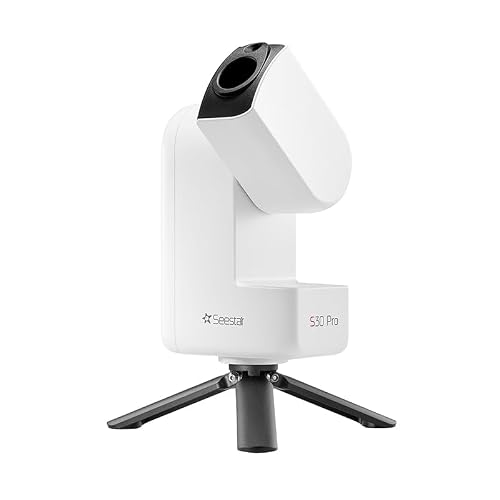
- ZWO Seestar S30 Pro: GoTo, three listings, one stating 6 hours of battery life and one bundled with a TH10 head and TC20 tripod. ZWO's site recommends that head and tripod for its EQ mode.
- DWARFLAB Dwarf 3 and Dwarf mini: GoTo and the DWARFLAB app. The Dwarf mini lists a Sony IMX662 sensor (1/2.8-inch, 2.9 μm pixels).
A smart telescope does the alignment, the focus and the stacking. It leaves you the folding chair and the decision about when to go to bed.
Kinds of astrophotography setups
Wide-field deep sky
Nebulae, star fields and big galaxies want a short focal length, clean color and long total exposure. That's the job for an ED or APO refractor on an equatorial mount, or a smart telescope. Choose this if the Milky Way and big glowing clouds are what you want on the screen.
Planets and the Moon
Small, bright targets want a long focal length. The SPA calls catadioptrics, such as SCTs and Maksutovs, particularly suitable for planets. The NexStar SE line, the 127SLT and the Astro Fi 102 are examples in our data. The SPA lists dedicated planetary cameras for this. Choose this if Jupiter's bands and the lunar terminator are the point.
Through-the-eyepiece phone shots
The simplest start of all. The SPA notes that phone cameras are increasingly sensitive, but must shoot through the eyepiece. Any scope here can do it with a phone adapter. Choose this if you want a Moon photo next week and a decision about cameras later.
Best telescope for astrophotography beginners: where to start
There's no single answer, but there is an order. Here's the path I'd sketch on a napkin.
- Camera on a tripod. The Planetary Society's 500 rule says a full-frame camera can expose for about 500 divided by the lens focal length, in seconds, before stars trail. A 14 mm lens gives about 35 seconds.
- Camera on a star tracker. A star tracker turns the camera with the sky. Longer lenses, longer exposures.
- Smart telescope or small ED refractor on a tracking mount. The first real telescope step.
- Bigger aperture and focal length. Only after the mount is sorted.
Each step adds one new problem. That's why the order matters.
Who should skip this page
Skip it if you mainly want to look through the eyepiece. Looking doesn't need a camera, cables or a laptop on the driveway. The telescopes for planets list is a better start for looking.
Skip it, too, if you don't want to spend setup time on alignment. Equatorial mounts need it every session. A smart telescope does it for you, and that trade is worth knowing about before you shop.
Dark skies and the Moon still decide the night
The Planetary Society says to shoot the Milky Way at new Moon, or within about a week either side, because moonlight washes it out. Get as far from city lights as you can, and bring spare batteries, since long exposures and cold nights drain them. My first rule for any photo night is to look at the Moon's calendar before I look at the camera.
Sun safety with cameras and telescopes
Never look at the Sun through a telescope, binoculars, a finder or a camera, or with your eyes, without a certified solar filter made for that purpose and fitted correctly. Eye damage can be instant and permanent.
The American Astronomical Society says the filter goes on the front of the telescope or camera lens, never at the eyepiece end, and that the finder needs a cap or its own filter. NASA says never to look through a camera, binoculars or a telescope while wearing eclipse glasses. Smart telescopes are no exception. ZWO sells a solar filter accessory for the S30 Pro; use the filter made for your model, on the front, as its maker directs.
Mount first, camera second, tube third. The stars have been in no hurry for a long time.
Brands in this list
Related
Questions people ask
How do I get into astrophotography?
Start with what you own. A camera on a steady tripod with a wide lens can photograph the Milky Way. The Planetary Society suggests f/2 to f/2.8, 10 to 30 seconds and ISO 1600 to 6400 as starting settings, on a moonless night far from lights. When trailing stars limit you, add tracking: a star tracker for a camera, then a telescope on a tracking mount.
How do you take pictures through a telescope?
Two ways. Hold a phone at the eyepiece, ideally in a phone adapter. The Society for Popular Astronomy notes that phones work but must shoot through the eyepiece. Or remove the eyepiece and attach a camera body with an adapter for your camera's mount, so the telescope acts as the lens. Check the back focus first, since some scopes can't reach focus with a camera.
What is a focal reducer?
A focal reducer is a lens that shortens a telescope's effective focal length. That gives a wider field and a lower focal ratio, which means shorter exposures for the same brightness. The Society for Popular Astronomy notes that focal length can be changed with a focal reducer or a Barlow, and that reducers can cause back-focus problems, so check fit with the maker first.
What does a field flattener do?
Many refractors bring stars to focus on a slightly curved surface, while a camera sensor is flat. Stars in the middle look sharp and stars near the corners stretch. A field flattener is a lens that sits in front of the camera and flattens that focal surface. The Society for Popular Astronomy lists a curved focal plane among the limitations of telescopes for imaging.
Can a smart telescope photograph planets?
Not well, according to the Society for Popular Astronomy, which calls smart telescopes unsuitable for planetary imaging. They're built for wide, faint targets: they align themselves, take many short exposures and stack them in an app. For planets, the usual tools are a long-focal-length scope on a tracking mount and a dedicated planetary camera.
Sources
- Society for Popular Astronomy (hosted by the British Astronomical Association): Introduction to equipment — accessed 2026-10-23
- The Planetary Society: Night sky photography for beginners — accessed 2026-10-23
- ZWO Seestar: smart telescopes — accessed 2026-10-23
- British Astronomical Association: Eyepieces — accessed 2026-10-23
- NASA Science: Eclipse Safety — accessed 2026-10-23
- American Astronomical Society: Solar Filters for Optics — accessed 2026-10-23