Why this telescope for kids list goes by size, not age
Here's the problem with shopping for a kid's telescope. Toy boxes print an age. Telescope boxes almost never do. None of these six listings states a starting age at all, so the table shows a dash in that column. That leaves a parent guessing, and I don't like guessing. A survey starts from a benchmark you can check.
So I used a stand-in rule that the data can actually check. Every pick has 50 to 90 mm of aperture, and every pick sits on a manual alt-az mount. Aperture is the width of the main lens, in mm. More aperture gathers more light. An alt-az mount moves up-down and left-right, like a camera tripod head. You push it by hand. There are no motors, no batteries and no app to update at bedtime.
In practice, all six picks landed between 70 and 90 mm. That's 2.8 to 3.5 in of lens. No brand gets more than two spots, and the list is sorted by aperture, biggest first. The data date is October 23, 2026.
Here's the rule, the short version:
- Aperture: 50–90 mm, as the listing states
- Mount: manual alt-az, pointed by hand
- Brands: two picks each, at most
- Order: aperture, largest first
- Age: shown only if the listing states one (none of these six does)
That last line matters. No listing here states a starting age, and none of these is a toy. So my advice is to treat it as a family scope. The adult carries it, sets it up, and keeps the finder capped in daylight. The kid gets the best job in the hobby, which is asking "what's that one?"
A first telescope should be one you can carry and set up alone
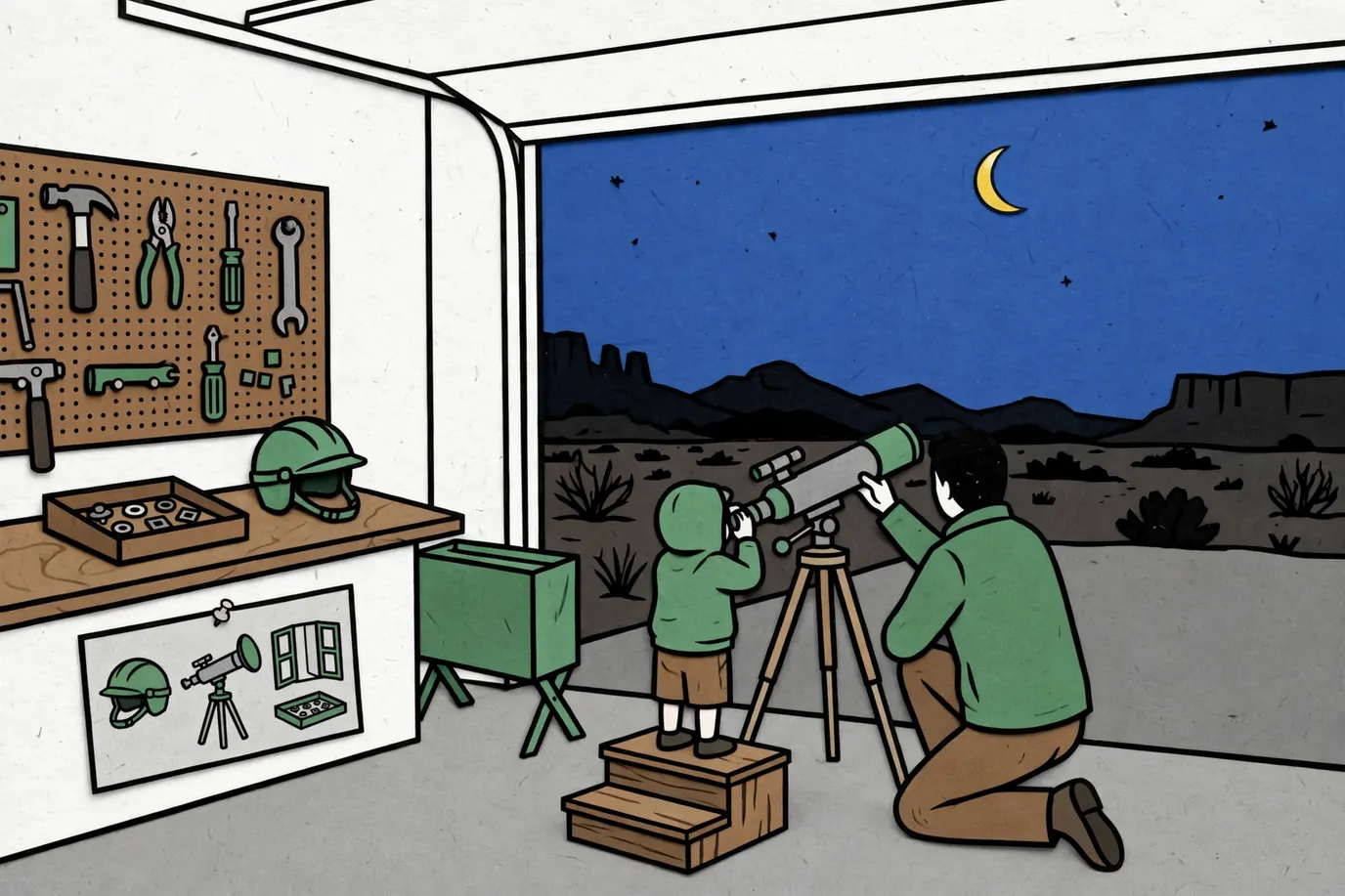
This is my one strong opinion, and it isn't about optics. A telescope that takes two people and twenty minutes to set up goes out on Saturdays, maybe. A telescope one adult can carry out the back door goes out on a Tuesday, when the Moon is up and homework is done. The second scope gets used. The first one gets dusted.
The mount type tells you a lot here. A manual alt-az mount has fewer parts to level, balance and align than an equatorial mount, which is built to follow the stars along Earth's axis. That's why it's in the rule. Weight would tell you the rest, but the data doesn't list weight for any of these six. Check the listing for the tube and tripod weight before you buy, and picture yourself carrying both at once, in the dark, past a bicycle.
For the record, I learned the carrying part the honest way. One August night I had a scope set up in the driveway when a monsoon cell came over the Organ Mountains. Theo and I got everything into Bay Two in about 90 seconds. I check the radar before I carry anything out now. The lesson stuck: if it can't move fast, it won't go out often.
The six picks, largest aperture first
The table above has the key fields side by side. Below, each pick gets a few lines on who it suits and one trade-off from the data.
Gskyer AZ90600: short tube, low power first
The Gskyer AZ90600 is a 90 mm (3.5 in) refractor with a 600 mm focal length. A refractor uses a lens at the front instead of a mirror, so there's no mirror to clean or keep aligned. Three picks here tie for the most aperture on this page, and this is one of them. Focal length is the distance the scope uses to bring light to focus. Divide it by the aperture and you get the focal ratio, listed as f/6.7. Lower f-numbers give wider, brighter views, which suits the Moon and star fields.
The listing gives three eyepieces at 24x, 60x and 120x, plus a 3x Barlow. A Barlow is an extra lens that multiplies an eyepiece's power. Here's the honest part. The useful ceiling for 90 mm is about 180x, so the 3x Barlow stacked on the 120x eyepiece goes past it. Start at 24x. More at Gskyer.
SOLOMARK 90mm Telescope Vertisteel AZ Mount: phone adapter in the box
The SOLOMARK 90mm Telescope Vertisteel AZ Mount has 90 mm of aperture, a 1000 mm focal length and a manual alt-az mount. The listing includes a smartphone adapter. That's handy with kids, because a phone held to the eyepiece lets a second person watch the screen while the first one keeps their turn.
A 1000 mm focal length is the longest on this list. Longer focal lengths give more power with the same eyepiece. The trade-off: the data doesn't name the optical design or the eyepieces. Check both on the listing. The brand's page is SOLOMARK.
SVBONY SV520: a scope that teaches the math
The SVBONY SV520 is a 90 mm refractor with an 800 mm focal length. It comes with PL10 and K25 eyepieces, a Barlow and a phone adapter, per the listing. Those eyepiece names carry their focal lengths: 10 mm and 25 mm.
Celestron's formula for magnification is simple. Divide the scope's focal length by the eyepiece's focal length. So 800 ÷ 25 is 32x, and 800 ÷ 10 is 80x. That's a good sum to do with a kid at the kitchen table before the first night out. (Close enough is not a measurement. The division is exact.) The data doesn't state the Barlow's power. See SVBONY for more.
Gskyer 80mm AZ Refractor Telescope: the short tube
The Gskyer 80mm AZ Refractor Telescope has 80 mm (3.1 in) of aperture and a 400 mm focal length. That's the shortest focal length on the list. Short tubes give wide, low-power views, which makes the Moon easy to find and easy to keep in view.
The listing gives eyepieces at 16x, 40x and 80x, plus a 3x Barlow and a phone adapter. The useful ceiling for 80 mm is about 160x. The Barlow on the 80x eyepiece goes past that, so treat that pairing as one you can skip. For planets at higher power, a longer focal length is the better fit.
SOLOMARK 80900: two eyepieces, nothing extra
The SOLOMARK 80900 is an 80 mm refractor with a 900 mm focal length on a manual alt-az mount. It lists two eyepieces, 10 mm and 20 mm. By Celestron's formula, that's 90x and 45x, both well under the 160x ceiling for 80 mm.
Two eyepieces is a short menu, and for a family that's not a flaw. Fewer parts in the case means fewer parts in the grass. (My parts tray has a label. The label says "parts tray". I'm aware.) The data doesn't list a phone adapter for this one.
Celestron AstroMaster 70AZ: the smallest on the list
The Celestron AstroMaster 70AZ is a 70 mm (2.8 in) achromatic refractor on a manual alt-az mount, and the listing says no GoTo. It has the least aperture here, so it gathers the least light of the six. Its useful ceiling is about 140x.
The data skips focal length and eyepieces, so you can't work out its magnifications from this page. Check the listing for both. More on the line at Celestron. If two picks look equal to you and you can't decide, more aperture is the tiebreaker, and every other scope here has 80 or 90 mm.
How to choose a childrens telescope from these six
Aperture first, magnification second
Aperture decides how much light comes in. Magnification only decides how big the image gets. Sky-Watcher puts usable magnification at about 2x per mm of aperture under good conditions. Celestron's rule of thumb is 50 to 60 times the aperture in inches, under ideal conditions. Both land in the same place. A 70 mm scope tops out around 140x. A 90 mm scope tops out around 180x. Past that, Celestron notes, images get dimmer and lower in contrast.
That's why this page doesn't repeat any combined magnification above twice the aperture. If a box leads with a big number, it's selling a number.
Focal length sets the feel
Short focal lengths (400 and 600 mm here) give wide fields and low power. They're easier to aim, which matters for small hands and short patience. Long focal lengths (800 to 1000 mm here) reach higher power with the same eyepiece and suit the Moon up close and the bright planets. More long-focus picks are on the best telescopes for planets page.
Eyepieces and a phone adapter
Two or three eyepieces covers a family. Start every night with the lowest power, the biggest eyepiece number, and step up only once the target is centered. A phone adapter isn't an optical upgrade. It's a crowd-control device. Three picks list one.
Refractors are the easy keepers
Five of the six picks are listed as refractors. The SOLOMARK 90 mm listing doesn't say. A refractor has a sealed tube with a lens in front, so there's no mirror to touch. Anyone who has watched a child reach for the business end of a reflector knows why that matters. More on the type at refractor telescopes.
Solar safety: the one rule with no exceptions
Never look at the Sun through a telescope, binoculars, a finder or a camera without a certified ISO 12312-2 solar filter made for that purpose and fitted to the front of the optics. Eye damage can be instant and permanent.
NASA and the American Astronomical Society both say the solar filter goes on the front of the telescope. The AAS warns that the small solar filters sold with some inexpensive telescopes, made to thread into the eyepiece, are dangerous. NASA also says not to use eclipse glasses while looking through a telescope or binoculars. Cap or remove the finder scope too.
None of the six listings on this page includes a front solar filter in its data. Treat every one of them as a night scope. If a telescope is out in daylight with a child nearby, an adult stays with it and the caps stay on.
Who should skip this list
Skip this page if you want a toy to hand over and walk away. No listing here states an age, and my advice for every one is an adult to carry it, set it up and stay with it. If you're not ready to own and run a telescope, a pair of stargazing binoculars, used together, is a simpler first step.
Skip it too if the kid wants the scope to find things by itself. These are manual mounts by rule. And if you live where you'll have to drive to see the stars, keep my opinion above in mind. A scope that rides in the car twice a year is fine. A scope that lives by the back door is better. For gift ideas that aren't telescopes, try the gifts for kids page.
Getting the first night right
A few habits make the first night go well, whichever scope you pick.
- Set up before dark. Find the parts in daylight, then cap everything.
- Aim at the Moon first. It's big, bright and hard to miss.
- Start at low power. The biggest eyepiece number gives the widest view.
- Let the kid focus. Show them the knob, then step back.
- Keep it short. Twenty minutes beats an hour of cold feet.
- Pack up together. Every part back in its box, every cap back on.
At our sidewalk star nights on the loop, the first question from a kid is almost always "what's that one?" The second is "can I look again?" Plan for the second question. The rest of the telescope section is at /telescopes/.
Clear skies.