Telescopes & Stargazing · Type
Binoculars for Stargazing
Binoculars for stargazing are two small telescopes joined side by side, and for most people they're the right first instrument. The choice is the two numbers on the body: magnification and lens size. Bigger lenses gather more light; higher power needs more support. A pair fits in the glove box, sets up in the time it takes to take off the caps, and nobody has to explain which end you look into.
We earn a commission if you buy through our links, at no cost to you. Disclosure
| Model | Field of view | Magnification | Objective | Eye relief | Amazon |
|---|---|---|---|---|---|
Celestron SkyMaster 25x100Astronomy binoculars More specs
| — | 25 xlisting | 100 mmlisting | — | Check price |
Celestron SkyMaster 20x80Astronomy binoculars More specs
| — | 20 xlisting | 80 mmlisting | — | Check price |
Celestron SkyMaster Pro 20x80Astronomy binoculars More specs
| — | 20 xlisting | 80 mmlisting | — | Check price |
Celestron SkyMaster Pro ED 20x80Astronomy binoculars More specs
| — | 20 xlisting | 80 mmlisting | — | Check price |
Celestron SkyMaster 15x70Astronomy binoculars More specs
| — | 15 xlisting | 70 mmlisting | — | Check price |
Celestron SkyMaster 25x70Astronomy binoculars More specs
| — | 25 xlisting | 70 mmlisting | — | Check price |
Celestron SkyMaster Pro 15x70Astronomy binoculars More specs
| — | 15 xlisting | 70 mmlisting | — | Check price |
Celestron SkyMaster 25x70 (71008) with smartphone adapterAstronomy binoculars More specs
| — | 25 xlisting | 70 mmlisting | — | Check price |
Celestron SkyMaster Giant 15x70 with tripod adapterAstronomy binoculars More specs
| 4.4listing | 15 xlisting | 70 mmlisting | 13 mmlisting | Check price |
Celestron UpClose G2 10x50Astronomy binoculars More specs
| — | 10 xlisting | 50 mmlisting | — | Check price |
Celestron Cometron 7x50Astronomy binoculars More specs
| — | 7 xlisting | 50 mmlisting | — | Check price |
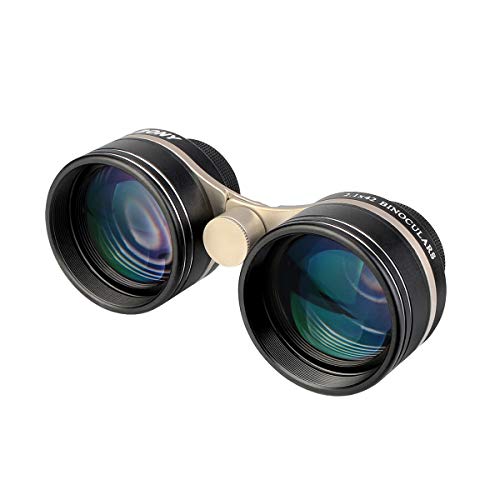
SVBONY SV407 2.1x42Astronomy binoculars | 26listing | 2.1 xlisting | 42 mmlisting | — | Check price |
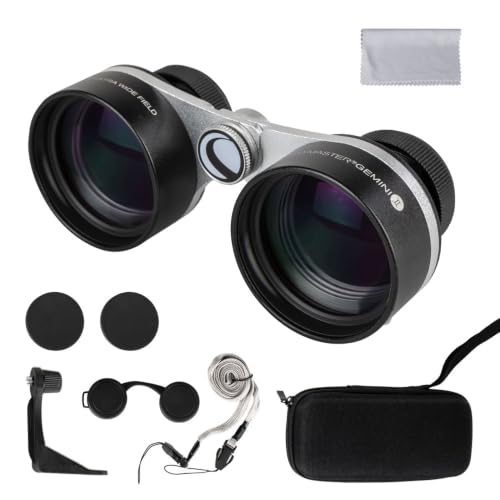
Celestron SkyMaster Gemini 2x40Astronomy binoculars | 24listing | 2 xlisting | 40 mmlisting | — | Check price |


What’s in this listAstronomy binoculars we track on Amazon US, biggest stated objective lens first. “—” means neither the maker nor the Amazon listing states it.
Why binoculars for stargazing come first
A pair of binoculars is two small refractor telescopes, side by side, one for each eye. That's the whole idea of a "binocular telescope." You get a low-power, wide view with both eyes open, and no eyepiece to swap.
For a first season under the stars, that wide view is the point. Finding things is the hard part of astronomy. A pair of 8x30s, the British Astronomical Association (BAA) notes, typically covers about 8 degrees. That's room to recognize a star pattern and walk from one star to the next.
The table above lists the astronomy binoculars we track on Amazon US, biggest stated front lens first. The list runs from 100 mm giants down to 40 mm wide-field pairs. Most come from Celestron's SkyMaster, UpClose and Cometron lines, plus one SVBONY pair. The sort is by lens size, not a ranking, and the right pair depends on how you'll hold it.
What the two numbers mean
Every binocular has a label like 10x50. The BAA explains it simply: magnification first, then the width of each front lens (the objective) in millimeters.
- 10x50: 10 times magnification, 50 mm objectives.
- 15x70: 15 times, 70 mm objectives.
- 25x100: 25 times, 100 mm objectives.
The second number decides how much light you collect. The first decides how big things look, and how much every wobble of your hands is magnified along with them.
Exit pupil: the third number nobody prints
Divide the objective by the magnification and you get the exit pupil, the width of the beam of light leaving the eyepiece. The BAA uses the same formula for telescopes. If the beam is wider than your own pupil, some of the light lands on your iris and is wasted.
Here's how the pairs in our data work out.
| Binocular | Exit pupil |
|---|---|
| 7x50 (Cometron) | about 7.1 mm |
| 10x50 (UpClose G2) | 5 mm |
| 15x70 (SkyMaster, SkyMaster Pro, SkyMaster Giant) | about 4.7 mm |
| 20x80 (SkyMaster, SkyMaster Pro, SkyMaster Pro ED) | 4 mm |
| 25x100 (SkyMaster) | 4 mm |
| 25x70 (SkyMaster) | 2.8 mm |
Theo checked the table before I published it. His take: "Seventy over fifteen is 4.67. I'd accept 4.7 on a quiz, if you showed your work."
How wide does your own pupil open? The BAA says a fully dark-adapted pupil is over 7 mm in your twenties, close to 5 mm in your sixties, and about 3 mm in your seventies, and light pollution keeps it smaller in practice. So a 7x50 suits young eyes under dark skies. A 4 to 5 mm exit pupil suits most adults. Nobody should feel bad about their pupils. Mine are 52 and doing fine.
What to look at on a stargazing binocular listing
Objective size: how much light
Bigger objectives gather more light, and that shows as fainter stars and brighter clusters. The pairs in our data run from 100 mm (the SkyMaster 25x100) down to 40 mm (the SkyMaster Gemini 2x40). The BAA adds a caution: more aperture doesn't always mean more detail under light-polluted skies, where magnification helps too.
Magnification: how much your hands shake
Higher power makes things bigger and makes your heartbeat visible. In our data, magnification runs from 2x to 25x. Above about 10x, steadiness becomes the main problem, not optics.
Support: the opinion on this page
This is my one strong view here, and it comes straight from the BAA: above 10x, plan for support, because firm support matters more than optical quality. The BAA puts the limit for comfortable long hand-holding at around 15x70, depending on the person and the weight, and says 20x80s can be used if supported.
Holding a pair of 20x80s at the zenith by hand is a shoulder workout with a view. It's a short workout.
Astronomy binoculars and tripods
Most of the larger pairs in our data are listed as tripod adaptable: the SkyMaster 25x100, all three 20x80s, the 15x70s and the 25x70. The Cometron 7x50 is listed that way too. An adapter connects the binoculars to a standard tripod.
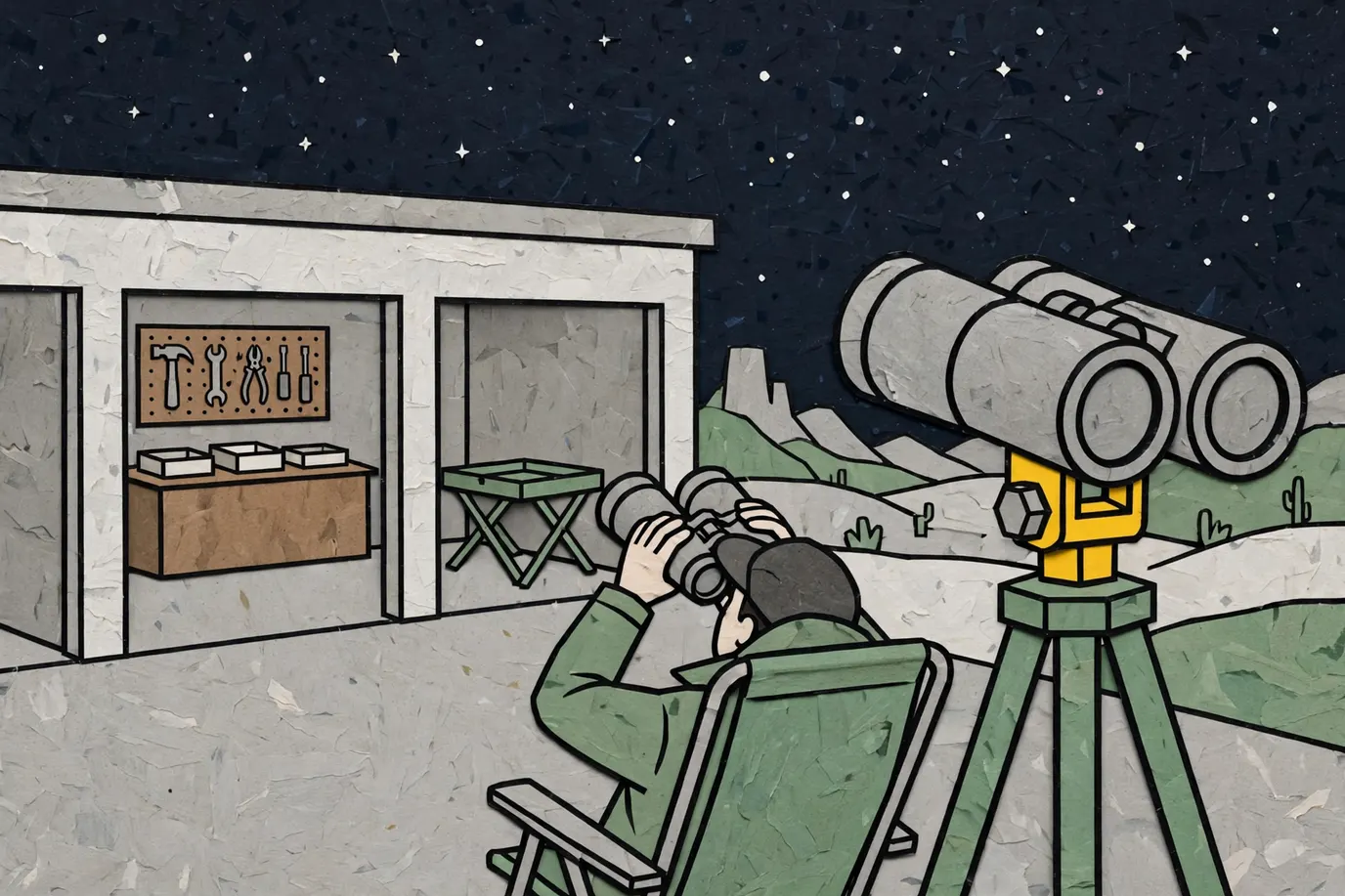
The BAA is honest about the limits. A tripod suits objects near the horizon. Near the zenith it's impractical, because you end up crouched under the eyepieces at an angle no survey crew would sign off on. For high targets, the BAA suggests sitting: a reclining chair or sun lounger is steadier than standing. A walking pole wedged between the barrels, a fence, a wall, a gatepost or a car roof all help. On Piñon Loop, the best binocular mount is the driveway wall at chest height. It has never once needed leveling.
Prisms and coatings
Binoculars use prisms to fold the light path and flip the image upright. The BAA recommends Porro prisms for astronomy because they lose very little light. It says good roof prisms are expensive and rarely made in large apertures. It prefers BaK-4 prism glass over BK-7, and fully coated optics over "coated," which can mean only the outer surfaces.
In our data, three pairs list Porro prisms: the SkyMaster 25x70 (71008) with smartphone adapter, the UpClose G2 10x50 and the Cometron 7x50. The rest leave the prism type blank.
Field of view and eye relief
Field of view is how much sky you see at once. Higher power usually means a narrower field. The BAA gives about 8 degrees for a typical 8x30. In our data, the SkyMaster Giant 15x70 lists a 4.4-degree field, and the two wide-field pairs list 24 (SkyMaster Gemini 2x40) and 26 (SVBONY SV407 2.1x42).
Eye relief is how far behind the eyepiece your eye can sit and still see the whole field. It matters if you wear glasses. The SkyMaster Giant 15x70 lists 13 mm. The BAA notes many glasses wearers can simply focus with glasses off, but people with astigmatism should check that the eye relief lets them keep glasses on. Folding back rubber eyecups helps.
Kinds of stargazing binoculars
Classic handheld pairs: 7x50 and 10x50
These are the all-rounders. The Cometron 7x50 and the UpClose G2 10x50 sit here. They're light enough to hold for a long look, wide enough to find things, and simple enough to hand to someone who has never looked through anything. The BAA author's own travel choice is a lightweight 10x50. Choose one if this is your first pair or a pair for the whole household.
Giant binoculars: 15x70 to 25x100
Giant binoculars trade portability for light and power. The SkyMaster 15x70, 20x80 and 25x100 families sit here, along with the Pro and Pro ED versions of the 15x70 and 20x80. They show more faint stars and make star clusters easier to resolve. Choose one if you'll sit down to observe and will add a tripod or a steady support. The 25x pairs, in particular, want a mount.
Same numbers, different versions
Several pairs in our data share their two numbers. There are three 20x80s: the SkyMaster, the SkyMaster Pro and the SkyMaster Pro ED. There are four 15x70s, counting the SkyMaster Giant with tripod adapter. The listings show the same magnification and objective size, so the differences sit in the model names and what ships with them. "ED" means extra-low dispersion glass, which cuts color fringing; the refractor telescopes page explains it. Some listings bundle extras, such as the smartphone adapter on the SkyMaster 25x70 (71008) or the tripod adapter on the Giant 15x70. Compare the box contents, not just the label.
Wide-field constellation binoculars: about 2x
The SkyMaster Gemini 2x40 and the SVBONY SV407 2.1x42 are a different tool. At about 2x, they barely magnify. Their job is to show a whole constellation, a bit brighter than your eyes alone. Their exit pupil works out far larger than any eye's pupil, so by the BAA rule some light goes unused. That's the trade for the wide field. Choose one if you're learning the constellations or want the Milky Way richer without a mount. Skip them if you want to look at the Moon's craters.
Who should skip astronomy binoculars
Skip big binoculars if you'll only ever look by hand while standing. A 20x80 or 25x100 without support shows a shaking view, and the BAA says firm support matters more than the glass.
Skip binoculars altogether if your goal is detail on planets. Binoculars show planets as points or small disks. A telescope with a long focal length is the tool, and the telescopes for planets list covers that. If you want a first scope for a kid instead, start with telescopes for kids.
Using binoculars on a dark night
Give your eyes time. The National Park Service says eyes take 20 to 30 minutes to adjust to low light, and red light protects that better than white. Go out when the Moon is down, before moonrise or after moonset, if faint stars are the goal.
Dew forms on cold lenses on clear nights. The BAA suggests a homemade dew shield: a cardboard tube painted matt black inside. In Bay Two that's a paper-towel tube with a second career. It's the most useful thing on the bench I didn't have to buy.
Hold the binoculars near the objective end, not the eyepieces; the BAA says that gives steadier control. Then sit down, lean back, and sweep slowly.
Sun safety with binoculars
Never look at the Sun through a telescope, binoculars, a finder or a camera, or with your eyes, without a certified solar filter made for that purpose and fitted correctly. Eye damage can be instant and permanent.
The American Astronomical Society says a solar filter for binoculars goes on the front of both lenses, never at the eyepiece end. NASA says never to look through binoculars while wearing eclipse glasses, because eclipse glasses aren't made for focused sunlight. Keep binoculars capped and away from kids around the Sun, and never sweep toward it near sunset.
Read the two numbers, divide one by the other, then find something steady to lean on. The stars will hold still if you do.
Brands in this list
Related
Questions people ask
What do the numbers on binoculars mean?
The first number is magnification and the second is the width of each front lens, in mm. A 10x50 magnifies 10 times through 50 mm lenses. The British Astronomical Association adds a useful third number: divide the lens size by the magnification to get the exit pupil, the width of the beam that reaches your eye. A 10x50 gives 5 mm.
What size binoculars are best for astronomy?
It depends on how you'll hold them. The British Astronomical Association suggests 8x30 as about the smallest suited to astronomy and around 15x70 as the largest most people can hand-hold for long. It says 20x80s can be used if they're supported. Many observers start with a 10x50 or 7x50 because they're light and give a wide, steady view.
Do I need a tripod for astronomy binoculars?
For 15x and up, plan on some support. The British Astronomical Association says firm support matters more than optical quality. A tripod works for objects low in the sky, but it calls tripod viewing near the zenith impractical. Sitting is steadier than standing, and a reclining chair, a fence, a wall or a car roof can steady your arms.
Can you see planets with binoculars?
You can find them and see them as points or tiny disks, and the Moon shows plenty of detail. Higher magnification, such as 20x or 25x, shows planets larger but still small, and needs a steady mount. For detail on planets, a telescope does that job; the telescopes for planets list on this site covers it.
Are Porro prism binoculars better for stargazing?
The British Astronomical Association recommends Porro prisms for astronomy because they lose very little light. It says good roof prisms are expensive and rarely made in large apertures. It also prefers BaK-4 prism glass over BK-7, and fully coated optics, since coated alone may mean only the outer surfaces. Check the listing for each of these.
Sources
- British Astronomical Association: Binoculars for the travelling astronomer — accessed 2026-10-23
- British Astronomical Association: Eyepieces — accessed 2026-10-23
- Society for Popular Astronomy (hosted by the British Astronomical Association): Introduction to equipment — accessed 2026-10-23
- National Park Service: Astronomy — accessed 2026-10-23
- NASA Science: Eclipse Safety — accessed 2026-10-23
- American Astronomical Society: Solar Filters for Optics — accessed 2026-10-23