Brand · Telescopes & Stargazing
Gskyer Telescopes: The AZ90600, the 80 mm and the 130EQ
Gskyer has three telescopes listed on Amazon US in our data: a 90 mm refractor called the AZ90600, an 80 mm refractor, and a 130 mm reflector called the 130EQ. Each Gskyer telescope comes as a beginner kit with three eyepieces and a 3x Barlow. That makes them easy to compare with each other and with similar kits from other makers. The model name AZ90600 is also most of its spec sheet. I respect a name that does its own paperwork.
We earn a commission if you buy through our links, at no cost to you. Disclosure
Gskyer on Amazon US
3 models- Telescopes
Gskyer AZ90600
- Optical design
- Refractor
- Aperture
- 90 mm
- Focal length
- 600 mm
- Telescopes
Gskyer 80mm AZ Refractor Telescope
- Optical design
- Refractor
- Aperture
- 80 mm
- Focal length
- 400 mm
- Telescopes
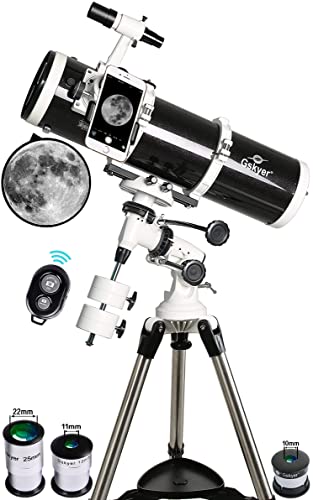
Gskyer 130EQ
- Optical design
- Reflector (Newtonian)
- Aperture
- 130 mm


Alternatives to Gskyer
- Telescopes · National Geographic
National Geographic 70mm Refractor Telescope by Explore Scientific (Computerized)
- Optical design
- Refractor
- Lens type
- Achromatic
- Aperture
- 70 mm
- Telescopes · Sky-Watcher
Sky-Watcher Classic 150 (S11600)
- Optical design
- Dobsonian
- Aperture
- 152 mm
- Focal length
- 1,200 mm
- Telescopes · Celestron
Celestron Astro Fi 102
- Optical design
- Maksutov-cassegrain
- Aperture
- 102 mm
- Telescopes · SVBONY
SVBONY SV48P 90mm
- Optical design
- Refractor
- Lens type
- Achromatic
- Aperture
- 90 mm
- Telescopes · Sky-Watcher
Sky-Watcher Virtuoso GTi 130P
- Optical design
- Dobsonian
- Aperture
- 130 mm
- Focal length
- 650 mm
- Telescopes · SVBONY
SVBONY MK105
- Optical design
- Maksutov-cassegrain
- Aperture
- 105 mm
- Focal length
- 1,365 mm
- Telescopes · SVBONY
SVBONY SV520
- Optical design
- Refractor
- Aperture
- 90 mm
- Focal length
- 800 mm
- Telescopes · SOLOMARK
SOLOMARK 130mm Astronomical Telescope 650mm Alt-Az
- Recommended age
- 8–12 years
- Aperture
- 130 mm
- Focal length
- 650 mm
- Telescopes · Celestron
Celestron PowerSeeker 114EQ
- Optical design
- Reflector (Newtonian)
- Aperture
- 114 mm
- Telescopes · Celestron
Celestron AstroMaster 70AZ
- Optical design
- Refractor
- Lens type
- Achromatic
- Aperture
- 70 mm
- Telescopes · Celestron
Celestron StarSense Explorer DX 102AZ
- Optical design
- Refractor
- Aperture
- 102 mm
- Telescopes · SVBONY
SVBONY SV503 80ED
- Optical design
- Refractor
- Lens type
- ED
- Aperture
- 80 mm


How alternatives are pickedSame type of gear from other brands, closest first: same price tier as Gskyer’s own listings at our last check, then the most maker-published specs. No popularity, no paid placement.
What Gskyer makes
Gskyer telescopes in our Amazon US data are three beginner kits. Our data tracks Gskyer across telescopes, binoculars, eyepieces, Barlow lenses, finders and filters, but the live telescope listings are these:
- AZ90600: 90 mm refractor, 600 mm focal length, f/6.7, manual alt-az mount
- 80mm AZ Refractor Telescope: 80 mm, 400 mm focal length, manual alt-az mount, smartphone adapter
- 130EQ: 130 mm Newtonian reflector, f/5
Gskyer's own site says the brand was founded in 1990 and established in China. It lists refractors at 70, 80 and 90 mm, a 130 mm reflector, and binoculars.
With only three Gskyer telescopes live, this page also has an "Alternatives to Gskyer" table. It's built from other makers' telescopes that match by type and aperture: refractors from 70 to 102 mm and reflectors from 114 to 152 mm. More on that below.
Gskyer telescope lineup, model by model
AZ90600: the 90 mm refractor
The name is the spec. AZ for alt-azimuth mount, 90 for the aperture in mm, 600 for the focal length in mm. Divide 600 by 90 and you get f/6.7, which the listing also gives.
The kit lists three eyepieces giving 24x, 60x and 120x, plus a 3x Barlow. Working back from the focal length, those are about 25 mm, 10 mm and 5 mm eyepieces. A 90 mm lens is a solid size for the Moon, the bright planets and star clusters.
An alt-az mount moves up-down and left-right, like a camera tripod. You point it by hand. There's no polar alignment to learn. That makes the AZ90600 a reasonable first scope for a family that wants to go outside and look, tonight, without reading a manual first.
80mm AZ refractor: the lighter one
The 80 mm refractor lists a 400 mm focal length, so it works out to f/5. That's a short tube with a wider field of view than the AZ90600. The kit lists eyepieces giving 16x, 40x and 80x, a 3x Barlow and a smartphone adapter.
A short, fast refractor shows more sky at once. It's the better pick for star fields, the Milky Way from a dark site, and getting a kid's first object into view quickly. It's less suited to high power on planets; the short focal length means small images unless you add the Barlow.
130EQ: the reflector
The 130EQ is a Newtonian reflector, which gathers light with a mirror at the bottom of the tube. It lists 130 mm of aperture at f/5, three eyepieces and a 3x Barlow. Our data doesn't fill in the mount type. The EQ in the name usually means an equatorial mount, the kind aligned with Earth's axis so one slow motion follows the stars. Read the listing to confirm.
A 130 mm mirror gathers about twice the light of a 90 mm lens, by area. That's the reason to choose it: fainter clusters, galaxies and nebulae. The cost is a bigger tube and, if it is equatorial, a mount that asks for polar alignment.
Two more things come with any Newtonian. The tube is open at the front, so it needs a cap on in storage to keep dust off the mirror. And the two mirrors sometimes need lining up again after a bumpy ride, a job called collimation. It's a few minutes with a screwdriver once you've done it twice. Nobody touches the mirror surface with a finger. That's the oldest rule in Bay Two, and nobody has asked for an exception.
Gskyer 80mm vs AZ90600 vs 130EQ
Side by side, the three sort cleanly.
- Smallest and widest view: the 80 mm, f/5, with a phone adapter.
- Middle size, longer focal length: the AZ90600, f/6.7, a little more aperture and more magnification per eyepiece.
- Most light: the 130EQ, f/5, the only reflector of the three.
If the scope will live in a closet and go out on short notice, choose a refractor. If it'll live in the garage and the goal is faint things, the 130 mm mirror is the one.
The magnification numbers on the box
Here's my one opinion on this page: read the aperture before the magnification. Every Gskyer kit lists its powers, and a 3x Barlow multiplies them. On the AZ90600, the 120x eyepiece with the 3x Barlow is 360x by the arithmetic.
Celestron's eyepiece guide puts the highest useful magnification at about 60x per inch (25.4 mm) of aperture. For 90 mm that's about 213x. Past that, the image gets bigger and dimmer without more detail. The same guide says that on unsteady nights, lower power gives the better view.
So treat the Barlow as a way to get one useful middle power from the eyepieces you have, not as a way to reach the top number. The 24x and 60x eyepieces are the ones that'll get the most use. In my own observing notes, medium power gets the most checkmarks, whatever the scope.
Alternatives to Gskyer
The alternatives table above lists telescopes from other makers that match Gskyer's three by type and aperture. The rule: refractors and reflectors in the same beginner range, from our telescope data. Here's what each group adds:
- Similar manual refractors: Celestron AstroMaster 70AZ and 90AZ, and the SVBONY SV520, a 90 mm, 800 mm refractor with a phone adapter. Same idea as the AZ90600, different focal lengths.
- Phone-guided: the Celestron StarSense Explorer DX 102AZ, a 102 mm refractor whose app tells you where to push.
- GoTo: the National Geographic 70 mm computerized refractor, the Celestron Astro Fi 102, and the Sky-Watcher Virtuoso GTi 130P. A motor finds objects for you.
- Bigger reflectors: the Sky-Watcher Classic 150 Dobsonian at 152 mm, the Celestron PowerSeeker 114EQ, and the SOLOMARK 130 mm on an alt-az mount.
- Tubes only: SVBONY's SV48P 90 mm and MK105 Maksutov, for someone who already owns a mount.
The SOLOMARK 130 mm lists ages 8 to 12, the only age range stated in this group.
What's in a Gskyer kit, and what isn't
All three listings name three eyepieces and a 3x Barlow lens. The 80 mm adds a smartphone adapter. That's a full starter set: low, medium and high power, plus a way to double up the middle.
What the listings in our data don't state is just as useful to know:
- Weight. None of the three gives one in our data. If a child will carry it, check the listing photos and the box dimensions.
- Finder type. Our data doesn't fill it in. A finder is the small sight on top that helps you aim.
- Mount on the 130EQ. As above, the field is empty.
- Ages. None of the three states an age range in our data.
A blank in our table means the listing didn't say, not that the part is missing. Read the listing's "what's in the box" line before you count on a part.
A first night with a beginner refractor
The same routine works for the AZ90600, the 80 mm, or any of the refractors in the alternatives table.
- Set it up in daylight. Assemble the tripod, mount and tube on the lawn or driveway while you can see the screws.
- Line up the finder. Point the scope at a distant treetop or pole with the lowest-power eyepiece, then adjust the finder until it points at the same spot. Never aim at or near the Sun.
- Start on the Moon. It's bright, big and easy to find. Use the lowest power first.
- Move up one step. Swap to the middle eyepiece. Refocus.
- Try a bright planet or cluster. If the image gets soft and shimmery at high power, the air is unsteady. Go back down.
- Bring it in cool. Let the lens warm up with the cap off indoors so dew can dry, then cap it.
Step 2 is the one people skip. It's also the reason most first nights end early. Ten minutes with a treetop saves an hour of hunting.
Who should skip Gskyer for now
Skip these kits if you want the telescope to find objects for you. All three are pointed by hand. The GoTo alternatives above, the National Geographic 70 mm, the Celestron Astro Fi 102 and the Sky-Watcher Virtuoso GTi 130P, do the finding with a motor.
Skip them, too, if your main goal is photography of faint objects. A phone adapter on an eyepiece is fine for the Moon. Long exposures of galaxies need a tracking mount, and our astrophotography telescopes page explains that route.
How to pick a first telescope here
- Who carries it? If it's a kid, start with a refractor on an alt-az mount.
- Where does it live? A closet favors a short tube; a garage can hold a reflector.
- Who points it? By hand, with a phone app, or with a GoTo motor.
- What do you want to see? Moon and planets: any of these. Faint galaxies: more aperture.
Theo asked if 90600 was a ZIP code. I told him it was a better number than that: you can check it with a ruler.
Sun safety
Never look at the Sun through a telescope, binoculars, a finder or a camera, or with your eyes, without a certified solar filter made for that purpose and fitted correctly. Eye damage can be instant and permanent.
The American Astronomical Society says a solar filter goes on the front of the telescope, never at the eyepiece end. Keep the lens cap on during the day if a child is near the scope.
Start with the lowest power in the box. The Moon will still be there at 60x.
Where Gskyer shows up
Questions about Gskyer
Is Gskyer a good telescope brand?
We don't rank brands. What the data shows: three live Gskyer telescopes on Amazon US, all beginner kits. Two are refractors on manual alt-az mounts at 80 and 90 mm, and one is a 130 mm reflector at f/5. Each lists three eyepieces and a 3x Barlow. Judge them by aperture and mount, like any other first telescope.
Who makes Gskyer telescopes?
Gskyer's own site says the brand was founded in 1990 and was established in China. It sells refractor telescopes in 70, 80 and 90 mm sizes, a 130 mm reflector, and binoculars. The site doesn't name a current headquarters city that we could confirm.
What is the Gskyer 130EQ?
A 130 mm Newtonian reflector at f/5, listed with three eyepieces and a 3x Barlow. The EQ in the name usually means an equatorial mount, but our data doesn't fill in the mount type for this listing, so read the listing for the mount before you buy. A 130 mm mirror gathers far more light than an 80 or 90 mm lens.
Is the Gskyer 70mm telescope on Amazon?
Not among the live listings in our data. The Gskyer telescopes we found on Amazon US in October 2026 are the 80 mm AZ refractor, the AZ90600 at 90 mm, and the 130EQ reflector. Gskyer's own site also lists a 70 mm refractor. For a small refractor from another maker, the Celestron AstroMaster 70AZ is in the alternatives table above.
What magnification do I need on a Gskyer telescope?
Less than the box suggests. Magnification is focal length divided by eyepiece focal length. Celestron's guide puts highest useful magnification at about 60x per inch of aperture: about 189x for 80 mm, 213x for 90 mm and 307x for 130 mm. Most nights, low and medium powers give the steadiest, brightest views.
Can I take photos with a Gskyer telescope?
Phone photos of the Moon, yes. The 80 mm AZ refractor lists a smartphone adapter that holds a phone over the eyepiece. The AZ90600 and 130EQ listings don't state one in our data, so you'd add an adapter. Long-exposure photos of faint objects need a tracking mount, which none of the three lists.
Sources
- Gskyer: home page — accessed 2026-10-23
- Celestron: How to Determine Which Eyepieces to Use with Your Telescope — accessed 2026-10-23
- American Astronomical Society: Solar Filters for Optics — accessed 2026-10-23