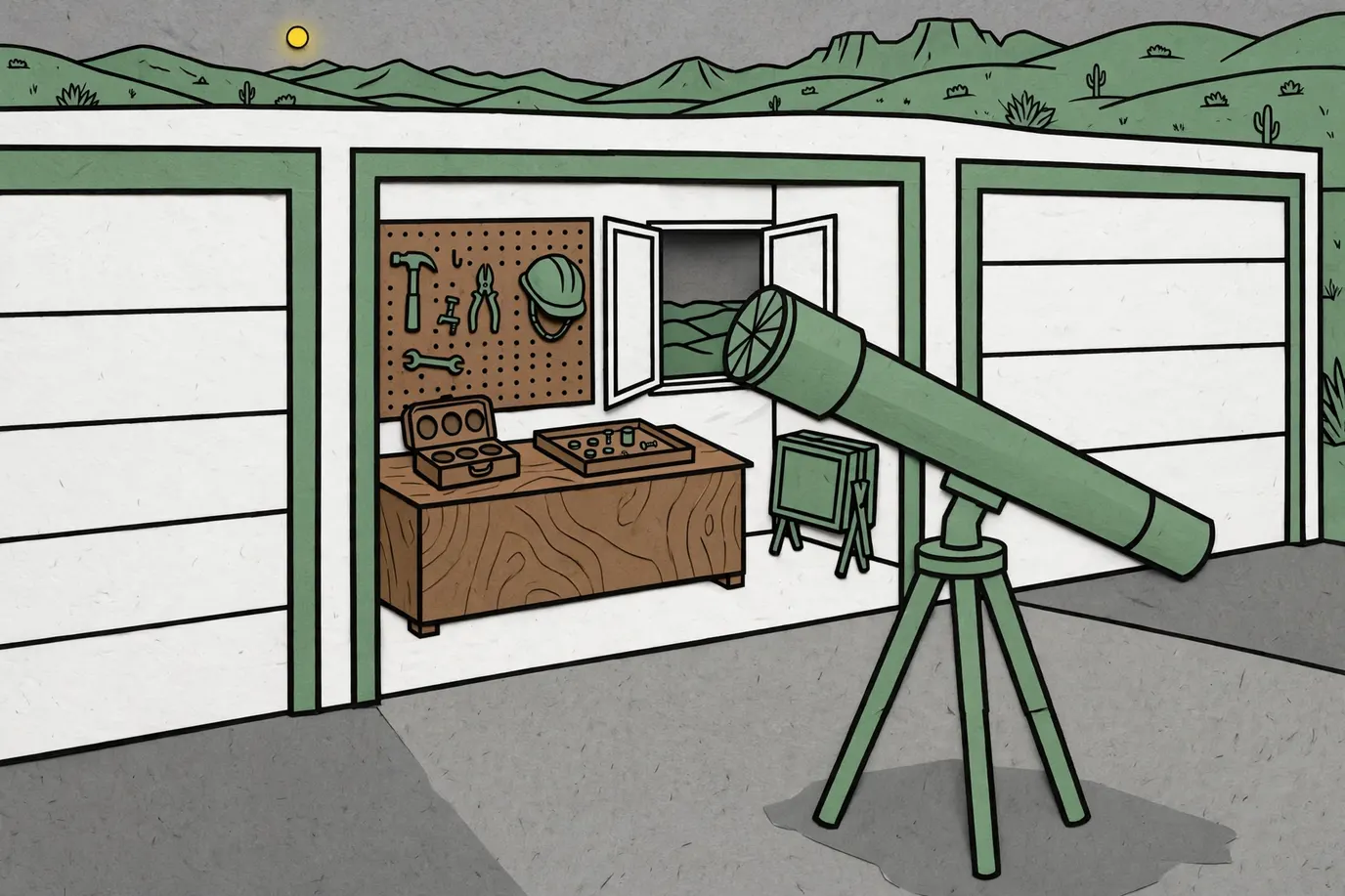
What a telescope to see planets needs first
Planets look big in photos. In the sky they are small and bright. The job is plain: make a small, bright thing larger without turning it to mush.
Two numbers decide how well a scope does that job. Focal length sets how much magnification you get from a given eyepiece. Aperture sets how much light and detail the scope can deliver at that magnification. This list asks for both: 900 mm or more of focal length and 70 mm or more of aperture, as the maker or listing states them. Then it sorts by focal length, longest first.
For the record, that order is a sort, not a ranking. I sort survey stakes by distance the same way. Nobody thinks the nearest stake is the worst one. The 203 mm scope at the top and the 80 mm scope at the bottom are for different people, different budgets and different arms. The cards below say who each one suits and what it leaves out.
One more rule. No magnification number on this page goes above twice the aperture in millimeters. The next section explains why.
Focal length, aperture and magnification in plain numbers
Focal length sets the magnification
Focal length is the distance, in mm, that the main lens or mirror uses to bring light to a focus. The eyepiece is the small lens you look into. Swap the eyepiece, and the magnification changes.
The formula is simple. Magnification equals the scope's focal length divided by the eyepiece's focal length. Celestron's knowledge base and the British Astronomical Association give the same formula. A 10 mm eyepiece in a 1000 mm scope gives 100x. The same eyepiece in a 2032 mm scope gives about 203x.
That's why this list starts at 900 mm. Planets need power. A long focal length gets there with ordinary eyepieces instead of very short ones. (Very short eyepieces tend to have tiny lenses you hold your eye right against. I wear reading glasses. I have notes on tiny lenses.)
A Barlow is a lens that multiplies an eyepiece's magnification. Celestron's article notes that a 2x Barlow doubles the power of any eyepiece used with it.
Focal ratio is focal length divided by aperture
The focal ratio, or f-number, is focal length divided by aperture. A 2032 mm scope with 203 mm of aperture works at f/10. Bigger numbers mean a longer, narrower light path for the size of the lens or mirror.
The British Astronomical Association says scopes at f/5 or faster are much more demanding of eyepiece quality than slower ones. Most picks here sit at f/10 or slower, by the listing or by the arithmetic. One sits at f/5.3, close to that line, and its card says so.
Aperture sets the light and the ceiling
Aperture is the width of the main lens or mirror, in mm. NASA's Space Place puts it plainly: the bigger the mirror or lens, the more light the telescope can gather.
That light matters at high power. The British Astronomical Association notes that raising magnification dims a planet's image, and Celestron's article says powers past the limit give a dim, low-contrast view. More aperture means more light to spread before the image fades.
Useful magnification is about twice the aperture in mm
The British Astronomical Association puts maximum magnification at about double the aperture in millimeters. Celestron gives 50 to 60 times the aperture in inches under ideal conditions, which lands in the same place. Here is that line for every aperture on this list:
| Aperture |
About 2x the aperture |
| 70 mm (2.8 in) |
140x |
| 80 mm (3.1 in) |
160x |
| 90 mm (3.5 in) |
180x |
| 105 mm (4.1 in) |
210x |
| 152 mm (6.0 in) |
304x |
| 190 mm (7.5 in) |
380x |
| 203 mm (8.0 in) |
406x |
That's a ceiling, not a target. The same BAA article says powers that high are rarely usable. It suggests half to two thirds of the maximum as a more useful limit. It also says air turbulence makes a target shimmer, and the shimmer gets worse at higher power. Only on rare nights of very good seeing does the top number come into play.
So the air gets a vote on every planet night. It doesn't care what the box says. Neither does Jupiter.
Aperture matters more than magnification
This is my one strong opinion on telescopes, and the arithmetic above backs it up. A box that leads with a big "x" number is selling a number. The aperture field tells you how much light the scope gathers, and it sets the ceiling on useful magnification.
You can check it on any listing in ten seconds. Find the aperture in mm. Double it. If the box claims more than that, the extra power makes the image bigger, not better.
Focal length still decides which eyepieces get you there. But two scopes with the same focal length and different apertures are not the same planet scope. Read the aperture first. The rest of the box is commentary.
The picks, longest focal length first
Every card uses only what the maker or listing states. Magnifications with included eyepieces are my arithmetic from the listed focal lengths.
Celestron NexStar 8SE: the most aperture on the list
The NexStar 8SE is a Schmidt-Cassegrain with 203 mm (8.0 in) of aperture and a 2032 mm focal length, at f/10, per the listing. It sits on a computerized alt-az GoTo mount. GoTo means a motorized mount that finds objects for you from a database. That saves time hunting for a planet in a sky full of bright dots.
The listing includes a 25 mm eyepiece plus a kit of 5 Plössl eyepieces and a 2x Barlow. The 25 mm alone gives about 81x. Its 2x line is about 406x, the highest on this page. The trade-off is in the design: a GoTo mount needs power and a setup routine before it points anywhere. The data doesn't list the weight, so check the listing before you plan to carry it alone. More on the maker at Celestron.
Celestron 6" Schmidt-Cassegrain OTA: a tube for a mount you already own
OTA means optical tube assembly. It's the telescope itself, with no mount. This one is a 152 mm (6.0 in) Schmidt-Cassegrain with a 1500 mm focal length at f/10, per the listing. It comes with a 25 mm eyepiece, which gives 60x.
Its 2x line is about 304x. It suits someone who already owns a mount that can carry it. If you don't, this tube has nowhere to sit.
SVBONY MK105: a compact long-focus tube
The MK105 is a Maksutov-Cassegrain with 105 mm (4.1 in) of aperture and a 1365 mm focal length at f/13, per the listing. That's the slowest focal ratio on this page. The listing gives a maximum useful magnification of 210x, which is exactly twice its aperture. It's the one listing here whose number lands right on the line.
The trade-off: it's OTA only, with no mount listed. The data doesn't list included eyepieces either. If you already have a sturdy mount and want a long focal length in a 105 mm tube, this one fits. If you want everything in one box, look further down the list. See SVBONY for the rest of the lineup.
Sky-Watcher Classic 150 (S11600): a Dobsonian with no tripod to level
A Dobsonian is a reflector on a simple swivel base you point by hand. This one has 152 mm (6.0 in) of aperture and a 1200 mm focal length, per the listing. That works out to about f/7.9. It comes with 25 mm and 10 mm eyepieces, which give 48x and 120x. Its 2x line is about 304x.
It has a straight optical finder, per the listing. The base sits on the ground, so there's no tripod to level on an uneven driveway. The trade-off: it's manual. You find each planet yourself and nudge the tube to follow it. More at Sky-Watcher.
Sky-Watcher S11550 Maksutov-Newtonian 190mm: big aperture, shorter focus
This tube has 190 mm (7.5 in) of aperture and a 1000 mm focal length at f/5.3, per the listing. Its 2x line is about 380x, second only to the 8SE. It has a right-angle optical finder.
It's the fastest scope on this page, close to the f/5 line where the British Astronomical Association says eyepiece quality matters much more. The data lists no mount and no eyepieces, so plan both before its first planet.
SOLOMARK 90mm Telescope Vertisteel AZ Mount: a 90 mm starter with a phone adapter
This is a 90 mm (3.5 in) scope with a 1000 mm focal length, about f/11.1, on a manual alt-az mount, per the listing. Alt-az means the mount moves up-down and left-right. It includes a smartphone adapter, which holds a phone at the eyepiece.
Its 2x line is about 180x, a step up from the two smaller refractors below. The data doesn't list the included eyepieces, so check the listing for what's in the box. More at SOLOMARK.
iOptron 6002 900x70: a long refractor at the minimum aperture
A refractor uses a lens at the front instead of a mirror. This one has 70 mm (2.8 in) of aperture and a 900 mm focal length, about f/12.9, per the listing. It sits on a manual equatorial mount. An equatorial mount is aligned with Earth's axis, so one motion follows the sky.
Its 2x line is about 140x, the lowest on this page. That's the trade-off of being at the 70 mm floor. The data doesn't list included eyepieces. More refractors are on the refractor telescopes page, and the maker has a page at iOptron.
SOLOMARK 80900: an 80 mm refractor with two eyepieces
This refractor has 80 mm (3.1 in) of aperture and a 900 mm focal length, about f/11.3, per the listing. It sits on a manual alt-az mount and comes with 10 mm and 20 mm eyepieces, which give 90x and 45x. Its 2x line is about 160x.
Two eyepieces in the box mean a low power for finding a planet and a higher one for looking at it. That's a sensible start. (My label maker has already printed "45x" and "90x" for an eyepiece case I don't own. Old habits.) The data doesn't list the weight.
Hold the scope steady before you add power
Magnification enlarges everything, including shake. At 120x, a small wobble in the mount moves the view 120 times as much as it would to your bare eye. So a steady mount is part of the planet plan, not an accessory.
Lucho's take: "A wobbly tripod is a loose bolt. Tighten it before you blame the glass."
Three picks here list no mount at all: the 6" Schmidt-Cassegrain OTA, the MK105 and the 190 mm Maksutov-Newtonian. For those, the mount is a second purchase. Count it in before you decide.
Never point a telescope at the Sun
Never look at the Sun through a telescope, binoculars, a finder or a camera, or with your eyes, without a certified solar filter made for that purpose and fitted correctly. Eye damage can be instant and permanent.
NASA and the American Astronomical Society both say a solar filter for a telescope goes securely on the front of the optics. Eclipse glasses and handheld solar viewers are not for use with telescopes, binoculars or cameras. Handheld viewers should meet the ISO 12312-2 standard. If you go after a planet near sunset, wait until the Sun is fully below the horizon.
Who should skip this list
Skip this list if you mostly want wide views of star fields and the Milky Way. A long focal length gives more power with every eyepiece, which also means a smaller slice of sky. For wide views, stargazing binoculars are a better start.
Skip it if the scope is for a child. This list is sorted by focal length, not by who will use it. The telescopes for kids page is built for that question.
Skip it if your main goal is photos. Imaging has its own needs, and the astrophotography telescopes page covers them.
And skip any scope here you won't carry outside. A long focal length does nothing from the hall closet. The telescopes section has more ways to choose. Then check the forecast, and carry it out.