Telescopes & Stargazing · Type
Star Trackers for Astrophotography
A star tracker is a small motorized mount that turns your camera with the sky, so stars stay sharp points during long exposures. It sits between a tripod and a camera, and it does one thing, very slowly. I respect that in a machine. The main choices are payload, how you polar-align it, and what comes in the box.
We earn a commission if you buy through our links, at no cost to you. Disclosure
| Model | Payload | Tracking rates | Polar scope | WiFi / app | Amazon |
|---|---|---|---|---|---|
iOptron SkyGuider Pro full packageStar trackers | 11 lblisting | — | Yeslisting | — | Check price |
iOptron SkyGuider Pro with iPolarStar trackers | 11 lblisting | — | Yeslisting | — | Check price |
iOptron SkyGuider Pro with iPolarStar trackers | 11 lblisting | celestial, solar, lunarlisting | Yeslisting | — | Check price |
| 11 lblisting | 1X celestial, 1/2X landscape, solar, lunarlisting | Yeslisting | — | Check price | |
iOptron SkyGuider Pro head onlyStar trackers | — | — | Yeslisting | — | Check price |
iOptron SkyGuider Pro with all accessoriesStar trackers | — | 1X, 1/2X, solar, lunarlisting | — | — | Check price |
iOptron SkyGuider Pro with iPolar, head onlyStar trackers | — | — | Yeslisting | — | Check price |
Sky-Watcher Star Adventurer Mini Pro Pack (S20582)Star trackers | — | — | Yeslisting | Yeslisting | Check price |
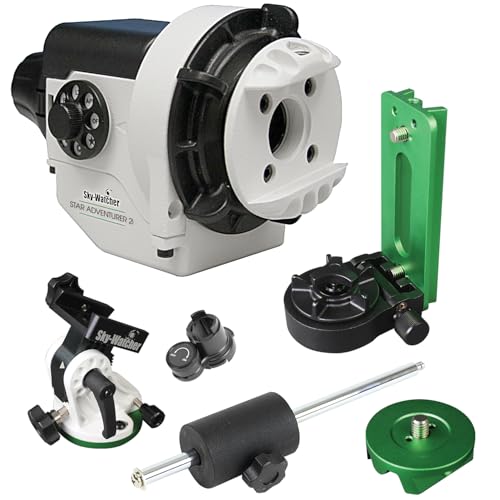
Sky-Watcher Star Adventurer 2i Pro Pack (S20512)Star trackers | — | — | — | Yeslisting | Check price |




What’s in this listStar trackers we track on Amazon US, highest stated payload first. “—” means neither the maker nor the Amazon listing states it.
What a star tracker does
Earth turns. From the ground, that makes the whole sky turn around the celestial pole, about 15 degrees an hour. A camera on a fixed tripod sees the stars slide across the sensor during a long exposure. Leave the shutter open long enough and every star becomes a short line.
A star tracker fixes that. It's a small equatorial mount for a camera. You tilt its axis so it points at the celestial pole, near Polaris in the Northern Hemisphere. Then its motor turns the camera at the same rate as the sky, in the opposite direction to Earth. The stars hold still in the frame.
iOptron describes its SkyGuider Pro as a camera tracker for "astroscape or wide field astrophotography." Sky-Watcher calls its Star Adventurer 2i a portable tracking platform for astronomy, astrophotography and time-lapse. That's the job: wide skies, camera lenses, long exposures.
The table above lists the star trackers we track on Amazon US, highest stated payload first. Right now that's the iOptron SkyGuider Pro in several packages and two Sky-Watcher Star Adventurer packs.
When you need a star tracker
A plain tripod gets you further than most people think. The Planetary Society gives the 500 rule as a starting point: on a full-frame camera, the longest exposure before stars trail is about 500 divided by the lens focal length, in seconds. On a crop-sensor camera, multiply the focal length by 1.5 first.
Here's what that does as the lens gets longer.
- 14 mm lens: about 35 seconds. Enough for a Milky Way photo.
- 50 mm lens: about 10 seconds.
- 85 mm lens: about 5 seconds.
- 200 mm lens: about 2.5 seconds. Not much time to collect faint light.
That list is the case for a tracker. With one, the exposure limit comes from the tracker's accuracy and your polar alignment, not from the 500 rule. You can use a longer lens on a smaller patch of sky, take longer frames, or keep a low ISO for less noise.
What to look at on a star tracker listing
Payload: how much camera it can carry
Payload is the weight the tracker can carry and still track. It's the first number to read. iOptron's page gives the SkyGuider Pro a maximum of 11 lb (5 kg), balanced, with the DEC mounting bracket, not including the counterweight. Sky-Watcher's US page lists the Star Adventurer 2i at 11 lb (5 kg). In our data, four SkyGuider Pro listings state the 11 lb payload. The rest leave it blank.
This is my one opinion here: weigh your camera, lens and ball head together on a kitchen scale before you shop. A payload number means nothing until you have your own number to set next to it. My kitchen scale has weighed more camera gear this year than flour. Nobody in the house has filed a complaint.
A stated maximum is a ceiling, not a target. A setup near the top of the range is harder to balance and less forgiving of a breeze.
Polar alignment: how you aim the axis
A tracker only works if its axis points at the celestial pole. That's polar alignment, and it's the step that decides how sharp the stars stay.
Most trackers use a polar scope, a small scope through the tracker's axis with a reticle to place Polaris. iOptron's page lists an AccuAlign dark-field illuminated polar scope with about a 6-degree field and adjustable brightness, and says it can be used with an iOS app for polar alignment. Several SkyGuider Pro listings in our data name iPolar in the title; check the listing for how that version aligns. Sky-Watcher's 2i page lists a built-in polar scope. In our data, the polar scope field is filled in for seven of the nine listings.
Polar alignment is the part I enjoy most, which tells you plenty about me. It's a survey with one benchmark, and the benchmark has been in the same spot all my life.
Tracking rates
The tracking rate is how fast the tracker turns. "1X" or sidereal matches the stars. The listings in our data mention more.
- Celestial (1X, sidereal): for stars and the Milky Way.
- 1/2X: iOptron describes this one as for sky and landscape together. The stars smear a little and the ground smears a little, so both stay mostly sharp. The Organ Mountains have never moved for a photo. The stars always have.
- Solar and lunar: the Sun and Moon move at slightly different rates than the stars, so trackers offer separate rates. Solar use needs a proper filter; see the safety section below.
iOptron says all four SkyGuider Pro rates work in both hemispheres.
Power and battery
A tracker runs all night, so power matters. iOptron lists a built-in rechargeable 3.7V, 2000 mAh lithium-polymer battery, charged through MiniUSB, reaching 80% in about 5 hours, and says it can also run on 5V DC. Sky-Watcher lists up to 24 hours on four AA batteries, or power through a 5V mini-USB connection. iOptron gives an operating range of -10 to 40 °C, about 14 to 104 °F.
The Planetary Society reminds photographers that cold nights drain batteries quickly. Charge before you leave, and carry the spare.
App control and camera control
Both Sky-Watcher packs in our data list app control. Sky-Watcher's 2i page describes WiFi control from a phone, a free Star Adventurer Console app for iOS and Android, and a SNAP port that fires a DSLR shutter through a cable, so no separate intervalometer is needed. iOptron lists a camera shutter trigger port and an ST-4 port for autoguiding, which means letting a small guide camera correct the tracking.
What's in the box, and what isn't
This field is where packages differ most, so read the listing title closely. iOptron's page lists, for its package: the mount head, an alt-azimuth base, the polar scope, a MiniUSB cable, a padded bag, a DEC mounting bracket with a camera mounting disk, a 1.35 kg counterweight and its shaft. It says camera, lens, telescope, ball head and tripod are not included.
Sky-Watcher's 2i Pro Pack page lists a ball head adapter, a DEC bracket, a latitude (EQ) base and a counterweight kit, and says camera, tripod and optical tube are not included.
In our data, two SkyGuider Pro listings say "head only." Those names suggest fewer parts than the packages, so check the listing's contents before you plan around a bracket or counterweight.
Kinds of star trackers and packages
Camera-only, light setups
For a camera with a wide or normal lens, a tracker can carry it on a ball head directly. This is the lightest way in. The Sky-Watcher Star Adventurer Mini Pro Pack lists app control and a polar scope; the listing in our data doesn't state a payload. iOptron gives the SkyGuider Pro head about 2.2 lb (1 kg) with battery and 3.2 lb (1.45 kg) with the alt-azimuth base. Sky-Watcher lists the 2i head at 3.63 lb with the DEC bracket.
Bracket and counterweight setups
For longer lenses, a DEC bracket holds the camera off to one side and a counterweight balances it. iOptron says its bracket is meant for heavier camera and lens setups and can support a light telescope. The full packages and the Star Adventurer 2i Pro Pack include that hardware, per the makers' pages.
Lucho helped me balance a rig on the driveway one night. His take: "A counterweight on a loose thumbscrew is just a camera drop waiting its turn. Snug it before you let go."
Head-only listings
These suit someone who already owns the bracket, base or tripod. Choose one if you're replacing a head or you know exactly which parts you have. Skip it if this is your first tracker; a package saves you a parts hunt.
How a night with a star tracker goes
The order is the same every time. It's worth learning on the driveway before a drive to a dark site.
- Set up a sturdy tripod and level it. A tracker can't fix a wobbly base.
- Mount the tracker and set the base angle to your latitude.
- Polar-align with the polar scope or app.
- Attach the camera, then balance it with the counterweight if you use one.
- Choose the tracking rate, frame the shot and focus manually.
- Take a test frame, zoom in on the stars, and adjust before the real run.
The National Park Service says eyes take 20 to 30 minutes to adjust to low light, and red light protects that. Set up with a red light and your eyes will be ready by the time the tracker is. The Planetary Society suggests new Moon, or within about a week either side, for the Milky Way.
Who should skip a star tracker
Skip one if you want to look at the sky rather than photograph it. A tracker has no eyepiece. Binoculars for stargazing are the better buy for looking.
Skip one, too, if your only camera is a phone and you're happy with what it takes. Trackers are built around camera bodies and lenses on standard threads.
If you want a telescope for photos, not just a camera, the astrophotography telescopes page explains bigger mounts and smart telescopes. A tracker is often the step before that, not a replacement for it.
Sun safety with a star tracker
Never look at the Sun through a telescope, binoculars, a finder or a camera, or with your eyes, without a certified solar filter made for that purpose and fitted correctly. Eye damage can be instant and permanent.
A solar tracking rate keeps the Sun in the frame. It does nothing to protect your eyes or your camera. The American Astronomical Society says a solar filter goes on the front of the camera lens or telescope, never at the eyepiece end. NASA says never to look through a camera, binoculars or a telescope while wearing eclipse glasses.
Weigh the camera, align the axis, then let the tracker take its time. It's better at waiting than I am.
Brands in this list
Related
Questions people ask
What is a star tracker?
A star tracker is a compact equatorial mount for a camera. Once it's aimed at the celestial pole, its motor turns once a day, matching Earth's spin in the other direction, so the camera follows the stars. iOptron describes its SkyGuider Pro as a camera tracker for wide-field astrophotography. Camera, lens and tripod are sold separately on both makers' pages.
Do I need a star tracker to photograph the Milky Way?
Not to start. The Planetary Society's 500 rule says a full-frame camera on a plain tripod can expose for about 500 divided by the lens focal length, in seconds. A 14 mm lens gives about 35 seconds, enough for a first Milky Way photo. A tracker lets you go longer, use a longer lens, or both, without stars stretching into trails.
How much weight can a star tracker hold?
The listings in our data that state it give 11 lb. iOptron's own page sets the SkyGuider Pro's maximum at 11 lb (5 kg), balanced, with the DEC bracket, not counting the counterweight. Sky-Watcher's US page gives the Star Adventurer 2i 11 lb (5 kg) as well. Weigh your camera, lens and ball head together before you choose.
Can a star tracker carry a telescope?
A light one, sometimes. iOptron says the SkyGuider Pro's DEC bracket is meant for heavier camera and lens setups and can support a light telescope. Sky-Watcher's page says its saddle takes cameras, tripod heads or optical tubes. Stay inside the stated payload, balance it with the counterweight, and remember a long focal length shows every small tracking error.
What is the difference between a star tracker and a telescope mount?
Size and job. A star tracker is built around a camera: light, battery powered and a few pounds, made to carry a camera and lens. A full equatorial telescope mount carries much heavier tubes, and many add GoTo to find objects. The Society for Popular Astronomy notes that equatorial mounts of any size need polar alignment every session.
Sources
- iOptron: SkyGuider Pro camera mount — accessed 2026-10-23
- Sky-Watcher USA: Star Adventurer 2i Pro Pack — accessed 2026-10-23
- The Planetary Society: Night sky photography for beginners — accessed 2026-10-23
- Society for Popular Astronomy (hosted by the British Astronomical Association): Introduction to equipment — accessed 2026-10-23
- National Park Service: Astronomy — accessed 2026-10-23
- NASA Science: Eclipse Safety — accessed 2026-10-23
- American Astronomical Society: Solar Filters for Optics — accessed 2026-10-23