Brand · Telescopes & Stargazing
ZWO Cameras, Seestar Smart Telescopes and Mounts
ZWO makes astrophotography gear: ASI cameras that replace the eyepiece, Seestar smart telescopes that do the whole job in one box, and mounts and tripods to hold them. Our Amazon US data has 20 live ZWO listings, and 12 of them are cameras with names like ASI6200MM Pro. Those names look like part numbers. They are part numbers, and once you can read them the lineup sorts itself. I like a lineup that sorts itself.
We earn a commission if you buy through our links, at no cost to you. Disclosure
ZWO on Amazon US
20 models- Astronomy cameras
ZWO ASI183MC Pro
Check price - Astronomy cameras
ZWO ASI174MM-MINI
Check price - Astronomy cameras
ZWO ASI294MM
Check price - Astronomy cameras
ZWO ASI585MC Pro
Check price - Astronomy cameras
ZWO ASI715MC
Check price - Astronomy cameras
ZWO ASI6200MM Pro
Check price - Astronomy cameras
ZWO ASI585MM Pro
Check price - Astronomy cameras
ZWO ASI678MM
Check price - Astronomy cameras
ZWO ASI676MC
Check price - Astronomy cameras
ZWO ASI585MC AIR
Check price - Astronomy cameras
ZWO ASI585MM AIR
Check price - Astronomy cameras
ZWO ASI662MC
Check price - Telescope & astrophotography tripods
ZWO Seestar Fluid Tripod Head TH10
Check price - Telescope & astrophotography tripods
ZWO Seestar TH10 Tripod Head with TC20 Tripod
Check price - Telescope & astrophotography tripods
ZWO Seestar TC20 Carbon Fiber Tripod
Check price - Telescope & astrophotography tripods
ZWO Tripod Head TH10 for Seestar S30 and S50
Check price - Smart & digital telescopes
ZWO Seestar S30 Pro
- Auto GoTo & tracking
- Yes
- Smart & digital telescopes
ZWO Seestar S30 Pro
- Auto GoTo & tracking
- Yes
- Smart & digital telescopes
ZWO Seestar S30 Pro bundle with TH10 head & TC20 tripod
- Auto GoTo & tracking
- Yes
- Telescope mounts
ZWO AM5N
- GoTo
- Yes
- Payload
- 44 lb








What ZWO makes
ZWO is an astrophotography company. Its site sorts its gear into Seestar smart telescopes, cameras, mounts, refractors, ASIAIR controllers, filters and filter wheels, and accessories. In our Amazon US data, ZWO's 20 live listings cover four of those:
- ASI astronomy cameras: 12 listings, from the ASI662MC to the ASI6200MM Pro
- Seestar smart telescopes: three Seestar S30 Pro listings, one a tripod bundle
- Tripods and heads: the TH10 fluid head, TC20 carbon fiber tripod, and combinations
- Mount: the AM5N, GoTo with a 44 lb payload listed
The site's tagline is "Make Astrophotography Easy and Fun." Fair enough. Everything in the list is built for taking pictures of the sky, not for looking through an eyepiece. If you want to look, start on the telescopes section instead.
ZWO ASI cameras: how the names work
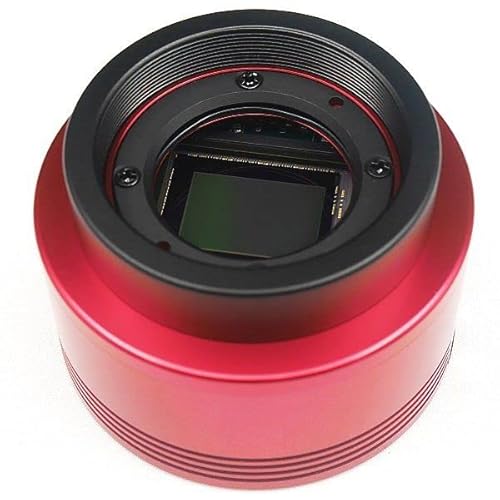
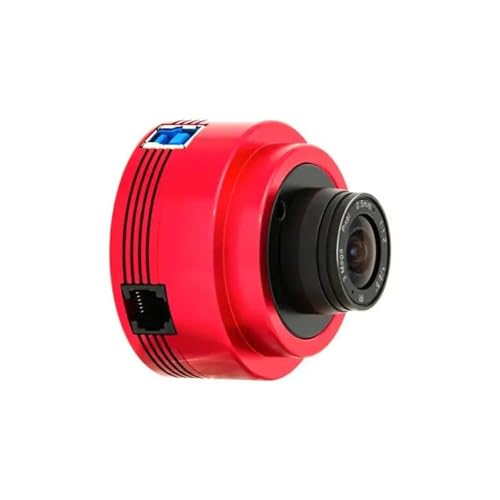
An ASI camera is a dedicated astronomy camera. It slides into a telescope focuser where the eyepiece would go, and it connects to a computer or controller. ZWO's site splits its cameras into smart, DSO cooled, planetary and guide categories. DSO means deep-sky objects: galaxies, nebulae and star clusters.
The name has three parts:
- The number points to the sensor. ZWO's ASI585 page, for example, lists an IMX585 sensor.
- MC or MM marks the two versions sold for many sensors: MM is mono (ZWO's planetary camera page lists the "ASI174MM (mono)"), MC is its color counterpart. In our data the 585 comes as ASI585MC Pro and ASI585MM Pro, and as ASI585MC AIR and ASI585MM AIR. ZWO's planetary guide suggests an MC model, the ASI224MC, as a first planetary camera, and an MM model, the ASI432MM, for the Sun and Moon.
- Pro or AIR marks a variant. ZWO's ASI585 Pro page lists two-stage TEC cooling, a small electric cooler that keeps the sensor colder than the night air to reduce noise. AIR is the newer variant name in our listings; check the listing for what it adds.
I won't pretend the naming is friendly. It's a parts catalog. But a parts catalog is honest, and you can learn to read it in one sitting.
Planetary and small-sensor cameras
The ASI662MC, ASI676MC, ASI678MM, ASI715MC and ASI174MM-MINI listings are the small-sensor end of the line in our data. ZWO's planetary guide says it tests cameras like these for planetary, solar and lunar imaging. The method is short video clips at high frame rates, then software stacks the sharpest frames. Small sensors keep files small and frame rates high.
These suit someone with a telescope and a tracking mount who wants the Moon, Jupiter and Saturn. Skip them if your goal is a whole nebula in one frame; the field of view is narrow.
Deep-sky cameras
The ASI585MC Pro and ASI585MM Pro are the middle of the range. ZWO's own page for the 585 Pro calls it an entry-level deep-sky camera and adds that its frame rate also suits solar, lunar and planetary work. The ASI183MC Pro, ASI294MM and the big ASI6200MM Pro sit above it. In our data the 6200 is the largest-sensor camera ZWO has listed, and it's a mono model.
A mono deep-sky camera usually shoots through a filter wheel, one filter at a time, and the colors are combined later. It's slower and more work. A color camera captures color in one shot. That's my one opinion on this page: for a first deep-sky camera, take the color version. The MM version asks you to buy a filter wheel and filters before the first finished picture, and the listings don't include them.
AIR cameras
The ASI585MC AIR and ASI585MM AIR are listed separately from the Pro versions. Read the listing to see what's in the box and how it connects before you plan around it.
Seestar S30 Pro: the all-in-one
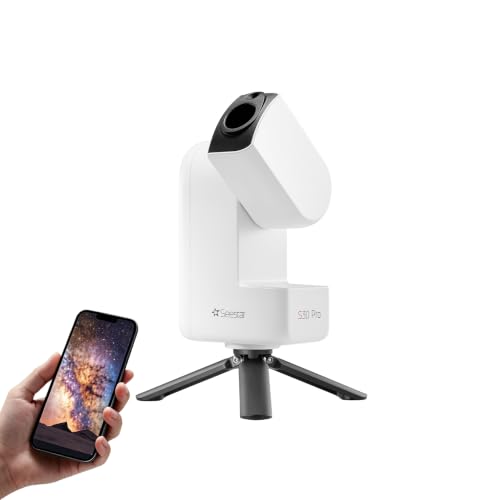
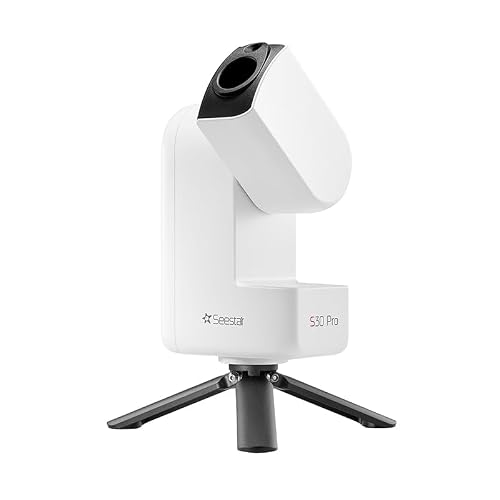
A smart telescope is a camera, lens and GoTo mount in one sealed unit. You control it from a phone or tablet, and the picture builds on the screen as it stacks exposures. There's no eyepiece and no polar alignment step to learn first.
Our data has three Seestar S30 Pro listings. All three list GoTo. One gives a 6-hour battery life. One is a bundle with the TH10 tripod head and TC20 carbon fiber tripod.
This suits someone who wants pictures of the night sky without learning a camera, a mount and a laptop at once. It also suits a family that wants everyone to see the same image at the same moment, on a screen. Skip it if what you want is to put your own eye to an eyepiece. A smart telescope is a different hobby from that one, and neither is the lesser.
If you're comparing, the DWARFLAB page covers the Dwarf 3 and Dwarf mini, which are smart telescopes too. Our astrophotography telescopes page compares smart telescopes with the separate tube, mount and camera route.
Seestar tripods and heads
Five listings in our data are tripod parts. The TH10 is a fluid tripod head; one listing names it for the Seestar S30 and S50. The TC20 is a carbon fiber tripod. There are listings for each part alone and for the two together.
A smart telescope sits on a tripod for every session, so the tripod is the part you'll touch most. Check that the head's thread matches your unit before you order the pieces separately. A bundle avoids that question.
AM5N mount
The AM5N is ZWO's GoTo mount in our data, with a 44 lb payload listed. That's a mount for a real imaging rig: a refractor or small reflector, a camera, a guide scope and a filter wheel. It's a long way from the Seestar end of the line.
For a sense of scale: a camera tracker like the ones on our star trackers page lists 11 lb. Four of those payloads fit inside the AM5N's number. Pick the mount for the gear you own today, then leave room on the scale for the one upgrade you already know you'll buy.
What else an ASI camera needs
An ASI camera listing is one part of a system. Before it takes a single frame of the sky, it needs most of this list:
- A telescope with enough focuser travel to bring the camera to focus
- A tracking mount, because the sky turns about 15 degrees an hour
- A computer or controller to run the camera; ZWO sells ASIAIR controllers for this job, per its site
- Adapters to connect the camera to the focuser, usually a 1.25" nosepiece or a threaded adapter
- Power, and for a cooled Pro camera, a power supply for the cooler
- Filters, especially for an MM camera
- Software to capture and to stack
None of that is a reason not to buy one. It's a reason to read the listing's "in the box" line and make your own list next to it. I keep mine on the inside of a kit-box lid, in pencil, because the list changes after the first night.
Smart telescope or camera on a telescope
This is the real choice inside ZWO's lineup, and it isn't about which is better.
A Seestar is one unit. You carry it out, set it on its tripod, open the app and pick a target. GoTo points it, and the picture builds on the screen. What you give up is choice: the lens, the sensor and the mount are fixed.
An ASI camera on a telescope is a set of parts you pick. You choose the focal length, the sensor size, the mount and the filters, and you can change any one of them later. What you give up is time: setup, alignment, cables, software, and a learning curve that runs for months.
Here's a test. If the idea of a laptop on a folding table in the driveway at midnight sounds fun, look at the cameras. If it sounds like a chore, look at the Seestar. Both groups go home with pictures. One group goes home later.
Who should skip ZWO for now
Skip ZWO if you want to look through an eyepiece. Nothing in this brand's listings has one.
Skip the ASI cameras if you don't have a mount that tracks. A camera on a fixed tripod behind a telescope sees stars drift across the frame in seconds. Start with the mount, or start with a smart telescope.
Skip the AM5N if your gear is light. A 44 lb payload mount is a lot of mount for a small refractor and a phone.
Where ZWO sits next to other brands here
ZWO's listings are mostly the camera end of an imaging rig, so they pair with other makers' tubes and mounts. In our telescope section, Sky-Watcher and iOptron list equatorial GoTo mounts and star trackers, and Sky-Watcher lists APO refractors and f/4 Newtonian astrographs as tubes only. SVBONY lists its own astronomy cameras, from small planetary models to cooled color cameras, along with filters and guide scopes. Celestron lists the Origin, a 152 mm smart telescope.
Mixing makers is normal in this hobby. The questions are the same every time: does the camera reach focus on this tube, does the mount carry the total weight, and do the threads match. Write the thread sizes down before you order. A missing adapter can cost a clear night, and the clear nights are the scarce part.
How to pick within ZWO
- Want pictures with the least gear? Seestar S30 Pro, ideally with the tripod bundle.
- Have a telescope and tracking mount, want planets and the Moon? A planetary camera from the small-sensor end.
- Have a tracking mount, want nebulae and galaxies? A deep-sky camera, color first.
- Building a full imaging rig? Start with the mount; the AM5N is the one ZWO lists here.
Lucho read the camera list over my shoulder and asked if ASI174MM-MINI was a camera or a carburetor. To be fair to him, the shop sells both and they're filed the same way.
Sun safety
Never look at the Sun through a telescope, binoculars, a finder or a camera, or with your eyes, without a certified solar filter made for that purpose and fitted correctly. Eye damage can be instant and permanent.
A camera at the focuser doesn't make solar work safe for the camera or anyone nearby. The American Astronomical Society says the solar filter goes on the front of the optics, never at the back. Follow ZWO's manual for any solar setup.
Decide what you're photographing first. The sensor line will make sense after that.
Where ZWO shows up
Questions about ZWO
Is ZWO a good brand?
We don't rank brands. What the data shows: 20 live ZWO listings on Amazon US, mostly ASI astronomy cameras across several sensor sizes, plus the Seestar S30 Pro smart telescope, Seestar tripods and the AM5N GoTo mount with a 44 lb payload listed. Pick a model by the job it's built for, not by the brand.
Who makes ZWO cameras and Seestar?
ZWO's site gives the company name as Suzhou ZWO Co., Ltd., and says its customers are spread across more than 70 countries and regions. Seestar smart telescopes are ZWO's own line, sold under the Seestar name on the listings. The site doesn't give a founding date we could confirm.
What is the Seestar S30 Pro?
A smart telescope from ZWO: a self-contained unit with GoTo that shows the sky on a phone or tablet instead of through an eyepiece. Our data lists it as GoTo, and one listing gives a 6-hour battery life. One listing bundles it with the TH10 head and TC20 carbon fiber tripod.
Do I need a telescope to use a ZWO ASI camera?
Yes. An ASI camera has no lens of its own for the sky; it goes into a telescope's focuser in place of an eyepiece and connects to a computer or controller. It also needs a mount that tracks the sky. The Seestar is the exception: camera, lens and mount are one unit.
Where can I buy ZWO products?
The grid above links each ZWO listing on Amazon US with a Check price button. ZWO's site also lists a dealer locator. Several listings are bundles, so compare what's included, not just the model name.
What is the difference between ZWO MC and MM cameras?
MM is the mono version of a sensor and MC the color version. ZWO's planetary camera page labels the ASI174MM as mono. A color camera records color in one exposure. A mono camera records brightness only, and color images come from shooting through separate filters and combining them, which means buying a filter wheel and filters too.
Sources
- ZWO: home page and product categories — accessed 2026-10-23
- ZWO: Our Company — accessed 2026-10-23
- ZWO: Selecting the ideal planetary camera — accessed 2026-10-23
- ZWO: Planetary Cameras — accessed 2026-10-23
- ZWO: ASI585MC/MM Pro — accessed 2026-10-23
- American Astronomical Society: Solar Filters for Optics — accessed 2026-10-23