Section
Model Kits and Scale Models
A model kit is a box of plastic parts on frames that you cut free, fit together and finish into a small copy of something real: a car, an airplane, a tank, a ship or a robot from a show. This section covers the kits and the supplies around them. Start with the subject you like, then read two numbers on the box: the scale and the skill level. (In my day job I survey county land. Fences wander. A ratio on a kit box never does.)
Gear in this section
Best-of lists
Best Model Car Kits for Adults
Glue-and-paint car kits at skill level 3 or higher as stated on the box or listing — the kits built for patience rather than speed.
Best PG Gundam Kits
Perfect Grade (PG) kits only — the grade as stated on the listing or box — from the biggest stated piece count down.
Brands in this section
What a model kit is, and what this section covers
A plastic model kit comes as parts molded on flat plastic frames. The frames are called runners, or sprues. You cut each part free, clean the spot where it was attached, and fit the parts together in the order the manual numbers them. Some kits snap together. Most glue together with plastic cement, then get paint and decals, the printed markings you slide onto the finished paint.
That's the whole hobby in one paragraph. The rest is choices: what subject, what size, how hard, and what supplies.
This section covers both halves. There are pages for kit types, lists that pick kits by a stated rule, and pages for the tools that come after the box, starting with airbrushes. Every number on those pages comes from the maker or the listing. Where a listing leaves a field out, we leave it out too.
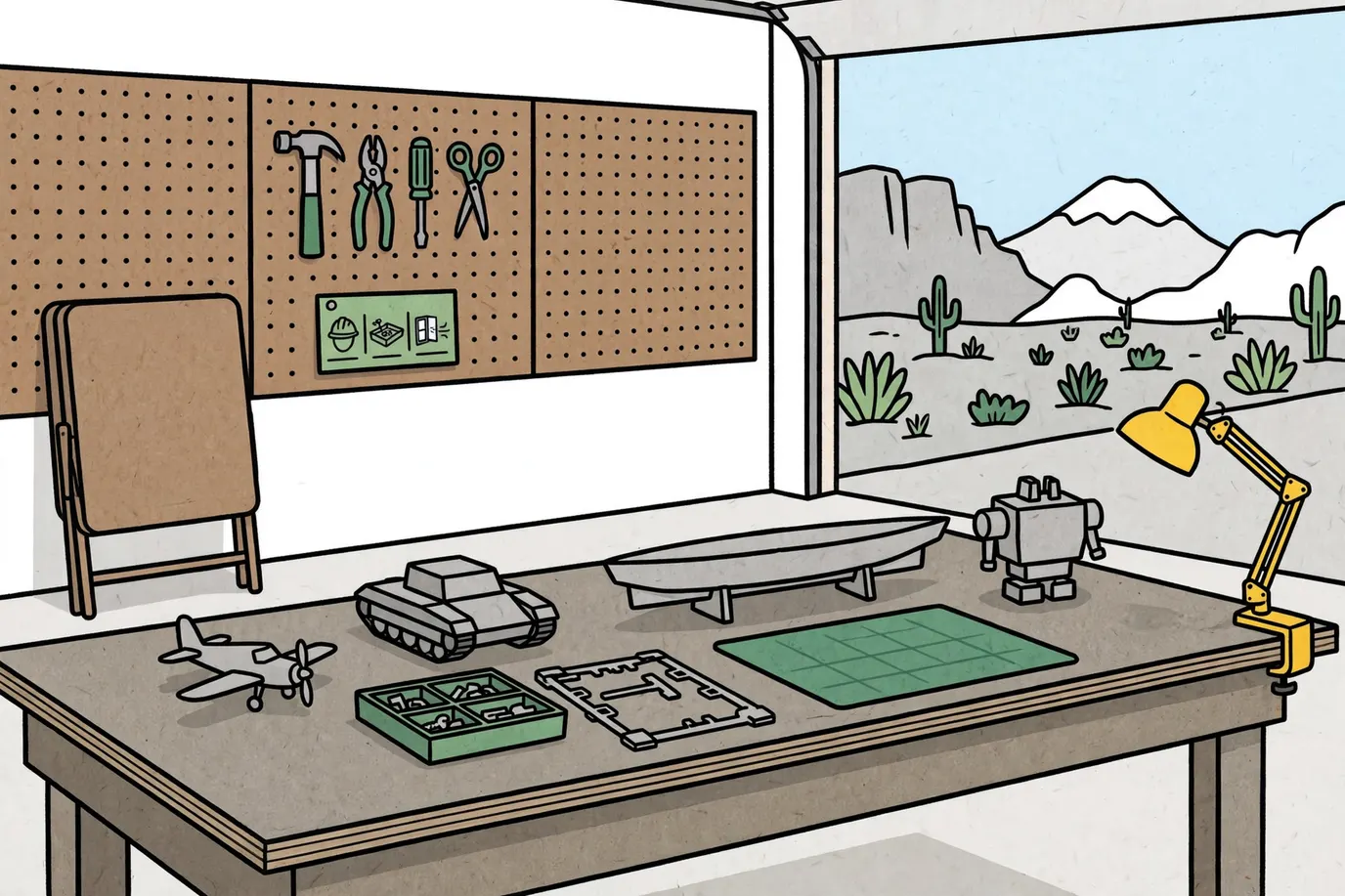
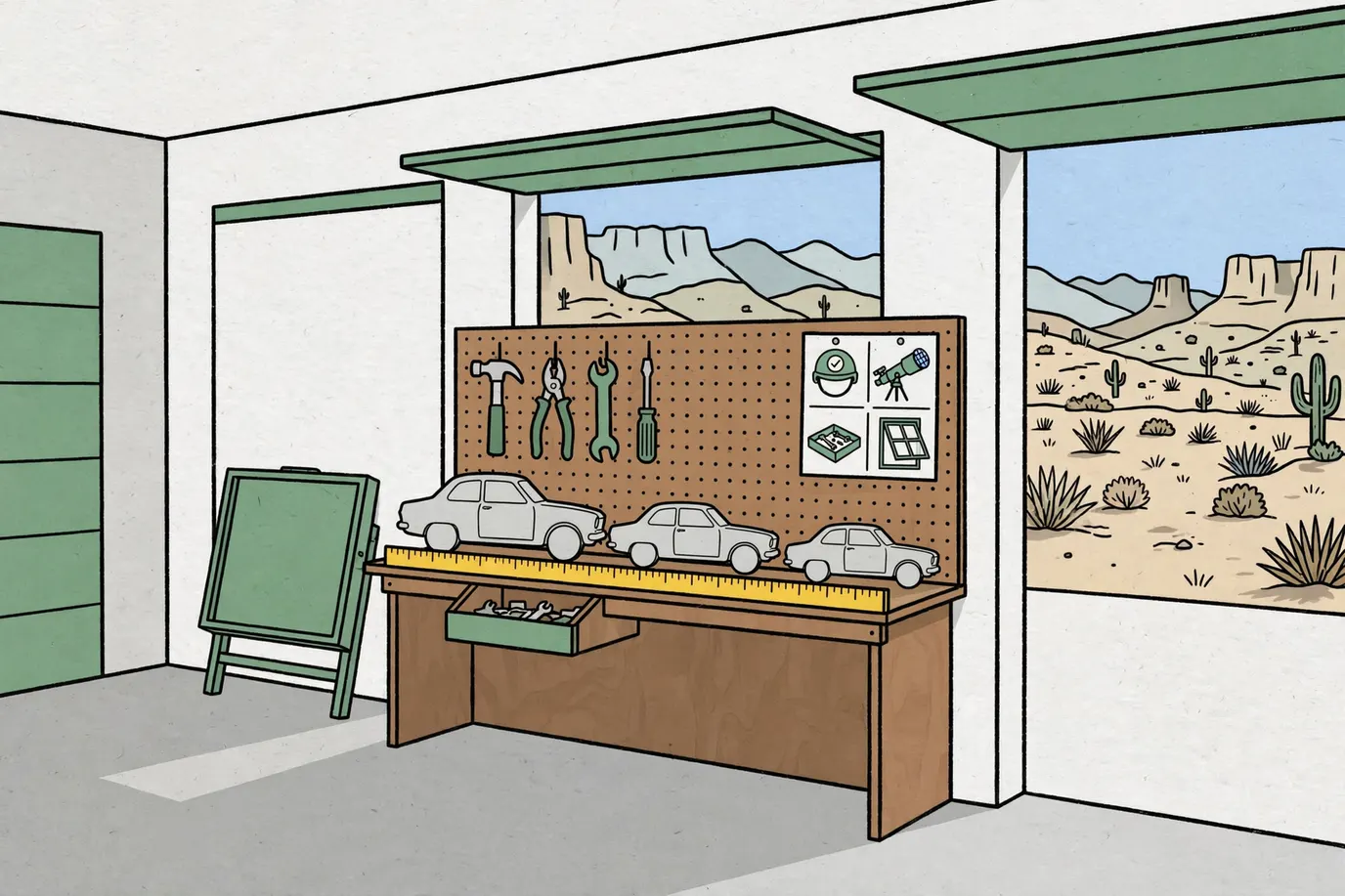
I write this section from Bay Two, which is the workbench half of our shared garage on Piñon Loop. The telescope rack is on the other wall. The two hobbies get along. Both reward reading the instructions before touching anything.
A tour of plastic model kits by subject
Scale modeling splits by subject first. Each subject has its usual scales, its usual skill range and its own habits. Here's the short tour.
Car and truck kits
Car kits are the classic start for many builders. Revell names 1:24 and 1:25 as the standard scales for cars and trucks. Expect a body shell, a chassis, wheels and tires, an interior tub and often an engine. Many need cement and paint, and the paint does most of the work of making a car look like a car.
The model car kits page covers the type, with scale, skill level and piece count in the table where the listings give them. If you want a harder build, the best model car kits for adults list keeps only glue-and-paint kits at skill level 3 or higher. Maker pages for the car side include Revell, AMT, Aoshima and Moebius Models.
Aircraft kits
Airplanes are where a lot of people first meet the hobby. Revell lists 1:32 and 1:48 as popular aircraft scales and calls 1:72 the benchmark for aircraft and military collections. At 1:144 you're in airliner and spaceship country.
Airfix's skill chart uses aircraft as its main examples. A 1:72 single-engine plane sits at level 1. A large 1:48 aircraft or a 1:24 aircraft sits at level 4, the top of that chart. So one subject covers the whole ladder, and the scale on the box tells you a lot about where on it you are. Airfix and Hasegawa have maker pages here.
Military vehicles and figures
Tanks, trucks and soldiers make up the military side. Airfix gives most 1:76 military vehicles as level 2 examples and 1:35 military vehicles as level 3. Revell names 1:72 for military vehicles and dioramas, which are small scenes with a base, a setting and often more than one model.
Military kits often carry tracks, many small parts and a camouflage scheme. That's a lot of masking tape. I find that relaxing, which says more about me than about tanks. Maker pages include MiniArt, Zvezda and Meng.
Ship kits
Revell calls 1:350 and 1:700 the classic shipbuilding scales. A 1/700 ship is small enough for a bookshelf. A 1/350 ship is not, so measure first. Airfix lists large ship kits among its level 4 examples. Ships reward patience with railings, rigging and long hulls that need a stand.
Gunpla: Gundam model kits
Gunpla is short for Gundam plastic models, made by Bandai. Bandai's company timeline dates the first Gunpla to July 1980. The kits come in grades. HG (High Grade, 1/144) dates to 1990, MG (Master Grade, 1/100) to 1995, PG (Perfect Grade, 1/60) to 1998, RG (Real Grade, 1/144) to 2010 and EG (Entry Grade) to 2020. The grade tells you the size and the depth of the build.
The Gundam model kits page covers every grade. The best PG Gundam list takes the top grade on its own. More on the maker is on the Bandai page.
Snap kits
A snap kit, or snap-fit kit, has parts that press together and hold without glue. Bandai's timeline dates its snap-fit method to December 1987, and its multi-color molding, with parts in more than one color on the same runner, to July 1983. Revell's level 1 is defined as no gluing or painting. Snap kits are a clean first build at a kitchen table. You still cut parts off runners, so the tools section below still applies.
Supplies: paint, cement, airbrushes and tools
The kit box is the start of the shopping list. Tamiya's basic modeling guide lists the bench supplies in one place, and I lean on its groupings here.
Paints
Bottled hobby paint comes in three common kinds: lacquer, acrylic and enamel. Tamiya sells all three and spray cans too. One rule from its guide is worth writing on the lid: lacquer paint should not go on top of acrylic or enamel. Plan the order of your coats before the first one goes on. Primer is the first coat that helps paint stick. Panel lining means running thin paint into the panel grooves so detail stands out.
Paint makers with pages here include Vallejo, Mr. Hobby (GSI Creos), AK Interactive, Testors and Tamiya.
Cement
Plastic cement softens the surface of the plastic and joins two parts as it sets. It's not a glue that sits on top. Tamiya's guide names a regular cement, an extra-thin one that flows into a seam, and a limonene-based one it describes as safety-conscious. It lists a separate cement for clear and plated parts, and a CA cement, a super glue, for metal parts. If your kit has a clear canopy or window, buy the cement meant for clear parts.
Airbrushes
An airbrush is a small spray tool that lays down thin, even coats. It needs a compressor and the right thinner for the paint. Tamiya's guide says to always use the appropriate thinner when airbrushing lacquer or acrylic paint. An airbrush is not required to start. None of the ten kits on the model car list for adults say one is required; they say paint is. The airbrush kits page covers the gear. Makers include Iwata, Badger, Harder & Steenbeck and Master Airbrush.
Tools
Here's the short bench list:
- Side cutters for plastic: often called nippers, for cutting parts off the runner
- Hobby knife: for trimming nubs and cleaning edges
- Cutting mat: protects the bench and holds the blade's path
- Files and sanding sponges: for smoothing the spot where a part met the runner
- Tweezers: for small parts and decals
- Masking tape: for clean paint lines
- A parts tray: one compartment per step
Tamiya's guide adds one line I'd frame: change blades as they get dull. A dull blade needs more force, and force is how slips happen. Tool makers with pages here include GodHand, Hasegawa and Tamiya.
Scale models in plain numbers
Scale is how much smaller the model is than the real thing. It's written as a ratio, like 1/24 or 1:24. Both mean the same: the model is one twenty-fourth of full size. Revell puts it in centimeters: 1 cm on the model stands for 24 cm on the real car.
The rule that trips people up: a bigger number after the slash means a smaller model. A 1/700 ship is tiny. A 1/24 car is a good handful.
Common scales and what they're used for, per Revell:
- 1/24 and 1/25: cars and trucks
- 1/32 and 1/48: aircraft with a lot of detail
- 1/72: aircraft and military vehicles, good for big collections and dioramas
- 1/144: airliners and spaceships, and the HG and RG Gunpla grades
- 1/350 and 1/700: ships
To compare two scales, divide the bigger number by the smaller. 1/35 against 1/48 is 48 divided by 35, about 1.37. So a 1/35 tank is about 1.37 times the size of the same tank at 1/48. Theo did that division before I finished the sentence. He teaches seventh-grade math. He'd like his students to know he got 1.37.
For a shelf that looks right, stay in one scale per row. Measure it, then trust it.
Skill levels: read the maker's own chart
A skill level is the maker's estimate of how hard a kit is to build. It's printed on the box. The catch is that each maker draws its own chart.
Revell's runs from 1 to 5. Level 1 needs no gluing or painting. Level 2 covers simple kits of up to 30 parts. Level 3 goes up to 100 parts, level 4 to 150 with precise gluing and painting, and level 5 means several hundred parts and fine detail.
Airfix's runs from 1 to 4. Its level 1 kits have about 25 to 50 parts, and they still need glue and paint. Level 2 runs 50 to 100 parts. Level 3 is 100 parts and up, sometimes with photo-etched metal parts. Level 4 is 200 parts and up, for builders who want a long project. Airfix itself calls its levels guidelines rather than hard rules.
Bandai uses grades instead of numbers, and the grade mostly tells you size and depth. EG is the grade Bandai describes as easy to assemble. PG is the one it calls its highest.
So compare levels inside one maker's line, not across makers. A level 2 at one company and a level 2 at another are close relatives, not twins. For a first glue kit, the low end of any chart is a sound start.
Set up a bench before you open the box
A model needs a place that can stay messy for a week. If the kitchen table has to be cleared for dinner every night, small parts will go missing. Here's the setup I'd give a neighbor:
- A flat surface you can leave set up: a desk, a card table, a corner of a garage
- A cutting mat: the bigger the better
- A lamp you can aim: light from the side shows seams and nubs
- A parts tray: sort by manual step, not by color
- A window or a fan nearby: for cement and paint, more on that below
- A shelf or box with a lid: for paints, cement and blades, up high
- A chair you can sit in for two hours: the part everyone skips
Read the whole manual once before the first cut. Check each part number against the runner before you cut it, because the runner is labeled and the box isn't. Dry-fit, which means test the parts together without cement, before you commit.
My chair in Bay Two is older than some of the kits on our lists. My back has filed a formal complaint. The chair has not responded.
Safety at the bench
Plastic cement, solvent paints and thinners give off fumes. The EPA lists paints, solvents and hobby supplies among the products that release volatile organic compounds indoors. Its advice is to increase ventilation, follow the label, and where a label calls for a well-ventilated area, work outdoors or near an exhaust fan. It also says to keep stored products away from children.
Airbrush, solvents, cement: Work with good ventilation and follow the paint or cement maker's label for masks and gloves.
Hobby knives and tools: Cut away from your body on a cutting mat, and keep blades away from kids.
Small parts: Kits are full of small parts. Check the age label on the box. Toys with small parts are a choking hazard for children under 3, so keep the parts tray out of reach of little ones.
Pick the scale, clear the bench, then cut the first part.
Related
Questions people ask
What does 1/24 scale mean on a model kit?
It means the model is one twenty-fourth of the real thing's size. Revell explains it this way: 1 cm on a 1:24 model stands for 24 cm on the real car. The bigger the number after the slash, the smaller the model. Revell lists 1:24 and 1:25 as the standard scales for cars and trucks.
What is the difference between 1/24 and 1/25 scale?
About 4 percent. 25 divided by 24 is about 1.04, so the same car built at 1/24 comes out roughly 4 percent longer, wider and taller than at 1/25. Side by side on a shelf you can see it if you look. Both are standard car and truck scales, so pick one if you want a matched row.
Is 1/35 bigger than 1/48?
Yes. 1/35 is the larger model, about 1.37 times the size of the same subject at 1/48 in every direction. Airfix's skill level chart gives 1:35 military vehicles and 1:48 aircraft as typical examples, and Revell lists 1:48 among its popular aircraft scales. Mixing the two on one display shelf will look uneven.
How do you remove nub marks from model kit parts?
A nub is the small stub left where a part joined its frame. Cut the part off with side cutters made for plastic, then smooth the nub with a hobby knife, a file or a sanding sponge. Tamiya's basic modeling guide pairs side cutters with files and abrasives for exactly this job. Go slowly, and cut away from your body.
What is the easiest kind of model kit for a beginner?
A snap kit or a kit at the lowest skill level on the box. Revell's level 1 needs no gluing or painting. Bandai's timeline describes its snap-fit method as building without adhesive, and its Entry Grade as easy to assemble. Airfix's level 1 kits have about 25 to 50 parts but still need glue and paint, so read the box.
Sources
- Revell: Model making (level system and scales) — accessed 2026-10-23
- Airfix: Skill level — accessed 2026-10-23
- BANDAI SPIRITS: History — accessed 2026-10-23
- Tamiya: Plastic Modeling - A Basic Guide — accessed 2026-10-23
- U.S. EPA: Volatile Organic Compounds' Impact on Indoor Air Quality — accessed 2026-10-23
- U.S. Consumer Product Safety Commission: Small Parts for Toys and Children's Products — accessed 2026-10-23