Telescopes & Stargazing · Type
Refractor Telescopes
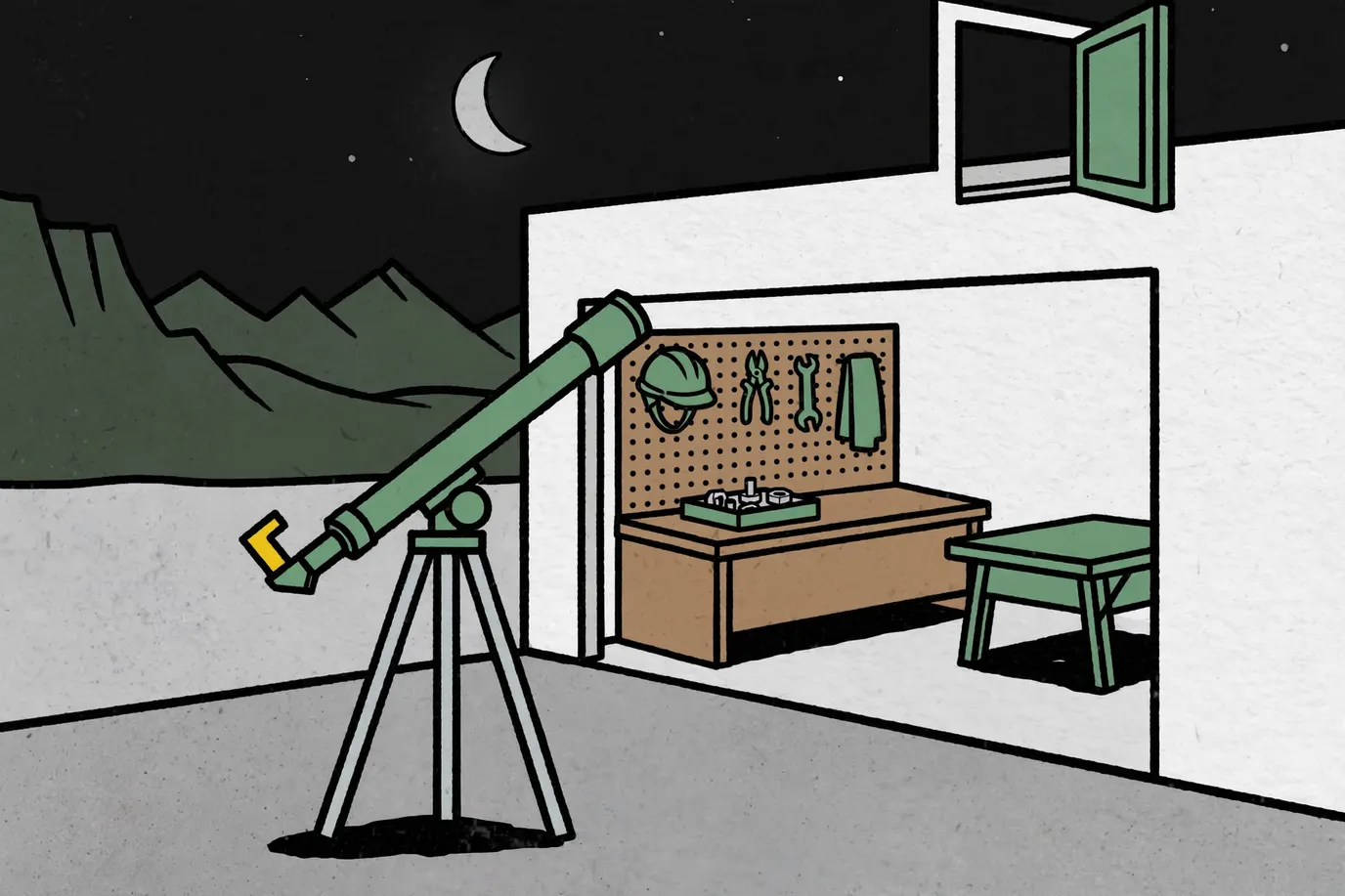
A refractor telescope uses a glass lens at the front of a tube to gather light, and you look in at the back. It's the easiest design to live with: no mirrors to line up, ready to use within minutes. The main choice is aperture, then the kind of glass, then the mount. Ask a kid on the loop to draw a telescope and you get a refractor every time: long tube, lens up front, three legs. The kid is right.
We earn a commission if you buy through our links, at no cost to you. Disclosure
| Model | Lens type | Aperture | Focal length | Amazon |
|---|---|---|---|---|
Celestron NexStar 102SLTTelescopes More specs
| — | 102 mmlisting | — | Check price |
Celestron StarSense Explorer DX 102AZTelescopes More specs
| — | 102 mmlisting | — | Check price |
Sky-Watcher AZ-GTe with StarTravel 102Telescopes More specs
| Achromaticlisting | 102 mmlisting | — | Check price |
SVBONY SV48P 102mm kitTelescopes More specs
| — | 102 mmlisting | — | Check price |
Gskyer AZ90600Telescopes More specs
| — | 90 mmlisting | 600 mmlisting | Check price |
SVBONY SV48P 90mmTelescopes More specs
| Achromaticlisting | 90 mmlisting | 500 mmlisting | Check price |
SVBONY SV520Telescopes More specs
| — | 90 mmlisting | 800 mmlisting | Check price |
Celestron Travel Scope 80Telescopes More specs
| — | 80 mmlisting | — | Check price |
Gskyer 80mm AZ Refractor TelescopeTelescopes More specs
| — | 80 mmlisting | 400 mmlisting | Check price |
Sky-Watcher Evostar 80EDX APO (S11135)Telescopes More specs
| Apochromaticlisting | 80 mmlisting | 600 mmlisting | Check price |
SOLOMARK 80900Telescopes More specs
| — | 80 mmlisting | 900 mmlisting | Check price |
SVBONY SV503 80EDTelescopes More specs
| EDlisting | 80 mmlisting | — | Check price |
SVBONY SV550 80mm APOTelescopes More specs
| Apochromaticlisting | 80 mmlisting | — | Check price |
SVBONY SV530 80mm EDTelescopes More specs
| EDlisting | 80 mmlisting | 480 mmlisting | Check price |
Celestron AstroMaster 70AZTelescopes More specs
| Achromaticlisting | 70 mmlisting | — | Check price |
Celestron Travel Scope 70Telescopes More specs
| — | 70 mmlisting | — | Check price |
iOptron 6002 900x70Telescopes More specs
| — | 70 mmlisting | 900 mmlisting | Check price |
iOptron 6003 700x70Telescopes More specs
| — | 70 mmlisting | — | Check price |
National Geographic 70mm Refractor Telescope by Explore Scientific (Computerized)Telescopes More specs
| Achromaticlisting | 70 mmlisting | 350 mmlisting | Check price |
iOptron AstroboyTelescopes More specs
| — | 60 mmlisting | — | Check price |
Celestron StarSense Explorer LT 80AZTelescopes More specs
| — | — | — | Check price |
Sky-Watcher EvoStar 100 APOTelescopes More specs
| Apochromaticlisting | — | — | Check price |
SVBONY SV503 80ED visual kitTelescopes More specs
| EDlisting | — | — | Check price |


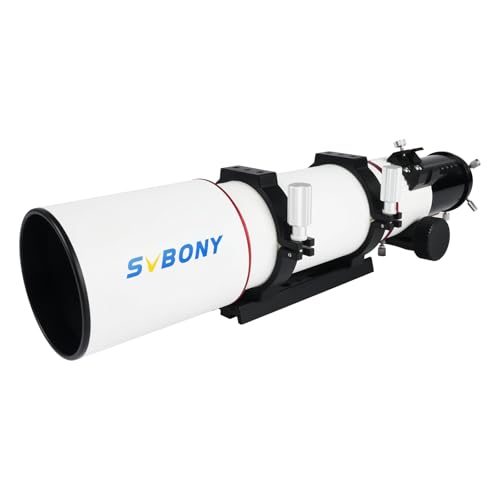


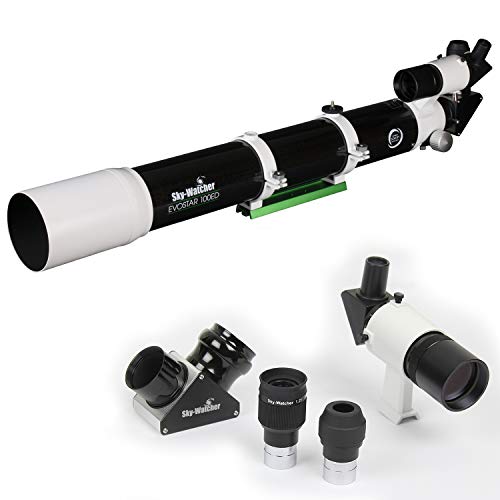

What’s in this listRefractors (lens telescopes) as the maker or listing describes them, biggest stated aperture first. “—” means neither the maker nor the Amazon listing states it.
What a refractor telescope is
A refractor telescope is the lens kind. Light comes in through a glass lens at the front, travels down a closed tube and comes to a focus near the back. An eyepiece there magnifies the image. NASA's Space Place explains the basic job in one line: the bigger the lens, the more light the telescope gathers.
The closed tube is the quiet advantage. The Society for Popular Astronomy (SPA) lists refractors as easy to use and sturdy. They stay in alignment, they give high-contrast views with a good field, and they're less bothered by warm air inside the tube than reflectors are. In practice, that means you can carry one out and start looking soon after.
The same source lists the costs too. Refractors get expensive in large sizes. The eyepiece end can sit low and awkward, which is why most come with a star diagonal. And basic lenses show some false color. Every refractor on this page is one of these trade-offs in a different proportion.
The table above sorts them by stated aperture, biggest first. It's a sort, not a ranking. A 70 mm scope at the bottom can be the right buy for the person who'll carry it out on a weeknight.
What to look at on a refractor listing
Five fields do most of the work. Read them in this order, and the rest of the box gets easier.
Aperture: the width of the lens, in mm
Aperture is the width of the main lens. It decides how much light you have and how fine the detail can get. The refractors in our data run from 60 mm to 102 mm. To convert to inches, divide by 25.4. A 102 mm lens is about 4.0 in; a 70 mm lens is about 2.8 in.
Light grasp grows with the lens area, not the width. So a 102 mm lens collects about 1.6 times the light of an 80 mm lens, and about 2.1 times the light of a 70 mm one. That's arithmetic, not a promise about any one view.
Aperture also sets the ceiling on magnification. The British Astronomical Association (BAA) puts the maximum at about twice the aperture in millimeters, and says half to two thirds of that is the more useful limit. For a 70 mm refractor, that's a ceiling near 140x and a working range of roughly 70x to 93x.
Focal length and focal ratio: what job the tube is built for
Focal length is the distance the lens uses to bring light to a focus, in mm. Focal ratio is focal length divided by aperture, written f/6 or f/12. The two together tell you what kind of refractor you're holding.
- Short focal ratio (about f/5 to f/7): wider views, shorter tubes. The Gskyer 80 mm AZ (400 mm, which works out to f/5), the SVBONY SV48P 90mm (f/5.5) and the National Geographic 70mm computerized (350 mm, also f/5) sit here.
- Long focal ratio (about f/10 and up): narrower views, more magnification from the same eyepiece. The SOLOMARK 80900 (900 mm on 80 mm, about f/11) and the iOptron 6002 900x70 (900 mm on 70 mm, about f/12.9) sit here.
The SPA notes that focal ratios shorter than about f/5 are harder to make to high quality. A short refractor is a sweeping scope. A long one is a Moon-and-planets scope. Neither is wrong; they have different jobs.
This is my one opinion on this page: read the focal ratio before you read the box art. It tells you what the maker built the tube for. If the listing leaves it out, divide the focal length by the aperture yourself. Measure it, then trust it.
Glass: achromatic, ED or apochromatic
A plain lens bends blue and red light by slightly different amounts. They don't land in quite the same place, and you see a colored fringe around bright edges. That's chromatic aberration, or false color.
- Achromatic: two lens elements that bring two colors together. The SPA notes they still show false color on high-contrast objects. Listed as achromatic in our data: the Sky-Watcher AZ-GTe with StarTravel 102, the Celestron AstroMaster 90AZ and 70AZ, the SVBONY SV48P 90mm and the National Geographic 70mm computerized.
- ED: extra-low dispersion glass that cuts the fringe further. Listed as ED: the SVBONY SV503 80ED, the SV503 80ED visual kit and the SV530 80mm ED.
- Apochromatic (APO): designed to bring the colors together closely. Listed as apochromatic: the Sky-Watcher Evostar 80EDX APO, the SVBONY SV550 80mm APO and the Sky-Watcher EvoStar 100 APO.
The SPA groups ED, apochromatic and fluorite refractors together as virtually free from chromatic aberration, and says they cost more. A purple halo around Venus in an achromat isn't a defect. It's the lens being honest about physics. For photos, the halo matters more, which is why the astrophotography telescopes page leans on ED and APO glass.
Where a listing doesn't name the glass, our table leaves the field blank. We don't guess it from the price or the color of the tube.
The mount: manual, equatorial, GoTo or none
The mount decides how you aim and whether the scope goes outside at all. The refractors in our data use four kinds.
- Manual alt-az: moves up-down and side to side by hand. The SPA calls this kind simple, stable and quick to set up. The AstroMaster 90AZ and 70AZ, the Gskyer AZ90600 and 80 mm AZ, the SVBONY SV520, the SOLOMARK 80900 and both Celestron StarSense Explorer models list it.
- Manual equatorial: tilted to line up with Earth's axis, so one knob follows a star. The iOptron 6002 900x70 and 6003 700x70 list it. The SPA warns that equatorial mounts need aligning on the Pole Star every session. I find north for a living, so I don't mind. Most people do.
- Computerized GoTo: a motor finds objects from a database. The Celestron NexStar 102SLT, the Sky-Watcher AZ-GTe with StarTravel 102 (with WiFi app control), the iOptron Astroboy and the National Geographic 70mm computerized list GoTo.
- None (OTA only): OTA means optical tube assembly, the tube without a mount. The SVBONY SV48P 90mm, SV503 80ED and SV550 80mm APO and the Sky-Watcher Evostar 80EDX APO and EvoStar 100 APO are listed this way. An OTA can't stand on its own. Neither can my argument for buying one without a mount to put it on.
There's a fifth idea in the middle. The Celestron StarSense Explorer DX 102AZ and LT 80AZ list a manual alt-az mount with an app push-to phone dock. The phone helps you find the target; your hands do the moving.
Eyepieces, finder and extras
Magnification is the telescope's focal length divided by the eyepiece's focal length. The BAA gives the example of a 10 mm eyepiece in a 1000 mm scope: 100x. So the included eyepieces tell you the range you get out of the box.
- The SVBONY SV520 lists a PL10 and a K25 eyepiece plus a Barlow on an 800 mm tube. That's 80x with the 10 mm and 32x with the 25 mm, before the Barlow.
- The Gskyer 80 mm AZ and AZ90600 state their magnifications directly: 16x, 40x and 80x, and 24x, 60x and 120x, each with a 3x Barlow.
- The SVBONY SV48P 102mm kit and the SV503 80ED visual kit list an SV135 7–21 mm zoom eyepiece.
- The Celestron Travel Scope 80 and 70 list 20 mm and 10 mm eyepieces. The SOLOMARK 80900 lists 10 mm and 20 mm.
A Barlow multiplies an eyepiece's power. It can't add aperture, so the ceiling from the section above still applies. Check any Barlow sum against twice the aperture before you get excited about it.
Finders and phone mounts come up too. The SV48P 102mm kit and the EvoStar 100 APO list a right-angle optical finder. The SV520, the Gskyer 80 mm AZ and the Travel Scope 80 list a smartphone adapter.
Kinds of refractors and when to choose which
The data sorts itself into four groups. Each one suits a different person.
Small grab-and-go refractors (60–80 mm)
These are the scopes you carry out in one trip. The Celestron Travel Scope 70 and 80, the AstroMaster 70AZ and the iOptron Astroboy live here. The SPA says a 70–80 mm scope shows plenty on the Moon and planets with patience, at up to about 75x or 100x. Choose one if you want to start this week and you'll mostly look at the Moon and bright planets.
The 90–102 mm middle
A 90 mm or 102 mm lens is the step up in light without a giant tube. The AstroMaster 90AZ, the Gskyer AZ90600, the SV520 and the four 102 mm scopes sit here. Choose one if you've used a small scope and want more, or you're buying once for a family that'll share it.
Long-focus refractors for the Moon and planets
A long tube at f/11 or slower gives high magnification with ordinary eyepieces. The SOLOMARK 80900 and the iOptron 6002 900x70 are the examples here. The telescopes for planets list sorts that kind by focal length.
ED and apochromatic tubes
These are mostly sold as OTAs, ready for a mount you choose. The ED and APO tubes in our data are all 80 mm where the aperture is stated, at f/6 to f/7.5. Choose one if color fringing bothers you or a camera is part of the plan. Skip it if you don't own a mount yet and don't want to shop for one.
Who should skip a refractor
Skip a refractor if your main goal is faint galaxies and nebulae. The SPA says those look pale through any size of scope, and that seeing spiral arms takes dark skies and around 300 mm of aperture or more. Refractors in our data top out at 102 mm. A reflector or Dobsonian gives more aperture for the money.
Skip the long ones if storage is tight. A 900 mm focal length means a long tube, and a long tube needs a closet corner of its own. I have one corner like that in Bay Two. It is spoken for.
Using a refractor on a real night
A few habits help any refractor. Give your eyes time first. The National Park Service says eyes take 20 to 30 minutes to adjust to low light, and red light protects that adjustment better than white. Start with the lowest-power eyepiece to find the target, then step up.
Point the scope low and you can stand. Point it high and the eyepiece drops toward the ground, which is the reason for the star diagonal. Without one, looking straight up means lying on the driveway gravel. I have checked. The gravel wins.
Sun safety for every refractor
Never look at the Sun through a telescope, binoculars, a finder or a camera, or with your eyes, without a certified solar filter made for that purpose and fitted correctly. Eye damage can be instant and permanent.
The American Astronomical Society says a solar filter for a telescope goes on the front of the tube, never at the eyepiece end, and that the finder must be capped, removed or filtered too. NASA adds that eclipse glasses are never a substitute for a filter on a telescope.
How this page is sorted
The table lists refractors we track on Amazon US, as the maker or listing describes them, biggest stated aperture first. Scopes with no stated aperture come last. Every number comes from the listing or the maker. A blank means nobody stated it, not that we skipped it.
Read the aperture first, then the focal ratio, then the mount. The lens will wait for you; the clear night won't.
Brands in this list
Related
Questions people ask
What is a refractor telescope?
A refractor is a telescope that uses a lens, not a mirror, to collect light and bring it to a focus. The lens sits at the front of a closed tube and the eyepiece at the back. The Society for Popular Astronomy describes refractors as easy to use and sturdy, quick to use because they're less bothered by tube cooling, and expensive in large sizes.
What can you see with a 70mm telescope?
The Society for Popular Astronomy says small telescopes of 70 to 80 mm show a lot of detail on the Moon and planets with patience, at up to about 75x or 100x. Star clusters look good in small scopes. Galaxies and nebulae look pale through any size of scope. The British Astronomical Association puts the magnification ceiling near 140x for 70 mm.
Is an achromatic refractor good enough for a beginner?
For looking, usually yes. An achromatic refractor shows a fringe of false color around bright, high-contrast objects such as the Moon's edge or Venus. Many observers accept that as the trade for a lower cost. ED and apochromatic refractors are nearly free of that fringe but cost more, and the difference matters most for photography.
Is a 102mm telescope much better than an 80mm?
It gathers more light. Light grasp grows with the area of the lens, and 102 squared is about 1.6 times 80 squared. The magnification ceiling rises too, from about 160x to about 204x by the British Astronomical Association's rule of twice the aperture. The trade is a longer or heavier tube and, often, a bigger mount.
What does ED mean on a refractor?
ED stands for extra-low dispersion glass. It bends the colors of light more evenly, so less false color shows around bright objects. The Society for Popular Astronomy groups ED, apochromatic and fluorite refractors together as virtually free from that color fringe. On this page, ED or apochromatic appears only when the listing states it for that model.
Sources
- Society for Popular Astronomy (hosted by the British Astronomical Association): Introduction to equipment — accessed 2026-10-23
- British Astronomical Association: Eyepieces — accessed 2026-10-23
- NASA Space Place: How Do Telescopes Work? — accessed 2026-10-23
- National Park Service: Astronomy — accessed 2026-10-23
- NASA Science: Eclipse Safety — accessed 2026-10-23
- American Astronomical Society: Solar Filters for Optics — accessed 2026-10-23