Building Toys · Type
Marble Run Sets: How to Choose One
A marble run is a set of tracks, chutes and towers you build so a marble, or a big ball for toddlers, rolls from the top to the bottom. The build takes a while. The run takes about four seconds. Stated ages in our data start anywhere from 1 to 12, so the age label decides the set before anything else does. Then pick a system, because most marble run sets only grow with their own pieces.
We earn a commission if you buy through our links, at no cost to you. Disclosure






What’s in this listEvery marble run we track on Amazon US, from the biggest stated piece count down. “—” means neither the maker nor the Amazon listing states it.
What a marble run is
A marble run is a set of pieces you build into a downhill path. You drop a marble or a ball at the top. It rolls through ramps, curves, funnels and drops until it reaches the bottom. Then you build it differently and drop it again.
That second part is the point. The marble doesn't care how long you spent on the build. It gets to the bottom in a few seconds either way. What keeps a kid at the table is the fixing: the curve that sends the marble off the edge, the drop that's a little too steep, the tower that leans.
We track 96 marble runs on Amazon US as of 2026-10-23. The makers in our data are Ravensburger, HABA, MindWare, Hape, Marble Genius, Learning Resources and National Geographic. The table above sorts them from the biggest stated piece count down. Our piece count field isn't filled in yet for marble runs, so most rows show a dash and the order there is just alphabetical by brand.
Marble run sets: what to look at
Marble run listings mix a lot of numbers. Here's what I'd read, and in what order.
Recommended age: two very different kinds of set
In our data, 65 of the 96 sets state an age. Here's how the starting ages spread:
| Starting age on the listing | Sets |
|---|---|
| 1 to 2 | 11 |
| 3 to 4 | 29 |
| 5 to 7 | 6 |
| 8 | 18 |
| 12 | 1 |
There are really two kinds of marble run hiding in that table. The 1+ and 2+ sets are toddler ball tracks with big balls and chunky parts. The 4+ and 8+ sets are marble runs in the usual sense, with real marbles and smaller pieces.
HABA's Kullerbü line is a good example of the toddler kind. On its Sim-Sala-Kling set page, HABA lists a ball diameter of 1¾ inches and calls the parts large and non-swallowable. In our data, Kullerbü sets list starting ages of 1, 2, 4 and 5 depending on the set. Hape's Quadrilla sets in our data list 4+, and Hape's own label on its Quadrilla Cyclone page warns of small parts and small balls.
We never put a set on a page for a child younger than its stated starting age. On marble runs, that rule does a lot of work.
System: the set you buy decides the add-ons
This is the field most people miss. Almost every marble run is a system. Pieces from one system fit other pieces from the same system. They usually don't fit another maker's, and sometimes they don't even fit another line from the same maker.
Two examples from the makers' own pages:
- HABA Kullerbü: HABA says all Kullerbü sets and accessories can be combined, though some pieces, like steep curves, don't take Kullerbü vehicles.
- Hape Quadrilla: Hape says Quadrilla sets work with other Quadrilla sets, but not with its separate Hape Marble Run E1100, E1101 and E1102 sets.
So the first box you buy is a bigger choice than it looks. It decides every add-on after it.
That brings me to my one opinion on this page. Get the starter set out on the table a few times before you buy expansions. An add-on adds pieces to a system nobody in the house has learned yet. In our data, a lot of the listings are add-ons: HABA's Kullerbü 8 Piece Expansion Set, Connectors and Base, Tall Columns and Straight Tracks and Curves; Hape's Quadrilla The Luge Add-On Set; Marble Genius's Booster Set 20 Pieces and Stable Bases 4pcs. They're useful once you know which pieces you keep running out of. Not before.
Material: wood or plastic
Marble runs come in wood, plastic or a mix. Wood sets tend to be blocks with grooves or rails. Plastic sets tend to be clear tubes, funnels and clip-together tracks. Hape says its Quadrilla sets are made of birch and rubber wood. HABA's Kullerbü sets combine wood and plastic.
The schema has a material field, but it's not filled in yet for these listings, and a listing that says "glass" may mean the marbles, not the track. Read the bullets and the photos.
Marbles included
Does the set come with marbles, and how many? Most starter sets include some. Add-ons often don't. Some listings count the marbles in the piece count, which makes a set sound bigger than its track.
Hape sells extra marbles on their own, the Quadrilla Marble Racers Add-On Bag of 50 Marbles. That's handy, because marbles go missing. They roll under things. That's what they're for.
Motor or elevator
A few marble runs have a motor or an elevator that carries marbles back to the top, so the run keeps going without a hand. The schema tracks this as "Motor / elevator". Our data doesn't have it filled in for the listings in the table yet. If a set has a motor, check the listing for the battery type.
Button batteries can cause serious injury if swallowed. Keep spares locked away and check that battery covers are screwed shut.
Compatibility
We only say two systems fit when the listing or maker says so. Some marble runs say they work with other building toys. Our magnetic tile page has ball-run tile sets, and those follow the tile maker's compatibility notes, not the marble run maker's.
Kinds of marble runs
Toddler ball tracks
Big balls, big pieces, short runs. These are for the 1+ and 2+ labels in our data. HABA's Kullerbü sets are the main group here, from the Kullerbu Marble Run Sound Stairs Step by Step (listed 1 to 4) to the Kullerbu Mountain Adventure Ball Track (listed 2 to 8). The run is short and the ball is easy to see, which suits a kid who wants to watch it happen again and again.
Classic wooden marble runs
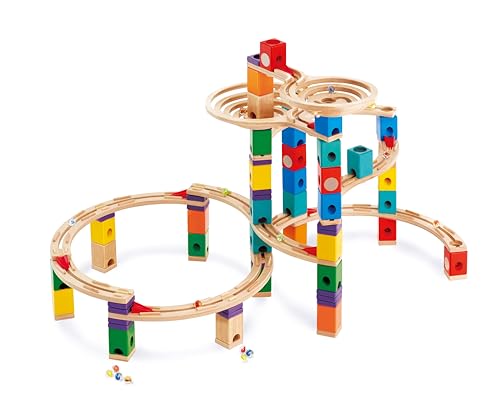
Blocks with grooves, rails and funnels, usually 4+. Hape's Quadrilla sets are the main group in our data: the Quadrilla Vertigo 134-Piece, Super Spirals, Cliffhanger and Stack Track Bucket Box 90 Piece, all listed 4+. The HABA Wooden Marble Run Ball Track Building Set 49-Piece lists ages 4 to 10.
Plastic tube and track sets
Clear tubes, clip-on curves, funnels and towers. Marble Genius's Marble Run Starter Set 130 Pieces lists ages 4 to 8. Plastic sets tend to build tall, which is where stable bases come in.
STEM and coding marble runs
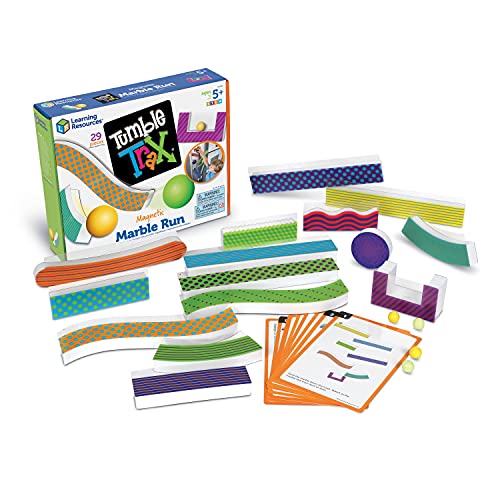
Some sets bring in logic, switches or simple coding. The Hape Quadrilla Basic Coding Set is one in our data. Learning Resources has its STEM Explorers Marble Runners and Tumble Trax Magnetic Marble Run. The name says magnetic, so read the listing for what surface it needs. These suit a kid who likes the "why" of the run as much as the run itself.
Giant marble runs
"Giant" isn't a field we track. It usually means a big piece count or a tall build. If you want a big run, look for a starter set from a system that sells lots of add-ons, then grow it over time.
Building it: a few things that help
Most kids figure out a marble run by building it wrong first. A few habits make that faster:
- Build from the bottom up. Set the base and the finish first.
- Test as you go. Drop a marble after every new piece.
- Short drops. A marble that falls too far jumps the track.
- Check the slope. Every piece has to go downhill, even a little.
- Use a tray. A run on a tray can move to a shelf without coming apart.
The first run of any new build is a test, and the test usually finds the one curve that went in backwards. That's normal. Turn it around and drop the marble again. If a kid gets stuck, the booklet's starter builds are worth going back to, even for an older builder. They show which pieces make a turn, which make a drop, and which hold the whole thing up.
June, who is 11, times every run with a phone stopwatch. Her record is a number she won't tell me, so she can beat it in private.
Lucho's take: "A marble run is a gearbox you can see into. Every jam has a reason, and you can point at it."
Who should skip a marble run
Skip a marble set with real marbles if a child under 3 lives in the house and you can't keep the marbles away from them. A toddler ball track with big balls, at the right age label, is the better fit there.
Skip any big set if your kid would rather play with the build than watch something run through it. Magnetic tiles or wooden blocks suit that kid better.
And skip the expansions until the starter set has been built a few different ways.
Marbles and small parts
Check the age label on the listing. Toys with small parts are a choking hazard for children under 3. The CPSC says to keep small balls and small parts away from children under 3.
Federal rules require a cautionary statement on toys and games for children 3 to under 8 that contain a marble or a small ball. A small ball is one that passes all the way through a 1.75-inch round hole. So a toddler ball can be big on purpose, and a marble is always small.
Count the marbles back into the box at the end of a session. Store the set in a bin with a lid, up high, if a younger child shares the house.
Where to go next
The gift pages check every pick against the age label: gifts for kids and gifts for girls both include marble runs. The building toys section covers every other kind of building set.
Build the bottom first. The marble will find every mistake above it.
Brands in this list
Related
Questions people ask
How do you build a marble run?
Start at the bottom, not the top. Lay out the base and the finish, then build up in towers, adding one track piece at a time and testing with a marble as you go. Keep each drop short and check that every piece slopes downhill. Most sets come with a booklet of starter builds, which is the easiest way to learn how the pieces fit.
How do you make a marble run at home?
Kids often make one from cardboard tubes, paper-towel rolls and tape on a wall or a box, with a ball rolling from tube to tube. The same rules as a store set apply. Use a ball that suits the child's age, and keep marbles and small balls away from children under 3. A homemade run is a good test of whether a kid wants a real set.
What age is a marble run for?
It depends on the set. In our data, 65 of 96 marble runs state an age, and the starting ages run from 1 to 12. Toddler sets use big balls, and many classic marble runs start at 4+ or 8+. Under federal rules, toys for ages 3 to under 8 that contain a marble must carry a cautionary statement, so read the box.
Are marble runs from different brands compatible?
Usually not, unless the maker says so. Most sets are built as a system that grows with its own pieces. HABA says all Kullerbü sets and accessories can be combined. Hape says its Quadrilla sets work with other Quadrilla sets but not with its separate E1100 to E1102 marble run line. Check before you buy an add-on.
Do marble run sets come with marbles?
Most starter sets include some, but not all add-ons do, and our data doesn't yet fill in the "marbles included" field for these listings. Read the parts list. Some piece counts include the marbles, which makes a set sound bigger than its track. Hape sells a Quadrilla Marble Racers Add-On Bag of 50 Marbles separately.
Sources
- Legal Information Institute: 16 CFR 1500.19, misbranded toys and children's articles (small parts, small balls, marbles) — accessed 2026-10-23
- U.S. Consumer Product Safety Commission: Small Parts for Toys and Children's Products — accessed 2026-10-23
- U.S. Consumer Product Safety Commission: Toys — accessed 2026-10-23
- HABA USA: Kullerbü Sim-Sala-Kling Wooden Track Set — accessed 2026-10-23
- Hape: Quadrilla The Cyclone — accessed 2026-10-23