Brand · Board & Card Games
HABA Games, Ball Tracks and Wooden Blocks
HABA games start younger than almost anything else on our shelves: the My Very First Games line lists ages from 2, and several HABA blocks and stacking toys list 1. The lineup then climbs through dexterity games at 5+ to strategy games at 8+ and 10+, plus Kullerbu ball tracks and wooden building blocks. Read the age first, because one name covers a toddler and a teenager. (A game listed for age 2 has one rule nobody prints: the pieces go back in the box. It's the hardest rule in any game, at any age.)
We earn a commission if you buy through our links, at no cost to you. Disclosure
HABA on Amazon US
87 models- Board & family games
HABA Game Meets Puzzle
- Recommended age
- 5+ years
- Players (min)
- 2
- Players (max)
- 4
- Board & family games
HABA Karuba
- Recommended age
- 8–12 years
- Players (min)
- 2
- Players (max)
- 4
- Board & family games
HABA Rhino Hero Super Battle
- Recommended age
- 5+ years
- Board & family games
HABA King of The Dice
- Recommended age
- 8+ years
- Players (min)
- 2
- Players (max)
- 5
- Board & family games
HABA Dragon's Breath
- Recommended age
- 5+ years
- Board & family games
HABA Mountains
- Recommended age
- 8+ years
- Players (min)
- 2
- Players (max)
- 5
- Board & family games
HABA Animal Upon Animal Christmas Limited Edition
- Recommended age
- 4+ years
- Players (min)
- 2
- Players (max)
- 4
- Board & family games
HABA Inspector Mouse: The Great Escape
- Recommended age
- 5+ years
- Board & family games
HABA Water Dragons
- Recommended age
- 5+ years
- Board & family games
HABA Bamboo Rally Cup Hype in The Jungle
- Recommended age
- 6–8 years
- Board & family games
HABA Animal Upon Animal Compact On the Go Edition
- Recommended age
- 4+ years
- Players (min)
- 2
- Players (max)
- 4
- Board & family games
HABA Rhino Hero XXL
- Recommended age
- 8+ years
- Board & family games
HABA Robbi Gelato The Wobbly Seal Mini Game
- Recommended age
- 6+ years
- Board & family games
HABA Dancing Eggs
- Recommended age
- 5+ years
- Board & family games
HABA Monza
- Recommended age
- 5+ years
- Board & family games
HABA Pencil Pirates
- Recommended age
- 8+ years
- Players (min)
- 2
- Players (max)
- 4
- Board & family games
HABA Stuglandet Cabin Toss
- Recommended age
- 8+ years
- Players (min)
- 2
- Players (max)
- 4
- Board & family games
HABA Biene Maja My First Games Flower Meadow
- Players (min)
- 2
- Players (max)
- 4
- Board & family games
HABA ABC Magic Duel
- Players (min)
- 2
- Players (max)
- 4
- Board & family games
HABA Froggos
- Recommended age
- 6+ years
- Board & family games
HABA Pirate Treasure Hunt Game
- Recommended age
- 4+ years
- Board & family games
HABA Ice Cream Derby
Check price - Marble runs
HABA Wooden Marble Run Ball Track Building Set 49-Piece
- Recommended age
- 4–10 years
- Marble runs
HABA Melodious Building Bricks Marble Run Accessory
Check price - Marble runs
HABA My First Ball Track Large Basic Pack
Check price - Marble runs
HABA Marble Run Kullerbu Windmill Playset
- Recommended age
- 2–6 years
- Marble runs
HABA Ball Run Kullerbu 8 Piece Expansion Set
- Recommended age
- 2–6 years
- Marble runs
HABA Ball Run Expansion Set Kullerbu Connectors and Base
- Recommended age
- 2–6 years
- Marble runs
HABA Ball Track Columns Expansion 10 Piece Set
- Recommended age
- 2–6 years
- Marble runs
HABA Ball Track Expansion Set Straight Tracks and Curves
- Recommended age
- 2–6 years
- Marble runs
HABA Kullerbu Expansion Set Tall Columns
- Recommended age
- 2–8 years
- Marble runs
HABA 304862 Marble Run
Check price - Marble runs
HABA Kullerbu Kringel Domino Playset
- Recommended age
- 2+ years
- Marble runs
HABA Kullerbu Mountain Adventure Ball Track
- Recommended age
- 2–8 years
- Marble runs
HABA Kullerbu 306745 Playway Station First Marble Run Basic Pack
- Recommended age
- 2+ years
- Marble runs
HABA Kullerbu Construction Zone Track Set
- Recommended age
- 4–8 years
- Marble runs
HABA Kullerbu Ball Track System Build & Grow
- Recommended age
- 5+ years
- Marble runs
HABA Kullerrum 2012251001 Marble Run
Check price - Marble runs
HABA Marble Run Bath Fun Water Swirl
- Recommended age
- 3+ years
- Marble runs
HABA Kullerbu Step-By-Step Growing Marble Run
Check price - Marble runs
HABA Kullerbu Marble Run Sound Stairs Step by Step
- Recommended age
- 1–4 years
- Marble runs
HABA Kullerhaus Standing Marble Run
Check price - Kids & preschool games
HABA Orchard Game
- Recommended age
- 3–6 years
- Players (min)
- 1
- Players (max)
- 8
- Kids & preschool games
HABA My Very First Games First Orchard
- Recommended age
- 2–4 years
- Players (min)
- 1
- Players (max)
- 4
- Kids & preschool games
HABA My Very First Games Here Fishy Fishy!
- Recommended age
- 2+ years
- Players (min)
- 1
- Players (max)
- 4
- Kids & preschool games
HABA My Very First Games Hanna Honeybee
- Recommended age
- 2+ years
- Players (min)
- 1
- Players (max)
- 4
- Kids & preschool games
HABA Unicorn Glitterluck A Party for Rosalie
- Recommended age
- 4+ years
- Players (min)
- 2
- Players (max)
- 4
- Kids & preschool games
HABA My Very First Games Building Site
- Recommended age
- 2–3 years
- Kids & preschool games
HABA Moonlight Heroes
- Recommended age
- 5+ years
- Kids & preschool games
HABA My Very First Games Forest Friends
- Recommended age
- 2+ years
- Kids & preschool games
HABA Wiggle Waggle Geese
- Recommended age
- 3+ years
- Kids & preschool games
HABA Hello Hello Kalamario
- Recommended age
- 4+ years
- Kids & preschool games
HABA Knuckling Knights
Check price - Kids & preschool games
HABA My Very First Games at The Vet
Check price - Kids & preschool games
HABA Mixalotl
- Recommended age
- 4+ years
- Kids & preschool games
HABA Unicorn Glitterluck Cloud Crystals
- Players (min)
- 2
- Players (max)
- 4
- Kids & preschool games
HABA Superstar Forest Festival Memory Game
- Recommended age
- 4–8 years
- Kids & preschool games
HABA Unicorn Glitterluck Cloud Stacking
- Recommended age
- 4–8 years
- Kids & preschool games
HABA Hurra Confetti Party
- Recommended age
- 4+ years
- Players (min)
- 2
- Players (max)
- 4
- Kids & preschool games
HABA My Very First Games Hello Vacation
- Recommended age
- 2–4 years
- Kids & preschool games
HABA Little Dinosaurs
- Recommended age
- 3+ years
- Wooden blocks & building logs
HABA Wooden Building Blocks 60 Piece Set
- Recommended age
- 1–8 years
- Wooden blocks & building logs
HABA Wooden Stacking Toy Rainbow Lighthouse 8-Piece
- Recommended age
- 1–3 years
- Wooden blocks & building logs
HABA Wooden Building Blocks Varius 21 Piece
- Recommended age
- 3–5 years
- Wooden blocks & building logs
HABA Wooden Building Blocks Bad Rodach 18-Piece
Check price - Wooden blocks & building logs
HABA Clever Up! Building Block System 2.0 66 Piece
- Recommended age
- 1+ years
- Wooden blocks & building logs
HABA Wooden Building Blocks Animal Parade 25 Piece
Check price - Wooden blocks & building logs
HABA Forest Friends Wooden Stacking Toy
Check price - Wooden blocks & building logs
HABA Crooked Tower Building Blocks Set
- Recommended age
- 4+ years
- Wooden blocks & building logs
HABA Teetering Towers Wooden Blocks Set
- Recommended age
- 4–8 years
- Wooden blocks & building logs
HABA Discovery Building Blocks Caterpillar
- Recommended age
- 1–3 years
- Wooden blocks & building logs
HABA Discovery Building Blocks Boat
- Recommended age
- 1–3 years
- Wooden blocks & building logs
HABA Creative Building Blocks 32 Wooden Blocks
Check price - Wooden blocks & building logs
HABA Cottage Puzzle Blocks
- Recommended age
- 3+ years
- Wooden blocks & building logs
HABA My First Building Block World
Check price - Card games
HABA Rhino Hero
- Recommended age
- 5+ years
- Card games
HABA Dragonella
- Players (min)
- 2
- Players (max)
- 5
- Card games
HABA Monster Peter
- Recommended age
- 4+ years
- Card games
HABA Galaxolotl
- Recommended age
- 8–13 years
- Card games
HABA BigWig Trick the Gods
- Players (max)
- 6
- Card games
HABA Molecools
Check price - Strategy & hobby games
HABA Honga
- Recommended age
- 8+ years
- Players (min)
- 2
- Players (max)
- 5
- Strategy & hobby games
HABA Nature Module 5: Amazon Rainforest
- Players (min)
- 1
- Players (max)
- 4
- Solo mode
- Yes
- Strategy & hobby games
HABA Nature Module 3: Natural Disasters
- Recommended age
- 10+ years
- Players (min)
- 1
- Players (max)
- 4
- Strategy & hobby games
HABA Karuba
- Recommended age
- 8+ years
- Players (min)
- 2
- Players (max)
- 4
- Strategy & hobby games
HABA Carni Flora
Check price - Party, trivia, drinking & social deduction games
HABA Children's Pantomime Game
- Recommended age
- 5+ years









What HABA makes
HABA makes games and wooden toys. In our data, its listings cover seven types: family games, preschool games, card games, strategy games, party games, marble runs (ball tracks) and wooden blocks. That's one of the widest spreads of any maker we cover, and it runs from toddler toys to 10+ strategy games.
HABA USA's About page says HABA USA is located in Skaneateles, New York, is part of the HABA FAMILYGROUP, and is the exclusive American distributor of HABA toys and games. It describes the company as family owned for over 85 years and says the toys are made from sustainably sourced wood. Those are the maker's own statements.
The 40 HABA listings we work from here sort into six groups:
- My Very First Games, from age 2
- Preschool and early family games
- Dexterity and family games from 5+
- Strategy games from 8+
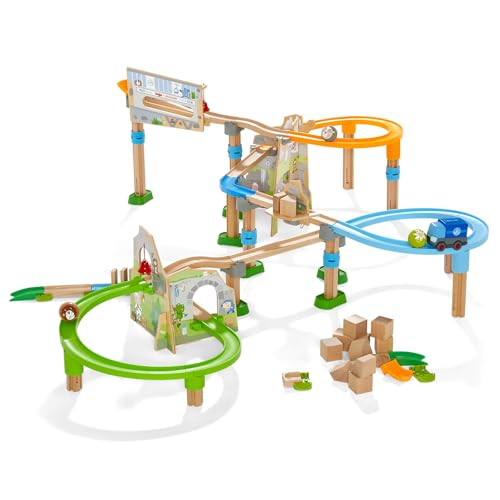
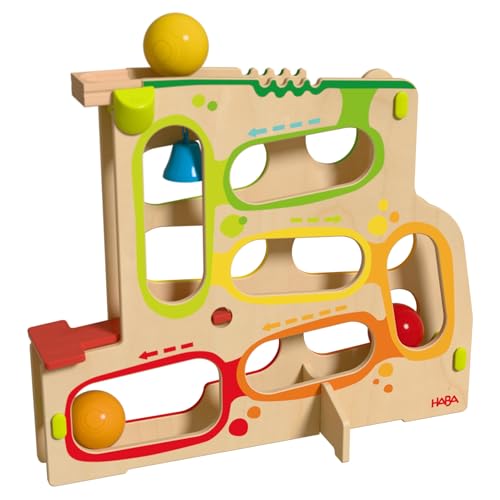
- Kullerbu and other ball tracks
- Wooden building blocks and stacking toys
HABA games by line
My Very First Games: from age 2
Five listings carry the My Very First Games name:
- First Orchard, 2–4, 1–4 players, colors
- Here Fishy Fishy, 2+, 1–4 players, colors and fine motor
- Hanna Honeybee, 2+, 1–4 players, about 5 minutes, colors and matching
- Building Site, 2–3
- Forest Friends, 2+, memory and matching
These are among the youngest board games in our data from any maker. They teach colors, matching and taking turns, and several list 1 player, so a toddler can play with a parent or alone.
First Orchard lists 2–4. Building Site lists 2–3. That end number is the maker telling you when the game has done its job. A 5-year-old will find these too simple, and that's fine. They're built to be outgrown.
Who should skip these: a family whose youngest is already 5. Move up a line.
Preschool and early family games
- Orchard Game, 3–6, 1–8 players
- Unicorn Glitterluck A Party for Rosalie, 4+, 2–4 players
- Moonlight Heroes, 5+
The Orchard Game is the bigger sibling of First Orchard. It lists 1–8 players, the widest seat count in this group. That makes it one of the few preschool games that can hold a whole table of cousins.
Dana's ruling: a game with an 8 on the box gets saved for the holidays, when there are eight people and somebody has to keep the 3-year-olds busy while the pie cools.
Dexterity, memory and family games from 5+
- Rhino Hero, 5+, a card game
- Rhino Hero Super Battle, 5+, dexterity
- Animal Upon Animal Christmas Limited Edition, 4+, 2–4 players, 28 wooden pieces in a collector's tin
- Dragon's Breath, 5+
- Game Meets Puzzle, 5+, 2–4 players, memory
- Inspector Mouse: The Great Escape, 5+, cooperative, electronic
Dexterity games ask for steady hands more than a strategy. Stacking, balancing and placing pieces carefully are the core. Steady hands don't depend on reading, so a 5-year-old and a grandparent start a dexterity game on equal footing. The grandparent usually has more to lose, mostly dignity.
Animal Upon Animal Christmas Limited Edition starts at 4 and lists its 28 wooden pieces. Inspector Mouse is the cooperative one: everyone wins or loses together, which suits a younger player who takes a loss hard.
Strategy games from 8+
- Karuba, 8–12, 2–4 players, tile placement with 144 tiles, adventurers, temples and treasures
- Mountains, 8+, 2–5 players, 20–30 minutes
- Honga, 8+, 2–5 players
- King of the Dice, 8+, 2–5 players, 30 minutes
- Nature Module 5: Amazon Rainforest, 1–4 players, solo mode
- Nature Module 3: Natural Disasters, 10+, 1–4 players, solo mode
Karuba lists 8–12. Mountains lists a cloth bag, 80 favor stones, five summit books and a summit stamp among its parts. King of the Dice lists 30 minutes. These are the HABA games for a family whose youngest is 8, and for adults who want something short.
The two Nature listings both name Nature as the base game required. Module 3 is marked as an expansion. Module 5's listing doesn't mark it as one, but still names the base game. Either way, both need Nature. The base game isn't among the HABA listings in our data here, so check before you buy.
Kullerbu and other ball tracks
HABA's ball tracks are a big part of the lineup, and they start young. The Kullerbu line is the main one:
- Kullerbu Windmill Playset, 2–6
- Kullerbu Mountain Adventure Ball Track, 2–8
- Kullerbu 306745 Playway Station First Marble Run Basic Pack, 2+
- Kullerbu Kringel Domino Playset, 2+
- Expansion sets: an 8-piece set, connectors and base, a 10-piece columns set, straight tracks and curves, and tall columns
Every Kullerbu listing that states an age starts at 2. That makes it the youngest ball-track system in our data. The expansions add parts to a basic set, so start with a playset or basic pack.
Outside Kullerbu, the Wooden Marble Run Ball Track Building Set 49-Piece lists 4–10. My First Ball Track Large Basic Pack, the 304862 Marble Run and the Melodious Building Bricks Marble Run Accessory don't state an age in our data. The accessory is an add-on, not a starter.
For ball tracks and marble runs across brands, see the marble runs page.
Wooden building blocks and stacking toys
- Wooden Building Blocks 60 Piece Set, 1–8
- Clever Up Building Block System 2.0 66 Piece, 1+
- Wooden Stacking Toy Rainbow Lighthouse 8-Piece, 1–3
- Wooden Building Blocks Varius 21 Piece, 3–5
- Wooden Building Blocks Bad Rodach 18-Piece, no age stated
- Wooden Building Blocks Animal Parade 25 Piece, no age stated
- Forest Friends Wooden Stacking Toy, no age stated
Three of these list 1 as the starting age. The Rainbow Lighthouse lists 1–3, a stacking toy built for the youngest builders. The 60-piece set lists 1–8, a long range for one box. The Varius set lists 3–5.
The wooden blocks page compares wooden sets across makers.
Building a Kullerbu track in steps
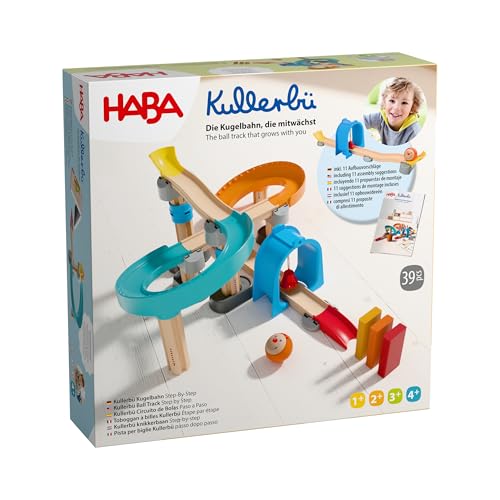
Kullerbu is a system, and the listings in our data make that plain. There are playsets and basic packs, and there are expansion sets that add parts. Here's the order that follows from the listings:
- Start with one base. The Windmill Playset (2–6), the Mountain Adventure ball track (2–8) or the Playway Station basic pack (2+).
- Play with it as it comes. A 2- or 3-year-old gets plenty from one track.
- Add columns when the track gets boring. The 10-piece columns set and the tall columns set add height.
- Add tracks and curves when height isn't enough. The straight tracks and curves set and the 8-piece set add length.
- Add connectors last. The connectors and base set ties pieces together.
The Kringel Domino Playset (2+) is another playset with the Kullerbu name. Read its listing for what it connects to.
The age ranges are worth a second look. The Windmill lists 2–6, the Mountain Adventure 2–8, and the tall columns 2–8. If your child is already 7, the end of the range is close. A 4–10 track like the 49-piece wooden marble run gives more years.
A first HABA game night at ages 3 to 5
For a family new to board games with a preschooler, the listed facts point to a short path:
- At 3: the Orchard Game (3–6, 1–8 players). It can seat the whole family.
- At 4: Animal Upon Animal Christmas Limited Edition (4+, 2–4) or Unicorn Glitterluck (4+, 2–4).
- At 5: Rhino Hero (5+), Game Meets Puzzle (5+, 2–4) or Inspector Mouse (5+, cooperative).
The cooperative one is worth singling out. A 5-year-old who hates losing can play Inspector Mouse with the family as a team. Nobody gloats, because nobody can.
How to pick within HABA
The age decides the line. Here's the map:
- Ages 1–2: stacking toys, the 1+ block sets, My Very First Games, and Kullerbu ball tracks from 2.
- Ages 3–4: the Orchard Game, the Varius blocks, Animal Upon Animal Christmas, Unicorn Glitterluck.
- Ages 5–7: Rhino Hero and Super Battle, Dragon's Breath, Game Meets Puzzle, Inspector Mouse, Moonlight Heroes, and the 49-piece wooden marble run from 4.
- Ages 8 and up: Karuba, Mountains, Honga, King of the Dice, and the Nature modules if you own Nature.
Then check the player count. My Very First Games go down to 1. The Orchard Game goes up to 8. The strategy games sit at 2–4 or 2–5.
One name, many ages
The useful thing about HABA, from a parent's chair, is that the same name follows a kid for years. A 2-year-old with First Orchard, a 5-year-old with Rhino Hero and a 9-year-old with Karuba are all at the same maker. The less useful thing is that a gift buyer can grab the wrong box. A grandparent who sees "HABA" and a cheerful picture could buy a 2+ game for a 7-year-old or an 8+ game for a 4-year-old.
So for every HABA gift, read the age before the picture. The age is the line. The picture is the decoration.
Who should skip HABA
- A family that wants a long strategy game for adults. The longest stated time here is 30 minutes.
- Anyone buying a Kullerbu expansion or a Nature module without the base.
- A gift buyer who doesn't know the child's age. Ask first.
Small parts and the youngest players
Check the age label on the listing. Toys with small parts are a choking hazard for children under 3. The CPSC requires toys that are a choking hazard for children under 3 to carry an age label. Several HABA products in our data start at 1 or 2. That label tells you the maker built them for that age. It doesn't make other HABA games safe for a toddler, so keep 4+ and 5+ games, their small pieces and any marble or ball from other sets out of reach.
Read the age, pick the line, and keep the small pieces on the table, not the floor.
Where HABA shows up
Questions about HABA
What age are HABA games for?
It depends on the line. My Very First Games list ages starting at 2. The Orchard Game lists 3–6. Rhino Hero, Dragon's Breath and Game Meets Puzzle start at 5. Karuba, Mountains, Honga and King of the Dice start at 8, and Nature Module 3 lists 10+. Never pick a game for a child younger than the listed start.
Are HABA games good?
We don't rate brands. What the data shows is an unusually young starting point and a wide range: listings from 1+ blocks and 2+ first games up to 8+ and 10+ strategy games, player counts from 1 to 8 where stated, and wooden components on several listings. Whether a box suits your family depends on its age line and player count.
Where is HABA based?
HABA USA's own About page says HABA USA is located in Skaneateles, New York, that it is part of the HABA FAMILYGROUP, and that it is the exclusive American distributor of HABA toys and games. The page describes the company as family owned for over 85 years. We haven't added facts it doesn't state.
Where can I buy HABA games and ball tracks?
The products in the grid above are listed on Amazon US, checked for delivery to ZIP 10001 when we collected the data in October 2026. Each card links to its listing, where you can check the current price and seller. The HABA lineup on Amazon is large, so the grid may show more products than this page names.
Do HABA Kullerbu expansion sets work alone?
The Kullerbu expansion listings in our data are add-ons: the 8-piece set, connectors and base, columns, straight tracks and curves, and tall columns. Pair them with a Kullerbu basic set such as the Windmill Playset, the Mountain Adventure ball track or the Playway Station basic pack. Read each listing for what it connects to.
Sources
- HABA USA: About HABA — accessed 2026-10-23
- U.S. Consumer Product Safety Commission: Small Parts for Toys and Children's Products — accessed 2026-10-23
- U.S. Consumer Product Safety Commission: Toys — accessed 2026-10-23