Building Toys · Type
Wooden Blocks: Sets, Styles and Ages
Wooden blocks are the plainest building toy there is: solid pieces of wood, no studs, no magnets, nothing to charge. They stay up by balance and come down with a clatter that sounds a lot like applause. In our data, stated ages on wooden blocks start as young as 1, and most start at 2 or 3. The main choice is the style of set: unit blocks, ABC blocks, stacking toys, balance games or building logs.
We earn a commission if you buy through our links, at no cost to you. Disclosure




What’s in this listEvery wooden block and building-log set we track on Amazon US, from the biggest stated piece count down. “—” means neither the maker nor the Amazon listing states it.
What counts as wooden blocks
Wooden blocks are building pieces cut from solid wood. They don't lock, snap or stick. A tower stands because each block sits flat on the one below it. That's the whole engineering course, and kids get it fast.
We track 55 wooden block and building-log sets on Amazon US as of 2026-10-23. The makers in our data are Melissa & Doug, HABA, Hape, MindWare, Lincoln Logs and Fisher-Price. The table above sorts sets from the biggest stated piece count down. Our piece count field isn't filled in for wooden blocks yet, so most rows show a dash.
Many set names carry a count, like the Melissa & Doug Wooden Building Block Set (200 blocks) or the Hape 100 PCs Wooden Building Block Set. Those numbers are the listing's own. We haven't checked them against the makers yet, so they stay out of the table.
Wooden building blocks: what to look at
Wooden block listings are short. That's part of the charm. Here's what's worth reading.
Recommended age: many start at 1 or 2
In our data, 37 of the 55 sets state an age. Here's how the starting ages spread:
| Starting age on the listing | Sets |
|---|---|
| Under 2 | 8 |
| 2 | 15 |
| 3 | 8 |
| 4 to 7 | 6 |
The low end is the firm one. A 1+ or 2+ label on a wooden toy usually means the pieces are big enough, and the set simple enough, for that age. A 4+ label often means smaller pieces or a game with rules, like HABA's Crooked Tower Building Blocks Set (4+) or Teetering Towers (4 to 8).
We use the age as the title, bullets or maker state it, and we never put a set on a page for a child younger than its starting age. Eighteen sets in our data don't state an age, and we leave those blank instead of guessing.
Style: what kind of wooden blocks
The schema has a "Style" field for wooden blocks: unit blocks, ABC blocks, stacking toys, puzzle blocks, building logs and so on. Our data doesn't have it filled in yet, so the type sections below do that sorting by product name. Style is the biggest choice on this page. Read it before anything else after the age.
Wood and finish
Two related fields: the kind of wood, and how it's finished. Natural or stained, painted or plain, sanded smooth or not. For a young child, the finish is what goes in the mouth, so it's worth reading what the maker says.
Some makers say a lot. Melissa & Doug's page for its Standard Unit Blocks calls them natural-finish, smooth-sanded hardwood with rounded edges. Hape's Maple Wood Building Blocks 50 Pieces names the wood in the product name. Many listings don't name the wood at all. If the maker doesn't say, we don't fill it in.
Storage included
Wooden blocks take up room. A set that comes with a box, tray or bucket saves you buying one. The Melissa & Doug 100 Wooden Building Blocks with Storage Box says so in its name, and Melissa & Doug's own page says the Standard Unit Blocks come in a wooden tray. Hape's Railway Bucket Builder Set 50-Piece names a bucket.
A storage box isn't a small thing. A wooden block set without one tends to live in a laundry basket, and the laundry basket tends to want its job back.
How many blocks you need
There's no right number, and the piece counts in set names aren't checked yet, so think in builds instead. A toddler stacking and knocking down needs a handful of big pieces. A preschooler building a road, a house and a bridge at the same time needs enough for all three, plus a few spares for whoever wanders over. If one set turns out too small, a second set from the same line usually matches in size and shape. Mixing makers can work, but blocks cut to different sizes make wobbly towers.
Compatibility
Most wooden blocks don't need to fit anything. They're blocks. The exception is building logs, where some makers advertise that their logs work with Lincoln Logs, and unit blocks, where "standard size" means the set follows the usual unit proportions. We note compatibility only when the listing says so.
Kinds of wooden blocks and when to choose which
Unit blocks
Unit blocks are the classroom kind: plain hardwood pieces in sizes that relate to each other. NSTA, the science teachers' association, describes the basic unit as 1-3/8 by 2-3/4 by 5-1/2 inches. That's a 1:2:4 ratio, and many of the other shapes in a set are based on it. NSTA credits educator Caroline Pratt with creating unit blocks in 1913.
The ratio is the point. Two half-length pieces match one unit. Two units match a double. A kid who builds with them sees "half" and "twice" before anyone names them.
Marisol's take: "A unit block is a benchmark you can hold. Every other piece in the set is measured from it."
In our data, the Melissa & Doug Standard Unit Solid Wood Building Blocks list ages 2+. Melissa & Doug's page says the set has 60 blocks in a wooden tray. Unit blocks suit a family that wants one set that lasts. There's nothing to outgrow except the floor.
Colored and shaped block sets
These are mixed sets of cubes, cylinders, arches and triangles, often painted. HABA's Wooden Building Blocks 60 Piece Set lists ages 1 to 8. Hape's Grow-with-Me 80-Piece Wooden Building Blocks lists 1 to 6. The Fisher-Price Wood Jungle Blocks Set lists 2+. They're a good first set for a toddler who wants to stack and knock down, which is most toddlers.
ABC and number blocks
Cubes with letters, numbers or pictures on the faces. The Melissa & Doug Deluxe Wooden ABC 123 Number Blocks list 2+. They stack like any cube, and they give the grown-up something to say out loud while the tower goes up. Spell a word and it usually comes down by the second letter. That's not a spelling problem. That's editing.
Stacking toys
Not quite blocks, not quite puzzles: a set of pieces that stack in one order or a few. HABA's Wooden Stacking Toy Rainbow Lighthouse 8-Piece lists ages 1 to 3. HABA's Forest Friends and Hape's Grip-n-Stack 10-Piece are in the same group. These suit the youngest builders, because there's a right answer and a toddler can find it.
Balance and tower games
Blocks with a game attached. You take turns adding a piece, and the one who topples the tower loses or wins depending on the rules. HABA's Crooked Tower (4+) and Teetering Towers (4 to 8) are in our data. Hape's Dynamo Wooden Domino Set is the other direction: you stand pieces up so they can come down in a line.
Puzzle blocks and art blocks
Blocks with a picture split across their faces. Turn them right and the picture lines up. HABA's Cottage Puzzle Blocks list 3+. Hape's Farm Wooden Blocks Puzzle is another. Hape also has two sets made with The Met, Hokusai Great Wave and Van Gogh Wheat Field with Cypresses, both listed 2 to 8.
Connectable wooden blocks
Wooden pieces that join by a peg, slot or ring. Melissa & Doug's Blockables Farm and Blockables Vehicles both list ages 2 to 7. HABA's Clever Up building block system, version 2.0 with 66 pieces, lists 1+. These sit between plain blocks and bricks: a build holds together better, so it can be carried around and played with.
Building logs
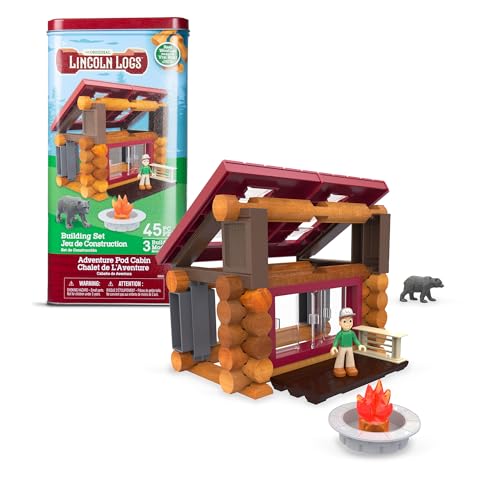
Notched wooden logs that stack crosswise into cabins, fences and forts. In our data, Lincoln Logs sets include the Oak Creek Lodge 137 Pieces, the Collector's Edition Village Set 327 Pieces and the Centennial Edition Tin, all listed 3+, plus the 100th Anniversary Tin, Beechwood Retreat and Adventure Pod Cabin. One more set, Lincoln Logs On The Trail, lists 3+; on Amazon its brand line shows K'NEX, but the set name says Lincoln Logs.
Logs are a good pick for a kid who likes to build a place, not a thing. A cabin has rooms. Rooms need people. The play starts after the roof goes on.
Who should skip wooden blocks
Skip a big wooden set if you don't have floor space and somewhere to store it. Wood is heavy, and a few hundred blocks need a box with a real bottom.
Skip plain blocks for a kid who wants to follow steps to a finished model. A brick building set with a booklet suits that kid. Skip them too for a kid who wants things to snap and hold. Magnetic tiles do that, at the age on their label.
And skip balance games for the youngest builders. A toddler doesn't want to take turns with a tower. A toddler wants the tower.
Small parts and wooden blocks
Check the age label on the listing. Toys with small parts are a choking hazard for children under 3. The CPSC bans small parts in toys made for children under 3, so a set labeled for a 1- or 2-year-old should have pieces sized for that age.
The risk comes from mixing sets. Older kids' wooden sets, puzzle blocks and log sets can have small pieces, pegs or roof slats. If a toddler shares the house, keep the older sets in a lidded bin up high. Check wooden toys now and then for cracks, splinters or loose parts, and throw away packaging once the box is open, as the CPSC advises.
Where to go next
For the youngest builders, the gifts for 3-year-olds page checks every pick against the age label, and gifts for kids covers older ages. The building toys section has every other kind of building set, including marble runs, which many wooden-block families add next.
Pick the style first. The wood will wait.
Brands in this list
Related
Questions people ask
What are unit blocks?
Unit blocks are plain hardwood blocks cut to fixed sizes that relate to each other. NSTA describes the basic unit as 1-3/8 by 2-3/4 by 5-1/2 inches, a 1:2:4 ratio, with other shapes based on it, and credits educator Caroline Pratt with creating them in 1913. Melissa & Doug's Standard Unit Blocks set is one example in our data.
What are the best wooden blocks for toddlers?
Start with the age label. In our data, 8 wooden block sets start under 2 and 15 start at 2. Toddler sets tend to be bigger, fewer pieces and simple shapes, like stacking toys and chunky blocks. Skip balance games and small-piece puzzle blocks until the label fits. Never buy a set for a child younger than its stated starting age.
Are ABC blocks good for toddlers?
ABC blocks are wooden cubes with letters, numbers or pictures on the sides. They stack like any block and give a grown-up something to name out loud. The Melissa & Doug Deluxe Wooden ABC 123 Number Blocks in our data list ages 2+. Check the listing for the finish and paint, and read the age before you buy for a younger child.
Do wooden building logs fit other log sets?
Only say yes when the listing says so. Building logs are notched wooden pieces that stack crosswise into cabins. In our data, Lincoln Logs sets list ages 3+, including On The Trail, whose Amazon brand line shows K'NEX. Some other makers advertise compatibility with Lincoln Logs, and we take that claim only from their listings.
Should wooden blocks be painted or natural?
Both are common. Natural blocks show the wood grain and are usually sanded smooth. Painted or stained blocks add color for sorting and naming. The schema tracks finish and wood species, but our data doesn't have those filled in yet for these listings, so read what the maker says about the finish before you buy for a young child.
Sources
- NSTA: Building Blocks, Building Skills and Memories — accessed 2026-10-23
- Melissa & Doug: Standard Unit Blocks — accessed 2026-10-23
- U.S. Consumer Product Safety Commission: Small Parts for Toys and Children's Products — accessed 2026-10-23
- U.S. Consumer Product Safety Commission: Toys — accessed 2026-10-23