Board & Card Games · Type
Ludo: How the Board Game Plays and What's on Amazon US
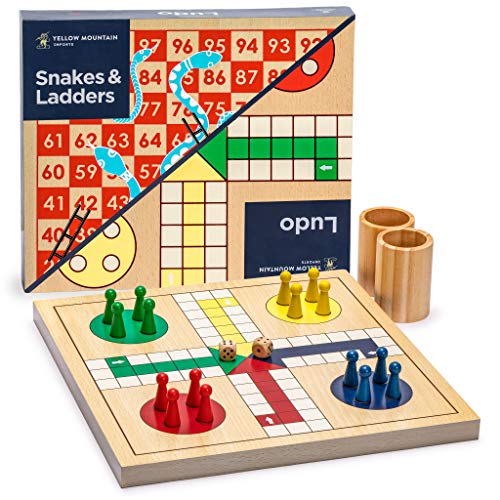
Ludo is a race game for 2 to 4 players: four pieces each, one die, and the first player to bring all four pieces home wins. You need a 6 just to get a piece onto the board, which makes Ludo the only game I know where the hardest roll is the first one. Our Amazon US data has one Ludo set right now, a wooden 2-in-1 board with Snakes and Ladders on the other side.
We earn a commission if you buy through our links, at no cost to you. Disclosure
| Model | Players (min) | Players (max) | Amazon |
|---|---|---|---|
Yellow Mountain Imports 2-in-1 Snakes and Ladders Ludo SetBoard & family games More specs
| 2listing | 4listing | Check price |
What’s in this listEditions and versions of Ludo sold on Amazon US, matched by the name on the listing. Players, age and play time come from the box or listing. “—” means neither the maker nor the Amazon listing states it.
What Ludo is
Ludo is a race. Each player has four pieces waiting in a colored base in one corner of a square board. A track runs around the board, and each color has its own home column that leads to the center. You roll one die, move one piece, and try to bring all four of your pieces around the track and into the home triangle in the middle. First player home with all four wins.
That's the whole goal. What makes it a game is the traffic. Every color shares the same track, so pieces land on each other, send each other back to base, and park in each other's way. Ludo looks polite on the box. On the board it's a little less polite.
Here's the table version of the basic facts, from the Yellow Mountain Imports rules page:
- Players: 2 to 4
- Pieces: four per color, starting in that color's base
- Dice: one
- Goal: all four pieces into the home triangle
- Turn order: highest roller starts, then play goes clockwise
- Ending: the first player home wins, and the rest can keep playing for second and third
The page doesn't print an age or a play time, and neither does the one Ludo listing in our data. I won't guess at either.
How Ludo plays
The rules below are in my own words, from the "How to Play Ludo" page published by Yellow Mountain Imports, the maker of the set in our table. It's a short page, so it covers the core game and leaves a few corner cases open. I'll point those out as we go, because that's where most table arguments start.
Setting up
- Open the board to the Ludo side. On the 2-in-1 set, the other side is Snakes and Ladders.
- Each player picks a color and puts all four pieces of that color in the matching base.
- Everyone rolls the die once. The highest roll goes first.
- Play moves clockwise from there.
With 2 or 3 players, the empty bases just stay empty. The track doesn't change.
Getting out of the base
A piece can't leave its base until you roll a 6. When you do, the piece moves to the start space, which is the first colored square just outside your base. Until at least one of your pieces is out, nothing else you roll does anything. You roll, you shrug, you pass the die.
This is the part of Ludo that tests patience. I teach middle-school math, so I'll do the arithmetic once: the chance of a 6 on any roll is 1 in 6. On average, that means about six rolls before your first piece gets out. Some nights it takes two rolls. Some nights it takes fourteen. An average is a long-run promise, not a promise about tonight.
A normal turn
Once you have a piece on the track, every roll counts:
- Roll the die.
- Pick one of your pieces that's out of the base.
- Move it forward, clockwise, exactly the number you rolled.
You move one piece per roll, not split moves across two pieces. If you have three pieces out, you choose which one goes. That choice is most of the strategy in Ludo.
What a 6 does
A 6 is the best roll in the game, for three reasons:
- It's the only roll that brings a new piece out of the base.
- You can use it to move a piece that's already out instead.
- You roll again after you move.
There's a limit. If you roll three 6s in a row, you lose your turn. I like that rule. It's the game's way of saying one person has had enough luck for now.
Captures
If your piece ends its move on a space with an opponent's piece, that piece goes back to its base. Its owner now needs another 6 to bring it out again. After all that waiting for a 6, getting sent back home stings, and everyone at the table knows exactly how much.
Captures are why Ludo isn't just a dice race. A piece sitting a few spaces in front of an opponent is in danger. A piece sitting a few spaces behind an opponent is a threat. Reading those distances is the skill.
Blocks
If one of your pieces lands on a space that already holds another of your own pieces, that space becomes a block. Opponents can't land on a block, and they can't move past it. A block is a traffic jam you're allowed to cause on purpose.
The maker's page doesn't say when or how a block has to break up. Some players leave a block in place as long as they like. Others say a block can't stay put forever. Decide this before the first roll, write it down, and you'll save yourself a long argument on move 40.
Going home and winning
When a piece has gone all the way around the track, it turns into its own color's home column and heads for the center. It enters the home triangle only on an exact roll. If you need a 3 and you roll a 5, that piece can't finish on that roll. The page doesn't say whether you can use the roll on another piece, so agree on that up front too. Most tables I know let you move a different piece if you have one.
The first player with all four pieces in the home triangle wins. The page says the others can keep going to settle second, third and fourth place, which keeps everyone at the table until the end.
What to decide before the first game
The short rules page leaves a few things open. These are the ones worth settling out loud before anyone rolls:
- Whether a block can stay in place for as long as its owner wants
- What happens to a roll you can't use, like a 5 when your only piece needs an exact 3
- Whether an opponent's piece is safe on its own start square
- Whether you must move if you have a legal move, even a bad one
None of these come from the maker. They're questions, not rules. Pick an answer for each and tell the whole table. A game where everyone knows the rule is a game. A game where one person learns it mid-turn is a debate.
House rules some tables use
These are house rules, not printed rules. Use them if they help your table and ignore them if they don't.
- House rule: start with one piece out. Every player puts one piece on its start square before the first roll. The game gets going sooner, which helps with younger players.
- House rule: a 1 also gets you out. This roughly doubles the chance of leaving the base on any roll. It shortens the game a lot.
- House rule: no stacking blocks at the home entrance. Some tables don't allow a block right in front of another color's home column, so nobody gets stuck there all night.
My advice: try the printed rules first. The wait for a 6 is part of what makes Ludo feel like Ludo. Add a house rule only once you know which part your table doesn't enjoy.
Ludo sets on Amazon US right now
Our data for this page lists one Ludo set on Amazon US as of October 2026. It was matched by the name on the listing, and the table above shows what that listing states.
- Yellow Mountain Imports 2-in-1 Snakes and Ladders Ludo Set. The listing says 2 to 4 players and a wooden set. It isn't an expansion, and it isn't marked as resale stock.
The maker's own page for its 2-in-1 reversible wooden set describes a board with Snakes and Ladders on one side and Ludo on the other. That's two games in one box. If you have a younger player who isn't ready to think about which piece to move, the Snakes and Ladders side is pure dice and counting. When they're ready for choices, flip the board. Our Snakes and Ladders page covers that game.
The listing doesn't give an age or a play time, and I won't fill those gaps in. If those numbers matter to you, check the listing again before you buy, because a listing can add details later.
One Ludo set in our data doesn't mean the game is rare. It means that, on the day our data was collected, only one listing used the Ludo name in a way our matching could confirm. Plenty of race games in the same family are sold under other names, which is the next section.
Ludo's family: Parcheesi, Sorry, Trouble and Aggravation
The Yellow Mountain Imports page says Ludo comes from Pachisi, an old Indian game, and that Ludo in turn inspired Parcheesi and Sorry. You can see the family resemblance on the board: a shared track, a base for each color, a home stretch, and pieces that bump each other back to start.
Here's how I'd think about the relatives, using our own pages:
- Parcheesi: the closest cousin by name and history; read its rules sheet for how entering and blocking work there
- Sorry: the same race-and-bump idea, driven by cards instead of a die
- Trouble: a race game with a die in a plastic bubble, so nobody rolls it off the table
- Aggravation: marbles on a track, with shortcuts through the middle
If your table likes Ludo, one of these is usually the next box. If your table finds Ludo too slow at the start, Sorry and Trouble are worth a look, because how a piece gets out of the base works differently in each. Check each game's page for the details.
Who Ludo suits
Ludo fits a table that wants a short list of rules and a lot of small decisions. The whole game can be taught in a few minutes. You roll, you pick a piece, you move. After that, the game teaches itself, because the first capture explains captures better than I can.
It works well for:
- Mixed ages, once the youngest player can count spaces to six
- A group of exactly 2, 3 or 4, since the board seats four colors
- Families that want a game with some luck in it, so the youngest player has a real chance to win
- Anyone who already likes Sorry or Parcheesi and wants the older, simpler shape of the game
The wooden 2-in-1 set adds one more reason: two games on one board. That's handy for a travel bag or a small game shelf.
Who should skip Ludo
Skip it if your group wants a game with no luck in it. Every Ludo game depends on the die, starting with the wait for a 6. A careful player can still lose to a lucky one, and some players don't enjoy that.
Skip it too if you have five or more players. The board has four bases, and no set in our data says otherwise. For a bigger group, look at our family board games page for boxes that seat more people.
And skip it for now if you have a child under 3 in the house who puts things in their mouth. The pieces and the die are small parts. Check the age label on the listing. Toys with small parts are a choking hazard for children under 3.
If you like Ludo, look at these
Picked by what they share with Ludo: a track, a die or a draw, and pieces you can send back to start.
- Snakes and Ladders: the other side of the 2-in-1 board, with no choices at all
- Parcheesi: Ludo's closest relative on the shelf
- Sorry: race and bump, with cards
- Chutes and Ladders: an easy first race game for younger players
- Classic board games: the wider shelf of older games that are still in print
Roll for a 6, then roll with whatever the die gives you.
Related
Questions people ask
How many players can play Ludo?
Two to four. The Yellow Mountain Imports rules page sets the game up for 2 to 4 players, each with four pieces in a colored base, and the 2-in-1 Snakes and Ladders and Ludo set in our data lists 2 to 4 players too. With 2 players, each person plays one color and the other two bases stay empty.
What do you need to roll to start in Ludo?
A 6. On the maker's rules page, a piece leaves its base only on a 6, and you can't move anything else until at least one piece is out. A 6 also gives you an extra roll after you move. Roll three 6s in a row, though, and you lose the turn.
Is Ludo the same as Parcheesi?
They're relatives, not twins. Yellow Mountain Imports says Ludo comes from the old Indian game Pachisi and that it inspired Parcheesi and Sorry. All of them are race games around a cross-shaped or square track with a home stretch. The rules for entering, blocking and capturing differ from game to game, so read the sheet for the box you own.
Is Ludo luck or strategy?
Mostly luck, with real choices. The die decides how far you go, but you decide which piece moves. That choice lets you capture, dodge a capture, build a block or race one piece home. Over a few games, the player who thinks about those choices wins more often than the one who always moves the front piece.
What age is Ludo for?
The one Ludo set in our Amazon US data doesn't list an age, so we can't quote one. The pieces and the die are small parts. Check the age label on the listing before you buy, and keep the set away from children under 3. Players need to count to six and follow a turn order.
Sources
- Yellow Mountain Imports: How to Play Ludo — accessed 2026-10-23
- Yellow Mountain Imports: 2-in-1 Reversible Wooden Snakes and Ladders, Ludo Game Set — accessed 2026-10-23
- CPSC: Small Parts Ban and Choking Hazard Labeling — accessed 2026-10-23