Board & Card Games · Type
Parcheesi Game: Rules, Blockades and Editions
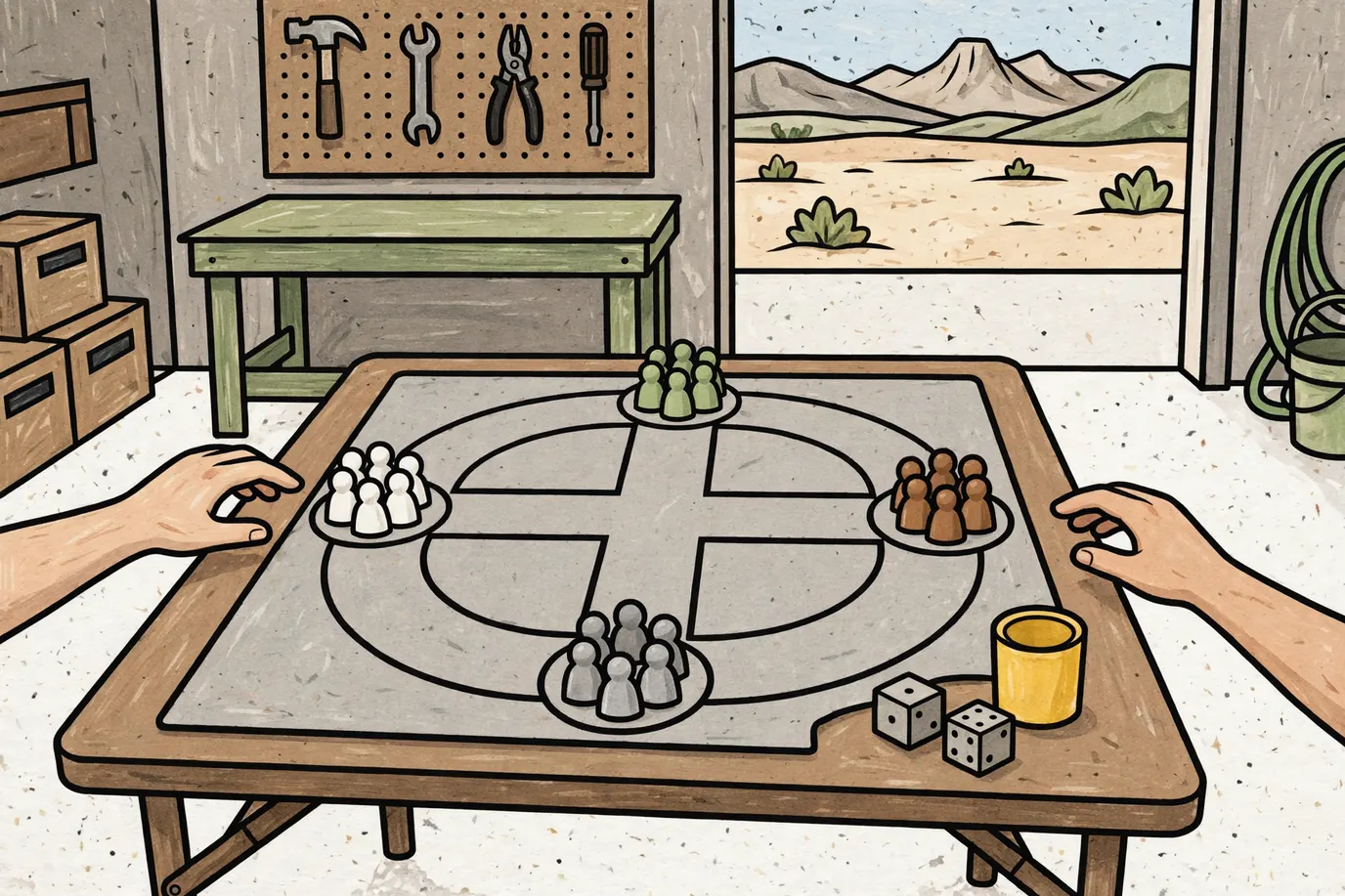
The Parcheesi game is a race for 2 to 4 players: each of you moves four pawns from a Start circle, around the board and up a Home Path, and the first to get all four home wins. You need a 5 to get a pawn out, doubles roll again, and two pawns of one color can wall off the track. The Parcheesi editions on Amazon US run from Milton Bradley boxes from 1975 and 1989 to the Winning Moves Royal Edition. It's the only race I know where parking is a strategy.
We earn a commission if you buy through our links, at no cost to you. Disclosure
| Model | Players (min) | Players (max) | Play time (min) | Play time (max) | Amazon |
|---|---|---|---|---|---|
Milton Bradley Parcheesi 1989 EditionBoard & family games More specs
| 2listing | 4listing | — | — | Check price |
Winning Moves Parcheesi Royal EditionBoard & family games More specs
| 2listing | 4listing | 45 minlisting | 45 minlisting | Check price |
Milton Bradley Deluxe Parcheesi (1999)Board & family games More specs
| — | — | — | — | Check price |
Milton Bradley Parcheesi 1975 EditionBoard & family games More specs
| — | — | — | — | Check price |
Winning Moves Parcheesi Royal EditionBoard & family games More specs
| — | — | — | — | Check price |


What’s in this listEditions and versions of Parcheesi sold on Amazon US, matched by the name on the listing. Players, age and play time come from the box or listing. “—” means neither the maker nor the Amazon listing states it.
What the Parcheesi game is
Parcheesi is a roll-and-move race. Each player has four pawns. They start in a circle off the track, come onto the board, travel around it, turn up a colored lane called the Home Path, and finish in the Home square in the middle. First to get all four pawns Home wins.
What makes it more than a race is what you can do to each other on the way. You can land on an opponent and send that pawn back to Start. You can park two of your pawns on one space and block the whole track. And you can choose which of your pawns each die moves, so every roll is a small decision instead of a simple count.
Here's the table version of the box facts, from the rules sheet and our listing data:
- Players: 2 to 4
- Age: the listings in our data don't state one
- Play time: 45 minutes on one Royal Edition listing, not given elsewhere
- Contents on the rules sheet: game board, 16 pawns in 4 colors, 2 dice, 1 dice cup
- Co-op or competitive: competitive, every player for themselves
- Expansions: none in our data
How Parcheesi plays
The rules below are in my own words from the Parcheesi rules sheet that Hasbro hosts on its instructions site under item 40337. The sheet is a Milton Bradley printing with copyright years 1959, 1967, 1975 and 1989. Hasbro's page for that item describes a 20 by 20 inch board, pawns in tiger, elephant, water buffalo and camel designs, and 2 wooden dice. If your box is a Winning Moves Royal Edition, I couldn't open that publisher's own rules online, so check the rules that come with the box for any differences.
Setup
- Each player picks a color and takes the four pawns.
- Find the path space with a circle in your color. That's your entry space.
- Put your four pawns in the Start circle to the right of it.
- Sit so your Start circle is on your right.
Everyone rolls both dice. The high roll goes first, and play passes to the left.
Getting pawns out of Start
A pawn sitting in Start isn't in the race yet. To bring one onto your entry space, you need a FIVE. That can mean a 5 on one die, a 5 on each die, or two dice that add up to 5, which is 4 and 1 or 3 and 2.
If you can enter a pawn, the sheet says you must. If you roll a 5 and can't enter, you can use it to move instead. In the first few rounds this rule controls everything. Some turns you roll a 6 and a 6 and stare at a board with nothing on it. (The dice feel that 12 is plenty. The rules disagree.)
Moving
Pawns travel counterclockwise along the path. Each die is its own move. You can:
- move one pawn by both dice, one after the other
- split them, one die per pawn
You have to move if any move is legal. If you can use only one die, you move by that one. No more than two of your own pawns can share a space.
Doubles, the bonus and the penalty
Doubles always earn another roll. Before all four of your pawns are on the board, you take your turn as normal and then roll again.
Once all four are out, doubles get bigger. You use the tops and the bottoms of both dice, a four-part move that always adds up to 14. You can give all of it to one pawn or split the four parts across two or more. If you can't use all four parts, you don't move at all, but you still roll again.
I teach middle-school math, and this rule is my favorite thing in the box. Opposite faces of a standard die always add up to 7. Two dice, tops plus bottoms, is 7 plus 7. The sheet doesn't explain why it's always 14. It just trusts you. I put it on a warm-up slide once, and a seventh grader asked if Parcheesi was going to be on the test.
The third doubles in a row is a different story. You don't move. Your pawn closest to Home, even if it's on your Home Path, goes back to Start, and your turn ends. The game has decided you've had enough luck for one evening.
Capturing
Land on an opponent's pawn by the count of either die and you capture it. That pawn goes back to its Start circle and has to come out again on a 5.
Pawns can't be captured on their Home Path or on safety spaces, with one exception. If an opponent sits on your entry space when you bring in a new pawn, that pawn gets captured.
Each capture pays a bonus: one of your pawns moves 20 extra spaces at the end of your turn. If no pawn can move the full 20, the bonus is lost. So a capture is a double hit. Somebody goes home, and you get a head start.
Safety spaces and blockades
The blue spaces on the track, including every entry space, are safety spaces. Two pawns of different colors can never share one.
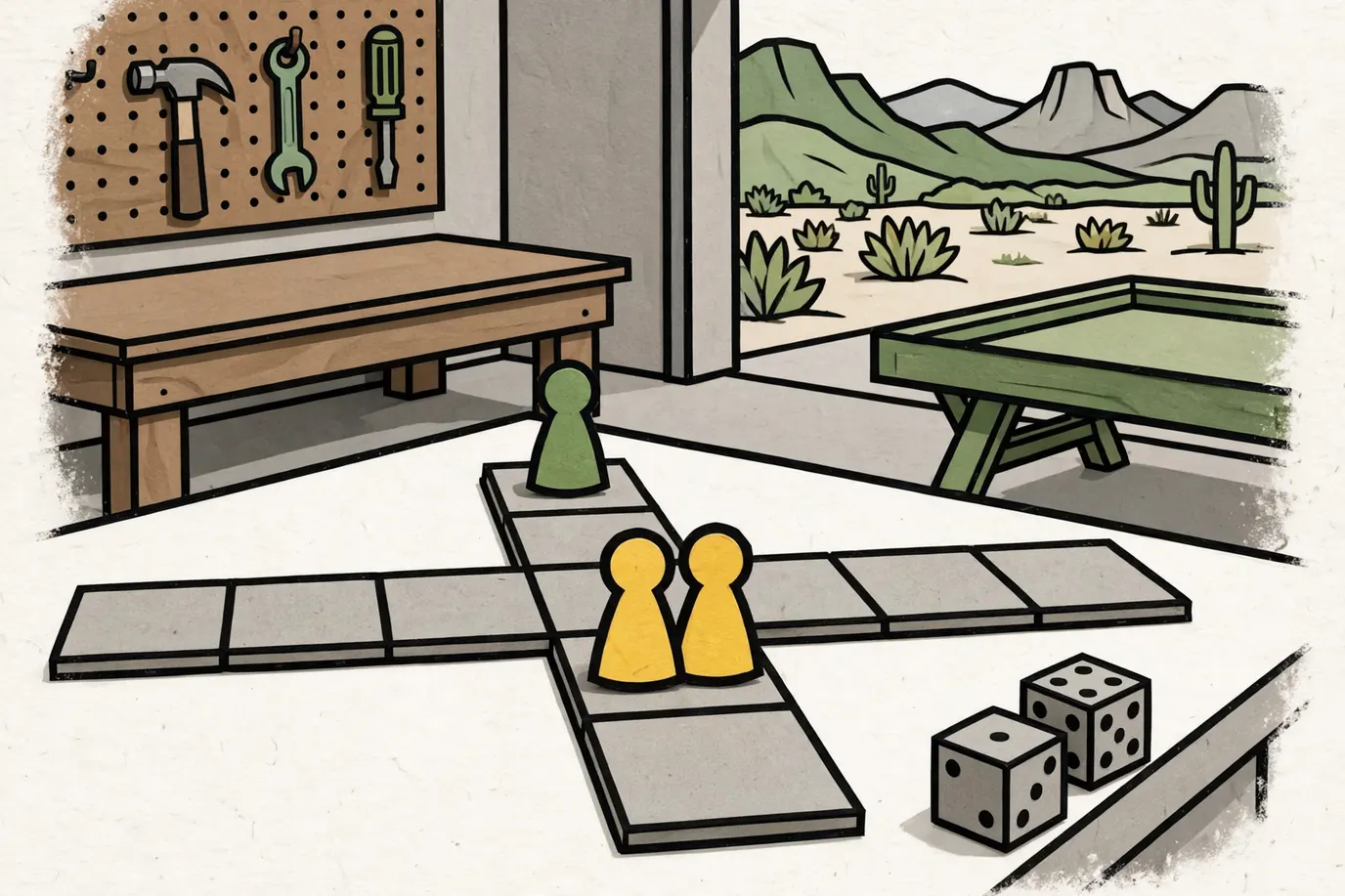
A blockade is two pawns of the same color on any one space of the path. Nobody can land on it or move past it, your own pawns included. If a blockade sits on your entry space, you can't bring a pawn in until it moves. You may have to break your own blockade if nothing else can move, and the two pawns can't march forward together to set up the same wall on a new space.
Lucho's take: "A blockade is a lane closure. There's always somebody behind it who thinks the cones don't apply to them."
Reaching Home and winning
Your Home Path is the colored lane in front of you, and no one else may move onto it. A pawn has to reach the Home square by exact count, and the Home square itself counts as a space. When a pawn gets Home, you collect a bonus of 10 spaces for any one pawn at the end of the turn, again only if a pawn can use all 10.
The first player with all four pawns Home wins.
Parcheesi editions on Amazon US right now
Our data for this page lists five Parcheesi listings on Amazon US as of October 2026. The table above shows players and play time wherever a listing states them. A dash means the listing leaves it out, and I won't fill it in. Here's what separates them.
Milton Bradley boxes from 1975 and 1989
Two listings carry a year in the name.
- Parcheesi 1975 Edition (Milton Bradley). Marked as resale stock. The listing gives no players, age or play time.
- Parcheesi 1989 Edition (Milton Bradley). Also marked as resale stock. It lists 2 to 4 players and names the contents: a game board, 16 wooden pawns, 2 dice and a dice cup.
Those 1989 contents match the list on the rules sheet above, and the sheet's copyright line includes both 1975 and 1989. That's as far as the data goes. Resale stock is somebody's earlier copy, so read the condition notes on the listing before you count on every pawn being in the box.
Deluxe Parcheesi (1999)
A Milton Bradley listing named Deluxe Parcheesi, with 1999 in the name and "deluxe" as the edition. It isn't marked as resale stock. The listing doesn't give players, contents or play time, so I can't tell you what the deluxe part covers. If that matters, the photos and the item description on the listing are the place to look.
Parcheesi Royal Edition (Winning Moves)
Two listings carry the Royal Edition name from Winning Moves, and neither is marked as resale stock. One lists 2 to 4 players, 45 minutes and roll-and-move as the kind of game. The other gives no details beyond the name. Both titles say the same edition, so compare the photos and the seller line before you choose between them.
If you want a current, sealed copy rather than a piece of game-closet history, the Royal Edition listings are the ones in our data that aren't marked as resale.
Which Parcheesi edition fits your table
Start with your head count. Every Parcheesi listing that gives a count says 2 to 4, and the rules sheet has no way to seat a fifth. If game night at your house is five or six people, Parcheesi is the wrong box no matter which edition you pick. The fifth person ends up rolling the dice for everyone else.
For two to four, here's how I'd sort it:
- You want a copy to play this weekend: a Winning Moves Royal Edition listing
- You want the box you grew up with: the 1975 or 1989 Milton Bradley listing, read as resale
- You want wooden pawns: the 1989 listing is the one that names them
- You're curious about the 1999 Deluxe: check its photos first, since the listing is thin
Pawns and dice are small parts. Check the age label on the listing. Toys with small parts are a choking hazard for children under 3.
House rules for a friendlier table
These are not in the rules sheet. They're optional, and they're ours.
- Skip the third-doubles penalty with young players. A pawn going back to Start from the Home Path is a hard lesson for a first game.
- Play with two pawns each. The race is half as long, and it's a fair way to teach the entry rule before the full game.
- Call blockades out loud. Newer players often miss that a wall stops their own pawns too.
Agree on them before the first roll. A rule announced after a capture always sounds like a complaint.
Who should skip Parcheesi
Skip it if your group wants a game with no luck in it. Every turn starts with two dice, and the early rounds can stall while you wait for a 5. Players who like full control will be happier with a game like chess or checkers.
Skip it too if anyone at your table takes being sent home personally. Capturing is the heart of the game, and the 20-space bonus rewards it. Some families love that. Some need a quieter evening. And if your crowd is usually five or more, look at a party game instead.
If you like Parcheesi, look at these
Pages chosen by what they share with Parcheesi: a race home, pawns that can be sent back, and 2 to 4 players.
- Ludo: another four-pawn race home
- Sorry: pawns, a race and sending people back to Start
- Trouble: a race with a pop-up die
- Aggravation: marbles, a track and captures
- Classic board games: the wider shelf of old standards
Three of the five listings carry the Milton Bradley name. See the Milton Bradley brand page for the rest of that lineup, and Hasbro for the company that now hosts the rules sheet.
Roll for a five. Everything else can wait.
Brands in this list
Related
Questions people ask
How many players can play Parcheesi?
Two to four. The Milton Bradley rules sheet that Hasbro hosts says 2 to 4 players, and every Parcheesi listing in our data that gives a player count says the same: the 1989 Milton Bradley edition and one of the two Winning Moves Royal Edition listings. Each player takes one color and four pawns. The rules sheet has no team or partner mode.
How long does a game of Parcheesi take?
One Winning Moves Royal Edition listing gives 45 minutes. The other listings in our data don't give a time, and the rules sheet doesn't either. In practice the clock depends on how many of you play, how often pawns get captured and sent back, and whether anyone builds blockades. Four players who capture a lot will run long.
What do you need to roll to start a pawn in Parcheesi?
A 5. On the Milton Bradley rules sheet, a pawn enters the board only on a FIVE: a 5 on one die, a 5 on both dice, or two dice that add up to 5, like 4 and 1 or 3 and 2. If you can enter a pawn, you must. A FIVE you can't use to enter can be used to move a pawn already on the track.
What is a blockade in Parcheesi?
Two pawns of the same color on one space of the path. On the rules sheet, no pawn of any color can land on a blockade or pass it, and if one sits on your entry space you can't bring a new pawn in. You can be forced to break your own blockade if no other move is possible, and the two pawns can't move forward together to rebuild it on a new space.
What happens if you roll doubles three times in Parcheesi?
On the third doubles in a row you don't move at all. The rules sheet calls it the Doublets Penalty: your pawn closest to Home goes back to your Start circle, even from the Home Path, and your turn ends. It has to be entered again later with a 5, like any other pawn waiting at Start.
Sources
- Hasbro: Classic Parcheesi Game instructions (40337) — accessed 2026-10-23
- Hasbro: Parcheesi game rules sheet, Milton Bradley, 40337 (PDF) — accessed 2026-10-23
- CPSC: Small Parts for Toys and Children's Products — accessed 2026-10-23