Board & Card Games · Type
Trouble Game: Rules, Pop-O-Matic and Editions
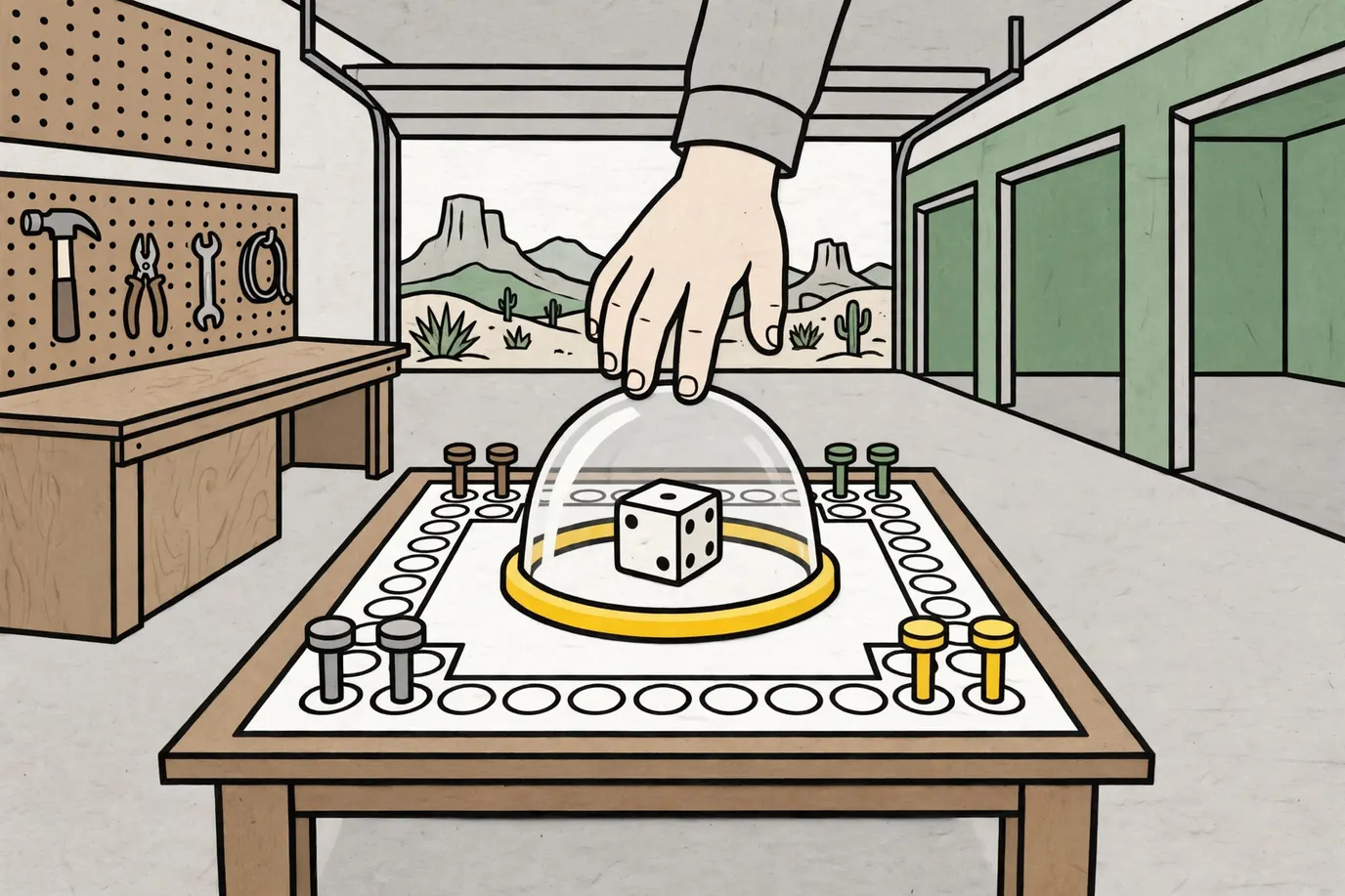
The Trouble game is a race for 2 to 4 players, ages 5+ on every box we track: pop the die in the plastic bubble, move four pegs around the track and into your Finish zone before anyone else. Land on a rival and you send that peg home. There are six Trouble editions on Amazon US in our data, from Hasbro's board to a travel case and a vintage-style reissue. It's the loudest die in the game closet, and the only one that can't escape.
We earn a commission if you buy through our links, at no cost to you. Disclosure
| Model | Play time (min) | Play time (max) | Amazon |
|---|---|---|---|
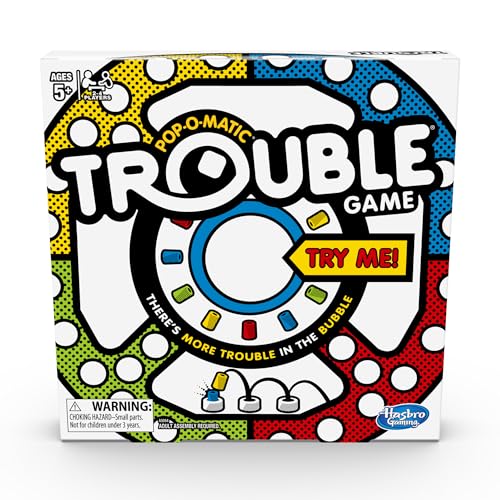
Hasbro TroubleBoard & family games More specs
| — | — | Check price |
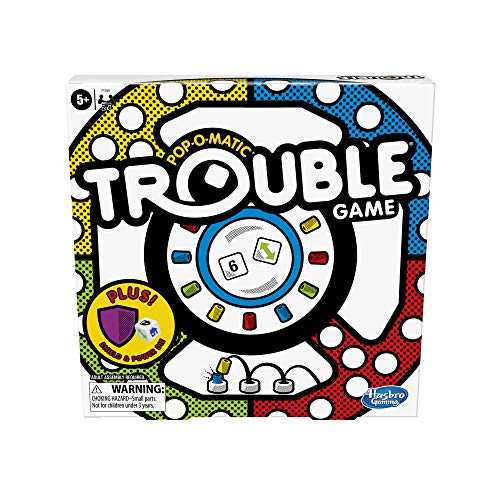
Hasbro Trouble with Bonus Power Die and ShieldBoard & family games More specs
| — | — | Check price |
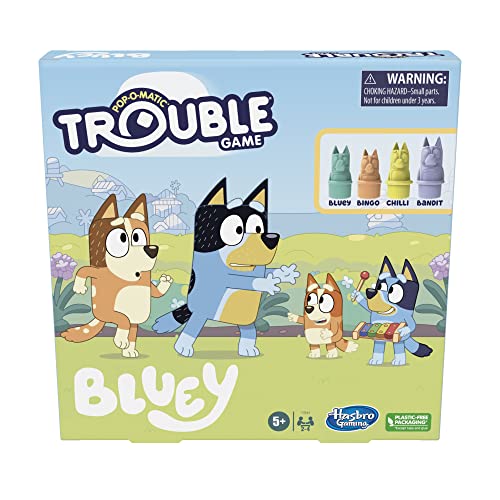
Hasbro Trouble Bluey EditionBoard & family games More specs
| — | — | Check price |
Hasbro Pop-O-Matic Trouble Grab and Go B1003Board & family games More specs
| — | — | Check price |
Winning Moves Classic TroubleBoard & family games More specs
| 30 minlisting | 30 minlisting | Check price |
WS Game Company Trouble Vintage Bookshelf EditionBoard & family games More specs
| — | — | Check price |


What’s in this listEditions and versions of Trouble sold on Amazon US, matched by the name on the listing. Players, age and play time come from the box or listing. “—” means neither the maker nor the Amazon listing states it.
What the Trouble game is
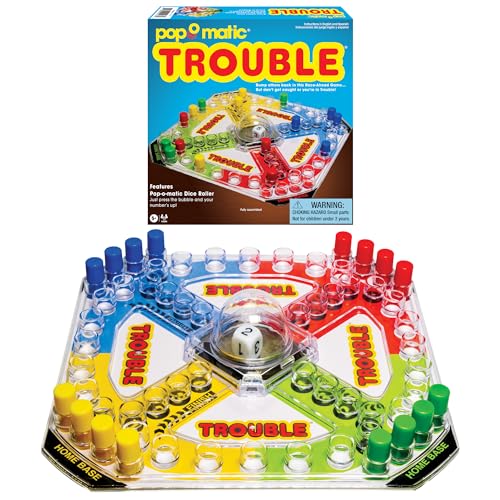
Trouble is a race-and-chase board game from Hasbro. Each player has four pegs in one color. They start in a Home area, enter the track at Start, run once around the board, and finish in a short lane in front of Home. First player with all four pegs in Finish wins.
Two things make it Trouble and not some other race game. The first is the Pop-O-Matic: a clear bubble in the middle of the board with the die sealed inside. You press it, it pops, the die jumps. Nobody shakes a cup, nobody throws anything, and nobody crawls after a die that ran off the table. The second is the bump. Land on a rival's peg and it goes all the way back Home.
Here are the box facts for the editions on Amazon US, from the listings:
- Players: 2 to 4 on every edition
- Age: 5+ on every edition
- Play time: 30 minutes on the Winning Moves listing; the others don't say
- Kind of game: competitive, luck-driven, no reading needed to play
- Expansions: none listed
How Trouble plays
I'm working from two Hasbro rule sheets I could open on Hasbro's instructions site. One is the Trouble edition with the Power Die and Shield, item F1358. The other is the Trouble Grab and Go game, item F8254. Both use the same core rules, and I'll point out where they differ. This is my summary in my own words, not Hasbro's text.
Hasbro's page for its standard Trouble board (A5064) describes two kinds of special spaces, Double Trouble and Warp. The PDF it offers is a picture guide for first-time young players, not a full rule sheet, so I can't explain the Warp space from Hasbro's own words. If your board has Warp spaces, the sheet in your box is the one to follow.
Setup
Each player picks a color and puts four pegs in their Home spaces. The youngest player goes first, and play passes to the left. That's the whole setup. The Grab and Go sheet asks you to stick four color labels on the board the first time you play, and the F1358 board takes four rubber feet. After that, it's open the lid and press.
Getting out of Home
You need a 6 to move a peg from Home onto your Start space. Both sheets add a second way out that I like a lot: when another player pops a 1, they can't move, but every other player gets to bring a peg out to Start. One roll, three people helped, one person sulking.
There's a limit. You can't bring a new peg onto Start if a peg is already sitting there. In the Grab and Go sheet that means your own peg. In the F1358 sheet it's any peg, yours or a rival's. The Grab and Go sheet has a name for parking your own peg on your own Start: you've blocked yourself. It's the one traffic jam in the game you can't blame on anyone.
A turn, roll by roll
- Pop a 1: you don't move; everyone else may bring a peg out.
- Pop 2, 3, 4 or 5: move one peg already on the track that many spaces.
- Pop a 6: bring a peg out to Start, or move a track peg 6. Then pop again.
You only get one bonus pop per turn. Pegs move clockwise. You can't land on your own peg. If that's your only legal move, you lose the turn.
Bumping
Land exactly on a space where a rival's peg sits and that peg goes back to its Home. Your peg takes the space. That's the "trouble" in Trouble. It's also why nobody's lead is safe until the last peg is in.
Finishing
A peg has to go once around the track before it can enter its Finish lane. In both Hasbro sheets I read, you don't need an exact count. When your peg reaches your lane, it moves into the first open Finish space closest to the bubble. The first player with all four pegs in Finish wins.
The Power Die and Shield edition
The F1358 edition puts two dice in the bubble. One is a regular number die. The other is a symbol die that changes what the number does. From the rule sheet:
- Double Trouble spaces: land on one and take another turn. If you already popped a 6, you still get only one extra turn.
- A plus-one symbol: add 1 to your number if you want to.
- A move-and-enter symbol: move a track peg by the number, then bring a peg out to Start if Start is clear.
- The shield symbol: take the cardboard shield. While you hold it, your pegs can't be bumped. If someone else pops the shield, it goes to them.
- A backward arrow: move any one peg forward or backward by the number. You can even back into your Finish lane.
The shield is a nice change for a younger table. A kid who keeps getting bumped gets a turn or two of protection, and it moves around by luck, not by who's oldest. The sheet adds one more rule: if you hold the shield and a rival's only move would land on your peg, they lose that turn.
Trouble editions on Amazon US
The product table on this page lists every Trouble listing we track. All six say 2 to 4 players and 5+. Here's what tells them apart, from the listings.
Hasbro boards
- Trouble (Hasbro): the standard board with the Pop-O-Matic. Hasbro's page for it (A5064) lists a gameboard, the plastic game unit with the die roller and 16 pegs.
- Trouble with Bonus Power Die and Shield (Hasbro): the two-dice edition described above. Hasbro's page lists a gameboard, 16 pegs, a cardboard shield with a stand and 4 rubber feet.
- Trouble Bluey Edition (Hasbro): listed with the Bluey line on the box, 2 to 4 players, 5+. The listing doesn't describe any rule changes, so I won't add any.
For the road
Pop-O-Matic Trouble Grab and Go (Hasbro, B1003) is listed as a travel edition. Hasbro's instruction page for B1003 describes a smaller board with the die roller and a cover. The rule sheet I read is the newer Grab and Go version, F8254, which lists a gameboard, a cover, 16 pegs and a label sheet, and says the pegs go back into the Finish zones with the cover on for storage. Pegs stored in their own holes is the kind of feature you appreciate at a rest stop.
Other makers
- Classic Trouble (Winning Moves): listed as the classic edition, 2 to 4 players, 5+, and the only one in our data with a play time: 30 minutes.
- Trouble Vintage Bookshelf Edition (WS Game Company): listed as a retro reissue in a bookshelf-style box. Our data marks it as sold as a vintage-style item.
Winning Moves and WS Game Company print their own rule sheets, and I couldn't open either one on the makers' sites. Read the sheet in the box for things like the exact-count rule, which is where house versions of Trouble tend to drift.
Which Trouble fits your table
A few quick matches, from the listings and the rule sheets:
- A first family copy: the standard Hasbro Trouble or Winning Moves Classic Trouble
- Kids who get bumped a lot and hate it: the Power Die and Shield edition, for the shield
- Car trips and hotel nights: Grab and Go, with the cover
- A shelf that shows its games: the Vintage Bookshelf Edition
- A Bluey household: the Bluey Edition, same 5+ label
Lucho's take, after watching the pegs go around: "Four pegs, one lane, no passing on the inside. That's a pit lane with better manners." He wasn't joking about the manners part. Trouble is a game where you send people home a lot, and the 5-year-olds handle it better than some adults I know.
Teaching Trouble to a 5-year-old
This is where Trouble earns its spot on the shelf. Almost nothing needs reading. A child who can count to 6 can play a full game.
Here's how I'd teach it, in order:
- Show the bubble. Let them press it a few times with no game going.
- Explain Home, Start and Finish by pointing, not by talking.
- Play the first game without bumping. Just race.
- Add bumping in game two.
Steps 3 and 4 are a house rule, not Hasbro's. Some kids love sending a peg home on the first try. Some kids are upset by it the first time it happens to them. You know which one you have. A no-bump warm-up game takes the sting out, and nobody has to explain why the rule suddenly changed halfway through.
Another house rule some tables use: count every space out loud as the peg moves. It's slow, but it settles "you skipped one" before it starts. Again, that's ours, not the rulebook's.
Who should skip Trouble
Skip it if your group wants choices that matter. Most turns have one or two sensible moves, and the die decides almost everything. For a 10-year-old who likes to plan, Sorry or Aggravation add more decisions to the same idea.
Skip it if your youngest is under 5. Every listing says 5+, and the pegs are small.
And skip it if somebody at your table takes being sent home personally. Trouble sends people home constantly. That's the game.
Check the age label on the listing. Toys with small parts are a choking hazard for children under 3.
If you like Trouble, look at these
Pages chosen by what they share with Trouble in our data: 2 to 4 players, a race around a track, and bumping rivals back to start.
- Sorry: cards instead of a die, and more ways to bump
- Aggravation: marbles, shortcuts and the same send-them-home idea
- Parcheesi: an older race game with two dice
- Ludo: the same family of race games, plain and quick
- Classic board games: the wider shelf of games most adults already know
Four of the six Trouble listings here come from Hasbro. See the Hasbro brand page for the rest of its lineup.
Press the dome, count every space, and send them home kindly.
Brands in this list
Related
Questions people ask
What age is the Trouble game for?
Every Trouble listing in our data says ages 5+, and Hasbro's instruction pages say the same. Hasbro's rule sheets also carry a small-parts warning: not for children under 3. The pegs are small. For a 3- or 4-year-old, wait for the age on the box, and check the age label on any edition before you buy.
How many players can play Trouble?
Trouble is 2 to 4 players on all six editions we track. Each player uses four pegs of one color. Hasbro's Grab and Go rule sheet adds a suggestion for two players: each person can play two colors of pegs. That keeps the board busy and gives more chances to bump.
What is the Pop-O-Matic in Trouble?
It's the clear plastic bubble in the middle of the board with the die sealed inside. You press the dome, it pops, and the die bounces and lands. Hasbro's pages describe it as the part that holds and rolls the die. The Power Die and Shield edition puts two dice in the bubble: a number die and a symbol die.
Do you need an exact roll to get into Finish in Trouble?
Not in the two Hasbro rule sheets we read. Both the Power Die and Shield edition (F1358) and the Grab and Go game (F8254) say you don't need an exact count. Your peg moves into the first open Finish space closest to the bubble. Older boxes and other makers' editions may print it differently, so check the sheet in your box.
How long does a game of Trouble take?
Only one listing in our data gives a time: Winning Moves' Classic Trouble says 30 minutes. The other listings don't say. A game ends when one player gets all four pegs home, so the clock depends on how often people get bumped back to start.
Sources
- Hasbro: Trouble with Power Die and Shield instructions (F1358) — accessed 2026-10-23
- Hasbro: Trouble rule sheet, F1358 (PDF) — accessed 2026-10-23
- Hasbro: Trouble Grab and Go Game instructions (F8254) — accessed 2026-10-23
- Hasbro: Trouble Grab and Go rule sheet, F8254 (PDF) — accessed 2026-10-23
- Hasbro: Pop-O-Matic Trouble Grab & Go Game instructions (B1003) — accessed 2026-10-23
- Hasbro: Trouble Game instructions page (A5064) — accessed 2026-10-23
- CPSC: Small Parts for Toys and Children's Products — accessed 2026-10-23