Board & Card Games · Type
Rummikub: The Tile Game, the Rules and the Editions
Rummikub is a tile game for 2 to 4 players in its classic box, ages 7+ or 8+ depending on the listing: you build runs and groups of numbered tiles, rearrange what's already on the table, and try to empty your rack first. The editions on Amazon US include the original set, large-number tiles, retro and travel tins, a six-player edition and a wooden vintage set. I teach middle-school math, and the scoring is the only score sheet I know that checks its own arithmetic.
We earn a commission if you buy through our links, at no cost to you. Disclosure
| Model | Recommended age | Players (max) | Play time (min) | Play time (max) | Amazon |
|---|---|---|---|---|---|
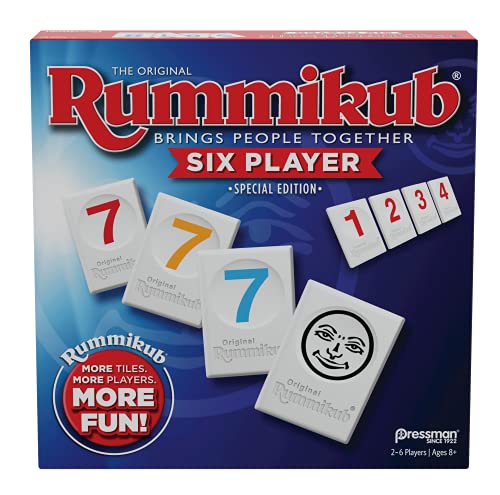
Pressman Rummikub Six Player EditionBoard & family games More specs
| 8+ yearslisting | 6listing | — | — | Check price |
Hasbro The Original RummikubBoard & family games More specs
| 7+ yearslisting | 4listing | 20 minlisting | 20 minlisting | Check price |
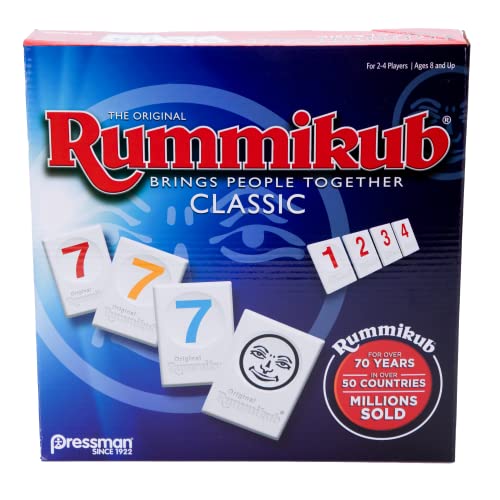
Pressman Rummikub The OriginalBoard & family games More specs
| 8+ yearslisting | 4listing | — | — | Check price |
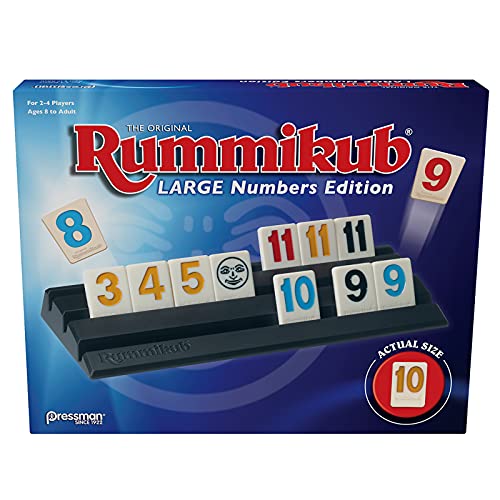
Pressman Rummikub Large Numbers EditionBoard & family games More specs
| 8+ yearslisting | 4listing | — | — | Check price |
Pressman Rummikub Retro Tin (Red)Board & family games More specs
| 8+ yearslisting | 4listing | — | — | Check price |
Pressman Rummikub Travel Tin (Blue)Board & family games More specs
| 8+ yearslisting | 4listing | — | — | Check price |
Pressman Original Retro Style Large Numbers RummikubBoard & family games More specs
| 8+ yearslisting | 4listing | — | — | Check price |
University Games Rummikub Vintage EditionBoard & family games More specs
| 8+ yearslisting | 4listing | — | — | Check price |



What’s in this listEditions and versions of Rummikub sold on Amazon US, matched by the name on the listing. Players, age and play time come from the box or listing. “—” means neither the maker nor the Amazon listing states it.
What the Rummikub game is
Rummikub is rummy played with tiles instead of cards. You hold tiles on a rack, lay them on the table in sets, and race to be the first to play your last one. The twist that makes it Rummikub is that the table belongs to everyone. Once you've opened, you can pull apart and rebuild any set on the table, as long as every set is legal when your turn ends.
The rules on this page come from the classic Rummikub rulebook on the maker's own site, rummikub.com. The rulebook carries the trademark line of M&M Ventures and names Lemada Light Industries in Israel as the manufacturer. The box facts, from that rulebook:
- Players: 2 to 4
- Ages: 7 to adult
- Tiles: 106 (numbers 1 to 13 in four colors, two of each, plus 2 jokers)
- Racks: 4
- Play: competitive, everyone for themselves
The same rulebook describes a set for 5 or 6 players that uses 160 tiles, 4 jokers and 6 racks. The rulebook doesn't print a play time. The Hasbro Original Rummikub listing in our data says 20 minutes; the other listings don't state one.
How Rummikub plays
Here's the classic game in my own words, from the maker's rulebook.
Runs and groups
There are two kinds of sets:
- A group: three or four tiles of the same number, each a different color
- A run: three or more numbers in a row, all the same color
The 1 is always the lowest number. It can't come after the 13. The number line doesn't wrap around in Rummikub, no matter how good a 12-13-1 looks at the end of a long night.
Setup
Turn all the tiles face down and mix them. Each player picks one tile; the highest number goes first. Put those back, mix again, and everybody takes 14 tiles for their rack. The rest form the pool. The rulebook suggests stacking the pool in piles of 7, which keeps the table neat and makes drawing faster.
Your first play: the 30-point opening
Before you can do anything else, you have to make an initial meld: one or more sets from your own rack that add up to at least 30 points. Each tile counts at its face value. You can't use tiles that are already on the table for this. A joker in your opening counts as the tile it stands for.
If you can't open, or don't want to, you draw one tile from the pool, and your turn is over. That's the rhythm for a while: open or draw.
A turn after you've opened
- Play new sets from your rack, add tiles to sets on the table, or rearrange the table.
- Every set on the table has to be legal at the end of your turn, with no loose tiles left over.
- If you can't play at least one tile from your rack, draw one from the pool and your turn ends.
A tile you just drew can't be played on the same turn. You wait until your next turn. The pool doesn't do same-day delivery.
Rearranging the table
The rulebook calls this manipulation and calls it the most exciting part of the game. I agree. You can add a fourth tile to a group, take a tile off the end of a run to start a new set, split a run in the middle with a tile from your rack, or pull tiles out of several sets at once to build new ones. Anything goes as long as the table is clean when you stop.
Lucho's take: "That's a rebuild on the bench. Borrow any part you like, as long as nothing is left over when you put the cover back on."
The jokers
There are two jokers, and each can stand in for any tile in a set. Once a joker is on the table, another player can take it back by replacing it with a tile that keeps the set legal. That tile can come from their rack or from the table. In a group of three, either missing color will do.
A retrieved joker has to be played again on the same turn in a new set, along with at least one tile from your rack. And you can't take back a joker until you've made your 30-point opening. The rulebook's strategy notes say keeping a joker on your rack can pay off, but a joker still on your rack when someone else goes out costs you 30 points.
The one-minute limit
The rulebook gives each player one minute per turn. Go over and you draw a tile, and your turn ends. If you started rearranging the table and can't finish in time, you put every tile back where it was, take back your own tiles, and draw 3 as a penalty. It's a strict rule, and it exists because rearranging the table is where a slow player can stall a whole evening.
Ending a game and scoring
A game ends the moment one player plays their last tile and calls out the name of the game. Everybody else adds up the tiles left on their rack, and that total becomes a negative score. The winner gets a positive score equal to all of those losses combined. If the pool runs out and nobody can play, the player with the lowest total on their rack wins the game.
Here's my math-teacher moment. Since the winner's points equal everyone else's losses, every game on the score sheet adds up to exactly zero. The rulebook even tells you to use that as a check. If your row doesn't sum to zero, somebody added wrong. My seventh graders call that a trick question. I call it the cleanest bookkeeping in the game closet.
Rounds and the overall winner
The rulebook groups games into rounds: with four players a round is four games, with three it's three, with two it's two. You can agree on how many rounds to play. At the end, the winner is the player who won the most games across all rounds. Points only break a tie. That surprised me the first time I read it, and it changes how you play the last game of a round.
My one opinion for this page: learn the 30-point opening before anything else. It's the rule new players trip on most, and the rulebook makes it the gate to everything fun: rearranging the table, taking back jokers, adding to other people's sets. Until you've opened, you're drawing tiles and watching.
Rummikub editions on Amazon US right now
Our data lists eight Rummikub listings on Amazon US as of October 2026. The table above shows players, age and play time where each listing states them; a dash means it doesn't.
The original set
- Hasbro, The Original Rummikub: ages 7+, 2 to 4 players, 20 minutes; the listing names 106 tiles and 4 racks
- Pressman, Rummikub The Original: ages 8+, 2 to 4 players
These two are closest to the rulebook above. The Hasbro listing is the one in our data that spells out the tile and rack count and the only one that lists a play time. It's also listed at 7+, a year younger than the Pressman boxes.
Large-number tiles
- Pressman, Rummikub Large Numbers Edition: ages 8+, 2 to 4 players
- Pressman, Rummikub Retro Tin (Red): ages 8+, 2 to 4 players; 106 large-number tiles in a tin
- Pressman, Original Retro Style Large Numbers Rummikub: ages 8+, 2 to 4 players; listed as a retro reissue
If anyone at your table reads numbers from across the table with reading glasses pushed up on their forehead, start with this group. The listings say large numbers; they don't give tile measurements, so check the photos.
Travel and six-player sets
- Pressman, Rummikub Travel Tin (Blue): ages 8+, 2 to 4 players, listed as the travel edition
- Pressman, Rummikub Six Player Edition: ages 8+, 2 to 6 players
The Six Player Edition is the only listing in our data that goes past 4 players. The maker's rulebook covers a 5-to-6-player set with 160 tiles, but the listing doesn't state its tile count, so I won't promise they're the same box.
A vintage set
- University Games, Rummikub Vintage Edition: ages 8+, 2 to 4 players, wooden components, marked as resale stock
It's the only listing in our data with wood named as the material. Because it's resale stock, check the condition and the seller's description before you buy it as a gift.
Rummikub tiles are small parts. Check the age label on the listing. Toys with small parts are a choking hazard for children under 3. The maker's rulebook carries that same warning for its set.
Who should skip Rummikub
Skip it if your group can't stand a quiet table. Some turns are a long stare at the middle while one player tries to rebuild four sets at once. The one-minute rule helps, but only if somebody holds the timer.
Skip it if you want team play. Rummikub is everyone for themselves. And skip it if you need more than 4 seats and don't want the six-player box. The classic set stops at 4 racks.
For younger kids, go by the listing. The ages on our listings start at 7 or 8. A younger child can sort tiles by color with you, but that's not the game on the box.
If you like Rummikub, look at these
Pages chosen by what they share with Rummikub: sets, runs, tiles and quiet arithmetic.
- Dominoes: tiles, matching and score-keeping
- Five Crowns: rummy-style melding with cards and a changing wild
- Phase 10: runs and sets in a card game with ten goals
- Qwirkle: another tile game where the shared table is the board
- Card games: the wider shelf for rummy-family games
Hasbro has one of the eight listings; see the Hasbro brand page for the rest of that lineup.
Fourteen tiles, thirty points to open, and a clean table when you stop.
Brands in this list
Related
Questions people ask
How many tiles are in Rummikub?
The classic rulebook from the maker lists 106 tiles: numbers 1 to 13 in four colors, two copies of each, plus 2 jokers. The Hasbro Original Rummikub listing in our data also says 106 tiles and 4 racks, and the Retro Tin listing says 106 large-number tiles. The same rulebook describes a 5- and 6-player version with 160 tiles and 4 jokers.
How many players can play Rummikub?
The classic game is 2 to 4 players, and seven of the eight listings in our data say exactly that. The Pressman Rummikub Six Player Edition lists 2 to 6. The maker's classic rulebook also describes a set for 5 or 6 players that uses 160 tiles and 6 racks, but the Six Player Edition listing in our data doesn't state a tile count.
How many points do you need to start in Rummikub?
Your first play, the initial meld, has to total at least 30 points, counting each tile at its face value. The points must come from tiles on your own rack, not from tiles already on the table. A joker in the initial meld counts as the value of the tile it stands for. Until you've made it, you can't add to other players' sets.
What is Rummikub Large Numbers Edition?
It's a Rummikub set listed by Pressman with large-number tiles, ages 8+, for 2 to 4 players. Our data has three large-number listings: the Large Numbers Edition, the Retro Tin (Red), which lists 106 large-number tiles in a tin, and the Original Retro Style Large Numbers set, listed as a retro reissue. The rules are the same game.
Is there a travel Rummikub?
Yes. The Pressman Rummikub Travel Tin (Blue) is listed as the travel edition, ages 8+, 2 to 4 players. Our data doesn't list its components or tile count. If the rules sheet in the tin differs from the classic rulebook described on this page, go by the sheet in the tin.
Sources
- Rummikub: How To Play (rules downloads) — accessed 2026-10-23
- Rummikub: Classic rules, English (M&M Ventures / Lemada, PDF) — accessed 2026-10-23
- CPSC: Small Parts Ban and Choking Hazard Labeling — accessed 2026-10-23