Board & Card Games · Type
Snakes and Ladders Game: Rules, Ages and Which Set to Buy
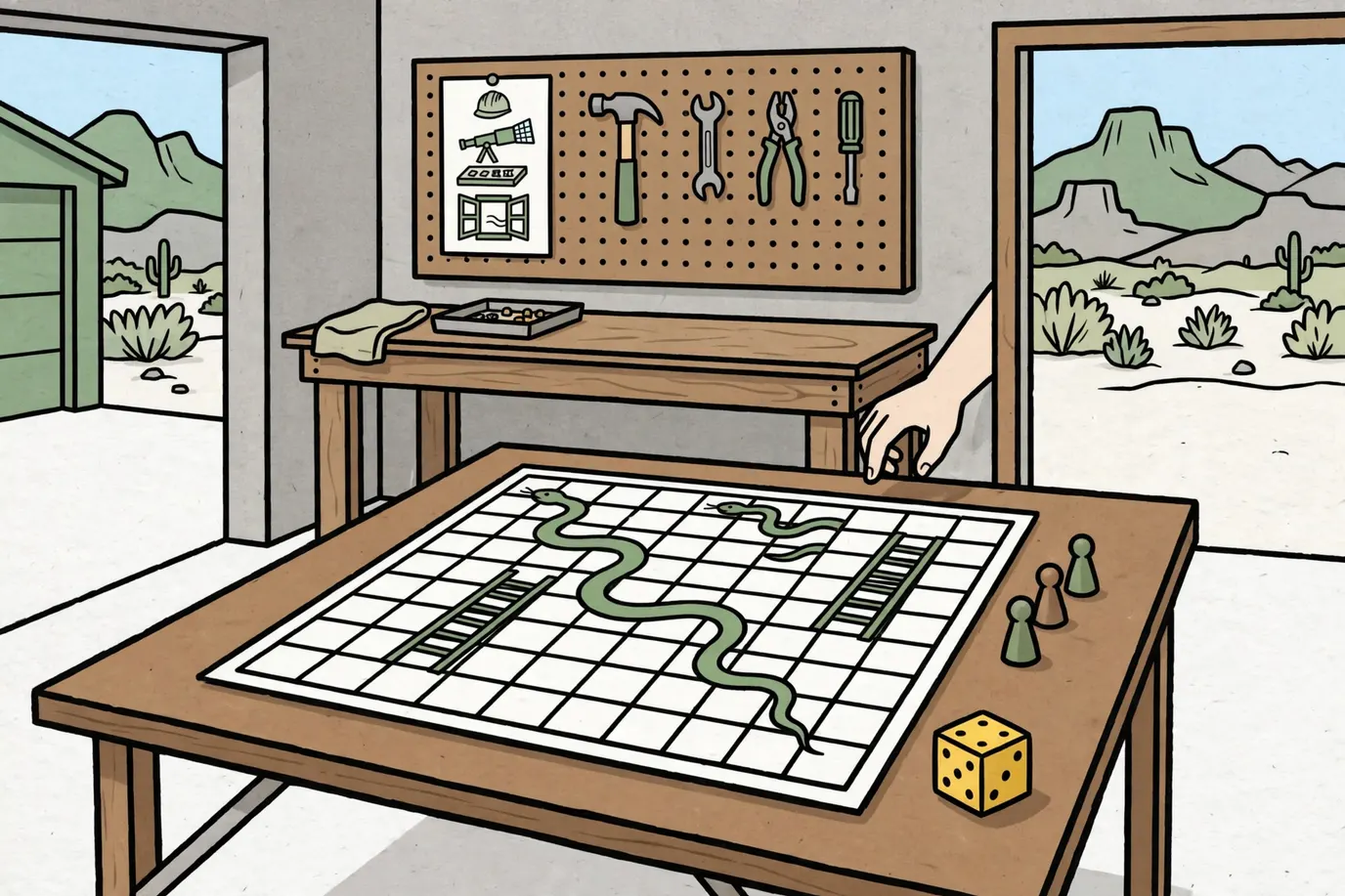
The Snakes and Ladders game is a race to square 100: roll one die, move, climb the ladders you land on and slide down the snakes. Nobody makes a choice, so a 3-year-old and a grandparent play on equal terms. Our data lists three sets on Amazon US: a Gamie board for 2 to 6 players, a wooden Snakes and Ladders and Ludo set from Yellow Mountain Imports, and a pocket-size Hape set that adds Tic Tac Toe. It's the only race I know where the course itself decides who wins.
We earn a commission if you buy through our links, at no cost to you. Disclosure
| Model | Recommended age | Players (max) | Amazon |
|---|---|---|---|
Gamie Snakes and LaddersBoard & family games More specs
| 3+ yearslisting | 6listing | Check price |
Yellow Mountain Imports 2-in-1 Snakes and Ladders Ludo SetBoard & family games More specs
| — | 4listing | Check price |


What’s in this listEditions and versions of Snakes And Ladders sold on Amazon US, matched by the name on the listing. Players, age and play time come from the box or listing. “—” means neither the maker nor the Amazon listing states it.
What the Snakes and Ladders game is
Snakes and Ladders is a race along a numbered board, from the first square to square 100. You roll one die and move that many squares. Ladders carry you up the board in one jump. Snakes slide you back down. The first player to land on 100 wins.
That's it. There's nothing to plan and nothing to trade. Every move comes from the die and the board. That sounds like a flaw until you sit down with a 4-year-old, who can play the whole game with no help except counting dots. It's one of the few games where a little kid and a grown-up play by the same rules and have the same chance.
Here are the box facts, from the listings in our data and the rules page from Yellow Mountain Imports, which makes one of the sets:
- Players: 2 to 4 on the rules page; the sets list 2 to 4 or 2 to 6
- Ages: 3+ on the two sets that state an age
- Equipment: a board, one die and a playing piece for each player
- Co-op or competitive: competitive
- Play time: none of the listings state one
Yellow Mountain Imports' page says the game began in ancient India, where it was called Moksha-Patamu, with ladders standing for virtues and snakes for vices. The board you buy today keeps the shape of that idea and leaves out the lesson plan.
How Snakes and Ladders plays
The rules below are in my own words, from the How to Play Snakes and Ladders page published by Yellow Mountain Imports. The Gamie and Hape sets may come with their own sheets. Where your box disagrees, follow your box.
Who goes first
- Each player rolls the die once.
- The highest roll goes first.
- If two or more players tie for highest, they roll again.
- Play goes clockwise from the first player.
Rolling for first is also the last thing anyone decides all game. From here on, the die drives and everybody else rides along.
Moving along the board
Players take turns rolling the die and moving their piece that many squares. The path runs from square 1 to square 100, and it zigzags. On the first row you move left to right. On the next row you move right to left. Then left to right again, all the way to the top.
That back-and-forth path is the part young players get wrong most. Run a finger along the first three rows before the first game and say the numbers out loud. A kid who follows the numbers will never get lost.
Marisol watched a game once and nodded at the board: "Left to right, then back. That's how you walk a grid on a site. It's the only way you don't miss a square."
Ladders and snakes
- Land at the foot of a ladder: climb straight to the top of it.
- Land on the top of a ladder: nothing happens. You don't climb, and you don't slide.
- Land on a snake's head: slide down to the bottom of its tail.
- Land on a snake's tail: nothing happens. You stay where you are.
I like that last rule more than I should. The tail of a snake is just a square like any other. Standing on it doesn't hurt. Only the head does. A lot of kids flinch at the tail the first time, and it's worth telling them before the game that the tail is a safe spot to stand.
Reaching square 100
The first player to land on square 100 wins. In the standard rules on Yellow Mountain Imports' page, you need the exact number to get there. If you're four squares away and roll a 6, you don't move that turn. You try again on your next roll.
The bounce-back variation
The same page gives a variation for players who don't like waiting near the finish. You don't need an exact roll. If your roll would take you past 100, you count up to 100 and then back down by the extra squares. Four squares away with a roll of 6 means four up to 100 and two back, landing on 98. The first player to land exactly on 100 still wins.
Bounce-back keeps everyone moving, so it works well with younger kids. It also means you can land on a snake on the way back down, which is either the game's best twist or its cruelest, depending on whose piece it is. Pick one version before the first roll and stick to it for the whole game.
Why some games are short and some go on
I teach middle-school math, so here's the one number I can't keep to myself. One die averages 3.5 squares a roll. On a plain track of 100 squares with no ladders and no snakes, that's somewhere around 29 rolls per player to reach the end. Ladders cut that down. Snakes add it back.
So the length of any one game depends on which squares you happen to land on, and nothing else. Two games on the same board can feel completely different. That isn't the board being unfair. It's the board being a board. If a game is dragging, the bounce-back variation and a snack break are both legal.
How to teach it to a young player
The rules fit on a sticky note, but a few habits make the first game smoother for a 3- or 4-year-old.
- Count the dots together. Point at each dot on the die, then move one square per count.
- Touch every square. Have them tap each square as the piece moves. It stops pieces from jumping ahead.
- Show one ladder and one snake first. Move a spare piece up a ladder and down a snake before you start.
- Say the rule for tails out loud. Only heads send you down.
- Keep the game short the first time. If attention runs out at square 60, call it a draw and play again tomorrow.
House rule for a first game, not a printed rule: everybody plays the bounce-back version, and the youngest player rolls first instead of rolling for it. Once the game is familiar, go back to rolling for first.
Snakes and Ladders sets on Amazon US right now
Our data for this page lists three Snakes and Ladders sets on Amazon US as of October 2026. The table above shows what each listing states. Where a listing leaves out a field, the table shows a dash.
Gamie Snakes and Ladders
- Players: 2 to 6
- Ages: 3+
- Type: roll-and-move
- Contents: a 14-inch board, 6 pegs and 1 die
- Expansion: no; it's a complete game
This is the set in our data that seats the most players, with a peg for each of 6. If you have a big family or play at a party, it's the one whose listing says the whole group can play at once. A 14-inch board is big enough to share across a table.
Yellow Mountain Imports 2-in-1 Snakes and Ladders Ludo Set
- Players: 2 to 4
- Material: wood
- Games: Snakes and Ladders and Ludo, per the listing name
- Age: not stated on the listing
Two classic race games in one wooden set. Yellow Mountain Imports is also the company whose rules page this page draws from, and it publishes a separate Ludo rules page. If you want a second game on the back of the board, this is the set in our data that says so. See our Ludo page for that game.
Hape 2in1 Tic Tac Toe / Snakes and Ladders
- Ages: 3+ on the listing; Hape's page says from 3 years
- Contents, per Hape's page: two game boards, eight player pieces and one die
- Parts: 16, per Hape's page
Hape's page calls it an easy-to-carry set, with Snakes and Ladders on one board and Tic Tac Toe on the other. The same eight pieces do both jobs. It's the small one in our data, the kind that fits in a bag for a waiting room or a restaurant table.
Which set fits
- A big family or a party table: the Gamie board, 2 to 6 players
- Two games in one wooden set: the Yellow Mountain Imports Snakes and Ladders and Ludo
- Travel and small hands: the Hape 2-in-1 set
All three are the same game underneath. The differences are in how many people they seat, what else is on the board and how much room they take up.
Small parts
Check the age label on the listing. Toys with small parts are a choking hazard for children under 3. These sets come with pegs, playing pieces and a die, and the two that state an age say 3+. Count the pieces back into the box after each game, and keep the set away from younger brothers and sisters.
Who the Snakes and Ladders game suits
Snakes and Ladders works best as a first board game. It teaches taking turns, counting to six, moving a piece one square at a time and losing without anyone being at fault. Nobody can play badly, so nobody can blame anyone, including themselves.
It also works for a mixed table: a grandparent, a parent and a 3-year-old can all play without anyone holding back. Every player has the same odds on every roll.
Who should skip it
Skip Snakes and Ladders if your youngest player is past the age where luck feels exciting. Kids who are ready for choices usually lose interest once they notice nothing they do changes the result. Skip it, too, for an adult game night. Without decisions, a full game can feel long once you've slid down the same snake twice.
If the child is under 3, wait. The labels on these sets start at 3 for a reason.
If you like Snakes and Ladders, look at these
Pages chosen by what they share with Snakes and Ladders: racing, simple turns and young players.
- Chutes and Ladders: Hasbro's playground-themed take on the same race, with a spinner
- Ludo: another race game, with a little more to decide
- Candy Land: a color-card race for preschoolers
- Best gifts for 3 year olds: games and toys with a 3+ label
Hape has its own brand page: see Hape for the rest of its lineup.
Roll, count, tap every square, and leave the tails alone. They never hurt anybody.
Related
Questions people ask
How do you play Snakes and Ladders?
Everyone starts off the board. Take turns rolling one die and moving your piece that many squares, following the numbers up the board. Land at the foot of a ladder and climb to its top. Land on a snake's head and slide down to its tail. The first player to reach square 100 wins.
Do you need an exact roll to win Snakes and Ladders?
In the standard rules on Yellow Mountain Imports' page, yes. If your roll would carry you past 100, you stay where you are and try again next turn. The same page gives a bounce-back variation: count up to 100 and then back down by the extra spaces. Agree on one before the game starts.
What age is Snakes and Ladders for?
The Gamie board and the Hape set in our data both list ages 3+, and Hape's own page says from 3 years. The Yellow Mountain Imports set doesn't state an age on its listing. The game needs counting to six and no reading, which is why the age labels start where they do.
How many players can play Snakes and Ladders?
It depends on the set. The Gamie board lists 2 to 6 players and comes with 6 pegs. The Yellow Mountain Imports set lists 2 to 4. Hape's page lists eight player pieces, which its Tic Tac Toe board also uses. Yellow Mountain Imports' rules page describes the game for 2 to 4.
Is Snakes and Ladders the same as Chutes and Ladders?
They're the same kind of race to 100 with shortcuts up and slides down. Chutes and Ladders is Hasbro's version with a playground theme and a spinner instead of a die; our Chutes and Ladders page covers it. The sets on this page use snakes and a die.
Sources
- Yellow Mountain Imports: How to Play Snakes and Ladders — accessed 2026-10-23
- Hape: TicTacToe / Snake & Ladders, item E0478 — accessed 2026-10-23
- CPSC: Small Parts Ban and Choking Hazard Labeling — accessed 2026-10-23