Board & Card Games · Type
SET Game: How the Card Game of Visual Perception Plays
The SET game is a card game of spotting patterns: 12 cards go face up, and everyone hunts at once for three cards that are all the same or all different on each of four features. There are no turns. The one box in our data is PlayMonster's SET The Family Card Game of Visual Perception, 81 cards, ages 8+ and 1 or more players on the listing. I teach middle-school math, and this is the only card game I own that is secretly a lesson on counting.
We earn a commission if you buy through our links, at no cost to you. Disclosure
| Model | Recommended age | Players (min) | Cards | Amazon |
|---|---|---|---|---|
PlayMonster SET The Family Card Game of Visual PerceptionCard games More specs
| 8+ yearslisting | 1listing | 81listing | Check price |

What’s in this listEditions and versions of sold on Amazon US, matched by the name on the listing. Players, age and play time come from the box or listing. “—” means neither the maker nor the Amazon listing states it.
What the SET game is
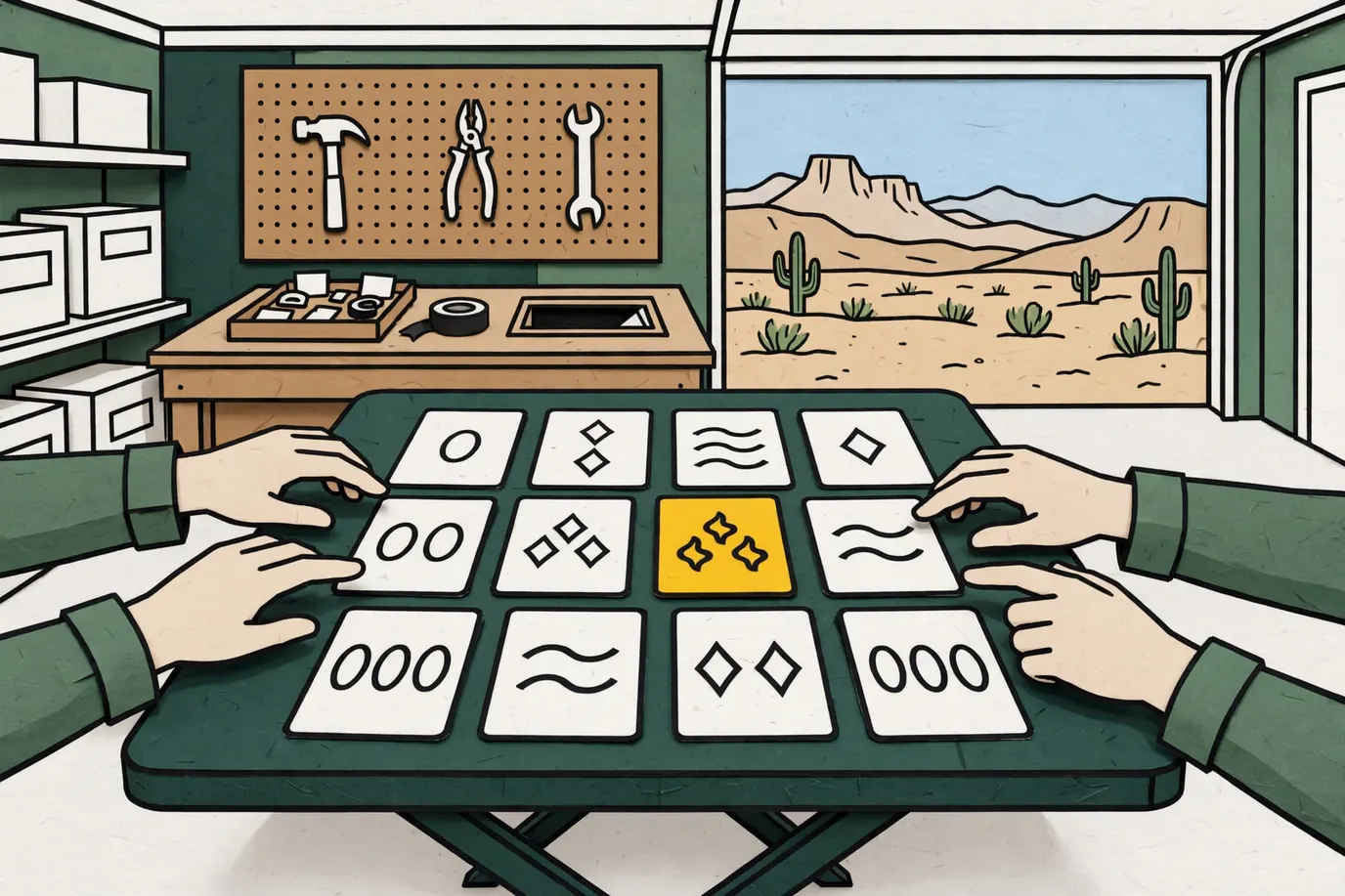
SET is a pattern-spotting card game. Twelve cards lie face up on the table. Every player looks at them at the same time, hunting for a group of three that follows one rule. Find one, call it out, and keep those cards. Most groups at the end wins.
There's no hand of cards to hide, no bidding and no turn order. Everything you need is on the table, in plain sight, for everybody. That's what makes it fair, and it's also what makes it humbling. The SET was right there the whole time. Somebody else just saw it first.
Here's what the box facts look like, from the one listing in our data and the SET rule sheet:
- Box: SET The Family Card Game of Visual Perception, sold by PlayMonster
- Cards: 81, per the listing
- Players: 1 or more, per the listing and the rule sheet
- Ages: 8+ on the listing (the older rule sheet says 6 to adult)
- Type: matching and speed, per the listing
- Play time: the listing doesn't state one
- Co-op or competitive: competitive, with a solo mode
- Expansion: no, it's the complete game
PlayMonster's SET brand page lists SET next to other PlayMonster card games, including Five Crowns. The page doesn't give box details, so the facts above come from the listing and the rules.
The four features on every card
Before you can play, you need to know what you're looking at. Each card shows a few symbols, and the symbols vary in four ways. The rule sheet calls these features:
- Shape: ovals, squiggles or diamonds
- Color: red, green or purple
- Number: one, two or three symbols
- Shading: solid, striped or open (just an outline)
Three options for each of four features. Multiply it out, 3 × 3 × 3 × 3, and you get 81. That matches the card count on the listing, and it means the deck holds every possible card exactly once. I enjoy that more than I should. Also, "squiggle" is a real, printed term in a rulebook, which I count as a win for everyone who has ever drawn one in a margin.
What makes a SET
A SET is three cards where each feature, checked one at a time, is either the same on all three cards or different on all three cards. All four features have to pass that test separately.
So for shape, the three cards are all ovals, or one oval, one squiggle and one diamond. For color, all red, or one of each color. Same idea for number and for shading.
The rule sheet gives a quick way to catch a mistake, and it's the most useful sentence in the box. In my own words: if two cards match on a feature and the third one doesn't, it isn't a SET. Two red and one purple fails. Two ovals and one diamond fails. You can stop checking right there.
Here are three kinds of SET, described the way the rule sheet's examples work:
- Same shape, same color, same number, all different shading. Say, one red solid oval, one red striped oval and one red open oval.
- Different shape, different color, different number, same shading. Say, one green open oval, two purple open squiggles, three red open diamonds.
- Different on all four features. One of everything, which is the hardest kind to see and the most satisfying to call.
Marisol's take, after one round: "Same or all different, on every feature. That's a closure check. If one line doesn't close, the figure doesn't close." She then found two SETs in a row and declined to explain how.
How SET plays
The rules below are in my own words, from the instruction sheet posted on the SET website (SET, The Family Game of Visual Perception, copyright Cannei, LLC). Your PlayMonster box may word things a little differently, so keep its sheet handy.
Setting up
- Shuffle the 81 cards.
- The dealer lays 12 cards face up in a rectangle, where everyone can see them. Three rows of four works well on most tables.
- The rest of the deck stays face down next to the dealer.
That's the entire setup. You can be playing before anyone has found a coaster.
Finding and calling a SET
- Everyone looks at the 12 cards at once. There are no turns.
- When you see a SET, say "SET" out loud before you touch anything.
- Once you call it, you have control of the table. Nobody else may pick up cards until you're done.
- Pick up your three cards within a few seconds. The rule sheet doesn't let you call first and look later.
- The other players check your three cards against the rule.
- If it's a real SET, you keep it for one point, and the dealer fills the gaps with 3 new cards.
- If it isn't, or if you called SET and had nothing, you lose one point and the cards go back on the table.
That penalty matters. Without it, the fastest mouth at the table would win every time. With it, the rule sheet is charging a small fee for enthusiasm, and that keeps everyone honest.
When nobody can find one
Sometimes the table goes quiet and stays quiet. If all players agree there's no SET in the 12 cards, the dealer adds 3 more cards face up, for 15. When the next SET comes off the table, those cards aren't replaced, so you drop back to 12.
The rule sheet gives the odds: about 33 to 1 that a SET is somewhere in 12 cards, and about 2,500 to 1 with 15 cards. So when your table agrees there's nothing there, the numbers suggest your table is probably wrong. I've seen a whole room stare at 12 cards for a full minute, add three, and then find a SET in the original twelve right away.
How the game ends and who wins
Play keeps going until the deck runs out. There may be a few cards left on the table that don't make a SET, and that's fine. Everyone counts their SETs, one point each, minus any penalties. High score wins.
For a longer game, the rule sheet says to pass the deal to the left, reshuffle and play again. When everyone has dealt once, the game ends and the highest total wins.
Playing SET alone
The listing says 1 or more players, and the rule sheet has a solitaire rule. You play the same way, finding SETs in the 12 cards. If you can't find one, you add 3 cards and take a penalty of one SET. To win, you have to clear that penalty by finding a SET among the last 12 cards. It's a good way to get faster before you play anyone else, and nobody sees you staring.
The easy start
The rule sheet suggests a gentler first game: play with only the cards with solid symbols. That takes shading out of the picture, so you're checking three features instead of four. Once spotting a SET feels quick, shuffle everything back together and play the full game.
A bit of math hiding in the deck
Here's the part my students don't believe until they check it. Pick any two cards. There is exactly one card in the deck that completes a SET with them.
Why? Go feature by feature. If your two cards match on color, the third card must be that same color. If they differ, the third card must be the one color they don't have. Either way, there's only one choice for each feature. Four features, one choice each, one card.
That's also a strategy. Instead of staring at all 12 cards, pick a pair, name the card that would finish it, and look for that exact card. Then try another pair. It feels slow for a round or two, and then it gets fast.
A few more habits that help, none of them rules:
- Scan one feature first. Look for three cards that share a color, then check the rest.
- Watch the "all different" sets. They're the ones beginners miss the longest.
- Say SET quietly in your head first. Then check with the quick test before you say it out loud and risk a point.
The SET game on Amazon US right now
Our data for this page lists one SET box on Amazon US as of October 2026: SET The Family Card Game of Visual Perception, sold by PlayMonster. The table above shows what the listing states.
- Cards: 81
- Ages: 8+
- Players: 1 or more
- Type: matching and speed
The listing doesn't state a play time, and it doesn't name any extra pieces beyond the cards. We don't have any SET expansions, junior versions or spin-offs listed in our data right now, so I won't describe any.
Who the SET card game suits
SET works best for people who like puzzles more than they like luck. Every card is face up, so nothing is hidden and nothing is left to a die. The player who sees patterns fastest wins, and that player is often not the oldest one at the table.
Good fits, by what the listing and rules say:
- Mixed ages from 8 up: no reading, no counting money, no long rules
- A player on their own: the solitaire rule makes it a daily puzzle
- A small table: the listing has no upper player limit, but everyone needs to see all 12 cards
- Travel and waiting rooms: a deck of cards and a flat surface is the whole kit
- Classrooms and math clubs: the deck is a counting problem in disguise
It's also one of the few games where the rules never get longer. Once you know what a SET is, you know the game. Getting better means getting faster, not learning new cards.
One house rule our family table could use, and it's a house rule, not a SET rule: if one player is much faster than everyone else, that player waits for a slow count of three after the cards change before calling. It keeps the rest of the table in the game.
Who should skip it
Skip SET if your group wants conversation while it plays. A good round of SET is very quiet, followed by someone shouting one word. Skip it, too, if someone at your table has trouble telling red, green and purple apart. The game depends on color as one of its four features, and the listing doesn't mention any colorblind-friendly marks.
And skip it for players who hate speed. There's no waiting for your turn here. If someone at the table gets upset when a faster player keeps calling SETs, a turn-based game like Five Crowns or a dice game will be a kinder evening.
For kids under 8, go by the listing and wait. A matching game with a smaller deck makes a better first step.
If you like SET, look at these
Pages chosen by what they share with SET: cards, matching and quick rounds.
- Spot It: another face-up matching game where the fastest eyes win
- Card games: the wider shelf of card games, sorted by player count
- Best family card games: short card games for mixed ages
- Five Crowns: another PlayMonster card game, turn-based and calmer
- Farkle: a different kind of quick game, with dice instead of patterns
Lay out twelve, look for three, and say it before you reach.
Related
Questions people ask
How do you play the SET card game?
Deal 12 cards face up. Everyone looks at the same time for a SET: three cards where each feature (color, shape, number, shading) is either the same on all three or different on all three. Call SET, then pick up the three cards. A correct SET scores a point and gets replaced from the deck. A wrong call costs a point. Most SETs at the end wins.
How many cards are in a SET deck?
The PlayMonster listing in our data says 81 cards. That number isn't random: each card has four features with three options each, and 3 × 3 × 3 × 3 is 81. So the deck holds every possible card exactly once, with no duplicates and no blanks you need to sort out.
What age is the SET game for?
The PlayMonster listing in our data says ages 8+. The older rule sheet posted on the SET website prints 6 to adult. We go by the box you'd actually buy, so on this site SET is 8+. The game needs no reading, just looking, so adults and kids play on the same terms.
Can you play SET by yourself?
Yes. The listing says 1 or more players, and the rule sheet has a solitaire rule. If you can't find a SET in the 12 cards, you lay out 3 more and take a one-SET penalty. To win, you have to work that penalty off by finding a SET among the last 12 cards.
What happens when there is no SET on the table?
If everyone agrees there isn't one, the dealer lays out 3 more cards, making 15. When the next SET is found, those 3 cards are not replaced, so the table goes back to 12. The rule sheet puts the odds of a SET being in 12 cards at about 33 to 1, so this doesn't happen often.
Sources
- SET Enterprises (Cannei, LLC): SET, The Family Game of Visual Perception, instructions (PDF) — accessed 2026-10-23
- PlayMonster: SET brand page — accessed 2026-10-23