Board & Card Games · Type
Farkle: The Dice Game, the Scoring and the Sets
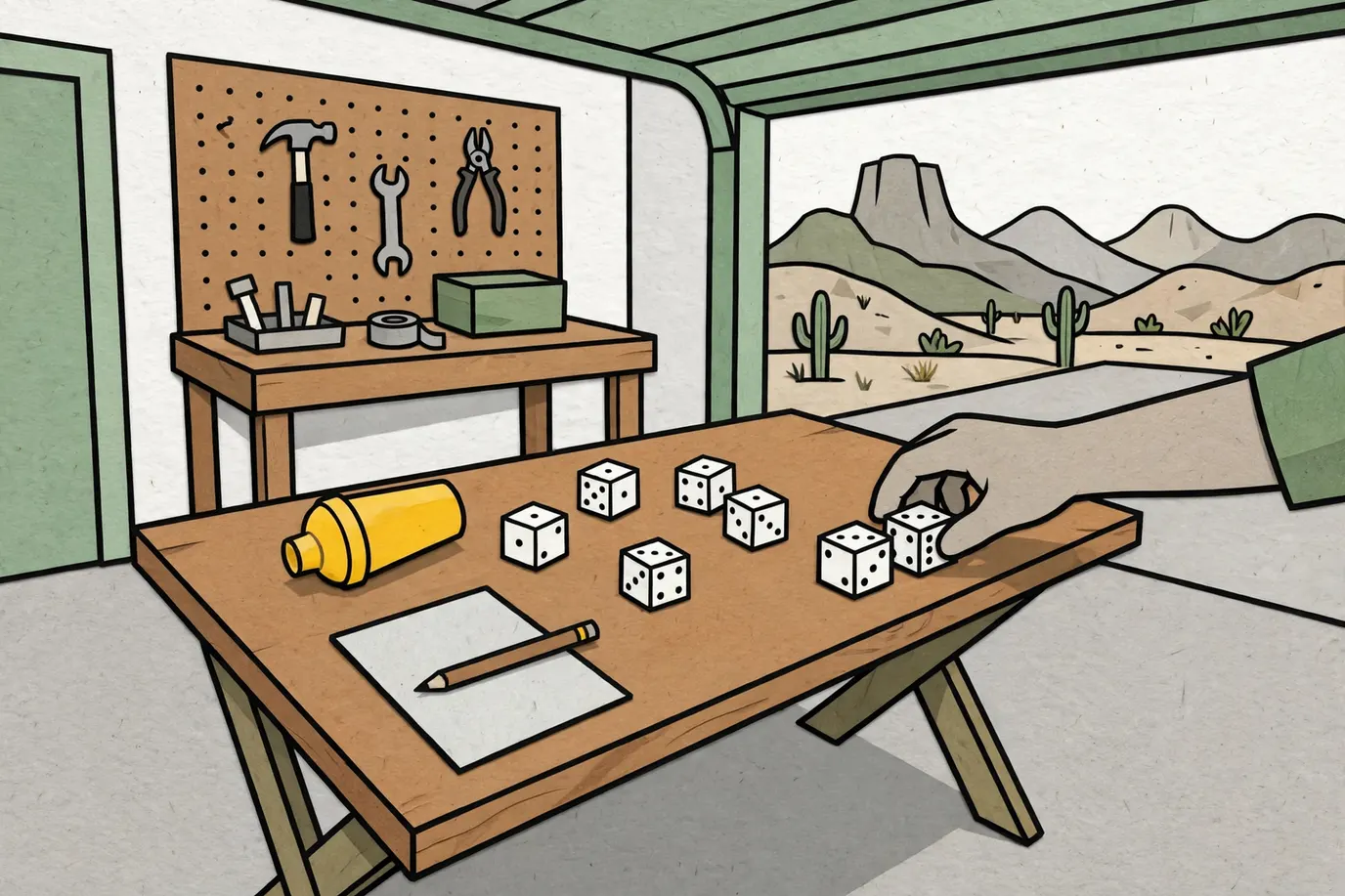
Farkle is a press-your-luck dice game for 2 or more players, ages 8+ on PlayMonster's rules sheet: roll six dice, set aside the ones that score, and decide whether to bank your points or roll again and risk losing them all. First past 10,000 starts the final lap. The Farkle sets on Amazon US range from a plain cup and six dice to a 36-dice deluxe box. It's the only game I know where the name is also the sound the table makes.
We earn a commission if you buy through our links, at no cost to you. Disclosure
| Model | Players (min) | Players (max) | Amazon |
|---|---|---|---|
Continuum Games Farkle Deluxe Dice Games SetBoard & family games More specs
| — | 6listing | Check price |
Brybelly Farkle: The Family Dice GameBoard & family games More specs
| — | — | Check price |
PlayMonster FarkleBoard & family games More specs
| — | — | Check price |
PlayMonster FarkleBoard & family games More specs
| 2listing | — | Check price |


What’s in this listEditions and versions of Farkle sold on Amazon US, matched by the name on the listing. Players, age and play time come from the box or listing. “—” means neither the maker nor the Amazon listing states it.
What the Farkle dice game is
Farkle is a dice game about knowing when to stop. You roll six dice. Some numbers and combos score. You set those aside, add them to a running total for your turn, and then you choose: bank it, or roll the dice that are left. Roll and get nothing that scores, and the whole turn's total is gone. That's a Farkle.
So every turn is a little negotiation with yourself. Five hundred points in your pocket, two dice left to roll. Do you push? The game never tells you. That's what keeps a table leaning in.
The game isn't owned by one maker, and several companies sell Farkle sets. The rules on this page come from PlayMonster's rules sheet, because it's a published rules sheet from a maker whose set is in our data. Box facts from that sheet:
- Players: 2 or more
- Ages: 8+
- Play time: about 30 minutes
- Contents: 6 dice, a shaker cup, a score pad
- Goal: highest score once someone passes 10,000
- Competitive; no team mode on the sheet
If you've played Yahtzee, the feel is close: dice, combos, a pencil. The difference is risk. In Yahtzee a bad roll costs you a box. In Farkle a bad roll costs you the turn.
How Farkle plays
The rules below are in my own words, from PlayMonster's Farkle rules sheet (the 2016 printing). Other makers' sheets may score a combo or two differently. If your set came with its own sheet, that sheet runs your table.
Setup
- Pick a scorekeeper. That person writes every banked score on the pad.
- Everyone rolls one die. Highest roll goes first.
- Play passes to the left.
That's the whole setup. There's no board, no deal, no pieces to sort.
A turn, roll by roll
- Put all six dice in the cup and roll.
- Look for scoring dice. Set aside at least one of them. You must take at least one every roll, but you don't have to take them all.
- Add what you set aside to your running total for the turn.
- Now choose. Bank the total and pass the cup, or roll the dice you didn't set aside.
- Keep going until you bank or Farkle.
If you set aside all six dice, you get them all back. Roll six fresh dice and keep building the same running total. The PlayMonster sheet treats that as a lucky break, and it is one.
Any die that rolls off the playing area gets rolled again. The die gets a second chance. You don't.
What a Farkle is
A Farkle is any roll where no die scores. It can happen on your very first roll of the turn, or on the last two dice you were brave enough to throw. Either way, your running total for that turn drops to zero, and play passes on.
Points already on the score pad are safe. The rules are clear on that. A Farkle only takes what you hadn't banked yet.
Getting on the board: the 500 rule
You can't bank small turns at the start. Your first score on the pad must be 500 or more. Until you hit 500 in a single turn, you have to keep rolling, even when it hurts.
After that first 500, you can stop and bank at any total you like. June, who is 11, calls the 500 the cover charge. She is not wrong, and she gets in faster than I do.
Farkle scoring, combo by combo
| Roll | Points |
|---|---|
| Single 1 | 100 |
| Single 5 | 50 |
| Three 1s | 300 |
| Three 2s | 200 |
| Three 3s | 300 |
| Three 4s | 400 |
| Three 5s | 500 |
| Three 6s | 600 |
| Four of any number | 1,000 |
| Five of any number | 2,000 |
| Six of any number | 3,000 |
| 1–6 straight | 1,500 |
| Three pairs | 1,500 |
| Four of a kind plus a pair | 1,500 |
| Two triplets | 2,500 |
That's PlayMonster's table, set out my way. Two things to notice. Only 1s and 5s score on their own. Any other number needs three or more of a kind, or a combo, to count. And three 1s score 300 on this sheet, not 1,000. If your family scores them differently, that's a house rule, not this sheet's.
Combos only count inside one roll
This is the rule people get wrong most. Dice from different rolls never add up into a combo. Set aside a 5 on your first roll and two 5s on your second, and you have three single 5s: 50 plus 50 plus 50, so 150. You do not have three of a kind worth 500. The combo has to land in one throw.
A sample turn, in my own numbers
- Roll six dice. You see one 1 and nothing else that scores. Set aside the 1. Running total: 100.
- Roll five dice. Three 2s and a 5 come up. Set aside all four. Running total: 100 + 200 + 50 = 350.
- One die left. You're under 500 and not on the pad yet, so you have to roll. It's a 5. Running total: 400. All six dice are now set aside.
- Roll all six again. A single 1. Set it aside. Running total: 500.
- You're at 500. Bank it, and you're finally on the pad. Or roll five more and risk the lot.
Most people bank there. Some people don't. You'll learn which kind you are by the second game.
When to stop: the fewer dice, the bigger the risk
The rules sheet doesn't tell you when to bank. It does give you everything you need to work it out. With one die left, only a 1 or a 5 saves you. That's 2 faces out of 6, so 4 times in 6 the roll is a Farkle. With two dice, you're safe if either one shows a 1 or a 5, which happens a bit more than half the time.
With six dice, the sheet itself says a Farkle is unlikely but possible. So the shape of the game is simple: rolling lots of dice is cheap, and rolling one or two is expensive. A running total of 300 with five dice left is worth another throw for most players. A running total of 300 with one die left usually isn't, once you're on the pad.
How it ends
When a player's banked score reaches 10,000 or more, every other player gets one last turn to beat it. Then the highest score wins. Reaching 10,000 first doesn't win by itself. It just starts the clock.
Marisol's take: "A score pad is a field book. You write it down when it happens, not afterward from memory." She keeps score at our table, and nobody has ever argued with her numbers. They've tried arguing with the dice.
Common Farkle mix-ups
From the rules sheet, these are the ones that come up:
- Adding dice across rolls. Combos only count inside one roll.
- Skipping the minimum. You must set aside at least one scoring die after every roll.
- Banking under 500 at the start. Your first bank must be 500 or more.
- Thinking 10,000 wins on the spot. Everyone else still gets a last turn.
- Scoring 2s, 3s, 4s or 6s alone. Only single 1s and 5s score without a combo.
A rule some tables add: three Farkles in a row cost you points from your banked score. That one's a house rule. It isn't on PlayMonster's sheet, so agree on it before the first roll, not after somebody's third Farkle.
Farkle sets on Amazon US right now
Our data for this page lists 4 Farkle sets on Amazon US as of October 2026, matched by the name on the listing. The table above shows what each listing states. Most of them don't list players, ages or play times, so expect dashes there. I won't fill them in with guesses.
The PlayMonster cup sets
Two PlayMonster listings are in our data, both named simply Farkle.
- Farkle (cup with lid). The listing names 6 dice, a dice cup with a lid and rules, and lists 2 players and up. That matches the classic rules sheet above.
- Farkle (cup and score card). The listing title says a cup and a score card are included. It doesn't list a player count or age.
Both are the plain version: one cup, six dice, one pad or card. If you want the game as the rules sheet above describes it, start here.
Brybelly Farkle: The Family Dice Game
The listing names a dice cup, 6 dice, 25 score cards and a storage box. The storage box is the detail that sets it apart from the cup sets. The listing doesn't give a player count or age in our data.
Continuum Games Farkle Deluxe Dice Games Set
This is the big box. The listing names 36 dice, 6 rolling cups, a rolling tray and score sheets, and lists up to 6 players. Thirty-six dice is six full sets, so every player can have their own cup and dice instead of passing one cup around. The rolling tray is the only one in our data, and it keeps dice from leaving the table.
The listing doesn't state an age. The core game only needs six dice, so the extra dice are about convenience and pace, not new rules.
Which Farkle set fits your table
- A first set, or a gift for someone who knows the game: a PlayMonster cup set
- Somewhere to keep it all: Brybelly, for the storage box
- A group of up to 6 that hates waiting for the cup: Continuum Deluxe
- Already own any dice: you can play with six of them and a sheet of paper, using the rules above
Dice are small parts. Check the age label on the listing. Toys with small parts are a choking hazard for children under 3.
Expansions and add-ons
No Farkle expansions are in our data. The game doesn't need one. Score pads run out before anything else does, and lined paper works for those.
Who should skip Farkle
Skip it if your table doesn't like luck deciding the game. You can make smart stops, but a Farkle on your last roll still erases a great turn. Skip it, too, if someone at your table can't stand losing points they could see. Farkle takes them away, every game, from everybody.
And skip it if your youngest player isn't adding three-digit numbers yet. PlayMonster's sheet lists ages 8+, and a turn runs on quick sums like 350 plus 50. That's good practice. It isn't fun for someone who's still counting on fingers.
If you like Farkle, look at these
Picked by what they share with Farkle: dice, quick turns and a table of 2 or more.
- Yahtzee: five dice, a score card, less risk per roll
- Dice games: the whole shelf of roll-and-score games
- Bunco: dice for a big group
- Shut the Box: dice and simple sums
- Liar's dice: dice plus bluffing
Bank at 500 the first time. After that, you're on your own.
Related
Questions people ask
What are the basic Farkle rules?
On PlayMonster's rules sheet, you roll six dice, set aside at least one scoring die, and either bank your turn total or roll the rest. A roll with nothing that scores is a Farkle, and you lose that turn's points. Your first bank must be 500 or more. When someone reaches 10,000, everyone else gets one more turn, and the highest score wins.
How does Farkle scoring work?
PlayMonster's sheet scores a single 1 at 100 and a single 5 at 50. Three of a kind scores 100 times the number, except three 1s at 300. Four of a kind is 1,000, five is 2,000 and six is 3,000. A 1-to-6 straight, three pairs, or four of a kind with a pair each score 1,500, and two triplets score 2,500.
What do you need for a Farkle score sheet?
One column per player and a running total. PlayMonster's rules name one player as scorekeeper, and only banked points go on the pad. Once written down, the rules say those points are safe. The PlayMonster cup set and the Brybelly set list score cards or a score pad in the box, and the Continuum deluxe set lists score sheets. Any lined paper works when they run out.
How many dice do you need to play Farkle?
Six. PlayMonster's rules sheet lists 6 dice, a shaker cup and a score pad. The Continuum Games deluxe set in our data lists 36 dice and 6 rolling cups, which works out to a full set of six dice and a cup for each of up to 6 players, plus a rolling tray.
How long does a game of Farkle take?
PlayMonster's rules sheet says about 30 minutes. The listings in our data don't give a play time. The real clock is the 10,000-point target and your group size: more players means more turns before anyone gets there, and the final lap gives everyone one more turn.
Sources
- PlayMonster: Farkle — accessed 2026-10-23
- PlayMonster: Farkle rules sheet (PDF) — accessed 2026-10-23
- CPSC: Small Parts for Toys and Children's Products — accessed 2026-10-23