How this list of family card games was built
Every game on this page is a card game that seats four or more players and has a listing that says ages 8 or younger. Most list a play time of half an hour or less. Two run longer at the top end, Skull King at 30–45 minutes and Unstable Unicorns at 30–60, and I flag both below so nobody gets surprised at 9 p.m.
The table up top shows all 15 with age, players and play time. Below, I've grouped them the way I'd sort them on the folding table in Bay One: by how long a game takes. A dash in the table means the listing doesn't say.
Here's the table version:
- Ten to fifteen minutes — speed and matching games, plus two quick sit-down games
- Twenty to thirty minutes — the after-dinner middle
- Longer sits — two games for a night with no bedtime
Get the base game to the table a few times before buying expansions
That's my one strong opinion about card games, and the play times on this page back it up. An expansion is an add-on that needs the base game. It adds new cards and new rules to a game your family hasn't learned yet.
Every pick here is a full game in one box. And most of them are short. Push lists 20 minutes. Sleeping Queens lists 20. Exploding Kittens Original Edition lists 15. Three games of any of those fit in one evening with time left to argue about who shuffles. Even the longest pick, Unstable Unicorns, lists 30–60 minutes, so two full games still fit in a weekend afternoon.
So you don't need more cards to find out if the game works for you. You need three nights. If the kids are still asking for it after the third one, then go read about what the add-ons do.
(Lucho once showed up to game night with an expansion for a game none of us owned. Dana asked where the base game was. He said "on order." It arrived the following Thursday. The expansion had already been opened.)
Ten to fifteen minutes: quick family card games
These are the games for a weeknight, a restaurant wait, or the stretch between homework and bath. Several are matching and speed games. That means everyone plays at once and the fastest eyes or hands take the round. Reflexes don't care about birthdays, so in my house the youngest player is often the one to watch. Dana's ruling on any speed game: it ends the moment somebody says "ow."
Spot It Classic (2024 Refresh), Eco-Blister and Eco-Sleeve editions
Two listings, one game. Both editions of the Asmodee Spot It Classic (2024 Refresh) are listed for ages 6 and up, 2–8 players, 10 minutes a game, and sorted as matching and speed. The only difference in our data is the edition name: Eco-Blister or Eco-Sleeve. Pick whichever one is in stock and don't buy both.
These are two of the three picks on this page that start at 6. That makes Spot It the easiest game here to bring to a table with a first grader on it. It's also the one I'd point a grandparent to first, since the youngest grandkid can usually join. More editions are on the Spot It page.
Rat-A-Tat Cat
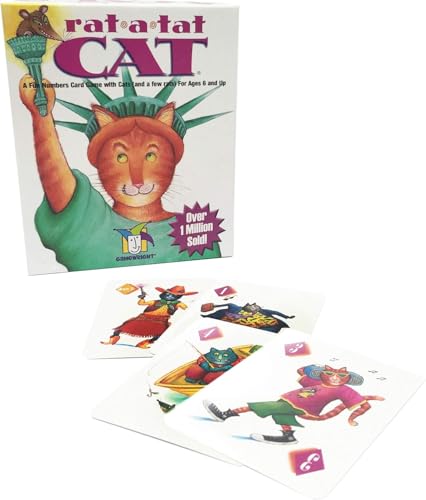
Gamewright Rat-A-Tat Cat is the other 6+ pick. The listing gives 2–6 players, 10–15 minutes and 54 cards. Gamewright's page describes the goal as ending up with the lowest score: you try to get rid of high cards and keep low ones, using peeks, draws and swaps.
That's adding numbers in your head, every round. As a math teacher, I'm contractually obligated to point that out. As a dad, I'll point out that a 6-year-old can win it without knowing it's math.
The trade-off is the cap. Six players is the listed maximum, so a crowd of cousins won't all fit in one game. The Gamewright page has the rest of the lineup.
Taco Cat Goat Cheese Pizza and the Poolside edition
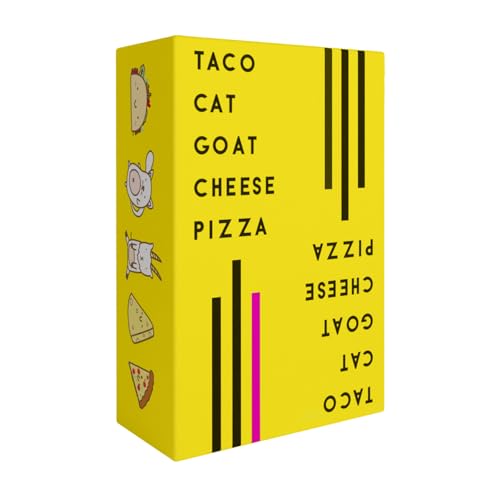
The original Taco Cat Goat Cheese Pizza is listed for 7+, 2–8 players, 10–15 minutes, matching and speed. The Poolside edition has the same age and player count and lists 10 minutes. Same game family, two decks.
If you already own the original, the Poolside listing is a second deck for a different spot in the house, not a new game. If you own neither, start with one. Speed games get loud, and that's the point. Plan the table away from the good lamp.
See the Taco Cat Goat Cheese Pizza page for more on its editions.
Exploding Kittens Original Edition
Exploding Kittens Original Edition is listed for 7+, 2–5 players and 15 minutes, with 56 cards. The maker's page describes it this way: everyone draws from one deck, uses action cards to skip, attack or defuse, and tries to be the last player who hasn't drawn an Exploding Kitten.
Five is the listed maximum, so it suits a family of four or five better than a party. With 56 cards, it's one of the smaller decks on the page by count. More on the game and its editions at Exploding Kittens.
Slapzi
Moose Master Slapzi is the shortest game on the whole page at 3–5 minutes. It's a matching and speed game for 2–8 players with 150 cards, and it's listed for 8+, which makes it the oldest label in this quick group.
A game that short works as a warm-up before a longer one, or as the last round when somebody says "one more" and means it. The age is the catch. A sibling who's 6 or 7 has the Spot It, Rat-A-Tat Cat, Taco Cat and Exploding Kittens picks above.
Twenty to thirty minutes: the after-dinner middle
This is the group I'd look at first if your family has outgrown the quickest games and wants a bit more to think about. A game this length lets you play twice before anyone checks the clock. Not three times. I've tried. Somebody always checks the clock.
Beat The Heat
Hasbro Beat The Heat stretches from 2 all the way to 10 players. It's listed for 8+ and 20 minutes. That range is the selling point: the same box works on a quiet night with two and at a holiday table with ten.
The data doesn't name what kind of game it is, so check the listing's description before you buy. The Hasbro page covers the brand's other games.
Push 2024
Ravensburger Push 2024 is a press-your-luck card game for 2–6 players, listed for 8+ and 20 minutes. Press-your-luck means you keep taking chances for more points, and you lose what you've gathered if you push one step too far.
That makes a quiet bit of probability practice. My seventh graders learn odds with a coin. A card game teaches it with a groan from across the table. Six is the listed maximum. See the Ravensburger page for more.
Sleeping Queens
Gamewright Sleeping Queens is listed for 8+, 2–5 players and 20 minutes. On Gamewright's page, players use cards like knights to wake and steal queens, and the player who wakes the most queens wins.
It's a calm game compared with the speed decks above. No slapping, no shouting, just a card at a time. The trade-off is size: five players is the listed cap, so it's a family game, not a party game.
Traitor Tots
Hasbro Traitor Tots lists 3–10 players, 25 minutes and ages 8 and up. Along with Beat The Heat, it ties for the biggest player count on this page.
The minimum is the catch. It needs at least 3 players, so a parent and one kid can't play it alone. If you host a lot of family dinners, that's not a problem. If your weeknight table is two, look at the 2-player picks instead.
A Daily Cloud
MindWare A Daily Cloud is listed for 8+, 3–6 players and 25 minutes. It has the narrowest player range on the page, 3 to 6, which makes it a good fit for a family of four or five and not much else.
The data doesn't name the kind of game, so read the listing's description before you buy. More on the brand at MindWare.
Pit Card Game
Winning Moves Pit Card Game is listed for 7+, 3–8 players and 30 minutes. It's the one 7+ pick in this section, so it's the one an older 7-year-old can join here.
Like Traitor Tots and A Daily Cloud, it needs at least 3 players. With 8 as the top, it suits a house where the cousins come over and everyone wants in on the same game.
Longer sits: two games for a night with no bedtime
Both of these go past half an hour at the top end. That's why they're last on the page, not because they're less of a family game. They just want a Saturday.
Skull King
Grandpa Beck's Games Skull King is a trick-taking game for 2–8 players, listed for 8+, with a 30–45 minute play time. Trick-taking means each player plays one card per round of play, called a trick, and the highest card wins it.
That's an old card-table idea that works as a bridge between kid games and the games adults grew up with. Eight players is a big table for a game that long, so plan for the top end of the time if everyone joins.
Unstable Unicorns
Unstable Games Unstable Unicorns lists 2–8 players and 8+. Its play time is the widest on the page: 30 to 60 minutes. That range is worth reading twice. A 60-minute game on a school night is a 75-minute game once you count setup and the argument about who goes first.
Save it for a weekend. And it's the pick where my opinion up top matters most: play the base box a few times before you add anything to it.
How to choose a card game for your family
Three numbers on the box do most of the work. I check them in this order.
Start with your youngest player's age
Read the age on the listing and trust it. On this page, the 6+ games are Spot It and Rat-A-Tat Cat. The 7+ games are Taco Cat Goat Cheese Pizza, Pit and Exploding Kittens. Everything else starts at 8. An 8+ label can be about reading, speed or how long the rules are, so I don't stretch it downward. Sam is 7. He's allowed into the 6+ and 7+ games. He has asked about the rest. Several times.
Count the chairs, then check both player numbers
Most people look at the top number. Look at the bottom one too. Pit, Traitor Tots and A Daily Cloud all need 3 players. If your weeknight game is one parent and one kid, those three are for weekends with guests. At the other end, Exploding Kittens and Sleeping Queens stop at 5.
Match the play time to the night
A school night wants the 10–15 minute group. A Friday can take the 20–30 minute picks. A weekend afternoon can handle Skull King or Unstable Unicorns. The time on the box is an estimate for one game, and teaching a new game takes longer the first night.
Who should skip this list
If your family mostly plays with two people, skip this page. Every pick was chosen for tables of four or more, and three of them don't run below 3 players. A list of 2-player games will serve you better. And if your youngest is under 6, nothing here fits yet. Look at the general card games page or the family board games page instead, and check the age on each listing.
Shuffle, deal, and let the youngest go first. That rule is printed in no rulebook I own, and it's never been appealed.