Scale Model Kits · Type
Airbrush Kits for Model Painting
An airbrush kit for models is a small spray tool, a hose and, in some kits, a compressor that feeds it air. The choice that matters most is what the kit leaves out: a kit with only the airbrush still needs an air supply before it sprays anything. I sort this page by that question first. Then feed, action and nozzle. (The compressor in Bay Two hums louder than the radio. The radio has stopped competing.)
We earn a commission if you buy through our links, at no cost to you. Disclosure


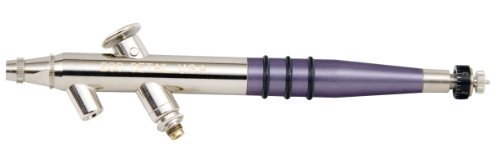


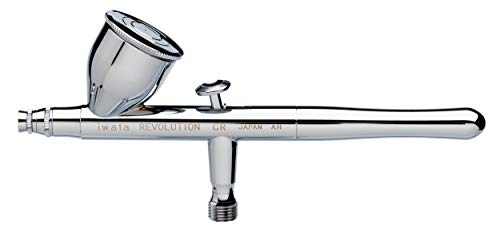

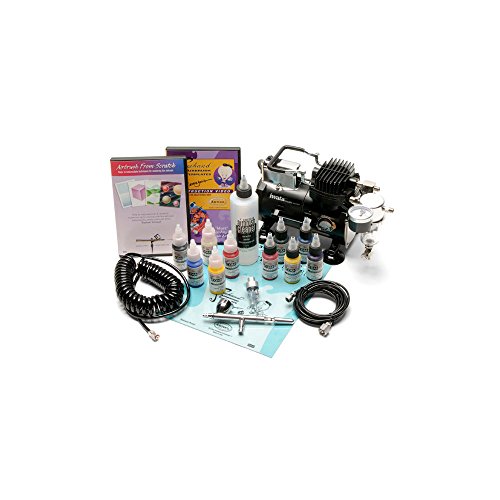













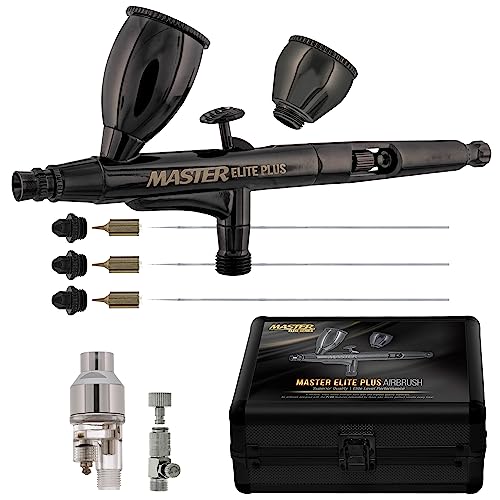


What’s in this listEvery airbrush kit we track on Amazon US, highest stated working pressure first. “—” means neither the maker nor the Amazon listing states it.
What an airbrush kit for models includes
An airbrush is a small spray tool that mixes paint with compressed air and lays it down in thin, even coats. Model builders use it for base coats on car bodies, camouflage on aircraft and tanks, soft shading and clear coats. A brush leaves marks. An airbrush, used well, doesn't.
The word "kit" covers a lot on Amazon US. This page tracks 91 listings, and they fall into a few groups:
- Airbrush only: the tool, sometimes with a cup or bottle and a wrench
- Airbrush set: the tool plus a hose, extra cups, bottles or heads
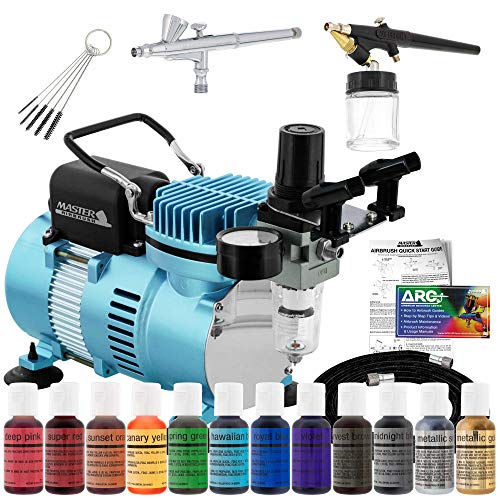
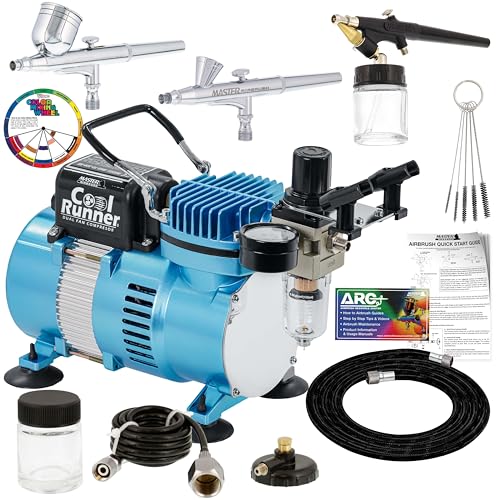
- Airbrush with compressor: a full system, ready once you add paint
- Compressor only: the air supply, for someone who already owns an airbrush
- Cleaning and service: cleaners, cleaning kits, lubricant, service kits
- Spray booths and filters: a box with a fan that pulls overspray away from you
- Paint: a few airbrush-ready colors
The makers in the table are Master Airbrush, Badger, Iwata, Harder & Steenbeck, Mr. Hobby, Testors and Tamiya. Each has its own page here.
How this table is sorted
The rule for this page is highest stated working pressure first. Here is the honest part: our data doesn't hold a pressure figure for any of the 91 listings yet. The feed, action, nozzle and compressor fields are empty too. So the table order is the order the data gives us, not a ranking.
What the data does have is the title of each listing, and many titles carry the facts that matter. "Gravity feed", "dual action", "0.3 mm" and "with air compressor" are all title words. Everything I cite about a specific listing below comes from its title. If a title doesn't say it, I don't either.
Check the air supply before anything else
An airbrush does nothing without air. That sounds obvious until a kit arrives and the box holds a tool, a hose and nothing to plug the hose into.
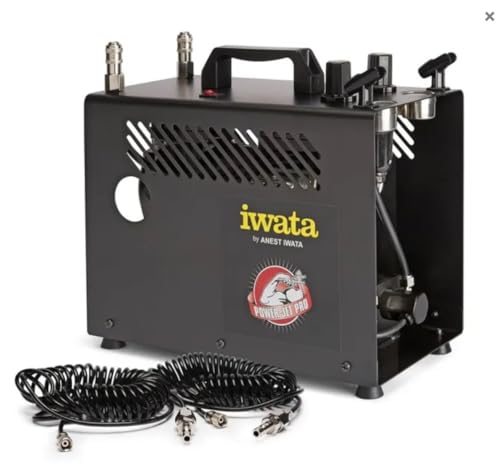
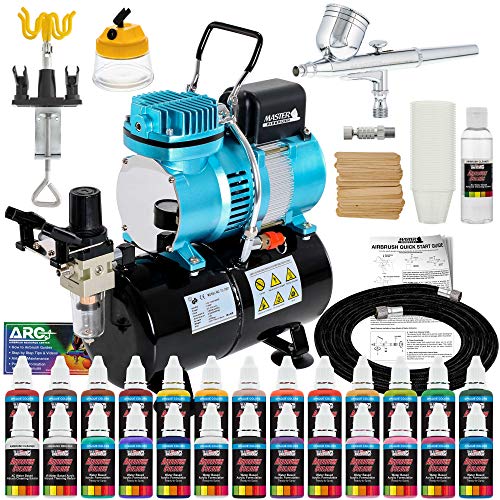
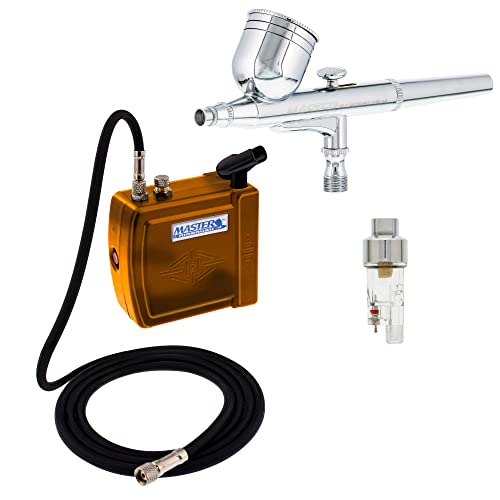
By title, 20 listings here mention a compressor. Most are Master Airbrush kits, many of them in the Cool Runner II line, some with an air storage tank. Two are Iwata Eclipse HP-CS systems, one with a Silver Jet compressor and one with a Smart Jet. The Iwata Power Jet Pro is a compressor only: its title lists a 2 L air tank, dual regulators, auto shut-off and 1 to 50 psi of adjustable output. Master Airbrush also lists a cordless kit with a rechargeable compressor at 20 to 36 psi, per its title.
Many Badger, Harder & Steenbeck and Iwata listings are the airbrush alone. That isn't a flaw. It's a choice for builders who already own an air supply or want to pick one separately.
ANEST IWATA, the company behind Iwata airbrushes, gives three pieces of plumbing advice:
- A pressure regulator: keeps the spray pressure steady
- An air filter: keeps water, oil and dust from the compressor out of the airbrush
- A thin airbrush hose: it names 2 × 3 mm tubing for its own airbrushes
Lucho looked at the water trap on a compressor and gave his ruling. "A compressor is a pump with opinions. Drain the trap before it gets the last word." He fixes engines for a living. I took the note.
Gravity, siphon or side feed
Feed means where the paint sits before it reaches the nozzle.
Gravity feed: cup on top
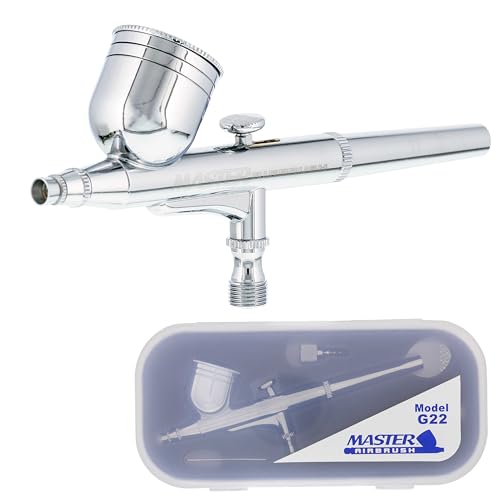
A gravity-feed airbrush has a small cup on top. Paint runs down into the airbrush from above. A small cup also means small batches, which suits model work: a few drops of a color for a cockpit, a little more for a wing. By title, 28 listings here say gravity. The Harder & Steenbeck Evolution, Infinity and Ultra listings, the Iwata Eclipse HP-CS and NEO CN, and most Master Airbrush G-series tools are gravity feed, per their titles.
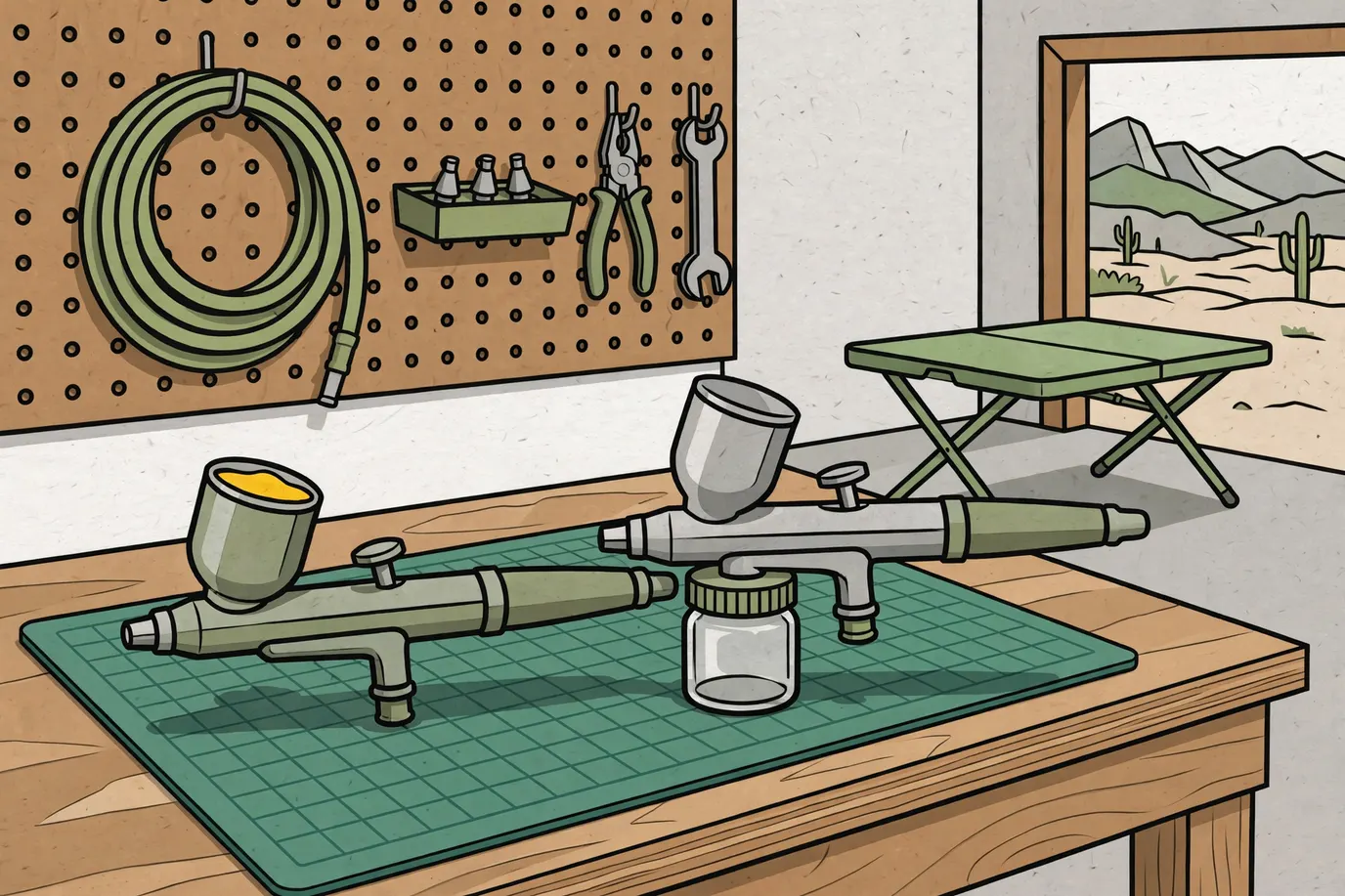
Siphon feed: bottle underneath
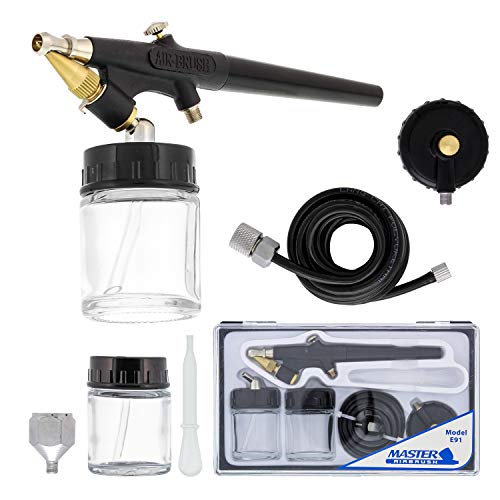
A siphon-feed airbrush draws paint up from a bottle or jar below it. Bottles hold more, and you can mix several colors ahead and swap them. That suits a big base coat. By title, 11 listings here say siphon, among them the Iwata Eclipse HP-BCS and NEO BCN, the Badger 200-3, and the Master Airbrush S68 and E91.
Side feed: cup on the side
A side cup clips to the side of the body instead of the top. One listing here says so in its title: the Mr. Hobby PS276 Procon Boy WA, with a side cup and a 0.3 mm nozzle.
Single action, dual action and trigger
Action means what your finger does.
Single action
ANEST IWATA explains it plainly. On a single-action airbrush, pressing the button releases air and paint together. You set the amount of paint ahead of time by turning a regulator, and changing it means stopping to adjust. That's simpler to learn and steady for flat coats. Listings here that say single action in the title include the Badger 200-20, 350-3 and 350-4, and the Master Airbrush E91. The E91 title adds external mix, which means the paint and air meet outside the tip.
Dual action
On a dual-action airbrush, pressing the button down releases air, and pulling it back releases paint. So you change the amount of paint while you spray. ANEST IWATA calls dual action the most widely used type and says it suits shading and gradients. Harder & Steenbeck uses the name "twin-action" for the same idea, per its Evolution CRplus title. Dual action is by far the most common action word in this table's titles.
Trigger style
A few tools use a pistol-style trigger instead of a top button. The Iwata Hi-Line HP-TH, the Iwata-Medea NEO TRN 1 and TRN 2, and the Master Airbrush G70 and G79 are trigger style, per their titles.
Nozzle size sets the spray width
The nozzle is the small tip the paint leaves through. Its size, in millimeters, sets how fine or wide the spray can go and how much air it uses. ANEST IWATA gives this guide:
- 0.2 mm: fine work
- 0.3 mm: the general choice, from very fine lines to fairly wide areas
- 0.4 to 0.5 mm: larger areas
Titles on this page run wider than that. The Mr. Hobby PS-771 lists 0.18 mm. The Badger Velocity Renegade lists 0.21 mm. Harder & Steenbeck lists 0.25 mm on the Infinity 2024 Solo, 0.28 mm on the Evolution 2024 and 0.45 mm on the Ultra 2024. The Evolution CRplus Twin-Action kit lists 0.4 and 0.6 mm. At the far end, the Master Airbrush E91 lists 0.8 mm.
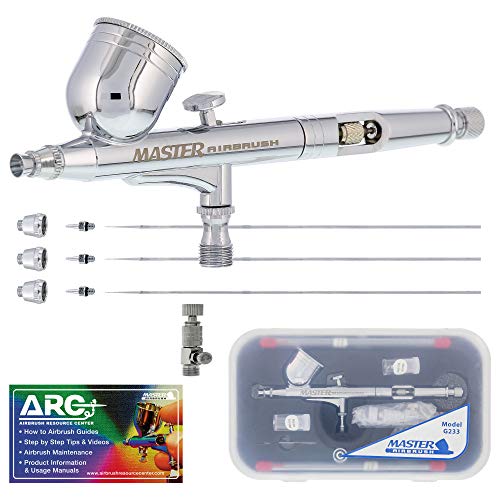
Some kits ship with more than one size. The Master Airbrush G233 lists three nozzle sets, 0.2, 0.3 and 0.5 mm. If you can only own one airbrush for a while, a set like that, or one 0.3 mm tool, covers the most ground.
A 0.18 mm nozzle is narrower than most pencil lines. I'd keep a magnifier near it, and a tray under it. A dropped nozzle on a garage floor is a long evening with a flashlight.
Pressure: start low
Air pressure is listed in psi (pounds per square inch) or in MPa or bar on many maker pages. ANEST IWATA lists a spray range of 0.10 to 0.29 MPa for its airbrushes. In US units that's about 15 to 42 psi.
Tamiya's compressor pages give two useful reference points. Its Spray-Work Advance compressor lists a maximum output of about 30 psi and a continuous pressure of 12 psi, with a dial for lower settings on detail work. Its basic battery-powered set lists about 0.11 MPa, roughly 16 psi, and a 0.3 mm airbrush that Tamiya calls easy for beginners. Neither is in this table. I mention them because they show how low a model painter can work.
So read the pressure range on a compressor as a ceiling, not a target. Detail work happens near the bottom of it.
Paint, thinner and the order of coats
Paint has to be thin enough to pass through a nozzle a fraction of a millimeter wide. Tamiya's guide says to always use the matching thinner when you airbrush its lacquer or acrylic paints. Its retarder lacquer thinner suggests 1 to 2 parts thinner to 1 part paint, and the retarder slows drying for a smoother finish.
Two more rules from Tamiya's guide are worth taping to the shelf. Lacquer should not go on top of acrylic or enamel paint. Plan the order of your coats before the first one. And use the guide's other habit: primer first, a coat that covers small flaws and gives the paint something to hold.
A few listings here are paint, not tools. Badger lists a 1 oz Weathered Black airbrush color and a Model Flex weathering set. Weathering means adding dirt, rust or wear on purpose.
Three Master Airbrush kits are sold for cake decorating or face and body paint, per their titles, with food coloring or face paint in the box. They're airbrush kits, so they show up in this table. For model paint, pick a kit sold for hobby use, and keep tools that touch food for food.
Cleaning is half the hobby
An airbrush is a tool you clean, which you sometimes also paint with. Dried paint in a 0.2 mm nozzle stops the work cold. So the cleaning listings matter as much as the airbrushes.
The table includes the Tamiya 250 ml airbrush cleaner, a Master Airbrush cleaner and two Master Airbrush cleaning kits, the Iwata-Medea cleaning kit and refill pack, Iwata's maintenance tool kit for Neo airbrushes, the Badger CMK-0116 maintenance kit, Badger's Regdab lubricant and the Harder & Steenbeck service kit. Spare parts matter too. The Harder & Steenbeck 2 ml color cup fits its Infinity and Evolution airbrushes, per the title.
Clean right after the session, with the cleaner the paint maker names. Paint dries on its own schedule, not yours.
Spray booths and ventilation
Here is my one opinion for this page. Ventilation isn't optional with an airbrush. An airbrush turns paint into a fine mist on purpose, and you are standing right next to that mist.
The EPA lists paints, solvents and hobby supplies among the household sources of volatile organic compounds, or VOCs, which are chemicals that turn into gas at room temperature. Its first two steps to cut exposure are to increase ventilation when you use these products and to follow the label. It also says not to store opened containers of unused paint indoors.
Airbrush, solvents, cement: Work with good ventilation and follow the paint or cement maker's label for masks and gloves.
A spray booth helps. It's a box with a fan that pulls overspray away from your face and out through a hose or filter. Master Airbrush lists two booths here, a large and a portable one, both with LED lights, a 25 W fan, a turntable and a 6 ft exhaust hose, plus a two-pack of booth filters. A booth works best with its hose aimed out a window.
Keep the airbrush, thinner and cleaner on a high shelf, away from kids.
Who should skip an airbrush for now
Skip this page if you've built one or two kits so far. A brush and a spray can cover a first car or a first plane, and Tamiya's guide lists its spray cans for large areas. Skip it, too, if you can't paint near an open window or set up a booth that vents outside. And if the kit you're building is snap-fit and molded in color, it may not need paint at all.
For a first look at kits that pair well with an airbrush later, see model car kits or Gundam model kits. The model kits section page has the full bench list.
Window open, pressure low, cup half full.
Brands in this list
Related
Questions people ask
What is the best airbrush for plastic models?
There isn't one answer, because the job decides it. For general model painting, ANEST IWATA calls a 0.3 mm nozzle the general choice, from fine lines to fairly wide areas, and calls dual action the most widely used type. A gravity cup on top suits small batches of paint. Then check whether the kit includes an air supply, because many listings here are the airbrush alone.
Do I need a compressor to use an airbrush?
You need a steady air supply, and for most hobby painters that's a compressor. ANEST IWATA recommends a pressure regulator for steady pressure and an air filter to keep water, oil and dust out of the airbrush. Some kits on this page include a compressor, per their titles. Others are the airbrush only. Read the title before you plan the first coat.
What paint do you use in an airbrush for models?
Hobby paint thinned to flow through a small nozzle. Tamiya's guide says to always use the matching thinner when airbrushing its lacquer and acrylic paints, and its retarder lacquer thinner page suggests 1 to 2 parts thinner to 1 part paint. The ratio differs by paint and by brand, so follow the paint maker's label, not a general rule.
What size airbrush nozzle is best for miniatures and model details?
Smaller nozzles spray finer. ANEST IWATA lists 0.2 mm for fine work, 0.3 mm as the general size and 0.4 to 0.5 mm for larger areas. On this page, nozzle sizes appear in many titles, from 0.18 mm on a Mr. Hobby Procon Boy listing up to 0.8 mm on a Master Airbrush single-action siphon set.
What air pressure should I spray models at?
Lower than most people expect for detail. ANEST IWATA gives a spray pressure range of 0.10 to 0.29 MPa for its airbrushes, which works out to about 15 to 42 psi. Tamiya's compressor page says lower pressures suit detailed sections. Start low, test on scrap plastic, and raise it only if the paint won't atomize.
Sources
- ANEST IWATA: About airbrushes (how to use) — accessed 2026-10-23
- Tamiya: Plastic Modeling - A Basic Guide — accessed 2026-10-23
- Tamiya: Lacquer Thinner (Retarder Type) 250ml — accessed 2026-10-23
- Tamiya: Spray-Work Air Compressor Advance — accessed 2026-10-23
- Tamiya: Spray-Work Basic Air Compressor w/Airbrush — accessed 2026-10-23
- U.S. EPA: Volatile Organic Compounds' Impact on Indoor Air Quality — accessed 2026-10-23