Brand · Scale Model Kits
Master Airbrush Kits, Compressors and Spray Booths
Master Airbrush sells airbrushes, complete airbrush kits with a compressor, spray booths and cleaning supplies, and the grid above holds 37 Master Airbrush listings on Amazon US. Most are either a G-series airbrush alone or a Cool Runner II system with one to three airbrushes. Start with one question: do you already own an air supply? (Some of these titles list three airbrushes, a compressor, a tank and the paint in one sentence. I read them with a pencil.)
We earn a commission if you buy through our links, at no cost to you. Disclosure
Master Airbrush on Amazon US
37 models- Airbrush kits
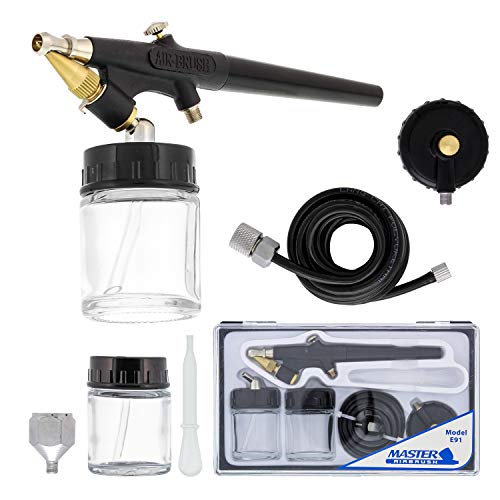
Master Airbrush E91 Airbrush Set Single-Action External Mix Siphon Feed
Check price - Airbrush kits
Master Airbrush G70 Universal Precision Trigger Style Gravity Feed
Check price - Airbrush kits
Master Airbrush G25 Multi-Purpose Dual-Action Gravity Feed Airbrush Kit
Check price - Airbrush kits
Master Airbrush S68 Precision Dual-Action Siphon Feed Airbrush
Check price - Airbrush kits
Master Airbrush Cool Runner II Air Tank Compressor & G44 Airbrush Kit, 24 Paint
Check price - Airbrush kits
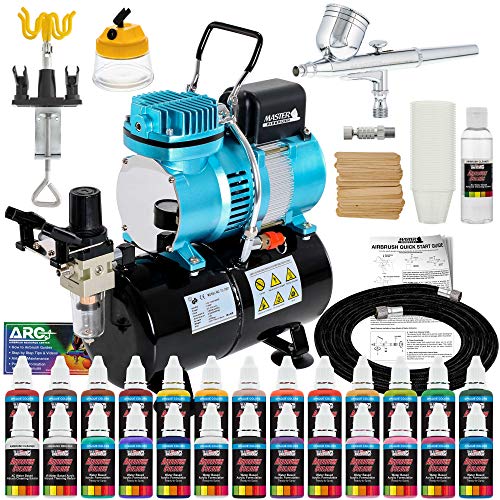
Master Airbrush Cool Runner II Deluxe Airbrush System Kit, 24 Acrylic Paint
Check price - Airbrush kits
Master Airbrush G34 Multi-Purpose Dual-Action Gravity Feed Airbrush
Check price - Airbrush kits
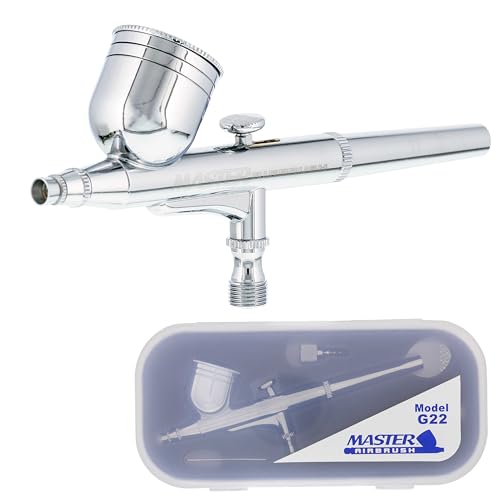
Master Airbrush G22 Multi-Purpose Dual-Action Gravity Feed Airbrush
Check price - Airbrush kits
Master Airbrush Multi-Purpose Airbrushing System Kit with Cool Runner II Compressor (Siphon Feed, 0.35 Tip)
Check price - Airbrush kits
Master Airbrush G22 Gravity Feed Airbrush Kit & Air Compressor
Check price - Airbrush kits
Master Airbrush G79 Precision Fixed Dual-Action Trigger Style Airbrush
Check price - Airbrush kits
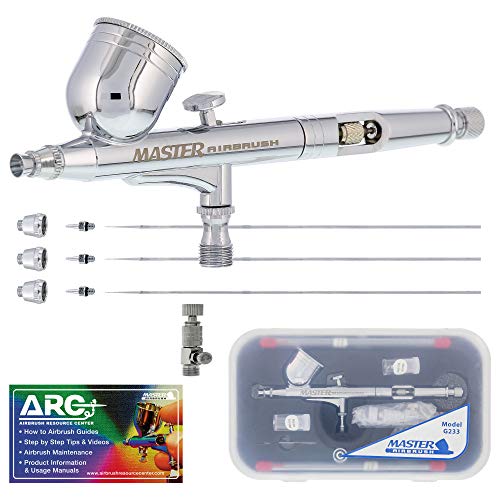
Master Airbrush G233 Performance Pro Airbrush Kit with 3 Nozzle Sets
Check price - Airbrush kits
Master Airbrush Airbrush Cleaning Kit
Check price - Airbrush kits
Master Airbrush G222 Multi-Purpose Dual-Action Gravity Feed Airbrush Set
Check price - Airbrush kits
Master Airbrush Precision G44 High Precision Dual-Action Gravity Feed Airbrush
Check price - Airbrush kits
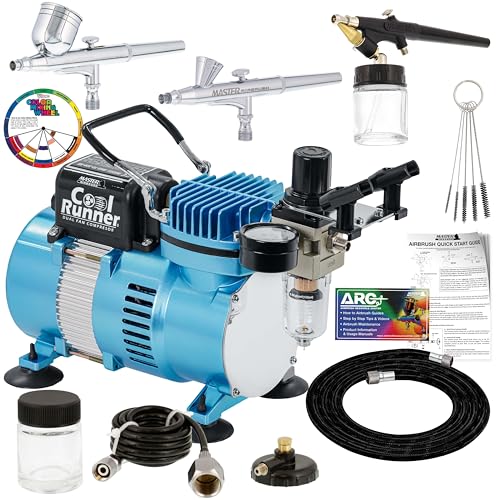
Master Airbrush Cool Runner II Dual Fan Airbrushing System Kit with 3 Airbrushes (0.3 Gravity, 0.35 & 0.8 Siphon)
Check price - Airbrush kits
Master Airbrush Cool Runner II Dual Fan Airbrushing System Kit with 3 Airbrushes (0.2, 0.3 Gravity, 0.8 Siphon)
Check price - Airbrush kits
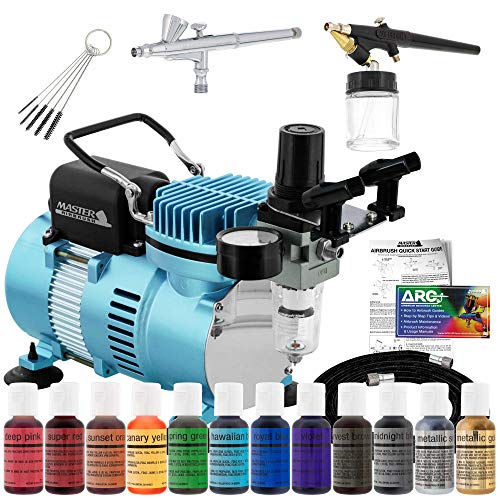
Master Airbrush Cool Runner II Airbrush Cake Decorating Kit
Check price - Airbrush kits
Master Airbrush Cool Runner II Airbrush Kit with 3 Airbrushes, Dual Fan Compressor
Check price - Airbrush kits
Master Airbrush Cake Decorating Airbrush Kit with Compressor, 12 Color Chefmaster
Check price - Airbrush kits
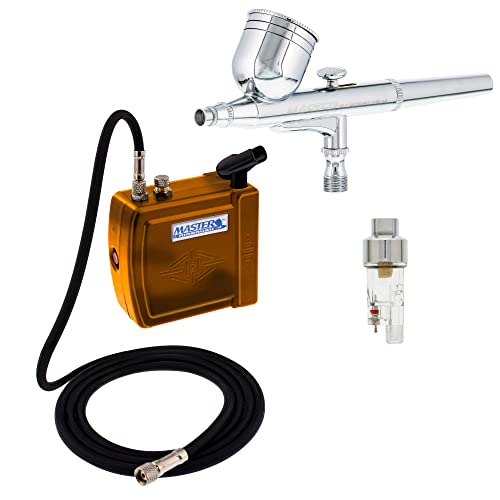
Master Airbrush Multi-Purpose Airbrush Kit with Mini C16-G Compressor
Check price - Airbrush kits
Master Airbrush Cool Runner II Airbrush Kit with 3 Airbrushes, 6 Color Acrylic Paint Set
Check price - Airbrush kits
Master Airbrush G22 Multi-Purpose Dual-Action Gravity Feed Airbrush Set
Check price - Airbrush kits
Master Airbrush Multi-Purpose Airbrush Decorating Kit (G34) with Mini Compressor
Check price - Airbrush kits
Master Airbrush Cool Runner II Airbrush Kit with 3 Airbrushes, Acrylic Paint, Dual Fan Compressor
Check price - Airbrush kits
Master Airbrush Cool Runner II Airbrush Face Paint Kit, 16 Color
Check price - Airbrush kits
Master Airbrush Portable Airbrush Spray Booth Station with LED Lights
Check price - Airbrush kits
Master Airbrush TC-40 Air Brush Compressor Kit Cool Runner
Check price - Airbrush kits
Master Airbrush TC-40T Air Brush Compressor Kit Cool Runner (3-Liter Tank)
Check price - Airbrush kits
Master Airbrush Cool Runner II Airbrush Kit with Dual Fan Compressor, 3 Liter Tank, 3 Airbrushes
Check price - Airbrush kits
Master Airbrush 13 Piece Airbrush Cleaning Kit
Check price - Airbrush kits
Master Airbrush Large Portable Airbrush Spray Booth Station with LED Lights
Check price - Airbrush kits
Master Airbrush Air Brush Kit with Air Compressor TC-320
Check price - Airbrush kits
Master Airbrush Hobby Airbrush Spray Booth Filter Set (2-Pack)
Check price - Airbrush kits
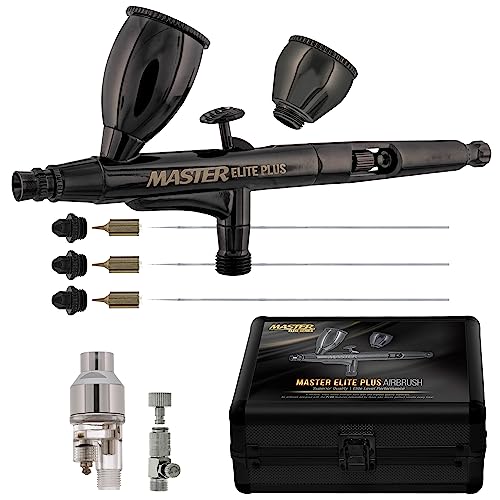
Master Airbrush Elite Plus Ultimate Airbrush Set Model 120
Check price - Airbrush kits
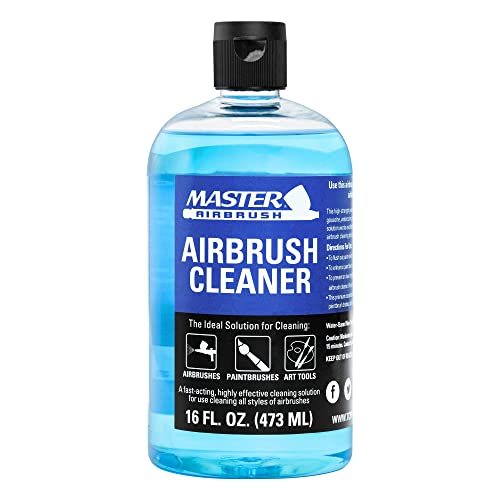
Master Airbrush Airbrush Cleaner 16-Ounce
Check price - Airbrush kits
Master Airbrush Cordless Airbrushing System Kit
Check price











What Master Airbrush makes
Master Airbrush sells the tools for airbrush painting: the airbrushes, the compressors that feed them air, kits that combine both, spray booths and cleaning supplies. An airbrush is a small spray tool that mixes paint with compressed air for thin, even coats. Model builders use it on car bodies, aircraft camouflage and clear coats. Cake decorators and face painters use the same kind of tool with different paint.
The 37 listings in the grid sort into these groups, by title:
- Airbrushes alone: the G-series gravity and trigger tools, the S68 and the E91
- Cool Runner II systems: a compressor with one to three airbrushes
- Other compressor kits: TC-40, TC-40T, TC-320, a mini C16-G and a cordless kit
- Cake and face paint kits: sold with food coloring or face paint
- Spray booths: a large and a portable booth, plus a filter two-pack
- Cleaning: two cleaning kits and a 16-ounce cleaner
- One more set: the Elite Plus set, Model 120
Our data doesn't fill a nozzle, pressure or feed field for these listings yet. Everything I cite about a listing comes from its title. When a title is silent, so am I.
Who sells it
The listings we spot-checked are sold by TCP Global Corp. TCP Global's own site shows Master Airbrush in its row of brands, and its header says Quality & Service Since 1974. That's the full extent of what the maker's site told us, so it's the full extent of this section.
Master Airbrush G-series airbrushes
The G in a model name goes with gravity feed in most of these titles, meaning a small cup on top that feeds paint down into the airbrush. Gravity suits model work, where you mix a few drops of a color at a time.
Dual-action gravity: G22, G222, G25, G34, G44
Dual action means you press the button for air and pull it back for paint, so you change the paint flow as you spray. ANEST IWATA, which makes Iwata airbrushes, calls dual action the most widely used type and says it suits shading and gradients.
- G22: listed alone, as a set and as a kit with an air compressor
- G222: a multi-purpose dual-action gravity set
- G25: a multi-purpose dual-action gravity kit
- G34: listed alone and in a decorating kit with a mini compressor
- G44: listed as high precision, and as part of a Cool Runner II kit with 24 paints
G22, G222, G233. Read model numbers the way I read lot numbers on a plat. One extra digit is a different parcel.
G233: three nozzle sets
The G233 Performance Pro kit lists three nozzle sets in its title. Swapping a nozzle changes how fine or wide the spray goes. ANEST IWATA's guide gives 0.2 mm for fine detail, 0.3 mm for general work and 0.4 to 0.5 mm for larger areas. A kit with more than one size covers more of that range with one tool.
Trigger style: G70 and G79
The G70 is a trigger-style gravity-feed airbrush. The G79 is a precision fixed dual-action trigger-style airbrush. A trigger airbrush is held like a small spray gun instead of with a finger on a top button. Some hands like that grip for long sessions. Others don't. Try one before you buy two.
Siphon feed and single action: S68 and E91
Siphon feed means the paint sits in a bottle or jar underneath, and the airflow draws it up. Bottles hold more, which suits big base coats and quick swaps between colors you mixed ahead.
- S68: precision dual-action siphon feed
- E91: single-action, external mix, siphon feed, sold as a set
On a single-action airbrush, ANEST IWATA explains, pressing the button releases air and paint together, and you set the paint amount ahead of time. External mix, per the E91 title, means the paint and air meet outside the tip.
Cool Runner II systems
Cool Runner II is the compressor name in 11 of these titles. The kits differ in what comes with the compressor:
- A named airbrush or tip: a G44 kit with 24 paints and an air tank; a siphon-feed system with a 0.35 tip
- Three airbrushes: several kits, some with a dual fan, a 3-liter tank or a paint set
- Paint included: 24-color acrylic, 6-color acrylic, or acrylic paint unnamed by count
- Not for models: a Cool Runner II cake decorating kit and a 16-color face paint kit
A tank stores compressed air between the compressor and the airbrush. The titles say which kits have one. Ours don't say how the tank changes the noise or the airflow, so I won't either.
Comparing the two dual-fan, three-airbrush kits
Two Cool Runner II dual-fan kits look the same until you read the nozzle sizes in the title:
- Kit A: 0.3 mm gravity, plus 0.35 mm and 0.8 mm siphon
- Kit B: 0.2 mm and 0.3 mm gravity, plus 0.8 mm siphon
Here is my one opinion for this page. With a multi-airbrush kit, the nozzle sizes in the title matter more than how many airbrushes are in the box. Both kits hold three. Kit B adds a 0.2 mm tool, which ANEST IWATA's guide puts at fine detail work, the job most model painters reach for an airbrush to do. Kit A adds a second siphon tool at 0.35 mm, closer to the general size. If you paint small parts and camouflage lines, Kit B's spread fits. If you paint big bodies and base coats, Kit A's does.
The 0.8 mm siphon tool in both kits is far wider than the sizes ANEST IWATA lists for model work. It's for broad coverage.
Other compressor kits
- TC-40: a compressor kit in the Cool Runner name
- TC-40T: the same name with a 3-liter tank
- TC-320: an airbrush kit with this compressor
- Mini C16-G: a multi-purpose kit with a small compressor
- Cordless Airbrushing System Kit: a compressor that runs on a rechargeable battery
Cordless means the air supply has a battery. It doesn't mean the cleanup has one. Read the listing for run time and pressure before you plan a long session on a charge, since our data doesn't record either.
ANEST IWATA's advice for any compressor applies here: a pressure regulator for steady pressure and an air filter to keep water, oil and dust out of the airbrush. Its stated spray range for its own airbrushes is 0.10 to 0.29 MPa, about 15 to 42 psi. Detail work sits near the low end.
Paint in the box, and paint you'll still need
Several Cool Runner II kits include paint, per their titles: a 24-color acrylic set, a 6-color acrylic set, and acrylic paint without a stated count. That's enough to learn how the airbrush behaves, test pressure and practice even coats on scrap plastic.
It isn't the same as the paint your next kit's instructions call for. A model car or an aircraft manual lists colors by its own paint maker's numbers. Plan on buying those colors, and the thinner made for them, separately.
Three habits help with any paint you put through an airbrush:
- Thin to the paint maker's guide: not to a general rule from somewhere else
- Test on scrap first: an old runner or a plastic spoon
- Note what worked: paint, thinner, ratio and pressure, on a strip of tape on the bottle
I keep those notes on label tape. That surprises nobody who has met me.
Cake decorating and face paint kits
Three listings are sold for food or skin, per their titles: the Cool Runner II cake decorating kit, a cake decorating kit with a 12-color Chefmaster set, and the Cool Runner II face paint kit with 16 colors. A fourth, the multi-purpose decorating kit with a G34, sits between the two worlds.
These are airbrush kits, so they appear in the grid. For model paint, choose a kit sold for hobby use. A cake doesn't need panel lines, and a model doesn't need frosting.
Spray booths and filters
Master Airbrush lists two spray booths with LED lights, a large one and a portable one, plus a two-pack of booth filters. A spray booth is a box with a fan that pulls paint mist away from you and out through a filter and a hose. It works best with the hose aimed out a window.
If you can't paint by an open window, a booth vented outside is how the air gets moving.
Cleaning
Three listings are for cleaning: the airbrush cleaning kit, a 13-piece cleaning kit and a 16-ounce airbrush cleaner. Dried paint in a nozzle a fraction of a millimeter wide ends a session. Clean right after you spray, with the cleaner the paint maker names.
How to pick a Master Airbrush listing
- Check the air. Own a compressor? Pick a G-series airbrush alone. Don't? Pick a Cool Runner II or other compressor kit.
- Check the purpose. Hobby, cake or face paint. The title says which.
- Check the feed. Gravity for small batches. Siphon for big coats.
- Check the nozzles. For models, look for 0.2 to 0.35 mm in the title.
- Check the extras. Paint, tank, booth, cleaner.
For other makers side by side, see airbrush kits, which lists Master Airbrush next to Iwata, Badger and Harder & Steenbeck. For things to paint, see model car kits.
Ventilation and safety
The EPA lists paints, solvents and hobby supplies among household sources of volatile organic compounds and says to increase ventilation when you use them, meet or exceed label precautions and store products out of reach of children.
Airbrush, solvents, cement: Work with good ventilation and follow the paint or cement maker's label for masks and gloves.
For the cordless kit, charge it with the charger that came with it and follow the maker's charging instructions.
Who should skip Master Airbrush for now
Skip the airbrush step if you're on your first or second kit. A brush and a spray can do the job. Skip it, too, if you can't open a window or vent a booth outside. And skip a cake or face paint kit if what you want to paint is plastic.
Read the nozzle sizes, then the airbrush count, then the box.
Where Master Airbrush shows up
Often compared
Questions about Master Airbrush
Is Master Airbrush good for model painting?
We don't grade brands. What the listings show: most Master Airbrush tools in the grid are dual-action gravity feed, the type ANEST IWATA calls the most widely used, and several kits list 0.2, 0.3 and 0.35 mm nozzles, sizes the same guide gives for fine and general work. Many kits include a compressor. Match the nozzle and the feed to your models.
Who makes Master Airbrush?
The listings we checked show Master Airbrush sold by TCP Global Corp, and TCP Global's own site lists Master Airbrush in its row of brands. The site's header says Quality & Service Since 1974. It doesn't say where the airbrushes are made, so we leave that out.
What is the Master Airbrush Cool Runner II?
It's the compressor name in many Master Airbrush kit titles. In the grid above, Cool Runner II kits come with one to three airbrushes, and some titles add a dual fan, an air tank or a paint set. Read each title for the airbrush count, the nozzle sizes and whether a tank is included.
Can I use a Master Airbrush cake decorating kit for models?
Those kits are sold for cake decorating, per their titles, with food coloring such as a 12-color Chefmaster set in one listing. For model paint, pick a kit sold for hobby use. Keep any airbrush that touches food for food only, and keep hobby paint tools out of the kitchen.
Where can I buy Master Airbrush supplies?
The listings in the grid above are on Amazon US, and the ones we spot-checked were sold by TCP Global Corp. Use the Check price button on each row. Cleaning kits, a 16-ounce cleaner and spray booth filters are listed separately from the airbrushes.
Sources
- TCP Global: home page — accessed 2026-10-23
- ANEST IWATA: About airbrushes (how to use) — accessed 2026-10-23
- U.S. EPA: Volatile Organic Compounds' Impact on Indoor Air Quality — accessed 2026-10-23