Board & Card Games · Type
Shut the Box Game: Rules, Boards and Who It Suits
The Shut the Box game is a dice-and-addition game: roll, add, and flip down numbered tiles that make your total until you can't. Fewer numbers left standing is better, and closing them all is the dream. Our data lists two wooden boards on Amazon US, one from AMEROUS for 1 to 4 players and one from Regal Games for ages 8+. It's the rare game where a kid practicing sums and a grown-up killing ten minutes want the same box.
We earn a commission if you buy through our links, at no cost to you. Disclosure
| Model | Recommended age | Players (min) | Players (max) | Amazon |
|---|---|---|---|---|
AMEROUS Shut The Box (12 Dice, 12 Inches)Board & family games More specs
| — | 1listing | 4listing | Check price |
Blue Orange Games Double Shutter Shut The Box Dice Game, Fun Math and Strategy Family Game by Blue Orange Games- 1 to 4 Players for Ages 8+Board & family games More specs
| 8+ yearslisting | — | — | Check price |
Regal Games Shut The BoxBoard & family games More specs
| 8+ yearslisting | 2listing | — | Check price |


What’s in this listEditions and versions of Shut The Box sold on Amazon US, matched by the name on the listing. Players, age and play time come from the box or listing. “—” means neither the maker nor the Amazon listing states it.
What the Shut the Box game is
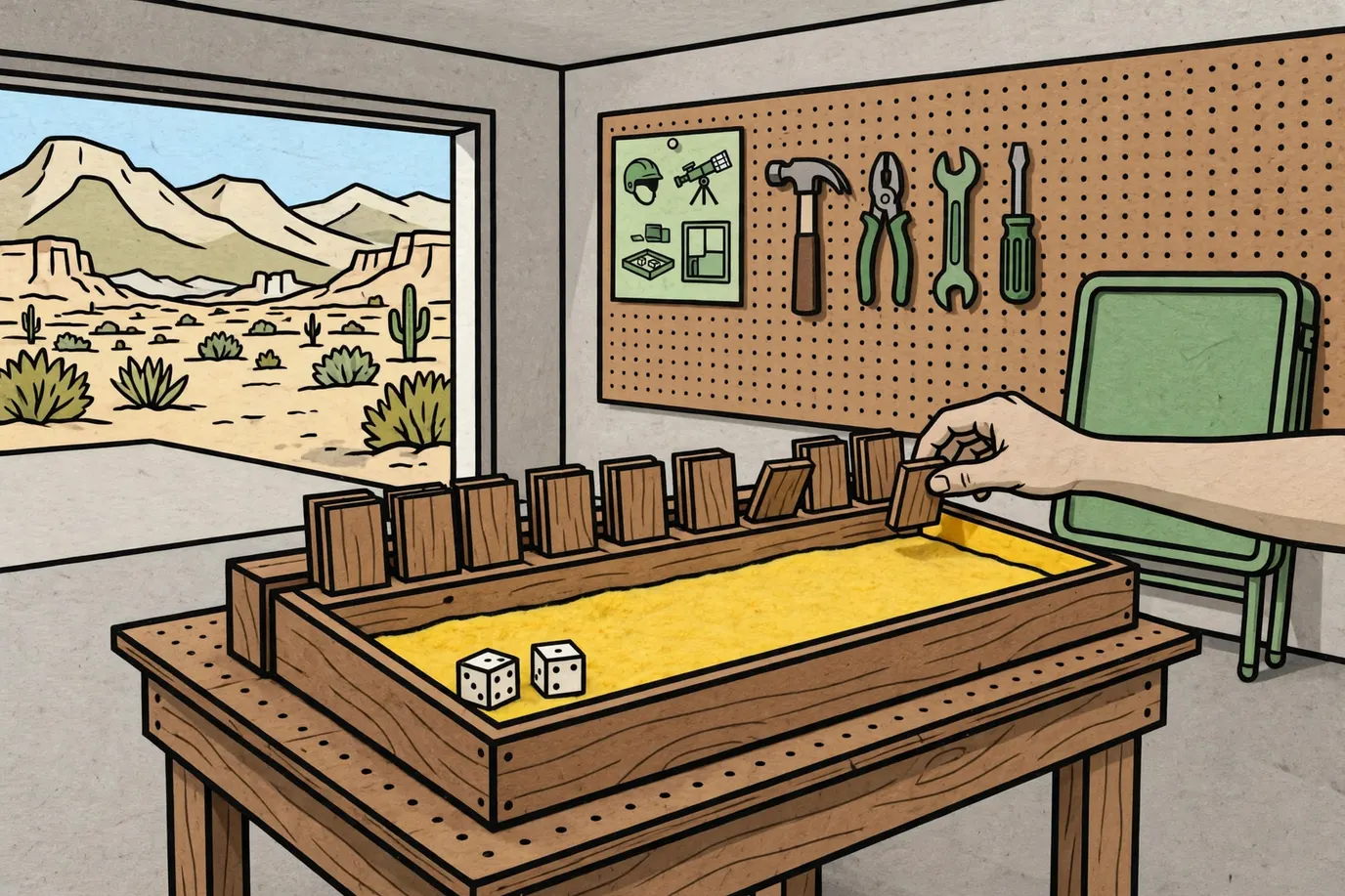
Shut the Box is a dice game built on adding. A row of numbered tiles stands up along the edge of a box. You roll dice, add them up, and flip down tiles that make that total. Then you roll again. Your turn goes on until a roll gives you nothing you can flip.
Whatever is still standing at that point is your score, and you want it low. Flip every tile down and you've "shut the box," which is the best thing that can happen and the reason for the name.
That's the whole idea. There are no cards, no board to move around and no pieces to lose except the dice. One player rolls at a time, everyone else watches, and the watching is half the fun. A turn can end on the first roll or run a long time, and the table always knows which one is coming a roll before the player does.
A note on where these rules come from
Neither maker of the two boxes in our data, AMEROUS or Regal Games, has a rule sheet we could open online. The AMEROUS listing name says instructions come in the box, and that sheet is the one to follow at your table.
So I'm working from a printed rule sheet from another maker: the University Games instruction sheet for its Old Century Shut-the-Box set. Shut the Box is an old public game, and many companies make a box for it. Their rules mostly agree, but details differ: how many tiles, when you drop to one die, and how the score is counted. Where those details matter, I'll say which version I mean.
Everything about the two boxes on Amazon US comes from their listings in our data.
How Shut the Box plays
These rules are in my own words, from the University Games Old Century Shut-the-Box sheet.
Before the first roll
- Flip all the number tiles up so every number shows.
- Decide who rolls first. The sheet doesn't say how, so pick any fair way.
- One player takes the dice. Everyone else waits for their own turn.
A round is simple: every player gets one turn on a fresh row of tiles.
A turn, start to finish
- Roll the dice inside the box.
- Add the two dice.
- Flip down any combination of standing tiles that adds up to that total.
- Roll again and repeat.
- When the tiles still standing add up to 6 or less, roll a single die instead of two.
- When a roll leaves you no combination you can flip, your turn is over.
The combinations are where the game gets interesting. The sheet's own example is a roll of 8: you could flip the 8 alone, or 5 and 3, or 6 and 2, or 7 and 1, or three tiles like 5, 2 and 1, or 4, 3 and 1. Every choice leaves a different row behind for your next roll.
One more rule worth knowing: a die that bounces out of the playing area, or one that leans against the side of the box at an angle, gets rerolled. The tray decides. Nobody at the table gets to.
Scoring and winning
When your turn ends, you score the tiles that are still standing. On the University Games sheet, you read them from left to right as one number. So if the 1, 4, 7, 8 and 9 are still up, your score is 14,789. That sounds like a lot of points. In this game it's a lot of points in the wrong direction.
Flip every tile down and your score is zero, which nobody can beat.
After everyone has had a turn, the lowest score wins the round. If two or more players tie for lowest, including a tie at zero, the sheet says everyone starts over with a new round.
Some other rule sheets count the score differently, often by adding up the standing tiles instead of reading them as one number. Both ways reward the same thing: leave the big numbers down and the fewest tiles up. Check your box's sheet and agree on one before the first roll.
The math under the lid
I teach middle-school math, so I can't let a game like this go by without a short lecture. I'll keep it to three points.
First, the 1 is the hardest tile to close on its own. Two dice can never roll a 1. The lowest they can make is 2. So the 1 tile only goes down as part of a bigger combination, like 7 and 1 for an 8, or on a single-die roll late in the turn. Smart players use it early as a helper, while big rolls are still coming.
Second, the big tiles want to go first. On a 12-number board, only two dice can close the 11 or the 12 tile alone, and only with a big roll. Once you're down to one die, nothing above 6 can close. So the high tiles get harder to clear the longer you wait.
Third, there's more than one right answer on most rolls. A roll of 9 might close the 9, or 8 and 1, or 6 and 3, or 5 and 4, or 4, 3 and 2. Picking between them is the whole skill of the game. Kids figure this out fast, usually right after they close a 9 with 5 and 4 and then roll a 9 again.
For the record, the tiles on a 12-number board add up to 78. You don't need that number to play. I just think it's nice to know what you're up against.
Shut the Box on Amazon US right now
Our data for this page lists two Shut the Box boards on Amazon US as of October 2026. Both are wooden dice games. The Regal Games listing names 12 numbers; the AMEROUS listing names 12 dice and a 12-inch size. Here's what each listing states. Where a listing leaves a field out, the table above shows a dash.
AMEROUS Shut The Box (12 Dice, 12 Inches)
- Players: 1 to 4
- Solo mode: yes, per the listing
- Components: a 4-way board and 12 dice
- Material: wood
- Size: 12 inches, in the listing name
- Age: not stated on the listing
The two facts that stand out are the 4-way board and the 12 dice. The listing doesn't explain how the four sides are laid out, but 12 dice in the box is a lot more than the two a single-row game needs, so it reads like a board built for several players at once. Look at the listing photos before you buy if that matters to you. The listing name also says instructions are included.
Regal Games Shut The Box
- Players: 2 or more
- Age: 8+
- Material: wood
- Numbers: 12, in the listing name ("12 Spots")
- Color: green, per the listing's variant
The listing name calls it a table math game and says it's good for game night and travel. It doesn't list the number of dice or other contents, so check the photos before you buy.
Which one to pick
If you want one board several people can play on together, the AMEROUS listing, with its 4-way board and 1 to 4 players, is the one that says so. If you want a plain board with an age label you can check, the Regal Games listing is the one that states 8+.
Neither listing gives a play time. A single turn is short, so a round goes about as long as your player count makes it.
Who the Shut the Box game suits
Shut the Box fits a lot of tables, for the same reason: everyone can learn it in one roll.
- Kids practicing addition: every roll is a sum, and every flip is a small subtraction from what's left
- Solo players: the AMEROUS listing names a solo mode, and the game works fine as a beat-your-own-score puzzle
- Mixed ages: one player rolls at a time, so the youngest and oldest play by the same rules
- A quick game between bigger ones: no setup beyond flipping tiles up
- Travel: a single box with no loose cards, as long as the dice stay put
House rule, if you have very new players: let beginners flip only one or two tiles per roll, and let everyone else flip any combination. It slows nobody down and keeps the choices small for a first game. That's our suggestion, not a rule on any sheet.
Another house rule some tables like: play three rounds and add the scores. One bad roll doesn't end your night that way. Agree on it before you start, and agree on which scoring method you're using, too.
Safety
Check the age label on the listing. Toys with small parts are a choking hazard for children under 3, and dice are small parts. The Regal Games listing says 8+, and the AMEROUS listing doesn't state an age, so keep the dice with the box and out of reach of little ones.
Who should skip it
Skip Shut the Box if your group wants to make big plans. Most of the game is the dice, and a strong choice can still lose to a roll of 2. Skip it, too, if your players don't like watching. One person rolls at a time, and on a table of four, you spend most of a round cheering for someone else.
And if the person you're buying for gets restless with numbers, this is a box full of numbers. A matching game or a dexterity game will land better.
If you like Shut the Box, look at these
Pages chosen by what they share with Shut the Box: dice, quick turns and adding.
- Dice games: the wider shelf of roll-and-score games
- Farkle: press-your-luck dice with scoring combos
- Yahtzee: five dice, three rolls and a score card
- Liar's dice: dice plus bluffing
- Travel games: small boxes for the road
Flip the big ones early. The 1 can wait for help.
Brands in this list
Related
Questions people ask
How do you play Shut the Box?
Start with every number tile up. Roll the dice, add them, and flip down any tiles that add up to your total. Keep rolling and flipping until a roll gives you no legal move. Then your turn ends and the tiles still standing make your score. Lower is better. Flip down every tile and you've shut the box, the best result there is.
How many players can play Shut the Box?
It depends on the box. The AMEROUS board in our data lists 1 to 4 players and a solo mode. The Regal Games board lists 2 or more players and no upper limit. The University Games rule sheet we read says any number can play, because each player takes a separate turn on the same tiles.
What age is Shut the Box for?
The Regal Games listing in our data says ages 8+. The AMEROUS listing doesn't state an age, so check the box. The game uses dice, which are small parts, and it asks a player to add two dice and find combinations that match, so 8+ is a sensible floor for the version on the listing.
How is Shut the Box scored?
Rule sheets differ, so use the one in your box. The University Games sheet we read scores by reading the tiles still standing from left to right as one number, so 1, 4 and 7 left up scores 147. The lowest score after one round wins, and shutting the box scores zero.
When do you roll one die instead of two?
The University Games sheet says to switch to a single die once the tiles still standing add up to 6 or less. That keeps the end of a turn possible, since two dice can never roll a 1. Other boxes word this rule differently, so check your sheet.
Sources
- University Games: Old Century Shut-the-Box instruction sheet (PDF) — accessed 2026-10-23
- CPSC: Small Parts Ban and Choking Hazard Labeling — accessed 2026-10-23