Board & Card Games · Type
Liar's Dice: Rules, Bluffing and the Sets on Amazon US
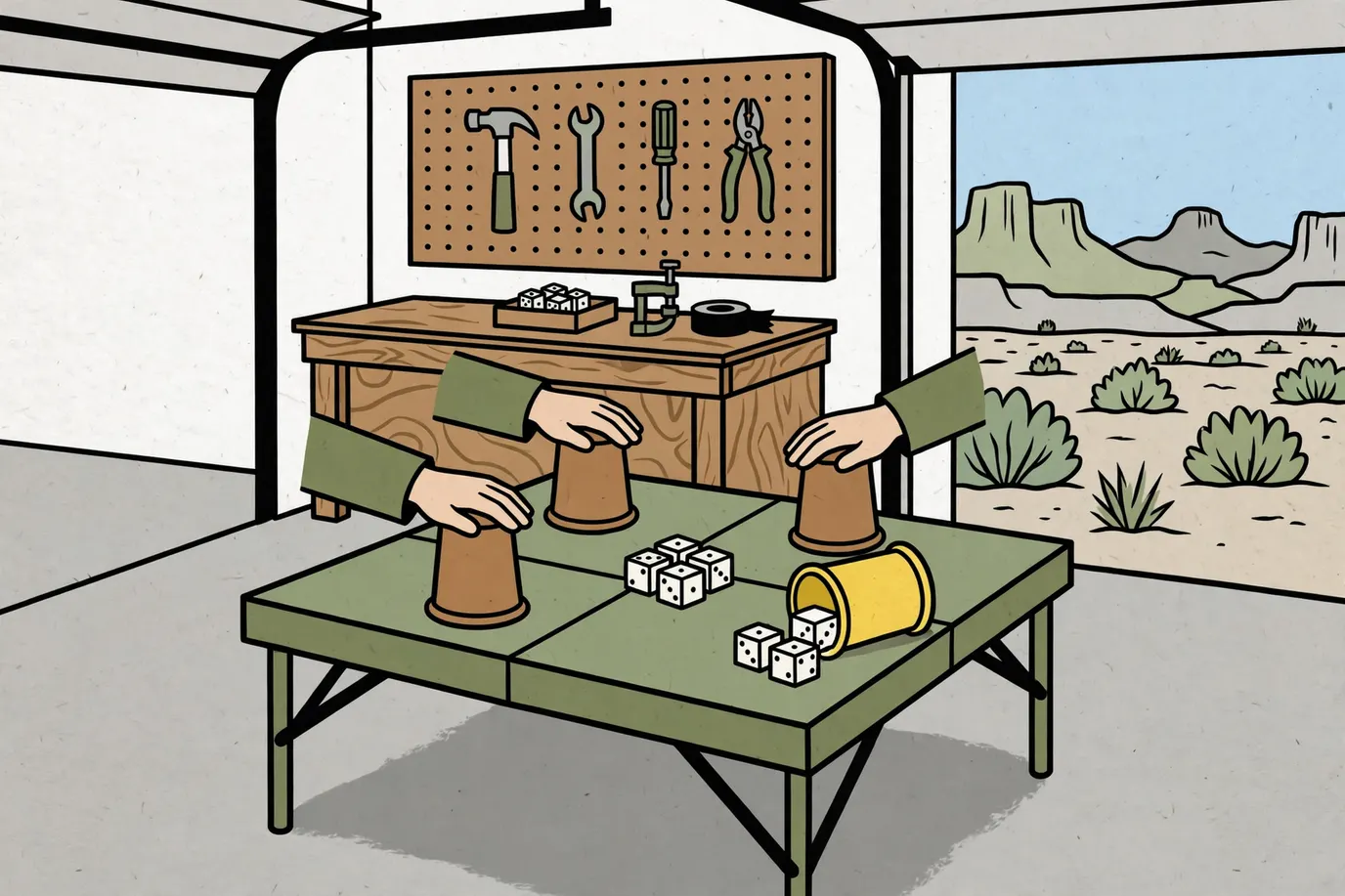
Liar's Dice is a bluffing game with dice hidden under cups: everyone bids on how many of one number are on the whole table, and the next player either raises the bid or calls liar. Lose a challenge and you lose a die. Last player with dice wins. Two Liar's Dice sets are listed on Amazon US right now, one for 2 to 4 players and one for 2 to 6. It's the only game in my closet where calling someone a liar is a legal move.
We earn a commission if you buy through our links, at no cost to you. Disclosure
| Model | Recommended age | Players (max) | Amazon |
|---|---|---|---|
Brybelly Liar's Dice Game Set Treasure ChestBoard & family games More specs
| — | 6listing | Check price |
University Games Liar's Dice in Wood CaseBoard & family games More specs
| 8+ yearslisting | 4listing | Check price |


What’s in this listEditions and versions of Liar'S Dice sold on Amazon US, matched by the name on the listing. Players, age and play time come from the box or listing. “—” means neither the maker nor the Amazon listing states it.
What Liar's Dice is
Liar's Dice is a bidding and bluffing game. Every player hides a handful of dice under a cup. Nobody sees anyone else's dice. Then players take turns making claims about all the dice on the table at once, like "there are six fives out there." Each claim has to be bigger than the last one, until somebody thinks the claim has gone too far and calls liar.
That's when the cups come up, and the table counts. Somebody was wrong, and they lose a die. Rounds keep going until one player has dice left.
Here are the box facts, from University Games' rule sheet for its Liar's Dice set (sold in its Front Porch Classics line) and the listings in our data:
- Players: 2 to 4 (University Games set); 2 to 6 (Brybelly set)
- Ages: 8+ (University Games set); not stated (Brybelly set)
- Contents: one cup and five dice per player
- Type: dice game with bluffing; everyone plays for themselves
- Expansion: no; both sets are complete games
Neither listing gives a play time, and the rule sheet doesn't print one. A game runs until every die but one player's is gone.
How Liar's Dice plays
Everything in this section is in my own words, from University Games' 2008 Liar's Dice rule sheet. Other Liar's Dice sets may come with slightly different rules. If your set came with its own sheet, that sheet wins.
Setup
Each player takes one cup and five dice. To see who starts, everyone rolls one die. Highest roll makes the first bid, and play goes clockwise from there.
A round, start to finish
- Everyone shakes their cup and sets it down upside down, dice hidden underneath.
- Each player peeks at their own dice, keeping them covered from everyone else.
- The first player makes a bid: a quantity and a number, like "six fives." That's a claim that at least six dice on the whole table show a five.
- The next player has two choices: raise the bid, or call liar. There's no passing.
- Bidding goes around until someone calls liar.
The no-passing rule is the one that makes the game. You can't sit out a round you don't like. You either push the claim higher or stake a die on calling it.
How to raise a bid
The rule sheet lists three ways to raise:
- More dice, any number. You can raise the quantity and even drop to a lower number. After "three threes," you can bid "four twos."
- Same quantity, higher number. After "six fives," you can bid "six sixes."
- Both. More dice and a higher number at once.
What you can't do is raise the number while lowering the quantity. After six fives, five sixes isn't a legal bid.
Ones are wild
In this rule sheet, ones count as any number. When the table counts a bid of seven fours, it counts every four and every one. Because of that, you can't open a round with a bid on ones.
Here's where the math teacher in me can't stay quiet. With ones wild, any single die has 2 chances in 6 of counting toward a bid on, say, fives: a five or a one. That's one in three. So with 20 dice on the table, you'd expect about 6 or 7 of them to count toward any number other than one. A bid of six fives at a four-player table is close to average, not bold. A bid of ten fives is a different conversation.
Calling liar
When a player calls liar, everyone lifts their cup. Count the dice that match the bid, ones included.
- The count meets or beats the bid: the player who called liar loses one die.
- The count falls short: the player who made the bid loses one die.
Whoever lost a die makes the first bid of the next round. When a player loses their last die, they're out, and the player to their left starts the next round.
Palafico: the last-die rule
This is the rule that gives Liar's Dice its best word. When a player is down to one die, they're Palafico, and they open the next round. That round plays differently:
- Ones are no longer wild.
- Ones are allowed as the opening bid.
- Nobody can change the number being bid. If the round opens on threes, it stays on threes, and players can only raise the quantity.
The rule sheet drops Palafico once only two players are left. At that point it's a straight duel to the last die.
How it ends
The last player with any dice wins. That's the only score in the game.
Rules people often get wrong
These come straight from the University Games rule sheet, and they're the ones a new table tends to skip:
- Passing. There's no pass. After any bid, the next player must raise or call liar.
- Raising the number. To bid a higher number, you need the same quantity or more. Six fives can become six sixes, not five sixes.
- Counting the ones. When the cups come up, ones count toward the bid, unless it's a Palafico round.
- Opening on ones. You can't open a normal round by bidding ones. Only a Palafico player can.
- Who starts next. The player who just lost a die opens the next round, not the player who won the challenge.
If your table has played a different way for years, that's fine. Just say so out loud before the first bid, and call it a house rule.
Bluffing, the University Games way
The rule sheet ends with three short strategy notes, and they're good ones. In my own words:
- Don't give away a bluff with your face or your hands.
- Don't bluff every time. Mix honest bids with bluffs so nobody can read you.
- Keep track of how many dice have left the game, and whose. Fewer dice on the table means smaller counts for every number.
That last one is the real skill. The table shrinks every round, and a bid that was safe with 20 dice is reckless with 12.
Lucho's take: "Bid like you've got five of them, even when you've got one." He loses about as often as that advice suggests. He's also never boring to play against.
Liar's Dice sets on Amazon US right now
Our data for this page lists 2 Liar's Dice sets on Amazon US as of October 2026. The table above shows what each listing states.
University Games Liar's Dice in Wood Case
- Players: 2 to 4
- Ages: 8+
- Contents: 4 dice shakers, 20 dice and a dice storage bag
- Listed as: a bluffing game in a solid wood case
This set lines up with the rule sheet in this page: four players, five dice each. If you want the game exactly as described above, this is the closest match in our data.
Brybelly Liar's Dice Game Set Treasure Chest
- Players: 2 to 6
- Age: not stated on the listing
- Contents: 6 leather dice cups, 30 dice, a bidding die and a game mat
- Listed as: a classic family bluffing game, in a treasure chest
This set seats up to six, with five dice each. It also lists two pieces the University Games rules don't use: a bidding die and a game mat. The listing doesn't explain how they're meant to be used, so I won't guess. The core game works without them either way.
What tells the two apart, by the listings: the player count (4 or 6), the stated age (8+ or none) and the extra bidding die and mat in the Brybelly set. Since the Brybelly listing doesn't state an age, I'd go by the University Games set for a family with kids.
Who Liar's Dice suits
The game is at its best with 4 to 6 players, enough hidden dice to make bids interesting and enough people to make calling liar a real risk. A few quick matches, from the listings:
- A family with kids 8 and up: the University Games set, listed at 8+
- A group of 5 or 6: the Brybelly set, the only one listing 6 players
- People who like poker but not cards: the bluffing is the same skill, without a deck
- A game that teaches odds without saying so: every bid is a guess about probability
It's also a good game for players who don't love long rulebooks. A short rule sheet covers it, and the only special rule is Palafico.
Who should skip Liar's Dice
Skip it if your group doesn't enjoy bluffing or being bluffed. Somebody gets caught in a fib every round. That's the game, and some tables find it more stressful than fun.
Skip it, too, if your youngest player is under 8. The University Games set lists 8+, and the other set doesn't state an age. Counting dice across the table and holding a guess in your head is a lot to ask before then.
And skip it for a quiet two-player night if you want a long game. With two players, there are only 10 dice to bid on, and the game moves fast.
Check the age label on the listing. Toys with small parts are a choking hazard for children under 3, and dice are small parts.
If you like Liar's Dice, look at these
Pages chosen by what they share with Liar's Dice: dice, bluffing and a table of 2 to 6.
- Dice games: the wider shelf of roll-and-score games
- Farkle: press-your-luck dice, no bluffing
- Yahtzee: five dice and a score card
- Coup: a card game built on bluffing
- Social deduction games: games about who's telling the truth
Lift the cup, count the ones, and don't look at your own dice twice.
Related
Questions people ask
How do you play Liar's Dice?
Everyone shakes five dice under a cup and peeks at their own. Players take turns bidding how many dice on the whole table show one number, like six fives. Each bid must go higher than the last, or the next player calls liar. Then everyone lifts their cups and counts. Whoever was wrong loses a die. The last player with dice wins.
Are ones wild in Liar's Dice?
In the University Games rule sheet we read, yes. Ones count as any number, so a bid of seven fours counts every four and every one on the table. You can't open a round by bidding ones. The exception is a Palafico round, which starts when a player is down to one die: then ones can be bid to open, and they aren't wild.
How many players can play Liar's Dice?
It depends on the set. The University Games set in a wood case lists 2 to 4 players, with 4 shakers and 20 dice, five dice each. The Brybelly Treasure Chest set lists 2 to 6 players, with 6 dice cups and 30 dice. The rules work the same at any size; a bigger table just means more hidden dice to bid on.
What does Palafico mean in Liar's Dice?
In the University Games rules, a player who's down to their last die is Palafico and opens the next round. In that round, ones aren't wild, ones may be bid to open, and nobody may change the number being bid, only raise the quantity. The Palafico rule is dropped once only two players are left in the game.
What age is Liar's Dice for?
The University Games set lists ages 8+ on its listing and on its rule sheet. The Brybelly Treasure Chest listing in our data doesn't state an age, so we don't suggest it for any particular age. Either way, the game needs a player who can count dice and hold a guess in their head, and the dice are small parts.
Sources
- University Games: Liar's Dice rule sheet (Front Porch Classics, 2008), PDF — accessed 2026-10-23
- CPSC: Small Parts for Toys and Children's Products — accessed 2026-10-23