Board & Card Games · Type
Checkers Board Game: How It Plays and the Sets
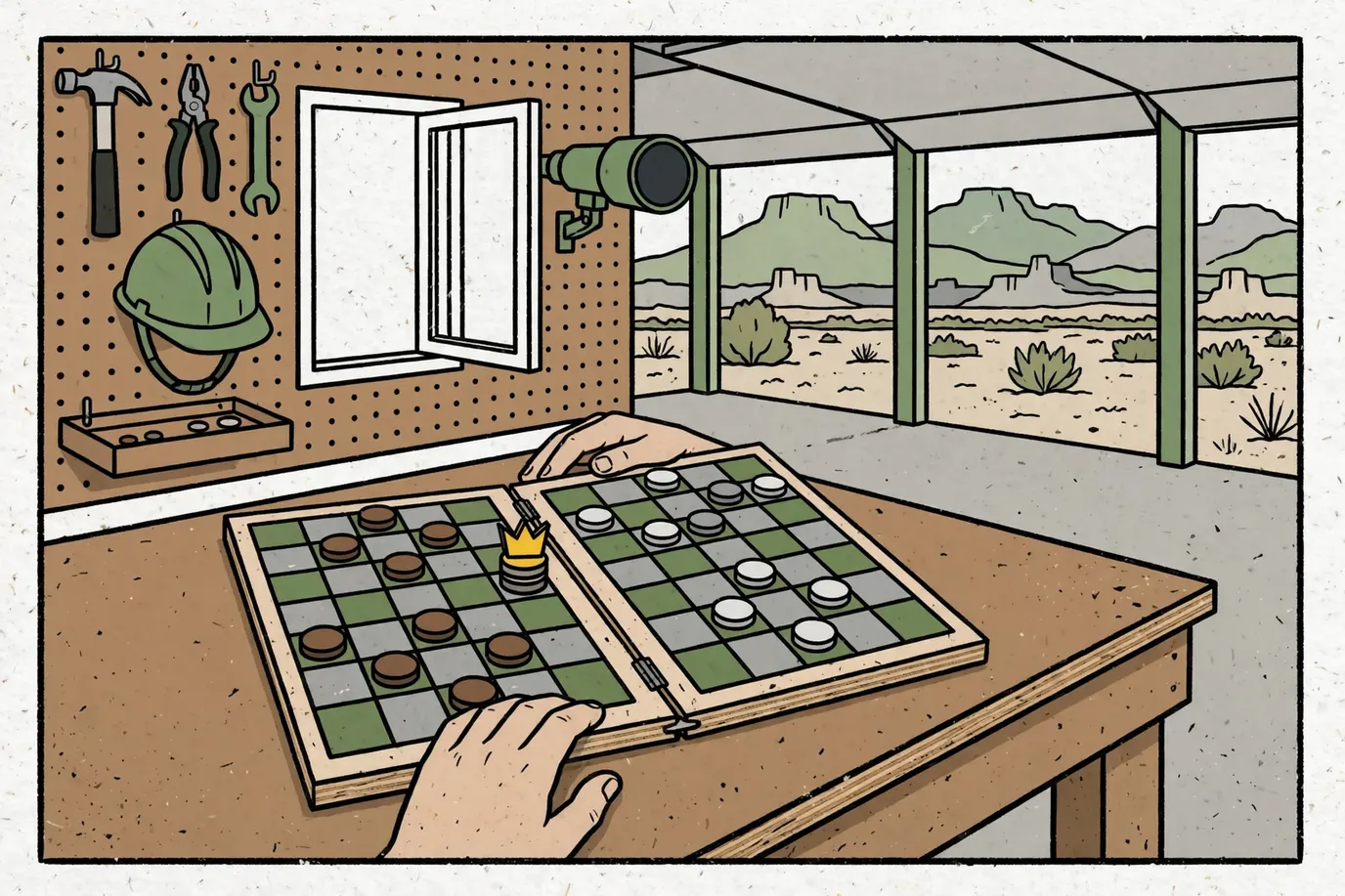
Checkers is a two-player board game on an 8 by 8 board: 12 pieces each, diagonal moves, forced jumps, and a crown for any piece that reaches the far side. The checkers board game sets on Amazon US run from folding boards for ages 6+ to giant mats and chess-and-checkers combos. Half the folding boards in my closet have a checkers grid on the back of some other game.
We earn a commission if you buy through our links, at no cost to you. Disclosure
Board & family games
| Model | Recommended age | Players (min) | Players (max) | Amazon |
|---|---|---|---|---|
WS Game Company Checkers and Backgammon Vintage Bookshelf EditionBoard & family games More specs
| 6+ yearslisting | 2listing | 4listing | Check price |
Pressman Checkers Folding BoardBoard & family games More specs
| 6+ yearslisting | 2listing | 2listing | Check price |
Pressman Premium Classics CheckersBoard & family games More specs
| 8+ yearslisting | 2listing | 2listing | Check price |
JOYIN 3-in-1 Vintage Giant Checkers, Tic, Tac, ToeBoard & family games More specs
| — | — | — | Check price |
Queen Games Checkers 30 PiecesBoard & family games More specs
| — | — | — | Check price |


Chess sets
| Model | Amazon |
|---|---|
| Check price | |
Spin Master Legacy Deluxe Chess & Checkers SetChess sets More specs
| Check price |


What’s in this listEditions and versions of Checkers sold on Amazon US, matched by the name on the listing. Players, age and play time come from the box or listing. “—” means neither the maker nor the Amazon listing states it.
What the checkers board game is
Checkers is a two-player strategy game with no luck in it. There are no dice and no cards. Each player starts with 12 round pieces on the dark squares of an 8 by 8 board. Pieces move diagonally, one square at a time, and capture by jumping over an opponent's piece. Reach the far row and your piece is crowned a king, which can move backward. Leave your opponent with no legal move and you win.
It's one of the oldest games most families own, and it's often on the back of another board. People in Britain call it draughts. The rules below come from the World Checkers/Draughts Federation, which uses that name.
The game facts, from the federation's rules:
- Players: 2
- Board: 64 squares, 8 by 8; play uses only the 32 dark squares
- Pieces: 12 per player, called men
- Who starts: Red moves first; colors are drawn for the first game, then alternate
- Luck: none
- Ages on the listings in our data: 6+ and 8+ where stated
How checkers plays
The rules below are in my own words, from the WCDF Rules of Draughts as posted by the American Checker Federation. Home games often relax a rule or two, and I'll point out which ones.
Setting up the board
- Turn the board so each player has a dark square at the lower left corner. The federation's rules call that the "single corner." The two dark squares at the right are the "double corner."
- Place 12 pieces on the dark squares of the three rows nearest you.
- Leave the two middle rows empty.
If the board is turned wrong, the pieces sit on the light squares, and the game feels backwards from the first move. Check the corners before anyone sits down.
A move, start to finish
- Pick one of your pieces.
- Move it one square diagonally forward to an empty dark square.
- Or, if an opponent's piece sits diagonally next to yours with an empty square behind it, jump over it and land on that square.
- Remove the piece you jumped.
- If the landing square sets up another jump, keep jumping with the same piece.
A regular man moves and captures only forward. A piece can't be jumped twice in the same sequence. The captured pieces come off the board at the end of the sequence, not one by one.
The rule families argue about: forced jumps
Under the federation's rules, all captures are compulsory. If you can jump, you have to, even if you'd rather not. If you have two different jumps, you choose which. You're not required to take the one that captures more.
This is what makes checkers a trap game. A good player offers you a piece on purpose, knowing you must take it, and then takes two of yours back. Plenty of family games skip the forced-jump rule, and it's a different game when you do. Pick a version and say it out loud before the first move.
Kings
When a man reaches the far row, it's crowned: a second piece goes on top of it. Crowning ends your turn, even if the new king could jump right away. It has to wait until your opponent moves.
A king moves one square diagonally in any direction, forward or back, and captures in any direction. The federation's kings move one square at a time. That's worth saying, because some games played on the same board let a king slide the whole diagonal. That's not this game.
In our house, you have to say "king me" out loud, or it didn't happen. It's not in the federation's rules. Dana enforces it anyway.
How a game ends
You win when your opponent can't make a legal move: every piece is captured, or every piece left is blocked in. You also win if your opponent resigns.
The federation rules allow draws too. Players can agree to one. A draw can also be claimed when the same position is about to come up a third time, or when 40 moves have passed on each side with no capture and no uncrowned man moving forward.
Two tournament rules worth knowing
- Touch and move. If you touch one of your pieces on your turn and it can legally move, you must move it, unless you warned your opponent you were only adjusting it.
- Illegal moves. In federation play, a first illegal move gets a caution and is taken back. A second one loses the game.
At home, touch-and-move is the only one I'd bring to the table. Once you add it, you'll watch adults hover a hand over a checker like it's a hot stove.
Teaching checkers to a new player
Checkers is a good first strategy game because a whole move fits in one sentence. Here's how I'd run a first game. These steps are our habits, not federation rules:
- Set up together. Have the new player count out their 12 and find the single corner themselves.
- First game, no forced jumps. Let them learn moving and jumping without the trap rule. Add it in game two.
- Show the trap once. Offer a piece on purpose, let them take it, then jump back twice. They'll remember it.
- Crown with ceremony. Stacking the second piece is the best moment in the game for a new player. Make it count.
- Talk about the back row. Pieces left on your home row take up the squares the other player needs to crown a king. It's the first real plan most players learn.
Checkers sets on Amazon US right now
Our data for this page lists 7 checkers listings on Amazon US as of October 2026. The table above shows what each listing states. A dash means the listing leaves it out. Here's what tells them apart.
Classic folding boards
- Pressman Checkers Folding Board. Listed for ages 6+, 2 players. The listing names a folding board and interlocking checkers. It's not marked as resale stock.
- Pressman Premium Classics Checkers. Listed for 8+, 2 players. The listing names a folding game board and 24 wooden checkers.
These two are the plain version of the game in the federation's rules: one board, one set of pieces, two players. The Folding Board starts at 6+, so it's the one for a younger first player.
Oversized and giant sets
- Queen Games Checkers 30 Pieces. The listing names 30 oversized checkers and a double-sided folding board. No age is listed in our data.
- JOYIN 3-in-1 Vintage Giant Checkers, Tic, Tac, Toe. The listing names 24 giant checkers and a reversible mat, and calls it a giant edition. It's marked as resale stock. No age is listed in our data.
The JOYIN set adds tic-tac-toe on the mat, so it covers two games. A giant mat is the one set here meant for the floor or the patio rather than a table.
Wooden sets with a second game
- WS Game Company Checkers and Backgammon Vintage Bookshelf Edition. Listed for 6+, wood components, and listed as a retro reissue. The listing says 2 to 4 players, which covers the two games in the box. It's marked as resale stock.
- Spin Master Legacy Deluxe Chess & Checkers Set. Listed with wood pieces, a wood board and folding storage, and it plays checkers as well as chess.
- AMEROUS Magnetic Wooden Chess and Checkers Set (2 in 1). Our data holds no specs for this listing beyond its name, which says magnetic, wooden, chess and checkers.
Magnetic pieces stay put on a bumpy table or a car seat, which is why people buy them. Swallowed magnets can cause serious internal injuries. Keep loose or broken magnetic pieces away from young children.
Check the age label on the listing for every set here. Checkers are small enough to swallow, and toys with small parts are a choking hazard for children under 3.
Which checkers set fits your table
My one opinion for this page: piece count is not value. The game needs 24 pieces, 12 a side. A box with 30 isn't a bigger game. The extras are spares, which is handy, since crowned kings need a second piece and the captured ones serve. A giant set's 24 pieces play exactly the same game as a folding board's 24. Buy for where you'll play and who's playing, not for the number on the box.
A few quick matches, from the listings:
- A first set for a 6- or 7-year-old: the Pressman Folding Board at 6+
- Wooden pieces, plain game: Pressman Premium Classics at 8+
- A patio or a classroom floor: the JOYIN giant set
- Two games in one box: the WS Game Company checkers and backgammon set, or one of the chess and checkers sets
- A car trip: a magnetic set, kept away from little kids
Who should skip checkers
Skip it if your table wants more than two players at once. Checkers is strictly two. The WS Game Company box lists 2 to 4 players because of its second game, not because checkers stretches.
Skip it if one player is much stronger than the other and neither enjoys that. There's no luck to even things out. The stronger player wins nearly every time. Handicaps help, as a house rule: the stronger player starts with one or two fewer pieces.
Skip the 8+ sets for a child younger than 8. Look at the 6+ Pressman Folding Board instead.
If you like checkers, look at these
Pages chosen by what they share with checkers: two players, a board and no luck.
- Chess sets: the next step for a checkers player, often on the same board
- Chinese checkers: jumping pieces, for up to six
- Backgammon sets: a two-player classic with dice
- Othello: two colors, one board, flipping instead of jumping
- Classic board games: the wider shelf of old favorites
The Spin Master set in this table has a Spin Master brand page with the rest of that lineup.
Single corner on your left. Then Red moves.
Brands in this list
Related
Questions people ask
How do you play checkers?
Each player sets 12 pieces on the dark squares of the three rows closest to them. Players take turns moving one piece diagonally forward to an empty dark square, or jumping an opposing piece to capture it. A piece that reaches the far row becomes a king and can move backward too. You win when your opponent has no legal move left.
Do you have to jump in checkers?
Under the World Checkers/Draughts Federation rules, yes. Captures are compulsory: if you can jump, you must. If you have more than one jump available, you may choose which one, even if another captures more pieces. Once a jump starts, you must keep jumping with that piece while jumps are available. Many families play this rule loosely, but the printed rules don't.
Can kings move backward in checkers?
Yes. Under the federation rules, a regular piece, called a man, moves and captures only forward. A king moves one square diagonally in any direction and can capture forward or backward. A man becomes a king when it reaches the far row, and a second piece is stacked on top to mark it. Crowning ends that turn.
How many pieces are in a checkers set?
The game uses 12 pieces per player, 24 in all. The Pressman Premium Classics listing in our data names 24 wooden checkers. The Queen Games set lists 30 oversized checkers, and the JOYIN giant set lists 24 giant checkers. Extra pieces are spares; captured pieces can serve as the crowns for kings.
Who moves first in checkers?
The federation rules call the two sides Red and White, and Red moves first. Colors are drawn at random for the first game and alternate after that. Home sets are often red and black, so agree before the first move which color counts as the one that starts. That's a house rule for sets whose colors don't match the federation's names.
Sources
- American Checker Federation: WCDF Rules of Draughts (checkers) — accessed 2026-10-23
- CPSC: Small Parts Ban and Choking Hazard Labeling — accessed 2026-10-23
- CPSC: Magnets — accessed 2026-10-23