Board & Card Games · Type
Backgammon Board and Sets: How the Game Plays and What to Buy
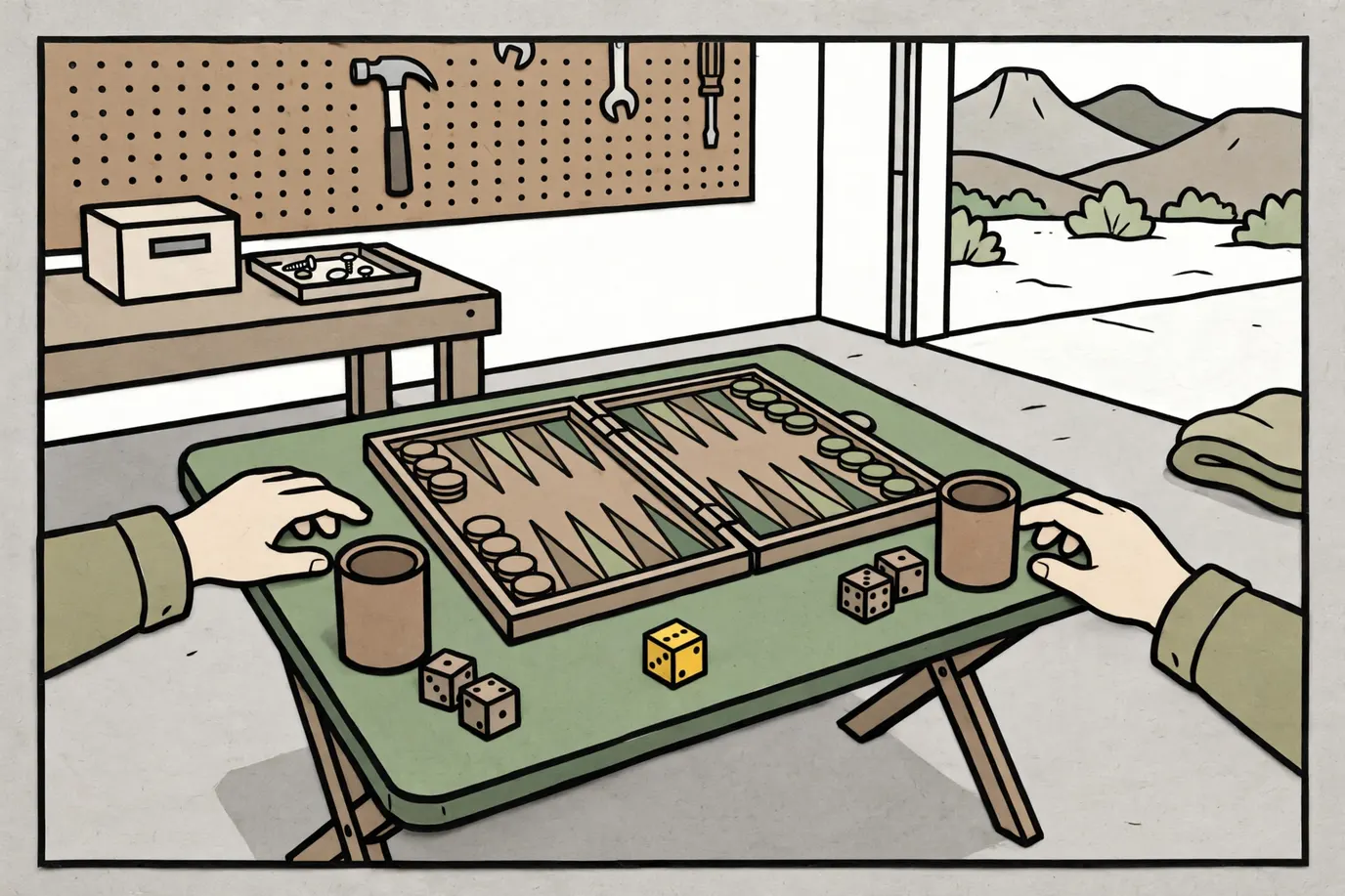
A backgammon board is a race track for two players: 15 checkers each, two dice, and 24 narrow points to run around before you can bear off. Every set on Amazon US plays the same game. What changes is the case, the size, the extras and whether the box shares space with chess or checkers. I like a game that fits on one board and still starts an argument about the dice.
We earn a commission if you buy through our links, at no cost to you. Disclosure
Board & family games
| Model | Recommended age | Players (min) | Players (max) | Amazon |
|---|---|---|---|---|
WS Game Company Checkers and Backgammon Vintage Bookshelf EditionBoard & family games More specs
| 6+ yearslisting | 2listing | 4listing | Check price |
Pressman BackgammonBoard & family games More specs
| 7+ yearslisting | 2listing | 2listing | Check price |
Queen Games Large Backgammon SetBoard & family games More specs
| — | 2listing | 2listing | Check price |
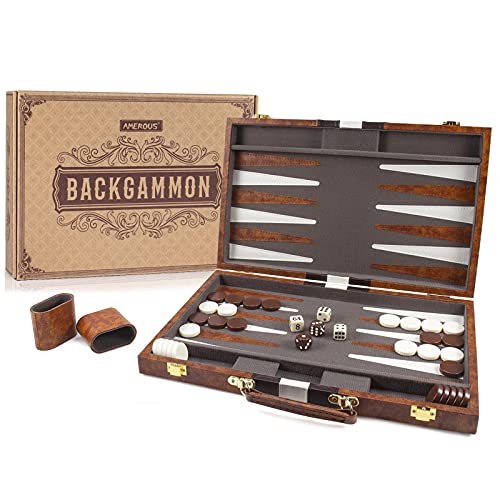
AMEROUS 15 Inch Backgammon Set with Leather CaseBoard & family games More specs
| — | — | — | Check price |


Chess sets
| Model | Amazon |
|---|---|
| Check price |

What’s in this listEditions and versions of Backgammon sold on Amazon US, matched by the name on the listing. Players, age and play time come from the box or listing. “—” means neither the maker nor the Amazon listing states it.
What a backgammon board is, and what you're buying
Backgammon is a two-player race game with dice. You and your opponent each have 15 checkers. You move them in opposite directions around a board of 24 points, and the first player to bring all 15 home and take them off the board wins. Along the way you can knock a lone enemy checker back to the start, and they can do the same to you.
That's the game. A backgammon set is the hardware for it. Every set on Amazon US in our data plays the same rules. The differences are physical:
- The case: a hinged board that folds shut, a leather-style case, or a bookshelf box
- The size: one listing puts 15 inches in the name, another calls itself "Large"
- The extras: dice cups, a doubling cube, spare pieces
- The company it keeps: two listings share the box with checkers, and one adds chess
So the buying question isn't "which backgammon?" It's "where will this set live, and who's carrying it?"
How backgammon plays
These rules are in my own words, from the US Backgammon Federation's "Backgammon Basics" page. The USBGF is the game's national players' group, and its page is the cleanest plain-English rules source I found. The sets in our data don't post their own rulebooks online. If your box has a rules sheet, it should match the standard game below.
The board, in one picture
The board has 24 long triangles called points. They sit in four groups of six. A raised strip down the middle, called the bar, splits the board in half. Each player has a home board, the six points where their checkers finish, and an outer board next to it.
You number the points from your own side. Your 1-point is the deepest point in your home board. Your 24-point is the farthest one away, which is also your opponent's 1-point. That flip is the first thing that trips up new players. Both of you are counting, just from opposite ends.
Setup
Each player places their 15 checkers like this, counting from their own side:
- Two checkers on the 24-point
- Five on the 13-point
- Three on the 8-point
- Five on the 6-point
Here's a number I can't leave alone. Add up how far every checker has to travel to get home. Two checkers at 24, five at 13, three at 8 and five at 6 comes to 167 pips. Both players start at 167. Players call that total the "pip count," and it's how you tell who's ahead in the race at any moment. I mention this to seventh graders as proof that adding is a strategy.
Who goes first
Each player rolls one die. High number goes first, and plays the two numbers just rolled as their opening move. If the dice tie, you both roll again. That means nobody ever opens with doubles, which is the kind of fairness rule I wish more games had.
A turn
- Roll two dice.
- Move one checker the number on one die, and one checker the number on the other. The same checker can take both moves.
- You can land on any point that's empty, holds your own checkers, or holds just one enemy checker.
- You can't land on a point that holds two or more enemy checkers. That point is blocked.
- Roll doubles and you play that number four times. Double 6s means four moves of six.
You have to use both dice if you legally can. If only one die can be played, you play that one. If either one could be played but not both, you play the larger. If nothing fits, you lose the turn. The rules don't let you skip a move because you don't like it, which is where most of the groaning at my table comes from.
Hitting and the bar
A single checker alone on a point is called a blot. If your opponent lands on it, that's a hit. Your checker goes to the bar in the middle of the board.
A checker on the bar has to come back in before you can move anything else. You bring it in on your opponent's home board, on the point that matches one of your dice. If that point is blocked, that die can't be used for it. If both are blocked, your turn is over. A player with a checker stuck on the bar just watches. It's backgammon's version of the penalty box, and nobody enjoys a power play against them.
Bearing off and winning
Once all 15 of your checkers are in your home board, you can start bearing off, which means taking them off the board. A die that matches a point lets you take a checker off that point. If you roll higher than your farthest checker, you take off the farthest one. If you roll a number with no checker on it but checkers sit farther out, you have to move one of those instead.
If you get hit while bearing off, that checker has to travel all the way back home before you take off any more. The first player with all 15 checkers off the board wins.
Gammons, backgammons and the cube
A normal win is worth one point, times the doubling cube. Win before your opponent has borne off a single checker and it's a gammon, worth double. Win while they've borne off nothing and still have a checker on the bar or in your home board, and it's a backgammon, worth triple.
The doubling cube is the six-sided block marked 2, 4, 8, 16, 32 and 64. It starts in the middle with the 64 facing up, which in this game means 1. It's the only object in my house where the biggest number means the smallest one. At the start of your turn, before rolling, you may offer a double. Your opponent either quits and pays the current stake, or accepts and takes the cube. Only the player holding the cube can double next.
House rule: if you're teaching a new player, leave the cube in the box for the first few games. The USBGF page lists a few optional extras that some players add, like automatic doubles on the opening roll, and flags that they aren't used in match play. Learn the race first. Add the money math later.
Backgammon sets on Amazon US right now
Our data for this page lists 5 backgammon sets on Amazon US as of October 2026. The table above shows the players, age and play time each listing states. Where a listing leaves a field out, the table shows a dash.
Dedicated backgammon sets
Three of the five are backgammon only.
- Pressman Backgammon. Listed for ages 7+ and 2 players. The listing in our data doesn't describe the case or the pieces, so check the photos on the listing before you buy.
- Queen Games Large Backgammon Set. Listed for 2 players. It's the most detailed listing in the group: 32 playing pieces, 4 dice, a doubling cube, 2 dice cups and a leather case. The rules use 30 checkers, and the listing doesn't say what the other two pieces are for.
- AMEROUS 15 Inch Backgammon Set with Leather Case. The size is in the name. The listing names a backgammon board, doubling cube, dice shakers, playing chips and dice, without counts. It doesn't state an age or player count.
If you want a set that's ready for the cube rules out of the box, the Queen Games and AMEROUS listings both name a doubling cube. The Pressman listing in our data doesn't mention one either way.
Sets that share the box
- WS Game Company Checkers and Backgammon Vintage Bookshelf Edition. Two games in one box. The listing calls it a retro or vintage reissue, lists ages 6+ and 2 to 4 players, and names wood components. It's also marked as resale stock. The 2 to 4 count covers the box as a whole. Backgammon itself stays a two-player game.
- Spin Master Cardinal Classics Chess, Checkers, Backgammon Set. Three games, per the name. Our data has no other details from the listing: no age, no player count, no component list. Check the listing itself before you buy.
A shared box makes sense for a family that wants one case on the shelf instead of three. A dedicated set makes sense if backgammon is the game you'll play most.
Which backgammon set fits your table
My one opinion for this page: piece count is not value. Every set here plays with the same 15 checkers per side, so a bigger board or a longer contents list doesn't give you more game. Size changes how the set feels on the table and how easily it travels. It doesn't change a single rule.
Here's the table version, from the listings:
- A first set for a 7-year-old and up: Pressman Backgammon, at 7+
- One case for several classic games: the Spin Master 3-in-1 or the WS Game Company checkers-and-backgammon box
- Doubling cube and dice cups named on the listing: Queen Games Large or AMEROUS 15 Inch
- Something that looks like a book on the shelf: the WS Game Company Vintage Bookshelf Edition
A few questions to ask before you click:
- Where will it be played? A big board wants a real table. A smaller one can work on a couch cushion, barely.
- Does it travel? A latching case keeps 30 checkers from leaving home without you.
- Who's the youngest player? The ages listed in our data start at 6+ and 7+. Some listings don't say.
- Is anyone going to want the cube? If yes, pick a listing that names one.
Check the age label on the listing. Toys with small parts are a choking hazard for children under 3, and dice and checkers are small parts.
Who should skip backgammon
Skip it if your group is usually three or more. Backgammon seats two, and the third person ends up keeping the pip count, which is a job, not a game. A multi-game box can help, since checkers and chess are two-player too. A party game would help more.
Skip it too if luck ruins the night for someone at your table. Backgammon has real strategy, but every turn starts with the dice, and a good plan can lose to a bad roll. If that makes someone flip the board, choose a game with no dice at all.
And skip the cube for new players. That's not skipping the game. It's skipping the hardest part of it until the race makes sense.
If you like backgammon, look at these
Pages chosen by what they share with backgammon: two players, a classic board, a short setup.
- Checkers: the other game in two of these boxes
- Chess sets: the third game in the Spin Master box
- Mancala: another very old two-player race to collect pieces
- Dice games: more games where the roll sets the pace
- Classic board games: the wider shelf of games your grandparents knew
- Vintage board games: reissues and older boxes, like the Bookshelf Edition
The Spin Master set has its own brand page: see Spin Master for the rest of that lineup.
Fifteen checkers, two dice, one cube. Roll one die each to see who starts.
Brands in this list
Related
Questions people ask
How many checkers are in a backgammon set?
The rules call for 15 checkers per player, 30 in all, plus two pairs of dice, dice cups and a doubling cube. The listings in our data describe their contents differently. The Queen Games Large Backgammon Set lists 32 playing pieces, 4 dice, a doubling cube, 2 dice cups and a leather case. The AMEROUS listing names chips, dice, shakers and a cube without counts.
How many players can play backgammon?
Backgammon is a game for exactly two players. The Pressman and Queen Games listings both say 2 players. The WS Game Company Vintage Bookshelf Edition lists 2 to 4 players, but that box holds both checkers and backgammon, and the listing doesn't break the count down by game. For backgammon itself, plan on two.
What is the doubling cube for?
The doubling cube raises the stakes of a single game. At the start of your turn, before you roll, you can offer to double. Your opponent either gives up the game at the current value or accepts and takes the cube. Only the player who holds the cube can double next. Casual players often leave it in the box, which the rules allow.
What is a gammon in backgammon?
A gammon is a bigger win. If you bear off all 15 checkers before your opponent bears off even one, they lose double the cube value. A backgammon is bigger still: the loser has borne off nothing and still has a checker on the bar or in the winner's home board, and loses triple.
What age is backgammon for?
The listings in our data start at 6+ for the WS Game Company Vintage Bookshelf Edition and 7+ for the Pressman set. The Queen Games, AMEROUS and Spin Master listings don't state an age. Dice and checkers are small parts, so keep any set away from children under 3.
Sources
- US Backgammon Federation: Backgammon Basics – How to Play — accessed 2026-10-23
- CPSC: Small Parts Ban and Choking Hazard Labeling — accessed 2026-10-23