Board & Card Games · Type
Chinese Checkers Game: Rules, Setup and Sets
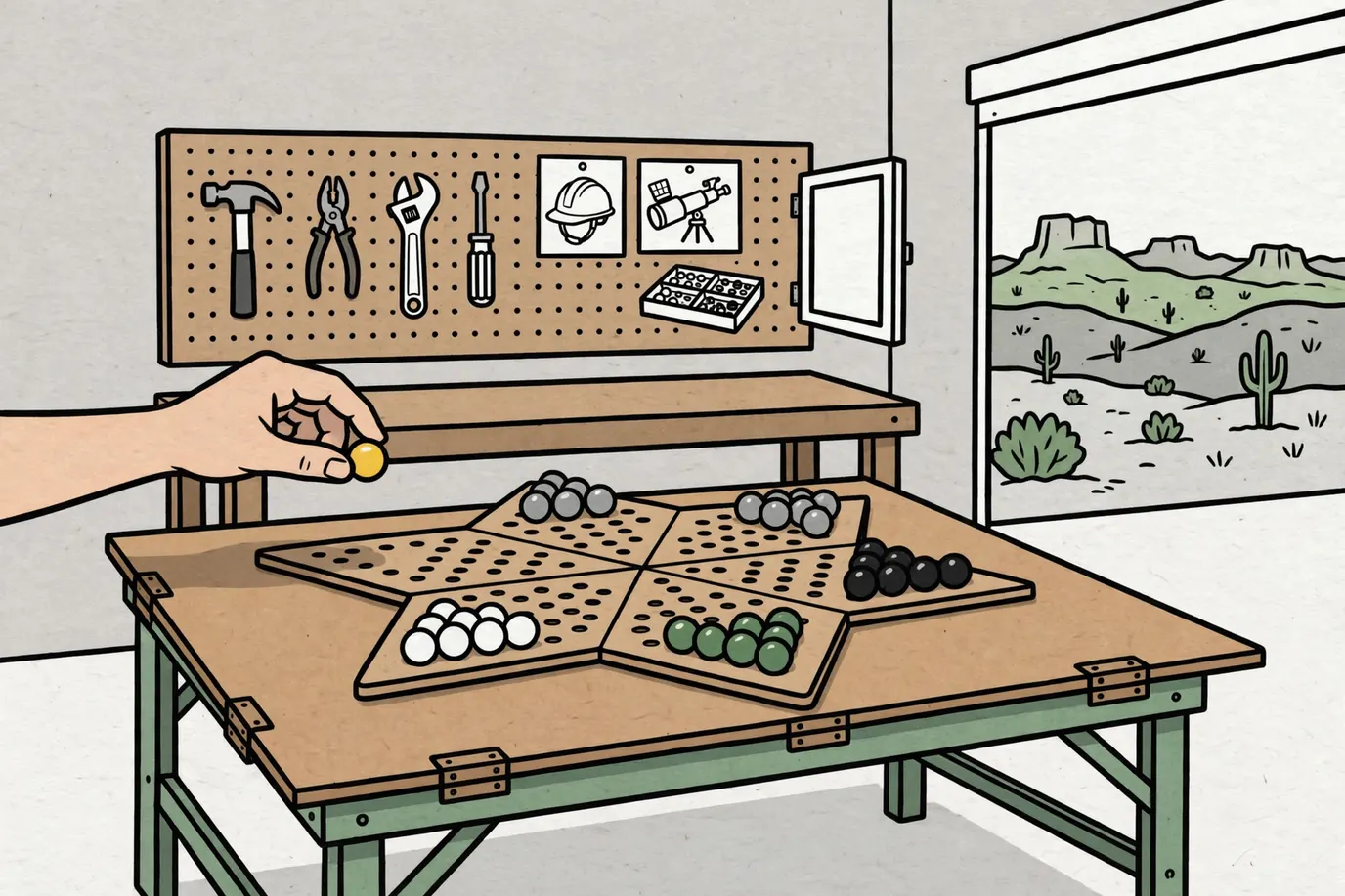
The Chinese checkers game is a race on a six-point star: move your 10 marbles across the board into the point opposite your start, before anyone else does. Both sets in our data list 2 to 6 players and 60 marbles. One is a wooden board with a storage drawer, the other a Pressman set listed for ages 7+. Sixty marbles split six ways is the friendliest division in any game box, and it's the last easy math of the night.
We earn a commission if you buy through our links, at no cost to you. Disclosure
| Model | Recommended age | Amazon |
|---|---|---|
AMEROUS 12.5 Inch Wooden Chinese Checkers with Storage DrawerBoard & family games More specs
| — | Check price |
Pressman Chinese CheckersBoard & family games More specs
| 7+ yearslisting | Check price |


What’s in this listEditions and versions of Chinese Checkers sold on Amazon US, matched by the name on the listing. Players, age and play time come from the box or listing. “—” means neither the maker nor the Amazon listing states it.
What the Chinese checkers game is
Chinese checkers is a race game played on a board shaped like a six-point star. Each point is a small triangle of holes. You start with your marbles packed into one point, and you win by moving all of them into the point directly across the board.
That's the whole goal. There's no capturing, no kings and no dice. Every turn you move one marble, and every move is your own decision. It's luck-free in a way most family games on our shelves are not.
The name is a little misleading on two counts. It's not really checkers, because nothing gets taken off the board. And the rules sheet I worked from doesn't claim any history at all, so I won't either. What I can tell you is what's in the box and how a turn goes.
Here's what the listings in our data state, before we get to the rules:
- Players: 2 to 6, on both sets
- Marbles: 60 on both sets, plus 12 spares on the wooden one
- Age: 7+ on the Pressman listing; not stated on the other
- Expansions: none; both are complete games
- Type: listed as a strategy game on the wooden set
How Chinese checkers plays
The rules below are in my own words, from Maple Landmark's Chinese Checkers instruction sheet. Maple Landmark makes wooden game boards and publishes its rules online. Neither of the two sets in our data put their own rulebook on the web, so I can't promise their printed sheets read word for word the same. The core rules are short, though, and they match across every version I've read.
Setup by player count
- Each player picks one color and takes 10 marbles of it.
- Fill one point of the star with your 10 marbles, one per hole.
- With two players, sit at opposite points.
- With three players, use every other point, so each player has an empty point across from them.
- With four or six, fill the points so everyone still faces the point they're racing toward.
The rules sheet says to set up two and three players exactly as above and leaves the larger counts with a short "and so on." Five players works the same way, with one point left empty. That's a table habit, not a printed rule.
A turn, start to finish
On your turn you move one marble. Just one. You have two kinds of move to choose from.
- A step. Move the marble one hole in any direction into an empty hole next to it.
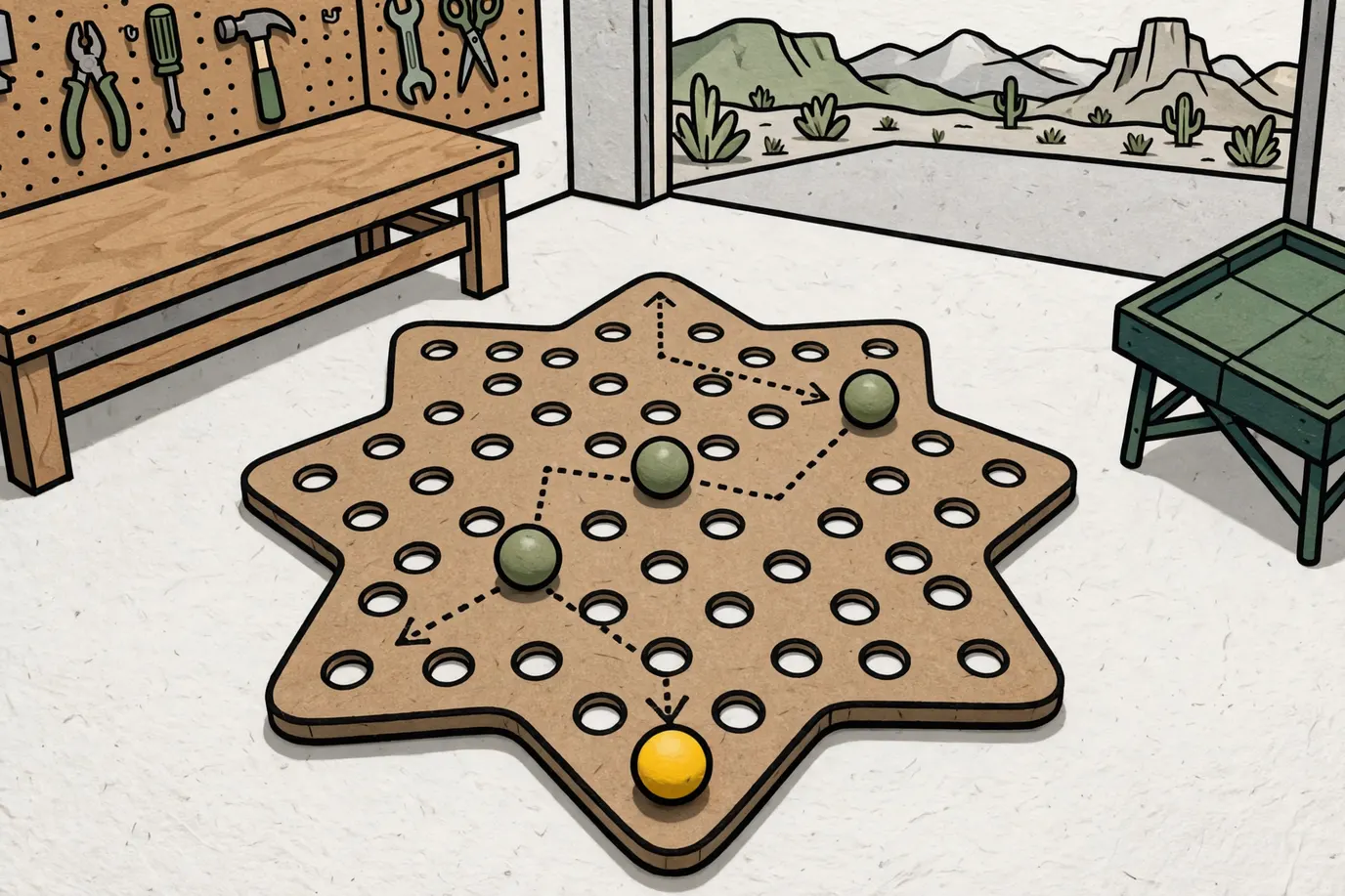
- A jump. Hop over one marble that sits right next to yours, in a straight line, and land in the empty hole directly beyond it. The marble you jump over can be yours or anyone else's.
After a step, your turn is over. After a jump, you can keep going. If your marble lands somewhere it can make another straight hop over another single marble, it can jump again. The rules sheet lets those chains go straight or zig-zag, as long as every single hop is straight and covers only one marble.
You can't mix the two. A step ends the move, so you can't jump twice and then take one step to finish.
Nothing leaves the board
Maple Landmark's sheet says it plainly: marbles are never removed. That's the rule that makes the game feel different from checkers. You can hop over an opponent ten times in one game and they lose nothing but a little time. The board just keeps getting more crowded in the middle.
How it ends
The first player to move all 10 marbles into the point opposite their start wins. With three or more players, the rest can keep going to settle second place, or you can call it there and set up again. Either is fine. The sheet only names the winner.
What actually wins a game
The rulebook gives you two moves. The game is about lining them up.
A single step moves a marble one hole. A good chain jump can move it most of the way across the board in one turn. So the real skill is building a path: leaving your marbles spaced one hole apart in a line, so a marble from the back can hop over all of them. Then you do it again with the next marble from the back.
Here's the catch. Your opponents can use your path too. For jumping, a marble is a marble, whoever owns it. Sam calls a long chain "the elevator," and he figured out at 7 that he could ride my elevator before I could. He's right. It was my path. He rode it home.
A few habits that help, all from the two-move rule:
- Move marbles from the back of your point first, so nothing gets stranded
- Keep a line open behind you for your own next jump
- Watch for gaps that would give an opponent a long chain
- Don't leave one marble behind at the start; the last one is always the slowest
Most games come down to that last marble. Everyone has nine home and one wandering around the middle of the star, one step at a time, while the person who planned ahead finishes.
Chinese checkers sets on Amazon US right now
Our data for this page lists two Chinese checkers sets on Amazon US as of October 2026. The table above shows the players and age each listing states. Where a listing leaves a field out, the table shows a dash.
AMEROUS 12.5 Inch Wooden Chinese Checkers with Storage Drawer
- Players: 2 to 6
- Board: wood, with a drawer built in, per the listing
- Marbles: 60 acrylic marbles, plus 12 spares
- Age: not listed
The drawer is the detail that tells this one apart. The marbles live inside the board, so the game is one piece on the shelf instead of a board plus a bag. The 12 spares cover the one or two marbles that will, sooner or later, find the lowest point of your floor. The listing gives the board's size in its name, 12.5 inches, and doesn't give an age.
Pressman Chinese Checkers
- Players: 2 to 6
- Age: 7+
- Marbles: 60, per the listing
- Spares: none listed
This is the set with an age printed on the listing. It doesn't list the board material or any spare marbles, so I won't guess at either. If you're buying for a 7-year-old and want the age stated on the box, this is the one that states it.
Which set fits your table
The two listings line up on the rules part: both seat 2 to 6, both come with 60 marbles. They differ on what the listing tells you about the box itself.
- Want storage built in: the AMEROUS set, with the drawer
- Want spare marbles in the box: the AMEROUS set, which lists 12
- Want a listed starting age: the Pressman set, at 7+
Check the age label on the listing. Toys with small parts are a choking hazard for children under 3, and marbles are small parts. The CPSC requires products with marbles to carry a choking-hazard warning, so read that label before the set goes on a low shelf.
House rules worth trying
These are house rules, not printed rules. Use them, change them, or ignore them. Agree on them before the first marble moves.
- The parking rule. You can pass through a point that isn't your goal, but you can't end your turn there unless you can hop out next turn. It stops a player from blocking someone's home point on purpose. Plenty of tables play this way. The sheet I worked from doesn't mention it.
- The home rule. Once a marble reaches your goal point, it can move around inside that point but can't leave it.
- The short game. For younger players, use six marbles each, filling only the first three rows from the tip of your point. Games go faster, and the jump idea still shows up.
Marisol's take: "Write the house rules on a card and put it in the box. If it isn't written down, it's a rumor." She offered to label the card. I said yes before she finished the sentence.
Who the Chinese checkers game suits
It suits a table that likes thinking but doesn't want a rulebook. There are two moves and one goal. A new player understands the whole game after one demonstration turn.
It also suits mixed ages, within the listed starting age. A 7-year-old and a grandparent play the same game with the same moves. The grandparent may plan three jumps ahead. The 7-year-old may find a chain nobody else saw. Since there's no luck, the better plan wins, which means kids can win fair. I like that about it.
And it suits any number from two to six without changing the rules, which is rare. Most games we own get slower or stranger at the extremes of their player count.
Who should skip it
Skip it if your group wants talking, bluffing or teamwork. Chinese checkers is quiet. People stare at the board. Some of them stare for a long time.
Skip it too if anyone at the table is under 3, or if you can't keep the marbles away from little siblings. Sixty small round pieces in one box is a real job to keep track of.
And skip it if your players want luck to even things out. There's no dice roll to blame here. The person who plans better wins most of the time, and some kids, and some grown-ups, would rather have a die to argue with.
If you like Chinese checkers, look at these
Pages chosen by what they share with Chinese checkers: no luck, short rules, and a race or a strategy you can see on the board.
- Checkers: the two-player cousin, with captures
- Mancala: another counting-and-planning game with small pieces
- Classic board games: the long-running family games, wooden sets included
- Strategy board games: when you want more choices per turn
- Othello: a two-player game where a plan can flip in one move
Ten marbles, one point, all the way across. That's the game.
Related
Questions people ask
How many marbles do you need for Chinese checkers?
Ten per player. Maple Landmark's instruction sheet says each player picks a set of 10 marbles of one color and fills one star point with them. A full six-player game uses 60. Both sets in our data list 60 marbles, and the AMEROUS wooden set lists 12 spare marbles on top of that, which matters more than it sounds once a few roll away.
How many players can play Chinese checkers?
Both listings in our data say 2 to 6 players, and Maple Landmark's rules say the same. Two players start in opposite points. Three players use every other point. With four or six, every player still races to the point straight across from their own. The board doesn't change, only how many points are filled.
Can you jump more than one marble in Chinese checkers?
Not in a single hop. Each jump goes over exactly one marble, in a straight line, into the empty hole right behind it. But you can chain jumps in one turn, and the chain can zig-zag, as long as each single jump is straight and over one marble. That's the move that wins most games.
Do you capture marbles in Chinese checkers?
No. Maple Landmark's rules say marbles are never removed from the board. You can jump over anyone's marble, yours or an opponent's, and the marble you jumped stays where it is. That's the biggest difference from regular checkers, where a jump takes the piece.
What age is Chinese checkers for?
The Pressman set in our data lists ages 7+. The AMEROUS wooden set doesn't list an age. The marbles are small parts either way, so the set belongs on a high shelf in a house with children under 3, whatever the box says about strategy.
Sources
- Maple Landmark: Chinese Checkers Instructions — accessed 2026-10-23
- CPSC: Small Parts Ban and Choking Hazard Labeling — accessed 2026-10-23