Board & Card Games · Type
Qwirkle: The Game, How It Plays and the Editions
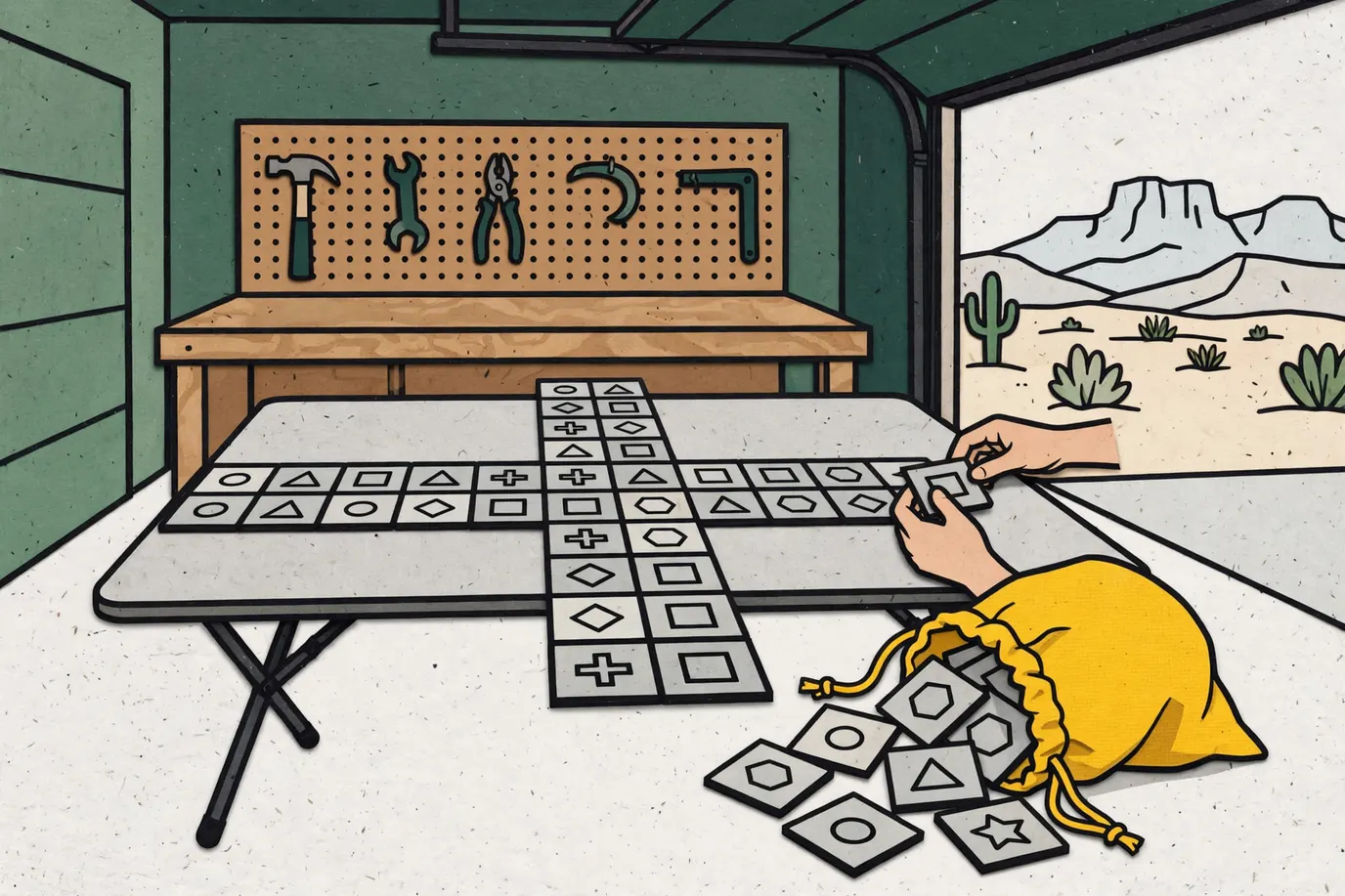
Qwirkle is a tile-matching game from MindWare for 2 to 4 players, ages 6+ on most listings: you build lines of tiles that share a color or a shape, and a line of six scores a Qwirkle for extra points. Amazon US has eight Qwirkle editions in our data, from the classic wooden tiles to a travel box, a Flex set, Qwirkle Cubes and two card versions. Laid out on a table, a finished game looks like somebody started a kitchen backsplash and got very competitive about it.
We earn a commission if you buy through our links, at no cost to you. Disclosure
Board & family games
| Model | Recommended age | Players (min) | Players (max) | Amazon |
|---|---|---|---|---|
MindWare QwirkleBoard & family games More specs
| 6+ yearslisting | 2listing | 4listing | Check price |
MindWare Travel QwirkleBoard & family games More specs
| 6+ yearslisting | 2listing | 4listing | Check price |
MindWare QwirkleBoard & family games More specs
| 6+ yearslisting | 2listing | 4listing | Check price |
MindWare Qwirkle Flex EditionBoard & family games More specs
| 8+ yearslisting | 2listing | 4listing | Check price |
MindWare Qwirkle CubesBoard & family games More specs
| 6+ yearslisting | — | — | Check price |
MindWare Qwirkle Color Blind FriendlyBoard & family games More specs
| 6+ yearslisting | — | — | Check price |



Card games
| Model | Recommended age | Players (min) | Players (max) | Amazon |
|---|---|---|---|---|
MindWare Qwirkle Rummy Color Blind-Friendly EditionCard games More specs
| 6+ yearslisting | 2listing | 4listing | Check price |

Party, trivia, drinking & social deduction games
| Model | Amazon |
|---|---|
MindWare Qwirkle RummyParty, trivia, drinking & social deduction games More specs
| Check price |
What’s in this listEditions and versions of Qwirkle sold on Amazon US, matched by the name on the listing. Players, age and play time come from the box or listing. “—” means neither the maker nor the Amazon listing states it.
What the Qwirkle game is
Qwirkle is a tile game about matching. You lay tiles in lines, and every line has to agree on one thing: the color or the shape. When you complete a line of six, that's a Qwirkle, and it scores extra points. That's the core idea in one breath.
I want to be upfront about where this page's rules come from. MindWare's website blocked our requests, so I couldn't open the publisher's rules page or a rules PDF. Everything I say about how Qwirkle plays comes from the Amazon US listings, mainly the color-blind-friendly edition, which spells out the scoring idea in its product bullets. Where the listings stop, I stop. Your box comes with a rules sheet, and that's the one to trust at the table.
Here's the table version of the box facts, from the classic MindWare listing in our data:
- Players: 2 to 4
- Ages: 6+
- Type: strategy game
- Expansion: no, it's a complete game
- Play time: the listings in our data don't state one
The newer MindWare box with storage trays lists 108 wooden tiles and 4 storage trays. The listings don't say Qwirkle is cooperative, and nothing in them suggests a team mode, so plan on everyone scoring for themselves.
How Qwirkle plays, from the listings
Here's what the listings tell you about a game, in my own words.
The goal: lines that share one thing
You score points by making lines of tiles. A line works when all its tiles share the same color or the same shape. The MindWare listing sums up the game as matching colors and shapes to build lines and score. The color-blind-friendly listing adds the detail that matters most: a line of six scores a Qwirkle and earns extra points.
So every tile you place is a small decision. Does this tile go where it fits the color, or where it fits the shape? A tile can often land in more than one spot, and the spot you pick changes what the next player can do with it.
What the listings don't say
The listings in our data don't give the hand size, the exact points per tile, how many points a Qwirkle adds, how a turn ends, or how the game ends. I won't fill those in from memory or from somebody's video. If you're reading this before buying, know that the rules sheet in the box handles all of it. If you've lost yours, the publisher is the place to ask.
That's a short "how it plays" for a game page, and I know it. I'd rather give you a short true section than a long one I can't check.
The tiles do the explaining
What I can describe is what the pieces look like and how that shapes the game. The tiles carry two pieces of information each: a color and a shape. On the color-blind-friendly edition, the listing says each tile also has an interior shape that shows its color, so a player who can't tell two colors apart can still read the tile. Lines are built on the table, out in the open, so everyone can see every line at all times.
That openness is what makes Qwirkle a good teaching game. A new player can look at the table and ask, "Can I put this here?" and everyone can check the answer by looking. No hidden cards, no secret goal, no long rulebook to pass around.
The Qwirkle editions on Amazon US right now
Our data lists eight Qwirkle editions on Amazon US as of October 2026, all from MindWare. The table above shows players and age where each listing gives them; a dash means the listing leaves it out, and I won't guess. Here's what tells them apart.
The classic tile game, three ways
These three listings are the tile-and-line game the rest of this page describes.
- MindWare Qwirkle (the classic listing). Ages 6+, 2 to 4 players, tagged as a strategy game. The listing in our data doesn't break out the components.
- MindWare Qwirkle with storage trays. Ages 6+, 2 to 4 players. The listing names 108 wooden tiles and 4 storage trays.
- Qwirkle Color Blind Friendly. Ages 6+, tagged as strategy. The listing names 108 wooden tiles and a canvas drawstring bag, and says the tiles use interior shapes to show color, with stronger color contrast. The listing doesn't state a player count.
If someone at your table is color blind, the third one is the clear pick on the facts. It's the only tile edition in our data that says it was made for that. If nobody needs it, the deciding detail between the other two is storage: one listing says trays, the other doesn't list components.
Travel Qwirkle
Travel Qwirkle is listed as the travel edition, ages 6+, 2 to 4 players, strategy. Our data doesn't list the components or tile count for it. If you want a game for a cabin, a hotel table or a long wait somewhere, this is the edition built for that by name. Check the listing photos for the tile size before you count on it for anyone with small hands or tired eyes.
Qwirkle Flex Edition
The Flex Edition lists 108 Flex tiles, 4 tile racks and a drawstring bag, for 2 to 4 players. Its listing says ages 8+, which is higher than every other Qwirkle edition in our data. The listing doesn't say why. So if you're shopping for a 6- or 7-year-old, this is the one edition to pass on. The racks are the other visible difference: it's the only listing that names tile racks.
Qwirkle Cubes
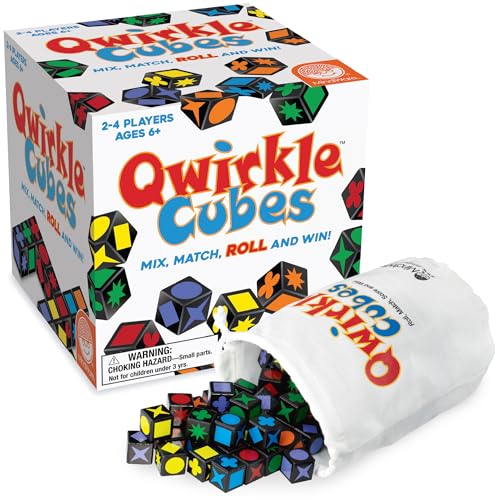
Qwirkle Cubes lists 90 wooden cubes, ages 6+, and is tagged as a dice game. The listing doesn't give a player count. The name and the color-and-shape idea carry over from the tile game, but the pieces are cubes, and a cube that rolls brings luck into the game in a different way than a tile pulled from a bag. If your group already owns the tile game and wants a second Qwirkle that feels different, this is the obvious one to look at.
The two Qwirkle Rummy listings
Two listings use the Qwirkle name for a rummy-style game:
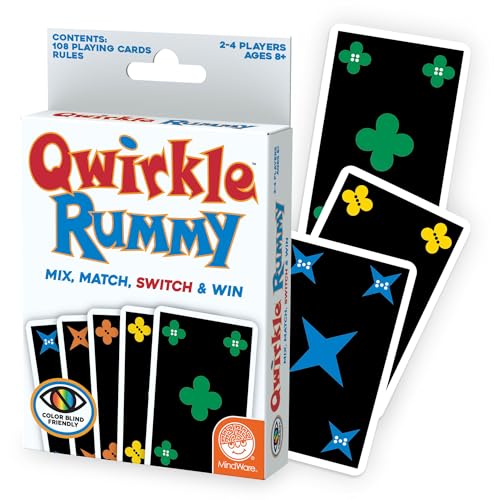
- Qwirkle Rummy Color Blind-Friendly Edition: ages 6+, 2 to 4 players, tagged rummy, listed as color-blind accessible
- Qwirkle Rummy: our data has almost nothing on this one beyond the name and that it's not an expansion
Rummy means a card-style game of collecting and melding sets. These two aren't the tile-line game described above, and I won't describe their rules, because I haven't been able to read them. If you're after Qwirkle as most people mean it, skip this pair. If your house already loves rummy and you want the Qwirkle color-and-shape twist on it, the color-blind-friendly one is the listing with the facts filled in.
Picking a Qwirkle box for your table
My one opinion for this page: pick the Qwirkle box by where it's going to be played, not by the photo. The classic game is the same color-and-shape idea in every tile edition. The differences in our data are about pieces and storage: wooden tiles and trays, a canvas bag, Flex tiles with racks, a travel box. Those decide whether the game gets carried somewhere or stays on a shelf.
A few quick matches, from the listings:
- A first family copy: the classic MindWare Qwirkle or the version with 4 storage trays
- A player who is color blind: Qwirkle Color Blind Friendly
- Trips and small tables: Travel Qwirkle
- A kid who is 6 or 7: any 6+ edition; skip the Flex Edition, which says 8+
- A second Qwirkle for a group that owns one: Qwirkle Cubes
- A rummy family: Qwirkle Rummy Color Blind-Friendly Edition
Table space
Qwirkle doesn't come with a board. The lines grow out across the table in every direction, so the game is as big as your players make it. On a small table, that means somebody will eventually ask to slide the grid. Clear the salt and pepper before the first tile goes down, and if you play on a tablecloth, know that a tug on one corner moves the whole map.
Marisol's take: "A line that can only grow in two directions is a survey traverse. Write down where it started, and nobody argues about where it ends."
Teaching it to new players
Qwirkle is easy to show and slow to explain. My advice for a first game is to show, not tell:
- Lay out the box contents and show one tile's color and shape.
- Read the rules sheet's opening section out loud, once.
- If your rules sheet has players hold tiles out of sight, play the first few turns with them face up.
- Count each score out loud so new players hear how lines add up.
- Go back to the printed rules once everyone gets the idea.
Steps 3 and 5 are a house rule, not a MindWare rule. They work for most games where the whole decision is visible on the table.
Who should skip Qwirkle
Skip it if your group wants a game with a story, a theme or characters. Qwirkle is tiles, colors and shapes, and that's all it is. Skip it too if you want everyone on one team; the listings describe scoring for each player, not a cooperative goal.
If you're buying for a child under 6, wait. Every Qwirkle listing in our data that states an age starts at 6 or 8. Check the age label on the listing. Toys with small parts are a choking hazard for children under 3, and loose tiles and cubes are small pieces that wander off the table.
And skip it if you need more than 4 seats. Every listing that states a player count stops at 4. A fifth person can keep score, but that's not playing.
If you like Qwirkle, look at these
Pages chosen by what they share with Qwirkle: open-table play, pattern matching, small groups.
- Azul: tile drafting and pattern building for a small table
- Blokus: shapes on a shared board, no luck in the draw
- Dominoes: matching ends and lines of tiles, one of the oldest versions of the idea
- Bananagrams: tiles in a growing grid, built from words instead of colors
- Family board games: the wider shelf for mixed-age tables
Every edition on this page comes from MindWare. See the MindWare brand page for the rest of that lineup.
Pick the box by the table it's going to. Then shake the bag.
Brands in this list
Related
Questions people ask
How many players can play Qwirkle?
Every Qwirkle listing in our data that states a player count says 2 to 4 players. That covers the classic MindWare box, the box with 4 storage trays, Travel Qwirkle, the Flex Edition and the color-blind-friendly Qwirkle Rummy. Qwirkle Cubes, plain Qwirkle Rummy and the color-blind-friendly tile set don't list a player count, so check the box if you plan to seat more than 4.
What age is Qwirkle for?
Most Qwirkle listings in our data say ages 6+. The Qwirkle Flex Edition is the exception and lists 8+. Plain Qwirkle Rummy doesn't state an age at all. If you're buying for a 6- or 7-year-old, stick to an edition that says 6+ on the listing.
Is there a color-blind version of Qwirkle?
Yes, two listings in our data use that label. Qwirkle Color Blind Friendly is a tile set with 108 wooden tiles and a canvas drawstring bag. Its listing says interior shapes on each tile show the color, with stronger color contrast. Qwirkle Rummy Color Blind-Friendly Edition is a rummy-style version for 2 to 4 players, ages 6+.
What is a Qwirkle in the game?
A Qwirkle is a line of six tiles. The color-blind-friendly tile listing says you score by making lines of tiles that share the same color or the same shape, and that a line of six scores a Qwirkle and earns extra points. The listings in our data don't say how many points, so check the rules sheet in your box.
What's the difference between Qwirkle and Qwirkle Cubes?
Qwirkle uses flat tiles; the classic box in our data lists 108 wooden tiles. Qwirkle Cubes lists 90 wooden cubes and is tagged as a dice game, ages 6+. The listing doesn't give a player count. The color-and-shape idea carries over, but the pieces are cubes you roll instead of tiles you draw.
Sources
- Amazon US listing: MindWare Qwirkle Color Blind Friendly (product description and bullets) — accessed 2026-10-23
- Amazon US listing: MindWare Qwirkle Board Game — accessed 2026-10-23
- CPSC: Small Parts Ban and Choking Hazard Labeling — accessed 2026-10-23