Board & Card Games · Type
Phase 10: The Card Game, the Ten Phases and the Editions
Phase 10 is a rummy-style card game for 2 to 6 players, ages 7+ on Mattel's instruction sheet: each round you try to lay down a set combination of cards called a Phase, and the first player to finish all ten Phases wins. Miss your Phase and you try the same one again next round. The Phase 10 editions on Amazon US include the classic deck, a storage tin, Flip, Masters, Tiles and bundles with UNO and Skip-Bo. I teach seventh grade, and it's the only game I own that holds a player back a grade.
We earn a commission if you buy through our links, at no cost to you. Disclosure
| Model | Recommended age | Players (min) | Players (max) | Amazon |
|---|---|---|---|---|
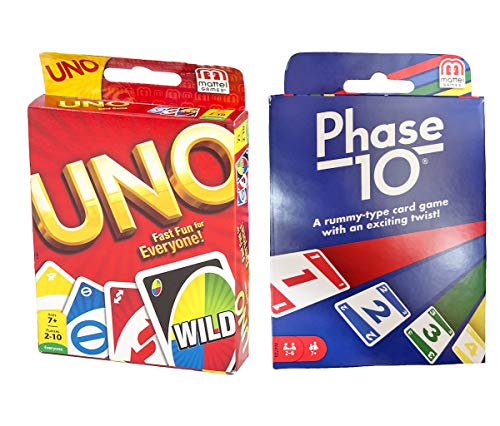
Mattel Phase 10 with UNOCard games More specs
| 7+ yearslisting | 2listing | 7listing | Check price |
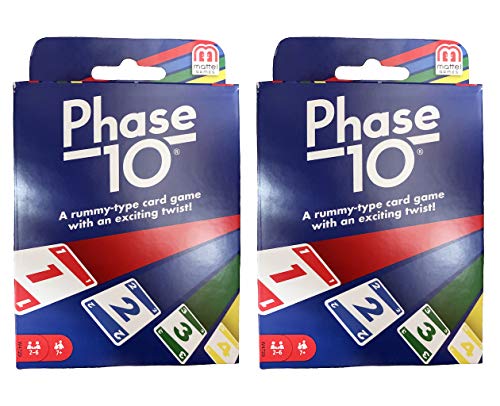
Mattel Phase 10 2 PackCard games More specs
| 7+ yearslisting | 2listing | 6listing | Check price |
Mattel Phase 10 in Storage Tin (Amazon Exclusive)Card games More specs
| 7+ yearslisting | 2listing | 6listing | Check price |
Mattel Phase 10 FlipCard games More specs
| 7+ yearslisting | 2listing | 6listing | Check price |
Mattel Phase 10 MastersCard games More specs
| 7+ yearslisting | 2listing | 6listing | Check price |
Mattel Phase 10 TilesCard games More specs
| 7+ yearslisting | 2listing | 4listing | Check price |
Mattel Card Game Set (Skip Bo, Uno & Phase 10)Card games More specs
| — | — | — | Check price |
Mattel Phase 10 with Skip-BoCard games More specs
| 7+ yearslisting | — | — | Check price |
Mattel Phase 10 W4729Card games More specs
| — | — | — | Check price |
Mattel Set of 3 Card Games: UNO, Phase 10 & ONO 99 (Amazon Exclusive)Card games More specs
| — | — | — | Check price |


What’s in this listEditions and versions of Phase 10 sold on Amazon US, matched by the name on the listing. Players, age and play time come from the box or listing. “—” means neither the maker nor the Amazon listing states it.
What the Phase 10 card game is
Phase 10 is rummy with a syllabus. In regular rummy, you collect sets and runs however they come. In Phase 10, every player has a specific assignment each round: Phase 1, then Phase 2, then Phase 3, all the way to Phase 10. Each Phase is a combination of sets, runs or same-color cards. Lay yours down and you move on next round. Miss it and you repeat it.
That one rule is why the game feels different from other card games. Players spread out. By the middle of a game, one person is on Phase 7 while someone else is still stuck on 3. Nobody is ever out of it, though, because a round can end before the leader finishes their Phase too.
Here's the table version of the box facts, from Mattel's Phase 10 instruction sheet (W4729) and our listing data:
- Players: 2 to 6 on the sheet; one bundle listing says 2 to 7, Tiles says 2 to 4
- Age: 7+ on the sheet and on every listing in our data that gives an age
- Deck: 110 cards, including 8 Wild and 4 Skip cards
- You also need: paper and a pencil for scores (the sheet says so)
- Co-op or competitive: competitive
- Expansions: none in our data; the editions are separate games
How Phase 10 plays
The rules here are in my own words from Mattel's instruction sheet with item number W4729, printed in 2018. One of the listings on this page carries that same number in its name. Other editions, like Flip, Masters and Tiles, come with their own rules, and I couldn't open those, so this section covers the classic card game only.
The deck
The sheet lists 110 cards:
- 96 numbered cards: two of each number from 1 to 12, in each of four colors
- 8 Wild cards
- 4 Skip cards
- 2 Phase reference cards that list all ten Phases
The ten Phases
Every player works through the same list, in order:
- Two sets of 3
- A set of 3 and a run of 4
- A set of 4 and a run of 4
- A run of 7
- A run of 8
- A run of 9
- Two sets of 4
- Seven cards of one color
- A set of 5 and a set of 2
- A set of 5 and a set of 3
A set is two or more cards with the same number, in any colors. A run is four or more cards in number order, in any colors. "One color" means just that, in any number order. The two sets in Phase 1 can even be the same number, like three 10s and three more 10s.
Look at Phases 4 through 6. Three runs in a row, each one card longer. That stretch of the game is a long hallway, and everybody walks it at a different speed.
Setup
- Pick a dealer and put the two reference cards where everyone can see them.
- Shuffle and deal 10 cards face down to each player.
- Put the rest face down as the draw pile.
- Flip the top card over next to it to start the discard pile.
The player to the dealer's left goes first, and play moves clockwise.
A turn in four steps
- Draw one card, either the top of the draw pile or the top of the discard pile.
- Lay down your Phase, if you can make the whole thing from your hand. Face up, on the table.
- Hit, if your Phase is already down. Play cards from your hand onto any Phase on the table where they fit: yours, someone else's, or both.
- Discard one card to end your turn.
You only get credit for a Phase once you lay it down, and you can only lay down one Phase per round. You don't have to win the round to move up. Lay down Phase 1, and next round you work on Phase 2, even if someone else went out first.
Wild cards and Skip cards
A Wild card can stand in for any number or any color in a Phase. You can use as many as you like, with one limit: the Phase needs at least one numbered card. So you can't build a Phase out of pure hope. Once a Wild goes into a Phase on the table, it stays there for the rest of the round.
A Skip card makes another player lose a turn. You discard it, name your target, and your turn ends. A Skip can't be picked up from the discard pile, can't go into a Phase, and can't be used on the same player two turns in a row. That last rule was clearly written by someone who got skipped twice in a row once and never got over it.
If the dealer flips a Wild to start the discard pile, the first player may take it. If the dealer flips a Skip, the first player's first turn is skipped. (The dealer did nothing wrong. The dealer will still hear about it.)
Going out and scoring
Once your Phase is down, the goal is to get rid of every card in your hand by hitting and discarding. The first player to empty their hand goes out, and the round ends for everyone. The player who went out, and anyone else who laid down a Phase that round, moves up one Phase for the next round.
Everyone else adds up the cards still in their hand:
| Card left in hand | Points |
|---|---|
| 1 to 9 | 5 each |
| 10 to 12 | 10 each |
| Skip | 15 each |
| Wild | 25 each |
Low score is good. The player who went out scores zero. Only cards in hand count, never cards already on the table. Then the deal passes to the left.
Lucho's take: "Never get caught holding a Wild. That's twenty-five points for a card you were saving for a better day."
How it ends
The first player to complete Phase 10 at the end of a round wins. If two or more players finish Phase 10 in the same round, the lowest total score wins. If that's tied too, the tied players replay Phase 10, and the first to go out takes it.
Two shorter versions on the sheet
The sheet prints two variations, so these aren't house rules:
- Ten rounds, everybody advances. Play exactly ten rounds. Everyone moves to the next Phase each round whether they made it or not, and the lowest total score wins.
- Pick a finish line. Before the game, agree to play to a smaller number of Phases, like five or seven. Everything else stays the same.
The first one is the version I'd use with a 7-year-old at the table. Nobody repeats a Phase, and nobody watches the older kids pull ahead for half an hour.
Phase 10 editions on Amazon US right now
Our data for this page lists ten Phase 10 listings on Amazon US as of October 2026, all from Mattel. The table above shows age and players wherever a listing states them, and a dash where it doesn't. Here's how they group, from the listing facts.
The classic card game
- Phase 10 W4729. The listing named with the same item number as the instruction sheet above. It's tagged as a rummy game. The listing doesn't state players or age.
- Phase 10 in Storage Tin (Amazon Exclusive). Ages 7+, 2 to 6 players, comes in a storage tin, and the listing says it's colorblind accessible.
- Phase 10 2 Pack. Ages 7+, 2 to 6 players. Two decks under one listing.
The colorblind line matters more in Phase 10 than in most rummy games. Phase 8 asks for seven cards of one color. If someone at your table needs that, read the line on the listing, because not every edition states it.
Flip, Masters and Tiles
- Phase 10 Flip. Ages 7+, 2 to 6 players, edition named Flip, and the listing says it's colorblind accessible.
- Phase 10 Masters. Ages 7+, 2 to 6 players, with "Masters Classic" as the edition name.
- Phase 10 Tiles. Ages 7+, 2 to 4 players, edition named Tiles. It's the one listing here that tops out at 4.
All three are tagged as rummy games. I couldn't open Mattel's rules for any of them, so I won't describe how they change the classic game. If you already own the classic deck, these are the ones to read about. If you don't, start with the classic deck and learn the ten Phases first.
Bundles with other card games
Four listings pair Phase 10 with other Mattel card games:
- Phase 10 with UNO. Ages 7+, 2 to 7 players.
- Phase 10 with Skip-Bo. Ages 7+, no player count listed.
- Card Game Set (Skip Bo, Uno & Phase 10). Three games in one listing; no age or players listed.
- Set of 3 Card Games: UNO, Phase 10 & ONO 99 (Amazon Exclusive). Comes in a storage tin; no age or players listed.
A bundle makes sense for a house that plays a different card game each night, or for a gift. It doesn't change Phase 10 itself.
Which Phase 10 box fits your table
Head count first. Most Phase 10 listings say 2 to 6, one bundle says 2 to 7, and Tiles stops at 4. With 6 players and 10 cards each, a lot of the deck is in hands before anyone draws. With a family of four, any edition here fits. With five or six regulars, skip Tiles.
A few quick matches, from the listings:
- A first copy: the classic deck, in the storage tin or the W4729 listing
- A player who needs colorblind-friendly cards: a listing that states it, like the storage tin or Flip
- A house that also plays UNO or Skip-Bo: one of the bundles
- Two households, one game: the 2 Pack
Who should skip Phase 10
Skip it if your group wants a short game. Ten Phases means ten rounds at the very least, and most games run longer because people repeat Phases. The sheet's ten-round variation helps, but it's still ten deals.
Skip it, too, if a younger player hates falling behind. Players end up on different Phases, and a 7-year-old stuck on Phase 2 while everyone else moves up can have a long evening. Use the everybody-advances version, or pick a lighter game like UNO.
And if your group is bigger than six, look at a party game instead.
If you like Phase 10, look at these
Pages chosen by what they share with Phase 10: cards, sets and runs, and a table of 2 to 6.
- Skip-Bo: another Mattel card game, sold in two of the bundles above
- UNO: the quicker Mattel deck many families learn first
- Five Crowns: rummy that changes each round
- Rummikub: sets and runs with tiles instead of cards
- Card games: the wider shelf of card games we track
Every Phase 10 listing on this page is from Mattel. See the Mattel brand page for the rest of its lineup.
Deal ten. Phase 1 is two sets of three. The rest is patience.
Brands in this list
Related
Questions people ask
What are the 10 phases in Phase 10?
On Mattel's W4729 sheet: 1, two sets of 3. 2, a set of 3 and a run of 4. 3, a set of 4 and a run of 4. 4, a run of 7. 5, a run of 8. 6, a run of 9. 7, two sets of 4. 8, seven cards of one color. 9, a set of 5 and a set of 2. 10, a set of 5 and a set of 3.
How many cards are in a Phase 10 deck?
110 on Mattel's W4729 instruction sheet: 96 numbered cards, which are two of each number from 1 to 12 in blue, green, red and yellow, plus 8 Wild cards, 4 Skip cards and 2 Phase reference cards that list all ten Phases. Each player is dealt 10 cards at the start of a round.
How do you score Phase 10?
Only the cards left in your hand count when someone goes out. Mattel's sheet scores 5 points for each card from 1 to 9, 10 for each 10, 11 or 12, 15 for a Skip and 25 for a Wild. The player who went out scores zero. Low score is good, and it breaks ties between players who finish Phase 10 in the same round.
What is Phase 10 Masters?
It's a Phase 10 edition listed by Mattel on Amazon US for ages 7+ and 2 to 6 players, with "Masters Classic" as the edition name on the listing. We couldn't open Mattel's own rules sheet for Masters, so we can't tell you how its rules differ from the classic game. Read the listing's description before buying it as a first copy.
Is there a Phase 10 dice game?
None of the Phase 10 listings in our data right now is a dice version. What's listed is the card game in several boxes, the Phase 10 Flip and Phase 10 Masters editions, Phase 10 Tiles for 2 to 4 players, and bundles that pair Phase 10 with UNO, Skip-Bo or ONO 99. We don't list editions that aren't in our data.
Sources
- Mattel: Phase 10 card game instruction sheet, W4729 (PDF) — accessed 2026-10-23