Board & Card Games · Type
Bananagrams: The Word Game, the Rules and the Editions
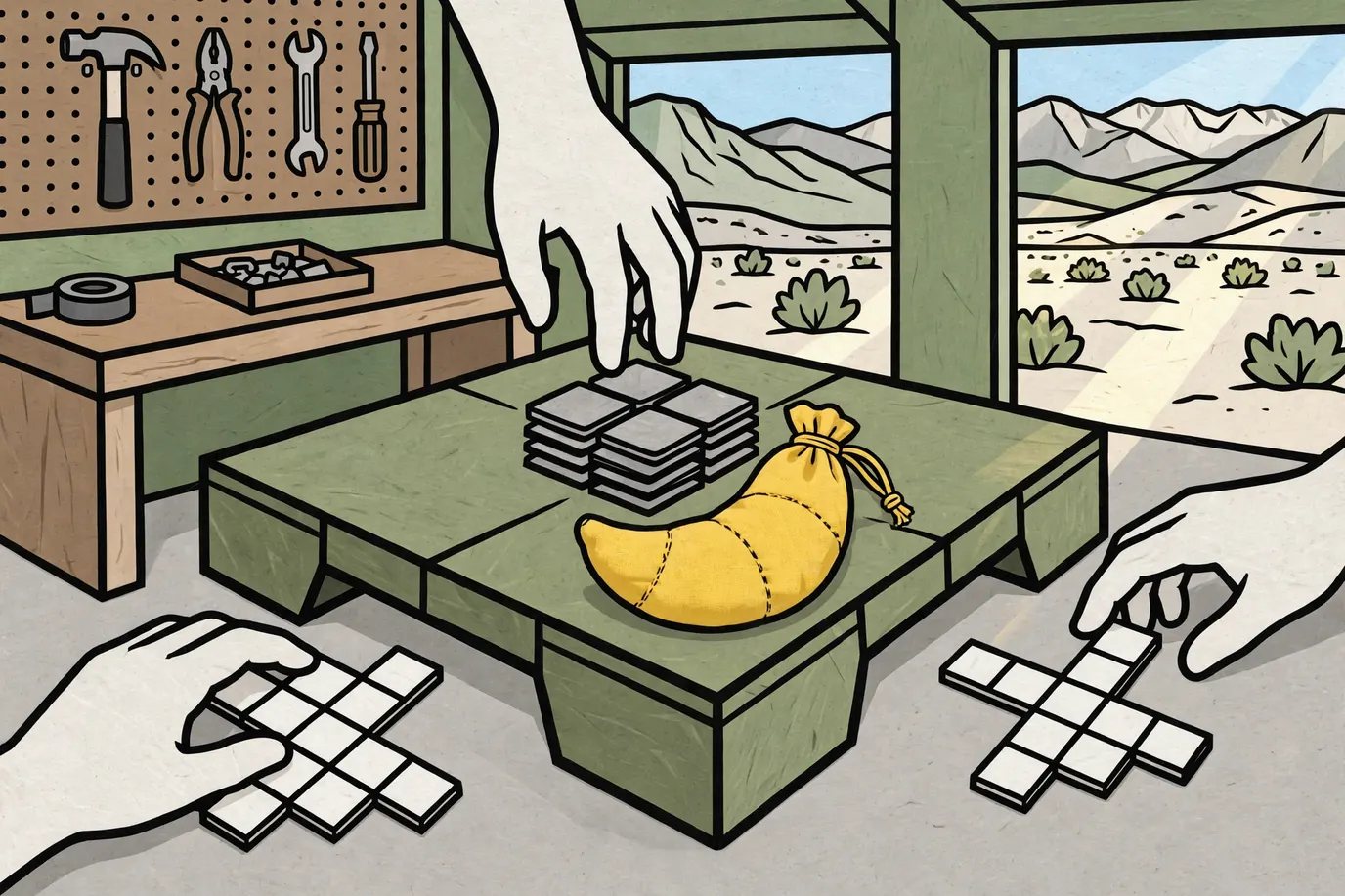
Bananagrams is a word game for 1 to 8 players, ages 7+ on the listing: 144 letter tiles in a cloth banana, no board and no turns. Everyone builds their own crossword grid at the same time, and the first player to use every tile wins. It's the only game in my closet where nobody waits for anybody, which is either relaxing or stressful, depending on how many vowels you drew.
We earn a commission if you buy through our links, at no cost to you. Disclosure
| Model | Recommended age | Players (min) | Players (max) | Amazon |
|---|---|---|---|---|
Bananagrams Bananagrams ClassicBoard & family games More specs
| 7+ yearslisting | 1listing | 8listing | Check price |
Moose Master I Heart BananagramsBoard & family games More specs
| 7+ yearslisting | 1listing | 8listing | Check price |
Bananagrams Bananagrams Party EditionBoard & family games More specs
| — | — | — | Check price |


What’s in this listEditions and versions of Bananagrams sold on Amazon US, matched by the name on the listing. Players, age and play time come from the box or listing. “—” means neither the maker nor the Amazon listing states it.
What the Bananagrams game is
Bananagrams is a speed word game. There's no board, no score pad and no turn order. Each player gets a set of face-down letter tiles. Somebody says "Split," everyone flips their tiles, and the race starts. You build your own crossword-style grid of connected words, and you can rearrange it as often as you like. When the shared pile of tiles gets low enough, the first player to use every tile in a valid grid wins.
That's the game. It packs into a cloth pouch shaped like a banana, which is the part everyone remembers.
The box facts, from the listings in our data and the rules page we used:
- Players: 1 to 8 on the Bananagrams Classic listing (the rules page says 2 to 8 for the standard game, with solo variants)
- Ages: 7+ on the Classic and I Heart Bananagrams listings
- Contents: 144 letter tiles in a banana pouch (Classic)
- Turns: none. Everyone plays at once.
- Co-op or competitive: competitive by default, with a cooperative variant on the rules page
Moose Toys' product page for Classic Bananagrams lists the same core: 1 to 8 players, 144 tiles, a zipper banana pouch and an instruction sheet. It also makes the point I'd make first: nobody waits for a turn.
How Bananagrams plays
The publisher doesn't post the full rules sheet on its product page, so the rules below are in my own words from the Bananagrams rules page on Asmodee UK's site. Asmodee UK sells the game in Britain, and its page matches what the listings describe. If your box has a different sheet, follow that one.
Setup
- Find a hard, flat surface. A table works. A carpet does not, as anyone who has tried to slide a tile across a rug will tell you.
- Dump all 144 tiles face down in the middle. That pile is the Bunch.
- Each player takes tiles from the Bunch, face down:
- 2 to 4 players: 21 tiles each
- 5 or 6 players: 15 tiles each
- 7 or 8 players: 11 tiles each
- Don't look yet.
Split
Any player calls "Split." Everyone turns their tiles face up and starts building at the same time.
Your grid is yours alone. Words run across, reading left to right, or down, reading top to bottom. No diagonals. Every word has to connect to the rest of your grid, like a crossword. You're free to tear it apart and rebuild it whenever you want, which is good, because your first idea for the Q usually doesn't last.
Peel
When you've used every tile you have, call "Peel." Every player at the table, you included, takes one tile from the Bunch and has to fit it into their grid.
This is the engine of the game. You finish, and everyone else gets a little more work. Peels keep coming until the Bunch holds fewer tiles than there are players.
Dump
Stuck with a letter you can't use? Put it back face down in the Bunch, call "Dump," and take three tiles in its place.
Read that again. You give one tile and get three back. It's the only trade in my house where you walk away with more than you gave and you're still behind. There's no limit on dumps, but each one makes your hand bigger. Dump only when the letter is truly hopeless.
Bananas
Once the Bunch has fewer tiles than there are players, there are no more peels. The next player to use all their tiles in a connected grid calls "Bananas." That player is the Top Banana, as long as the grid holds up.
Rotten Banana
The other players check the Top Banana's grid. These words don't count:
- Misspelled words
- Abbreviations
- Proper nouns
- Any word the group doesn't accept
If a word fails, anyone can call "Rotten banana." The player who called Bananas is out. Their tiles go back into the Bunch, and everyone else keeps racing.
June, who is 11, once tried to play her own name. The table called rotten banana before she'd let go of the last tile. She now argues that "june" is a month and should count in lowercase. The rules say no proper nouns, and a month is one. She hasn't let it go.
Ties
The rules page's FAQ covers two players calling Bananas at the same moment: call it a tie, or give the win to whoever has the longest word.
Teaching it to a new group
This is how I'd say it, in order:
- "Take your tiles face down. Don't peek."
- "When someone says Split, flip them and build your own crossword."
- "Use every tile? Say Peel. Everyone takes one more."
- "Hate a letter? Say Dump. Give one back, take three."
- "When the middle is almost empty, the first one done says Bananas."
That's the whole lesson. Everything else, from the Rotten Banana check to the variants, makes sense the first time it comes up.
Variants on the rules page
The rules page lists several official ways to play. These are not house rules.
- Banana Smoothie: split all 144 tiles evenly between players. No Bunch, no peel, no dump. First to use every tile calls Bananas. If nobody finishes, or it's a tie, the longest word wins.
- Banana Café: tiles stay face down in the pouch, and you dump by swapping inside the pouch. No peeling. First to finish wins. It suits a small table where a spread-out Bunch won't fit.
- Banana Solitaire: play alone. Race the clock to use all 144 tiles, or try to use them all in as few words as possible.
- Cooperative: all tiles face up, and players take turns adding to one shared grid.
Three extras from our table. These are ours, not the publisher's:
- Ours: the two-letter list. Before the first Split, agree whether two-letter words count. The rules page says words the group doesn't accept are out, so the group decides. Deciding early saves a fight later.
- Ours: one dictionary, one judge. Pick one dictionary and one person to check it. Phones at the table start a second game nobody signed up for.
- Ours: a head start for new readers. A newer reader at the table can flip tiles a few seconds before "Split." It evens the race without changing any rule that matters.
A few things the rules don't say out loud
These are observations about how the game works, not rules.
Short words are not a weakness. Every word must connect, so a grid of short words with lots of crossings can absorb a new tile faster than one long word with nowhere to hang anything.
The Bunch is shared, so peeling helps you and slows everyone else. A player who finishes fast forces the whole table to keep adapting. That's why the game feels fast even with eight people.
Hard letters show up for everyone. Keep one open spot in your grid where an odd letter could land. A grid with no loose ends has nowhere to put a peel.
Bananagrams editions on Amazon US right now
Our data for this page lists 3 Bananagrams editions on Amazon US as of October 2026. The table above shows players, age and play time where the listing gives them, and a dash where it doesn't.
- Bananagrams Classic. The game described on this page. Listed for ages 7+ and 1 to 8 players, with a solo mode, 144 tiles and the banana pouch. If you're buying your first copy, this is the one.
- I Heart Bananagrams (Moose Master). Same core on the listing: ages 7+, 1 to 8 players, solo mode, 144 letter tiles. The difference is the pouch, which the listing describes as heart-shaped. Same game, different bag. If someone in your house already owns the banana, this is a second copy that won't get mixed up with the first.
- Bananagrams Party Edition. Listed as a word game. Our data doesn't give its player count, age or tile count. The rules page says the Party version adds 14 party tiles for a sillier game, but the listing in our data doesn't confirm what's in the box, so check the listing before you buy.
Check the age label on the listing. Toys with small parts are a choking hazard for children under 3, and every letter tile is a small part. Count the tiles back into the pouch after a game if a toddler lives in the house.
Which Bananagrams fits your table
I'll keep this one simple, since there are only three choices.
- First copy: Bananagrams Classic
- A second copy, or a gift for someone who has one: I Heart Bananagrams
- A group that already knows the rules and wants something new: Party Edition, after you've checked the listing for what the extra tiles do
- Playing alone: Classic or I Heart, both listed with a solo mode
A big group doesn't need a second set for the standard game. The 11-tile hands for 7 or 8 players come from the same 144. A second set does help with Smoothie at a large table, since the 144 tiles split thin across eight people. That's my math, not a rule.
Who should skip Bananagrams
Skip it if your youngest player isn't reading and spelling yet. The listing says 7+, and the game only works if a kid can build real words under a little time pressure. A picture-matching game is a better fit until then.
Skip it if speed makes someone at your table miserable. There are no turns, so there's no pause to think while someone else plays. Some players love that. Some players need a turn to breathe. A turn-based word game will suit them better.
And skip it if you want a scored game you can track over weeks. Bananagrams has a winner each round and no running score. You can keep a tally on paper, but the box doesn't come with one.
If you like Bananagrams, look at these
What these share with Bananagrams: letters, speed, and small boxes.
- Boggle: another timed word race, from a grid of letter dice
- Scattergories: words against the clock, sorted by category
- Qwirkle: tiles laid in lines, matching colors and shapes instead of letters
- Rummikub: tile sets and runs, for players who like rearranging
- Travel games: small boxes and pouches for the road
Split, peel, and keep a spot open for the Q.
Related
Questions people ask
How many tiles do you start with in Bananagrams?
It depends on the player count. Per the rules page we used, 2 to 4 players take 21 tiles each, 5 or 6 players take 15 each, and 7 or 8 players take 11 each. The rest stay face down in the middle as the Bunch. Both full-size editions in our data list 144 tiles in all.
Can you play Bananagrams alone?
Yes. Both the Bananagrams Classic and I Heart Bananagrams listings in our data say 1 to 8 players with a solo mode. The rules page we used describes Banana Solitaire: race the clock to use all 144 tiles, or try to use all of them in as few words as you can.
What does peel mean in Bananagrams?
Peel is what you call when you've used every tile in your hand in a connected grid. Everyone at the table, including you, takes one new tile from the Bunch. Peeling keeps going until the Bunch has fewer tiles than there are players. After that, the next player to finish calls Bananas instead.
Are proper nouns allowed in Bananagrams?
No. When a player calls Bananas, the others check the grid. Misspelled words, abbreviations and proper nouns don't count, and neither do words the group doesn't accept. If the grid fails, it's a Rotten Banana: that player's tiles go back into the Bunch and everyone else keeps playing.
What is the difference between Bananagrams and Bananagrams Party Edition?
The rules page we used says the Party version adds 14 party tiles for a sillier game. Our data for the Party Edition listing only confirms it's a word game, with no player count, age or tile count. Learn the classic game first, then decide if you want the extra tiles.
Sources
- Asmodee UK: Bananagrams Rules – How to Play — accessed 2026-10-23
- Moose Toys: Classic Bananagrams product page — accessed 2026-10-23
- CPSC: Small Parts Ban and Choking Hazard Labeling — accessed 2026-10-23