Board & Card Games · Type
Jenga: The Game, the Rules and the Two Boxes
Jenga is a wooden block-stacking game for 1 or more players, ages 6+ on Hasbro's box: you build a tower of 54 blocks, pull one out from below, and stack it on top until somebody brings the whole thing down. Two Jenga boxes are listed on Amazon US right now, the classic and a version with a digital die. The rule sheets differ on one thing that matters: what happens to the player who knocks it over.
We earn a commission if you buy through our links, at no cost to you. Disclosure
| Model | Amazon |
|---|---|
Hasbro JengaBoard & family games More specs
| Check price |
Hasbro Jenga with Digital DieBoard & family games More specs
| Check price |


What’s in this listEditions and versions of Jenga sold on Amazon US, matched by the name on the listing. Players, age and play time come from the box or listing. “—” means neither the maker nor the Amazon listing states it.
What the Jenga game is
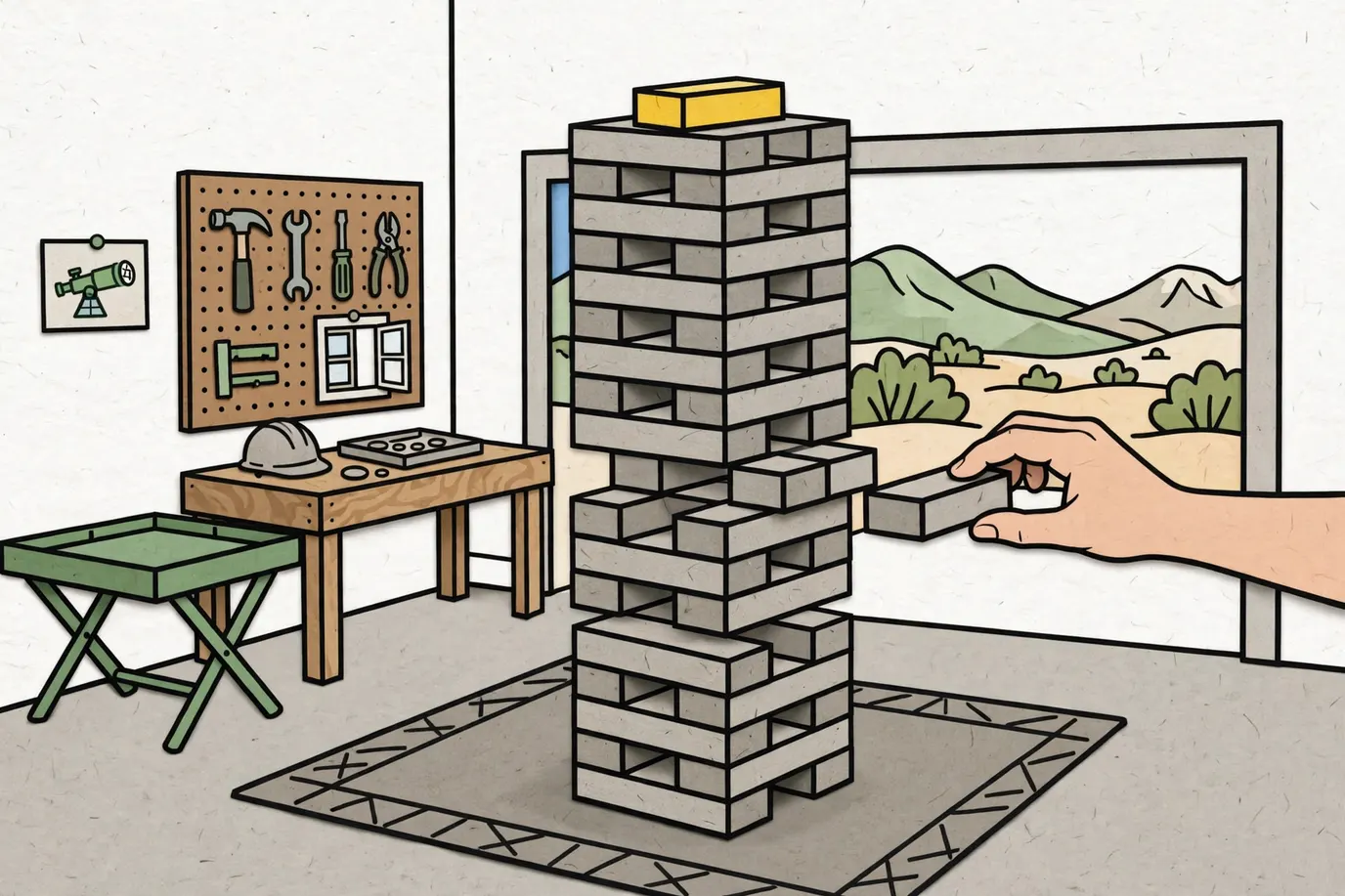
Jenga is a stacking game with one rule you can explain to anyone: take a block out of the tower and put it on top without knocking the tower over. The tower starts solid. Every turn moves weight from the middle to the top, so it gets taller and shakier at the same time. Somebody eventually pulls the wrong block, and the game ends with a crash.
Hasbro sells Jenga under license. The classic rule sheet says Jenga is a registered trademark of Pokonobe Associates, and that Hasbro makes the game under license from them. The rule sheet we read carries the Parker Brothers and Hasbro names.
Here are the box facts, from Hasbro's two rule sheets and the listings in our data:
- Players: 1 or more
- Ages: 6+ (the classic sheet says "6 to adult")
- Contents: 54 wooden blocks and a stacking sleeve
- Type: dexterity game; competitive, with a solo mode
- Expansion: none; both listed boxes are complete games
Neither rule sheet prints a play time, and neither listing gives one. A game lasts as long as the tower does.
How Jenga plays
Hasbro has two rule sheets that matter for the boxes on Amazon US. Below, in my own words, are both: the classic Jenga sheet (product code 53557) and the sheet for the box with the digital die (product code G1499). They agree on the basics and disagree on a few details.
Building the tower
Dump the blocks onto a flat surface. One person uses the stacking sleeve to build the tower, three blocks per layer, each layer turned crosswise to the one below it. The finished tower is 18 layers tall. Stand the sleeve upright and slide it off so the tower stands on its own.
Dana's ruling, from the first week the box came home: the tower gets built on the floor. Our kitchen table has a wobble, and the wobble isn't a player.
A turn, start to finish
- Using one hand, pull a block out from anywhere below the highest complete layer.
- Stack that block on top of the tower, crosswise to the blocks just under it.
- If the tower stays up, play passes to the left.
That's the whole turn on both sheets. You may touch blocks to find a loose one before you commit. Both rule sheets allow that.
The extra rules on the classic sheet
The 53557 sheet adds a few details that the newer sheet leaves out:
- One hand at a time. You can switch hands whenever you want. You can't use both at once. My left hand forgets this rule about once a game.
- Fix what you move. If you nudge a block out of place while hunting for a loose one, you have to put it back, one-handed, before touching another.
- Finish the layer. On top, complete a 3-block layer before starting a new one.
- The 10-second rule. Your turn ends 10 seconds after you stack your block, or as soon as the next player touches the tower. After that, it's the next player's turn, and the tower is theirs to worry about.
- Who starts. The player who built the tower goes first.
The 10-second rule is the one people skip, and it's the one that settles arguments. Without it, a slow lean after your turn becomes a debate about whose fault it was.
Marisol watched a game from the Bay Two doorway and offered one note: "Right angles, every layer. That's not a game rule. That's framing." She went back to her bench before the tower fell, which I think was on purpose.
How it ends: two different rulings
Both sheets agree on the winner: the last player to stack a block without bringing the tower down. They disagree on the player who knocks it over.
- Classic sheet (53557): whoever topples the tower sets it up for the next game. Losing comes with a chore, which is the most honest rule in my closet.
- Digital Die sheet (G1499): if the tower falls on your turn, you're out. The youngest player goes first instead of the builder.
The "you're out" version makes more sense with a big group, where you keep playing until one stacker is left. The "you rebuild" version is the one to use at a table of two or three, where the game just ends and starts again. Use whichever sheet came in your box, or pick one before the first block moves. That's a house rule, not Hasbro's, and it saves a lot of talk after the crash.
The solo game
Both sheets include a solo mode. The classic sheet calls it practice: take a block from any level, stack it on top and see how tall you can build before it falls. The newer sheet says try to beat your own highest tower. The classic sheet adds that a very steady player can build to 36 layers or more. Treat that as a number on paper, not a promise. It reads like a dare anyway.
The digital die, explained
The Digital Die box plays the classic game with an optional twist. Per Hasbro's instructions page for that box (G1499), a parent scans the QR code in the package, or opens Hasbro's web app on a phone or tablet. The rule sheet says to roll the digital die before your turn. Hasbro's page says there's nothing to download and nothing extra to buy, but the phone or tablet isn't included.
The die gives you a challenge for that turn. Hasbro's page lists these, plus more it doesn't name:
- Race the clock
- Stack 2 blocks
- Pick an opponent to take your turn
- Use thumbs only
- Team up: guide another player who has their eyes closed
- Place the block anywhere but the top row
The listing name in our data says the die adds 6 more ways to play, which matches the six on Hasbro's page. If you don't want a screen at the table, skip the die and play it as the classic game. The blocks are the same.
Jenga editions on Amazon US right now
Our data for this page lists 2 Jenga boxes on Amazon US as of October 2026, both from Hasbro. The table above shows what each listing states.
- Jenga. The classic wooden game. The listing says ages 6+, 1 or more players, a solo mode, wooden blocks and a dexterity game.
- Jenga with Digital Die. The same listed facts: ages 6+, 1 or more players, solo mode, wooden blocks. Our data also marks it as electronic, because of the die, which runs in a web app on a device you supply.
My one opinion for this page: piece count is not value. Both boxes list the same 54 blocks. What separates them is the rule sheet and the digital die. If you want the classic game and nothing else, either box plays it. If you want the challenges, take the Digital Die box, and plan on a phone at the table.
Our data doesn't show a giant Jenga, a Jenga Tetris or any other Jenga-branded edition on Amazon US right now. If one turns up in a later data check, it will join the table.
Jenga vs tumbling towers
"Tumbling tower" is the generic name people use for the same idea: a tower of wooden blocks you pull from and stack on. Plenty of makers sell sets like that. Only the boxes with the Jenga name are on this page, because this page follows the Jenga listings.
Here's what to compare when you're looking at a Jenga box and another tumbling-tower set side by side:
- Block count. Jenga lists 54. Another set will list its own number, and a different count means a different tower height.
- Material. Both Jenga listings say wood. Check the other listing's material line.
- Rules. Jenga comes with Hasbro's printed rule sheet. A generic set may or may not include rules; read the listing.
- Age. Both Jenga boxes say 6+. Go by the age on the other set's own listing, never by Jenga's.
The core game is the same idea either way. What you're choosing between is the specific box, its listed contents and its rule sheet.
Who Jenga suits
Jenga works for almost any group size, since both boxes say 1 or more players and there's no upper number. A few quick matches, from the listings:
- A mixed-age family table, 6 and up. No reading and no math. A steady hand matters more than age.
- A party where people come and go. A new player can join between turns. The tower doesn't care.
- A solo player. Both boxes list a solo mode, and the rule sheets describe one.
- A gift for someone who owns a lot of games. It's a small box, and it plays differently from cards and boards.
The tension builds in a way kids can see. Nobody needs to explain that the tower is getting worse. They can watch it lean.
Who should skip Jenga
Skip it if anyone at your table has trouble with fine hand control and would rather not play a game built entirely on that. Jenga has no variant in either rule sheet that takes the steady hand out of it.
Skip it, too, if your group wants decisions with a long arc. Every turn is the same choice: which block. There's no score, no plan and no comeback. That's the point of the game, but it isn't for everyone.
And skip the Digital Die box if you'd rather keep phones off the table. The classic box plays the same game without one.
Check the age label on the listing. Toys with small parts are a choking hazard for children under 3. Hasbro's page for the Digital Die box carries that warning.
If you like Jenga, look at these
Pages chosen by what they share with Jenga: a dexterity game, simple rules and a table of any size.
- Operation: another steady-hand game
- Don't Break the Ice: tap blocks out without dropping the middle
- Party games: more games for a crowd that comes and goes
- Stocking stuffers for kids: small gifts by stated age
Both Jenga boxes on this page are from Hasbro. See the Hasbro brand page for the rest of its games.
Pull slow, stack square, and let the loser rebuild.
Brands in this list
Related
Questions people ask
How many blocks are in Jenga?
54. Hasbro's classic rule sheet (53557) and its instructions page for the Digital Die box (G1499) both list 54 wooden blocks and a stacking sleeve. Stacked three to a layer, they make an 18-story tower. The classic rule sheet says the tower can more than double in height during play as blocks move from the middle to the top.
What are the rules of Jenga?
On your turn, use one hand to take a block from anywhere below the highest complete layer, then stack it on top, crosswise to the layer under it. You can touch blocks to find a loose one. The classic rule sheet adds that you finish a 3-block layer before starting a new one, and that a moved block must be fixed before you touch another. Last player to stack without toppling the tower wins.
Is there a giant Jenga on Amazon US?
Not among the Jenga editions in our data right now. The two Jenga boxes listed are the classic game and the Jenga with Digital Die, and both list the same 54 wooden blocks. Large outdoor tumbling-tower sets from other makers aren't sold under the Jenga name, so they aren't on this page.
What is Jenga Tetris?
Jenga Tetris isn't among the Jenga editions listed on Amazon US in our data, so we can't describe a current box or its rules. The two Jenga listings we have are the classic wooden game and the version with a digital die. If one turns up in a later data check, it will appear in the table on this page.
Can you play Jenga alone?
Yes. Both listings in our data say 1 or more players and list a solo mode. Hasbro's classic rule sheet calls it solo practice: take blocks from any level and keep stacking to see how high you can build before the tower falls. The Digital Die rule sheet says the same thing in fewer words: try to beat your own highest tower.
How old do you have to be to play Jenga?
Ages 6+ on both listings in our data, and the classic rule sheet says 6 to adult. Hasbro's page for the Digital Die box carries a choking-hazard warning: not for children under 3. The digital die itself runs in a web app on a phone or tablet, and that rule sheet asks a parent to scan the QR code.
Sources
- Hasbro: Jenga Game (53557) instructions page — accessed 2026-10-23
- Hasbro: Jenga classic rule sheet, 53557 (PDF) — accessed 2026-10-23
- Hasbro: Official Hasbro Jenga Game with More Ways to Play (G1499) instructions page — accessed 2026-10-23
- Hasbro: Jenga with digital die rule sheet, G1499 (PDF) — accessed 2026-10-23
- CPSC: Small Parts for Toys and Children's Products — accessed 2026-10-23