Board & Card Games · Type
Scattergories Game: The Rules, the Scoring and the Editions
The Scattergories game is a party game for 2 to 6 players, ages 12+ or 13+ depending on the box: roll a letter, flip the timer, and write an answer for each category that starts with that letter. You only score for answers nobody else wrote. Amazon US has four Scattergories editions in our data, including Hasbro's Classic, a 30th Anniversary Edition and a Vintage Bookshelf Edition. Every round, somebody at my table writes the answer everyone else wrote too, and then defends it like a lawyer.
We earn a commission if you buy through our links, at no cost to you. Disclosure
| Model | Recommended age | Players (min) | Players (max) | Amazon |
|---|---|---|---|---|
Winning Moves Scattergories 30th Anniversary EditionParty, trivia, drinking & social deduction games More specs
| 12+ yearslisting | 2listing | 6listing | Check price |
WS Game Company Scattergories Vintage Bookshelf EditionParty, trivia, drinking & social deduction games More specs
| 12+ yearslisting | 2listing | 6listing | Check price |
Hasbro Scattergories ClassicParty, trivia, drinking & social deduction games More specs
| 13+ yearslisting | 2listing | — | Check price |
Winning Moves Scattergories Know It & Show ItParty, trivia, drinking & social deduction games More specs
| — | — | — | Check price |


What’s in this listEditions and versions of Scattergories sold on Amazon US, matched by the name on the listing. Players, age and play time come from the box or listing. “—” means neither the maker nor the Amazon listing states it.
What the Scattergories game is
Scattergories is a word game played against a timer. You get a list of categories and one letter. Before the sand runs out, you write an answer for every category, each one starting with that letter. Then you read your answers out loud, and anything another player also wrote is crossed off. You only score for the answers that are yours alone.
That last rule is the whole game. You're not trying to be right. You're trying to be right and different.
The rules on this page come from Hasbro's Scattergories rulebook, product code C1941, plus Hasbro's instructions page for the current Classic box, product code F6795. The box facts, at a glance:
- Players: 2 to 6, or teams
- Ages: 12+ on the C1941 box, 13+ on the F6795 Classic page
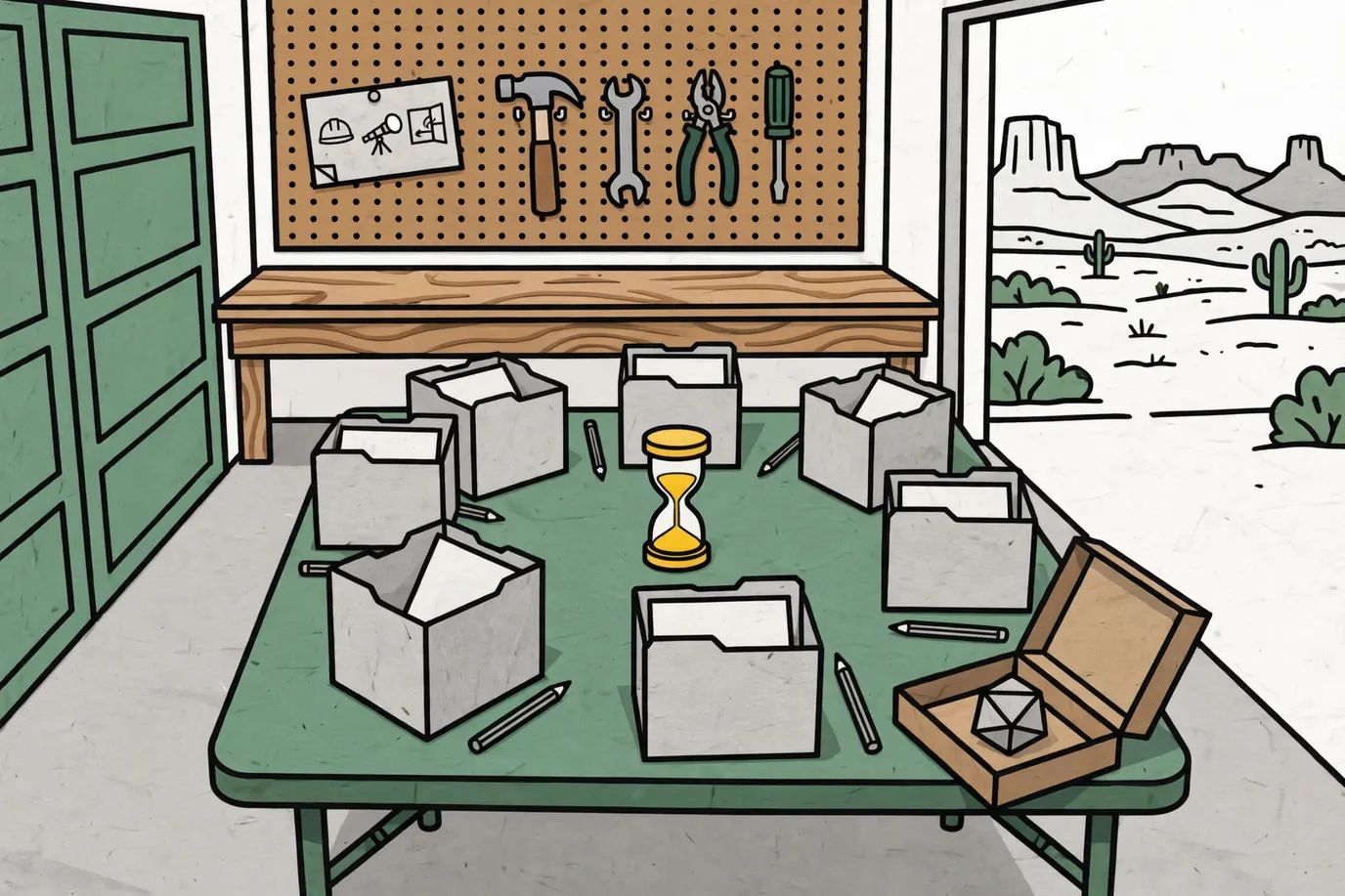
- Contents (C1941): 6 folders, an answer pad, a 20-sided die, 48 category cards, a timer
- Not included: a pen or pencil for each player
- Board: none
The F6795 Classic page lists the same kinds of parts, says the category cards add up to more than 190 categories, and adds an online timer and letter die you can open by scanning a QR code. It's competitive: you score for yourself, or for your team.
How Scattergories plays
These are the C1941 rules in my own words. The rulebook splits a round into two phases. I'll keep its order.
Setup
Each player gets a folder, an answer sheet slid into the folder's slot, and something to write with. Everyone uses the same category list for the round. The first time you play, you punch out the cardboard slot in each folder so the sheet fits.
You can also play in teams. The rulebook's one note on that: every team has to use the same category list.
Phase 1: think fast and write
- One player rolls the die and calls out the letter on top.
- Flip the sand timer.
- Flip up the folder's top flap so nobody can read your answers.
- Write one answer per category. Every answer has to fit the category and start with the rolled letter.
- When the sand runs out, everybody stops writing, mid-word if they have to.
The rulebook has a note about the die that I appreciate. It's heavy, so roll it only in the game box. A 20-sided die with a weight warning is basically a tiny bowling ball with letters on it. Keep it off the good table.
Phase 2: read and compare
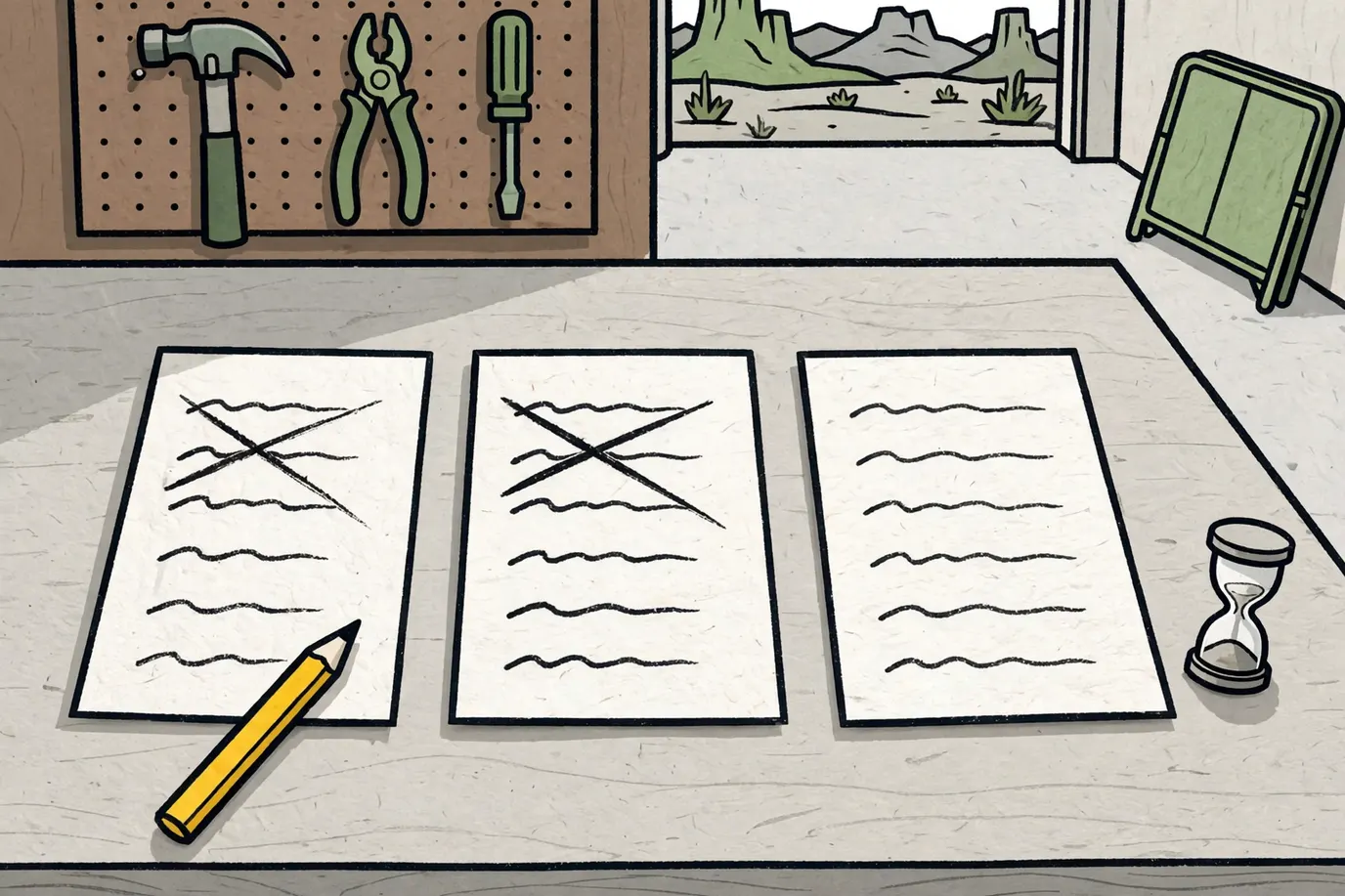
Players take turns reading their answers out loud, one category at a time. You score 1 point for each acceptable answer that's different from everyone else's. If two players wrote the same thing, neither scores it.
There's a bonus for alliteration. If the rolled letter starts more than one word in your answer, it scores double. Say the letter is B and the category is something you'd find in a toy box. "Bouncy ball" scores 2. Keep your score at the top of your answer sheet.
What counts as an acceptable answer
The rulebook lays out a short list:
- The first word has to start with the rolled letter.
- "A," "an" and "the" don't count as the first word. The rulebook's own example is a movie title that starts with "The," and it counts the next word. So "The" won't rescue you on a T round.
- You can't use the same answer twice in one round, even in two different categories.
- Creative answers are allowed. But if anyone challenges one, the group votes.
Challenges and votes
During scoring, any player can challenge an answer. Then everyone votes on whether it's acceptable, including the player who wrote it. Majority rules. On a tie, the challenged player's own vote doesn't count.
That tie rule is the smartest sentence in the rulebook. Everyone votes for their own answer. The tie rule just politely ignores you.
Rounds and winning
For the next round, roll a new letter, flip the timer, and use the same category list on a fresh answer sheet. If the same letter comes up twice in one game, roll again. In the C1941 rules, you play two rounds and add both scores. The highest total wins, and a tie plays a third round.
Playing to score, not just to answer
Scattergories rewards a slightly odd kind of thinking. The first answer that pops into your head is probably the first answer that popped into everyone's head. Here's how the rules push you, in plain terms.
The obvious answer is a trap
Matching answers score nothing, so the safest-looking answer is often a zero. If the category is a fruit and the letter is B, you can guess how many sheets say "banana." A slightly stranger answer that still clearly fits is worth more than a spot-on one that three people share.
Two words beat one
The double-point rule means a two-word answer with both words on the letter is worth twice as much as a plain one. It also tends to be more unusual, which helps it survive the matching. Two reasons in one answer.
Don't spend an answer twice
You can't repeat an answer within a round, even in a different category. If one word fits two categories, pick the category where it's least likely to be matched, and find something else for the other.
Know where challenges come from
Creative answers are legal, but they're the ones that get challenged. If your answer needs a sentence of explanation, expect a vote. Write it anyway if you think a majority will see it your way. That's the game.
The die has fewer letters than the alphabet
Hasbro's Classic page says the die has 20 letters. The alphabet has 26. That leaves 6 letters that never come up, and the page doesn't say which six. Which six is between you and the die.
Scattergories editions on Amazon US right now
Our data lists four Scattergories editions on Amazon US as of October 2026. The table above shows the players and age each listing states; a dash means the listing leaves it out.
Hasbro Scattergories Classic
The Hasbro Classic listing says ages 13+ and 2 players and up. Hasbro's F6795 Classic page, which matches that name, describes 6 folders, 48 category list cards, a 20-sided letter die, a timer and an answer pad, with more than 190 categories and an online timer and letter die by QR code. If you want the game this page describes, this is the one to start with.
Scattergories 30th Anniversary Edition
The Winning Moves 30th Anniversary Edition lists ages 12+ and 2 to 6 players. Our data doesn't list its components, so I can't tell you what's different inside from the listing alone. It plays the same core game: a letter, a timer, unique answers.
Scattergories Vintage Bookshelf Edition
The WS Game Company Vintage Bookshelf Edition lists ages 12+ and 2 to 6 players. It's the box for someone who wants the game to look like it's been on a shelf for a while. Our data doesn't list components for this one either.
Scattergories Know It & Show It
Winning Moves also has Scattergories Know It & Show It on Amazon US. Our data has no age, player count, play time or components for it, and I couldn't find a publisher page to read. I won't guess how it differs. Read the listing closely before buying it as a substitute for the classic game.
Getting a good game out of the box
My one opinion for this page: don't seat more than six writers. The C1941 box has 6 folders and the rulebook says 2 to 6 players. Past that, split into teams. Teams keep the box's math intact, and a pair arguing quietly over one folder is more fun than an eighth player writing on a napkin.
A few things that help, from the rules and the box:
- Pens first. The rulebook says pens or pencils aren't included. Count them before the die comes out.
- Pick the list as a group. Everyone has to use the same category list for a round, so choose it before the roll.
- Roll in the box. The rulebook's own advice about the heavy die.
- Name a reader. Reading answers in a set order, category by category, keeps scoring calm.
House rules, labeled as house rules
These aren't Hasbro's rules. They're optional ways tables tweak the game:
- Longer game: play three or four rounds before totaling, instead of two.
- Mixed speeds: a slower writer may get a short head start before the timer flips, if the whole table agrees.
- No challenges on the first round: for a brand-new table, so the voting doesn't swallow the first game.
Agree on any house rule before the first roll, and write it on the back of an answer sheet so nobody remembers it differently later.
Who should skip Scattergories
Skip it if anyone at your table hates writing under pressure. Every round is a timed spelling-and-recall sprint. Skip it too for kids below the box age. Every edition in our data that states an age starts at 12 or 13, and there's no Junior edition in our data.
Skip it if your group wants a quiet game. Phase 2 is mostly reading out loud, comparing and voting. And skip it if you're two players who want a long evening. Two works by the box, but the fun comes from matching answers, and with only two people, matches are rare.
If you like Scattergories, look at these
Pages chosen by what they share with Scattergories: words, timers and a group that likes to talk.
- Boggle: letters, a timer and words nobody else found
- Taboo: talking fast around words you can't say
- Balderdash: writing answers and bluffing the table
- Codenames: one-word clues and team play
- Party games: the wider shelf for bigger groups
Scattergories Classic comes from Hasbro; see the Hasbro brand page for the rest of that lineup.
Roll in the box, flip the sand, and write before you think too hard.
Brands in this list
Related
Questions people ask
How many players can play Scattergories?
Hasbro's Scattergories rulebook (C1941) and its Classic page (F6795) both say 2 to 6 players, and the box has 6 folders. You can also play in teams, which is how most groups seat more than 6. The 30th Anniversary and Vintage Bookshelf listings in our data also say 2 to 6. The Hasbro Classic listing says 2 players and up.
What age is Scattergories for?
Hasbro's C1941 rulebook says ages 12+, and its Classic Scattergories page (F6795) says 13+. In our data, the 30th Anniversary Edition and the Vintage Bookshelf Edition list 12+, and the Hasbro Classic listing lists 13+. Scattergories Know It & Show It doesn't state an age in our data.
Is there a Scattergories Junior?
There's no Scattergories Junior among the editions listed on Amazon US in our data right now. Every edition in our data that states an age starts at 12 or 13. If you're shopping for a younger kid, the age on these boxes is the honest answer: they're built around fast writing and spelling under a timer.
How does Scattergories scoring work?
In Hasbro's C1941 rules, you score 1 point for each acceptable answer that no other player also wrote. Matching answers score nothing. An answer where the rolled letter starts more than one word scores double. You keep a running score on your answer sheet, add up two rounds, and the highest total wins. A tie plays a third round.
Is Scattergories a board game?
Not in the usual sense. Hasbro's rulebook lists folders, an answer pad, a 20-sided letter die, category cards and a timer. There's no game board. You write on answer sheets slid into folders, so the table only needs room for the folders, a pen for each player and a safe spot to roll the die.
Sources
- Hasbro: Instructions Manual & Rules for Scattergories Game (C1941) — accessed 2026-10-23
- Hasbro: Scattergories rulebook, C1941 (2016, PDF) — accessed 2026-10-23
- Hasbro: Instructions for Classic Scattergories Game (F6795) — accessed 2026-10-23