Brand · Building Toys
Engino STEM Building Kits: Lines, Ages and Model Counts
Engino makes STEM building kits: sets of rods, connectors, gears and panels that build working models of machines, bridges and vehicles. We track 23 Engino kits on Amazon US. Most stated ages start at 9+, the Creative Builder sets start at 6+, and Qboidz lists 3 to 6. Pick the science topic first, then check the age. (I teach seventh grade. Half these kit names are my lesson plans with better parts.)
We earn a commission if you buy through our links, at no cost to you. Disclosure
Engino on Amazon US
23 models- STEM building kits
Engino Creative Builder 30-in-1 Multimodel
Check price - STEM building kits
Engino Newton's Laws Inertia, Kinetic & Potential Energy
- Recommended age
- 9+ years
- STEM building kits
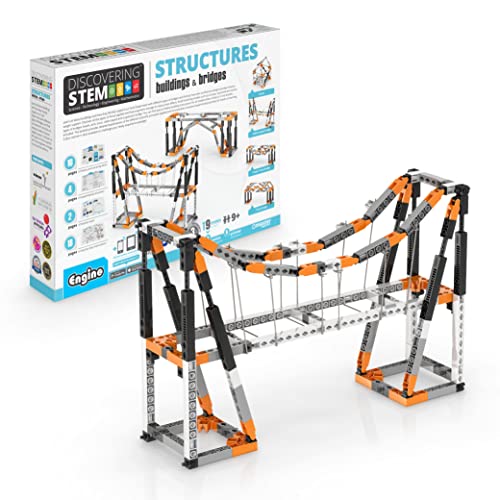
Engino Structures, Buildings & Bridges
- Recommended age
- 9+ years
- STEM building kits
Engino Qboidz 30 in 1 Multi Models
- Recommended age
- 3–6 years
- STEM building kits
Engino Physics Laws Inertia, Friction & Circular Motion
- Recommended age
- 9+ years
- STEM building kits
Engino Amusement Park London Eye, Ferris Wheel
- Recommended age
- 9+ years
- STEM building kits
Engino Discovering STEM Mechanics Cams & Cranks
Check price - STEM building kits
Engino Discovering STEM Solar Power Set
- Pieces
- 137 pcs
- Recommended age
- 9+ years
- Models (X-in-1)
- 16
- STEM building kits
Engino Discovering STEM Robotics Mini ERP 2.0
- Pieces
- 185 pcs
- Models (X-in-1)
- 8
- STEM building kits
Engino Discovering STEM Botanic Laboratory
- Pieces
- 251 pcs
- Models (X-in-1)
- 4
- STEM building kits
Engino Discovering STEM Mechanics Gears & Worm Drives
Check price - STEM building kits
Engino Discovering STEM Fluid Dynamics
- Pieces
- 299 pcs
- Models (X-in-1)
- 6
- STEM building kits
Engino STEAM Labs How Solar Energy Works
- Recommended age
- 8+ years
- STEM building kits
Engino Inventor Motorized Series Offroader 10-in-1
Check price - STEM building kits
Engino Inventor Space Shuttle Kit
- Recommended age
- 9+ years
- STEM building kits
Engino Discovering STEM Simple Machines 60 Models
- Recommended age
- 9+ years
- STEM building kits
Engino Discovering STEM Astronomy Traveling to Space
- Pieces
- 173 pcs
- Models (X-in-1)
- 6
- STEM building kits
Engino Discovering STEM How Aircrafts Work
Check price - STEM building kits
Engino Learning About Dinosaurs 5 Motorized Models
- Recommended age
- 9+ years
- STEM building kits
Engino Creative Builder 15 Multimodel Set
- Recommended age
- 6–9 years
- STEM building kits
Engino STEM Girls 20 Model Set
- Recommended age
- 6+ years
- STEM building kits
Engino Creative Builder Tipper Truck 3-in-1
- Recommended age
- 6+ years
- STEM building kits
Engino MEGA Builds 1.5m Eiffel Tower
- Recommended age
- 9+ years




What Engino makes
Engino makes STEM building kits. STEM stands for science, technology, engineering and math, and in toy terms it means a kit that builds a working model of an idea: a lever that lifts, a gear train that changes speed, a bridge that holds weight.
Engino's own story page says the system began in 2004 with Costas Sisamos, a mechanical engineer and Design & Technology teacher in Cyprus, and that the company runs a fully automated production plant there. As a teacher, I'll admit the origin story got my attention. Somebody looked at a class that couldn't turn a sketch into a model and built a kit about it.
All 23 Engino kits we track on Amazon US sit in one type in our data, STEM building kits. The table above lists them. They fall into a handful of lines, and the lines are what tell them apart.
Engino STEM kits by line
Discovering STEM
The biggest group, nine kits in our data. Each one is built around one science topic:
- Mechanics Cams & Cranks
- Mechanics Gears & Worm Drives
- Simple Machines 60 Models, 9+
- Solar Power Set, 137 pieces, 16 models, 9+
- Fluid Dynamics, 299 pieces, 6 models
- Astronomy Traveling to Space, 173 pieces, 6 models
- How Aircrafts Work
Add the Botanic Laboratory at 251 pieces and 4 models, and the Robotics Mini ERP 2.0 at 185 pieces and 8 models, listed as motorized. That makes nine.
A Discovering STEM kit suits a kid with one subject they keep asking about. Gears for the kid who takes apart the egg beater. Aircraft for the kid who folds every sheet of paper into a plane. The model count tells you how many builds the box gets you before you repeat.
Science topic sets outside Discovering STEM
Four more kits are built around a science idea but sit outside that line name:
- Newton's Laws Inertia, Kinetic & Potential Energy, 9+
- Physics Laws Inertia, Friction & Circular Motion, 9+
- Structures, Buildings & Bridges, 9+
- STEAM Labs How Solar Energy Works, 8+
The STEAM Labs kit is the youngest science set in our data at 8+. The other three all list 9+. If the kid's science class just covered forces, the two physics sets line up well with that unit. Mine covers it in the spring, and every year somebody asks if friction is the reason they're late.
Creative Builder
Three kits for builders who want lots of models from one box:
- Creative Builder 30-in-1 Multimodel
- Creative Builder 15 Multimodel Set, ages 6 to 9
- Creative Builder Tipper Truck 3-in-1, 6+
These are the youngest Engino kits after Qboidz. They're about building vehicles and shapes, less about one science topic. A Creative Builder kit is a good first Engino set for a 6-year-old who likes following pictures.
Qboidz
One kit: Qboidz 30 in 1 Multi Models, ages 3 to 6. It's the only Engino kit in our data listed for preschoolers.
The upper end is the useful part here. A 3-to-6 label says the kit was made for small hands and simple builds. For a 7-year-old, a Creative Builder set is the better match.
Inventor
Two kits: the Inventor Motorized Series Offroader 10-in-1 and the Inventor Space Shuttle Kit, 9+. The Offroader is motorized by its name and builds ten models. The Space Shuttle is one target build.
The big builds
Three Engino kits are about scale and a finished centerpiece:
- MEGA Builds 1.5m Eiffel Tower, 9+. The name gives the height: 1.5 meters, a little under 5 feet. Plan the ceiling, not just the shelf.
- Amusement Park London Eye, Ferris Wheel, 9+.
- Learning About Dinosaurs 5 Motorized Models, 9+.
The Eiffel Tower is the one to measure for. Five feet of tower in a kid's room is a piece of furniture. A tower that tall doesn't go on a shelf. It goes in a corner, and the corner stops being used for anything else.
STEM Girls
One kit: the STEM Girls 20 Model Set, 6+. It builds 20 models according to its name. The name is a marketing choice. The parts and the age label are what matter, and any kid aged 6+ can build with them.
Matching a kit to what they're learning
A STEM kit lands best when it lines up with something the kid already met somewhere else: a science unit, a museum trip, a question at dinner. Here's how the Engino topics in our data map to things kids run into.
- Forces and motion: the Newton's Laws and Physics Laws sets. Pushes, pulls, friction and things going around in circles.
- Machines: Simple Machines 60 Models, Cams & Cranks, Gears & Worm Drives. Levers, pulleys, wheels and the parts that turn one motion into another.
- Energy: the Solar Power Set and STEAM Labs How Solar Energy Works.
- Structures: Structures, Buildings & Bridges, plus the Eiffel Tower if you have the ceiling.
- Air and water: How Aircrafts Work and Fluid Dynamics.
- Space and living things: Astronomy Traveling to Space and the Botanic Laboratory.
- Robots: the Robotics Mini ERP 2.0.
If you don't know what's coming up at school, ask the kid. They'll tell you what they liked last year, and that's a better guide than any unit plan. When my students say a topic was "fine", it wasn't. When they say "wait, how does that work", it was.
What an Engino build session looks like
Here's the short version for a parent who hasn't seen one of these open. You get a box of parts and building instructions that show a model step by step. The science kits are named for an idea, so check the listing for how much explanation comes with the builds. That part varies by kit, and the listing is the place it's described.
Plan on the first session being slow. A kid has to learn which connector is which before the steps go quickly. After the first model, the next one goes faster because the parts aren't strangers anymore.
Sit nearby for the first build, even with a 9-year-old. Not to build it for them. To read any explanation out loud when they get to it, because that's the part a kid in a hurry skips. Then ask them what the model does before they take it apart. If they can tell you, the kit did its job. If they can show you, even better.
Engino STEM by stated age
Here's how the stated ages fall across the 23 kits:
| Stated age | Kits |
|---|---|
| 3 to 6 | 1 |
| 6 to 9 or 6+ | 3 |
| 8+ | 1 |
| 9+ | 9 |
| Not stated | 9 |
That 9+ group is where most of the science sets sit. The listings don't say why the line is drawn at 9. What I can say as a teacher is that a science kit's booklet explains why each model works, and the explaining is the part that needs a reader.
Nine kits in our data don't state an age on the listing. We leave those blank instead of guessing from the box art.
How to pick an Engino kit
- Start with the age. Only look at kits whose stated starting age your child has reached.
- Then the topic. One subject they love beats a box that covers six they don't.
- Count the models. Where the listing gives a model count, it tells you how many builds before the kit repeats itself.
- Motor or no motor? A motorized kit adds batteries and something to watch move. A plain kit makes the kid supply the motion, which is half the lesson.
- Space. The big builds need floor space or ceiling height. The Eiffel Tower needs both.
Lucho read the gear kit name over my shoulder. "Teach them the worm drive," he said. "It's the reason a winch holds when you let go. Kids should know that before they ever own a truck." I've never heard a better pitch for a gift.
Engino STEM vs other building systems
Engino kits use their own rods, connectors and gears. None of the listings in our data states compatibility with another system, so we don't claim any.
K'NEX is the nearest neighbor in our data. Both make rod-and-connector kits with education lines and motorized models. K'NEX also has big amusement-ride builds. If you're choosing between them, compare the stated age, the piece count and the topic the booklet teaches.
LEGO and other brick makers build with studs instead of rods. A brick set builds a model that looks like the thing. An Engino kit builds a model that works like the thing. Some kids care about the look. Some care about the crank turning.
For younger builders, the building blocks page covers simpler sets.
Small parts and batteries
Check the age label on the listing. Toys with small parts are a choking hazard for children under 3.
Rods, pins, gears and connectors are small parts. Keep loose ones in a lidded box and off the floor when younger siblings are around.
For motorized and robotics kits, check the listing for the battery type. Button batteries can cause serious injury if swallowed. Keep spares locked away and check that battery covers are screwed shut.
Who should skip Engino
Skip the 9+ science kits for a younger child who wants to build and play. The building part may go fine, and the topic will go past them. A Creative Builder set fits better.
Skip Engino for a kid who wants a model that looks exactly like a real car or a castle. These are working models. They look like their insides.
And skip a big build if you don't have a place for it to stand when it's done. A Ferris wheel that has to come apart the next day is a long build with a short ending.
Pick the subject they already ask about. The kit will do the rest of the asking.
Where Engino shows up
Questions about Engino
What age is Engino for?
It depends on the line. In our data, Qboidz 30 in 1 lists ages 3 to 6, the Creative Builder 15 Multimodel Set lists 6 to 9, and the Tipper Truck 3-in-1 and STEM Girls set list 6+. STEAM Labs How Solar Energy Works lists 8+. Nine kits, including most science sets, list 9+. Some listings don't state an age.
Who makes Engino?
Engino's own story page says the toy system began in 2004 with Costas Sisamos, a mechanical engineer and Design & Technology teacher who taught in Cyprus. The same page says Engino has a fully automated production plant in Cyprus. On Amazon US the kits are listed under the Engino name.
What is Engino Discovering STEM?
Discovering STEM is an Engino line of science building kits, each built around one topic: cams and cranks, gears and worm drives, solar power, fluid dynamics, astronomy, aircraft, a botanic lab and robotics. Several listings state how many models the kit builds, from 4 for the Botanic Laboratory to 16 for the Solar Power Set.
Does Engino work with LEGO?
None of the Engino listings in our data states compatibility with another brand, so we don't claim it. Engino kits use their own rods and connectors. If you want to mix systems, read the listing first, and expect each system to work best with its own pieces.
Are there motorized Engino kits?
Yes. In our data the Discovering STEM Robotics Mini ERP 2.0 is listed as motorized, and the names of the Inventor Motorized Series Offroader 10-in-1 and Learning About Dinosaurs 5 Motorized Models say so too. Check each listing for the battery type and what's included.
Is Engino good?
We don't give brand verdicts. Here's what the data shows: 23 Engino kits on Amazon US, nearly all built around a stated science or engineering topic, with stated ages from 3 to 6 up to 9+ and model counts on several listings. Whether it's good for your kid depends on the topic and the age label matching them.
Sources
- Engino: Our Story (founder, 2004, production plant in Cyprus) — accessed 2026-10-23
- U.S. Consumer Product Safety Commission: Small Parts for Toys and Children's Products — accessed 2026-10-23