Board & Card Games · Type
Root Board Game: The Factions, the Rules and the Expansions
Root is a strategy board game from Leder Games for 2 to 4 players, ages 14+ on the base listing: each player runs a different faction of woodland animals, and each faction plays by its own rules and scores in its own way. First to 30 victory points wins. Amazon US carries the base game, a Root and Vagabond Pack bundle, and two expansions that need the base box: The Marauder Expansion and The Homeland Expansion. It's the only game in my closet where the cat is the landlord.
We earn a commission if you buy through our links, at no cost to you. Disclosure
| Model | Recommended age | Players (min) | Players (max) | Amazon |
|---|---|---|---|---|
Leder Games Root: The Homeland ExpansionStrategy & hobby games More specs
| 10+ yearslisting | 2listing | 6listing | Check price |
Leder Games RootStrategy & hobby games More specs
| 14+ yearslisting | 2listing | 4listing | Check price |
Fantasy Flight Games Root + Vagabond Pack bundleStrategy & hobby games More specs
| — | — | — | Check price |
Leder Games Root: The Marauder ExpansionStrategy & hobby games More specs
| — | — | — | Check price |


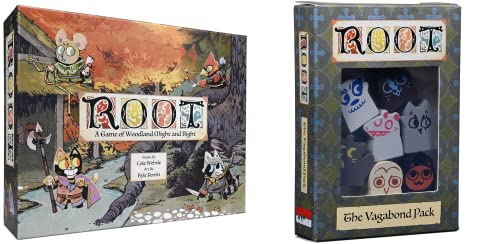

What’s in this listEditions and versions of Root sold on Amazon US, matched by the name on the listing. Players, age and play time come from the box or listing. “—” means neither the maker nor the Amazon listing states it.
What the Root board game is
Root is a war game in a storybook forest. Four factions of animals fight over a woodland, and none of them plays the same game. One builds an economy. One must follow an ever-growing list of orders. One stirs up an uprising. One wanders alone, doing quests and picking sides. You win by being the first to 30 victory points.
That's the whole hook. In most strategy games, everyone has the same moves and different luck. In Root, everyone has different moves. The table is playing four games at once on one map, and they all collide.
The box facts, from the base Root listing in our data and Leder Games' Learning to Play guide (the web edition dated October 15, 2020):
- Players: 2 to 4
- Ages: 14+
- Style: area control (holding parts of a map)
- Play: competitive, every faction for itself
- Expansion needed: no, the base game is complete
- Play time: the listing in our data doesn't state one
The guide sets which factions sit down by player count. With three players, you leave out the Vagabond. With two, you also leave out the Woodland Alliance.
How Root plays
These rules come from Leder Games' Learning to Play guide for the base game, in my own words. The full reference is a separate book Leder calls the Law of Root; I'm working from the learning guide, which is the one built for a first game.
The map and who rules it
The map is a woodland of 12 clearings connected by paths. The spaces between paths are forests, and only the Vagabond can move into those. Each clearing has a suit, fox, rabbit or mouse, and the suit matters because cards are suited too.
You rule a clearing if you have the most combined warriors and buildings there. On a tie, nobody rules it. Ruling clearings matters for almost everything: to move, you have to rule the clearing you're leaving or the one you're entering.
Marisol's take: "A tie means nobody owns it. That's not a rule I made up for the county. That's just how land works."
A turn in three phases
Every turn has three phases in order: Birdsong, Daylight and Evening. What you do in each phase depends on your faction. Each player has a faction board that spells out their own phases, and the guide says that board is designed to answer most of a player's questions about their faction. That's a smart design choice. Nobody has to pass the rulebook around the table.
What each base faction wants
- Marquise de Cat: an occupying power that builds sawmills, workshops and recruiters, and scores by constructing buildings. Wood made at sawmills pays for more buildings.
- Eyrie Dynasties: a proud bird aristocracy that scores each turn by building and protecting roosts. They must carry out a Decree, a row of orders that grows every turn. If they can't carry it all out, they fall into turmoil and lose points.
- Woodland Alliance: an uprising that scores by spreading sympathy across the woodland. When other players remove sympathy or march into sympathetic clearings, the Alliance gains support in a rule called Outrage.
- Vagabond: a single wanderer who scores by completing quests and by aiding and harming the other factions. He can move into forests, where nobody else can go.
The Eyrie's Decree is my favorite rule in the box. You promise to do certain things every turn, the promises pile up, and eventually the bird government can't keep them all. It's the only rulebook I own where the government's to-do list is a game piece.
How a battle works
To battle, you pick a clearing where you have warriors and an enemy has pieces. Then you roll two dice. The attacker deals hits equal to the higher roll, and the defender deals hits equal to the lower roll. Neither side can deal more hits than it has warriors in that clearing. The player taking hits chooses which of their own pieces to remove.
Two extras change the math. If the defender has no warriors in the clearing at all, the attacker deals one extra hit. And before the roll, a defender can play an ambush card matching the clearing's suit to deal two hits right away. The attacker can cancel that ambush by playing a matching ambush card of their own.
Cards and crafting
Cards in Root do double duty. Every card has a suit, and you spend cards for that suit to power actions. Bird cards are wild: you can usually treat one as a fox, rabbit or mouse card. But when a rule says you must spend a bird card, no other suit can stand in for it.
Most cards can also be crafted. To craft, you activate your faction's crafting pieces in clearings matching the suits shown on the card, and each crafting piece works once per turn. Crafting an item scores the victory points printed on the card. The Eyrie get fewer points from crafting; their faction board calls it Disdain for Trade.
How it ends
The first player to 30 victory points wins. The other path is a dominance card. There are four, one per suit. They can't be crafted, but they can be spent for their suit, and a spent dominance card stays near the map, where any player can pick it up later. Playing one changes how you win. The guide says to learn dominance cards after your first plays, and I agree with the guide. A first game has enough going on.
How to learn it without a long rules lecture
Leder Games offers a second booklet, Walking Through Root, for groups that would rather learn by playing. One person reads the Learning to Play guide before game night. Then the group follows the walkthrough's modified setup, and each player reads their part of the booklet out loud while taking the actions it describes, passing the booklet along each turn. The guide expects questions and tells you not to worry if play stops to sort out a finer point.
My one opinion for this page: buy Root for a group that will play it more than once. Each faction scores its own way and runs on its own board, so the first game is mostly about learning your faction, and the second is when people start reading each other's boards. That's the guide's own advice too, in spirit: one person learns it first, and the table learns it by playing.
Root boxes on Amazon US right now
Our data lists four Root listings on Amazon US as of October 2026. The table above shows the players and age each listing states; a dash means the listing leaves it out.
Root (the base game)
The Leder Games base listing says 2 to 4 players, ages 14+, area control, and it's not an expansion. Everything in the "How Root plays" section above is about this box. Start here.
Root and Vagabond Pack bundle
This listing names Root plus a Vagabond Pack, and in our data it carries the Fantasy Flight Games name. Our data has no player count, age or component list for it, so I can't tell you what the Vagabond Pack adds from the listing. Check the listing for its contents before you choose it over the plain base game.
The Marauder Expansion
The Marauder Expansion listing names Root as the base game it needs. Leder Games' Learning to Play guide for this expansion covers:
- Lord of the Hundreds: a faction that scores in Evening by oppressing clearings, meaning clearings it rules with no enemy pieces in them at all; it's led by a single warlord
- Keepers in Iron: a second new faction
- Hirelings: smaller factions that go to the leader; the guide gives one to the first player to reach 4, 8 and 12 points
- Advanced setup, rules tweaks and suggested faction mixes
The hirelings rule is the one I'd point out to a table that likes to gang up on the leader. Here, the leader gets reinforcements instead, which keeps the race honest.
The Homeland Expansion
The Homeland Expansion listing says ages 10+ and 2 to 6 players, and names Root as the base game required. Leder Games' Learning to Play guide for it covers three factions, the Lilypad Diaspora, the Twilight Council and the Knaves of the Deepwood, along with new maps, landmarks and game improvements. The Lilypad Diaspora adds a frog suit to the woodland, with frog cards shuffled into the shared deck and their own discard pile.
The 10+ on this listing is lower than the 14+ on the base game. Since the expansion can't be played without the base box, I'd go by the base game's 14+.
Who should skip Root
Skip Root if your group wants every player to learn the same rules. Each faction has its own board, its own scoring and its own way of moving, and new players spend their first game figuring out what their own animal does.
Skip it if your table is younger than the box. The base listing says 14+. A 10- or 11-year-old who loves strategy games might be fine on your call, but the listing doesn't say so, and I won't either.
Skip it too if you only want a two-player game you can teach in five minutes. The two-player setup works, but you'll be teaching two very different factions to each other at once. And if your group plays a game once and moves on, the asymmetry may never pay off.
Lots of small pieces come in the box: warriors, tokens and dice. Check the age label on the listing. Toys with small parts are a choking hazard for children under 3.
If you like Root, look at these
Pages chosen by what they share with Root: a planning-heavy game for a small, steady group.
- Everdell: woodland animals again, with workers and seasons instead of battles
- Dune: Imperium: deck building plus fights over spaces on a board
- Spirit Island: different powers for every player, but working together
- Risk: the classic way to fight over a map with dice
- Strategy board games: the wider shelf of planning games
Read your own faction board twice. Everyone else's, once.
Related
Questions people ask
How many players can play Root?
The base Root listing in our data says 2 to 4 players. The Learning to Play guide sets the base factions by count: with three players you take out the Vagabond, and with two you also take out the Woodland Alliance. The Homeland Expansion listing says 2 to 6 players, but it lists Root as the base game it needs.
What age is Root for?
The base Root listing in our data says ages 14+. The Homeland Expansion listing says 10+, but that box needs the base game, and the base game's 14+ is the number to go by for the whole table. The Marauder Expansion and the Root and Vagabond Pack bundle don't state an age in our data.
What does the Root Marauder Expansion add?
Leder Games' Learning to Play guide for the Marauder Expansion covers two new factions, the Lord of the Hundreds and the Keepers in Iron, plus hirelings: smaller factions that the leading player can take control of as the game goes on. The guide also has advanced setup rules, rules tweaks and suggested faction mixes. The listing says it needs the base Root game.
Do you need the base game for Root expansions?
Yes. Both expansion listings in our data, The Marauder Expansion and The Homeland Expansion, name Root as the base game required. Buy the base game first. If you want the Vagabond Pack too, there's a Root plus Vagabond Pack bundle listed, though our data has no details beyond its name.
How do you win at Root?
Leder Games' Learning to Play guide gives two ways. Score 30 victory points, or play a dominance card and complete what it asks. Dominance cards can't be played early in the game, and the guide suggests learning them after your first plays. Each faction earns points differently: building, holding roosts, spreading sympathy, or quests.
Sources
- Leder Games: Resources (rules downloads) — accessed 2026-10-23
- Leder Games: Root, Learning to Play (base game, Oct 15 2020, PDF) — accessed 2026-10-23
- Leder Games: Root, The Marauder Expansion, Learning to Play (PDF) — accessed 2026-10-23
- Leder Games: Root, The Homeland Expansion, Learning to Play (PDF) — accessed 2026-10-23
- CPSC: Small Parts Ban and Choking Hazard Labeling — accessed 2026-10-23