Board & Card Games · Type
Everdell Board Game: How It Plays and Which Edition to Get
The Everdell board game is a worker placement game for 1 to 4 players: you send critter workers out to gather twigs, resin, pebbles and berries, then spend them on cards that build your own woodland city over one year. The original listing in our data says ages 10+ and 40 to 80 minutes. It's the only game in my closet where the calendar is the clock, and autumn always shows up sooner than you planned.
We earn a commission if you buy through our links, at no cost to you. Disclosure
Board & family games
| Model | Recommended age | Players (min) | Players (max) | Play time (min) | Play time (max) | Amazon |
|---|---|---|---|---|---|---|
Starling Games Welcome to EverdellBoard & family games More specs
| 6+ yearslisting | 2listing | 4listing | 30 minlisting | 30 minlisting | Check price |

Strategy & hobby games
| Model | Recommended age | Players (min) | Players (max) | Play time (min) | Play time (max) | Solo mode | Amazon |
|---|---|---|---|---|---|---|---|
Starling Games Everdell Old EditionStrategy & hobby games More specs
| 10+ yearslisting | 1listing | 4listing | 40 minlisting | 80 minlisting | Yeslisting | Check price |
Starling Games Everdell Collector's EditionStrategy & hobby games More specs
| — | 1listing | 4listing | — | — | Yeslisting | Check price |
Starling Games Everdell Standard EditionStrategy & hobby games More specs
| — | 1listing | 4listing | — | — | Yeslisting | Check price |
Starling Games Everdell Farshore Collector's EditionStrategy & hobby games More specs
| — | 1listing | 4listing | — | — | Yeslisting | Check price |
Starling Games Everdell DuoStrategy & hobby games More specs
| — | 1listing | 2listing | — | — | Yeslisting | Check price |
Starling Games Everdell: BellfaireStrategy & hobby games More specs
| — | — | — | — | — | — | Check price |


What’s in this listEditions and versions of Everdell sold on Amazon US, matched by the name on the listing. Players, age and play time come from the box or listing. “—” means neither the maker nor the Amazon listing states it.
What the Everdell board game is
Everdell is a worker placement game with a city to build. Worker placement means you have a few pawns, and each one you put on a board location claims that spot's reward. Here, the rewards are resources: twigs, resin, pebbles and berries. You spend them to play cards face up in front of you, and those cards are your city.
The publisher's Standard Edition page calls it streamlined worker placement with a tableau-building side. "Tableau" is just the cards laid out in front of you. Your city is made of two kinds of cards: Critters, the animal citizens, and Constructions, the buildings they live and work in.
The rules I read are in The Gilded Book, the publisher's rulebook for the Everdell Complete Collection. It covers the base game and its expansions in one volume, with the base rules first. Here are the box facts from our listings and that rulebook:
- Players: 1 to 4 (Old, Standard and Collector's Edition listings), with solo rules in the rulebook
- Ages: 10+ (Old Edition listing)
- Play time: 40 to 80 minutes (Old Edition listing)
- Competitive, with a solo mode
- Expansions: Bellfaire in our data, which needs the base game
How Everdell plays
The rules below are in my own words, from The Gilded Book. Everdell runs on seasons instead of rounds. The game starts in late winter and ends as the next winter comes in.
Setting up
Setup is seven steps in the rulebook. In short:
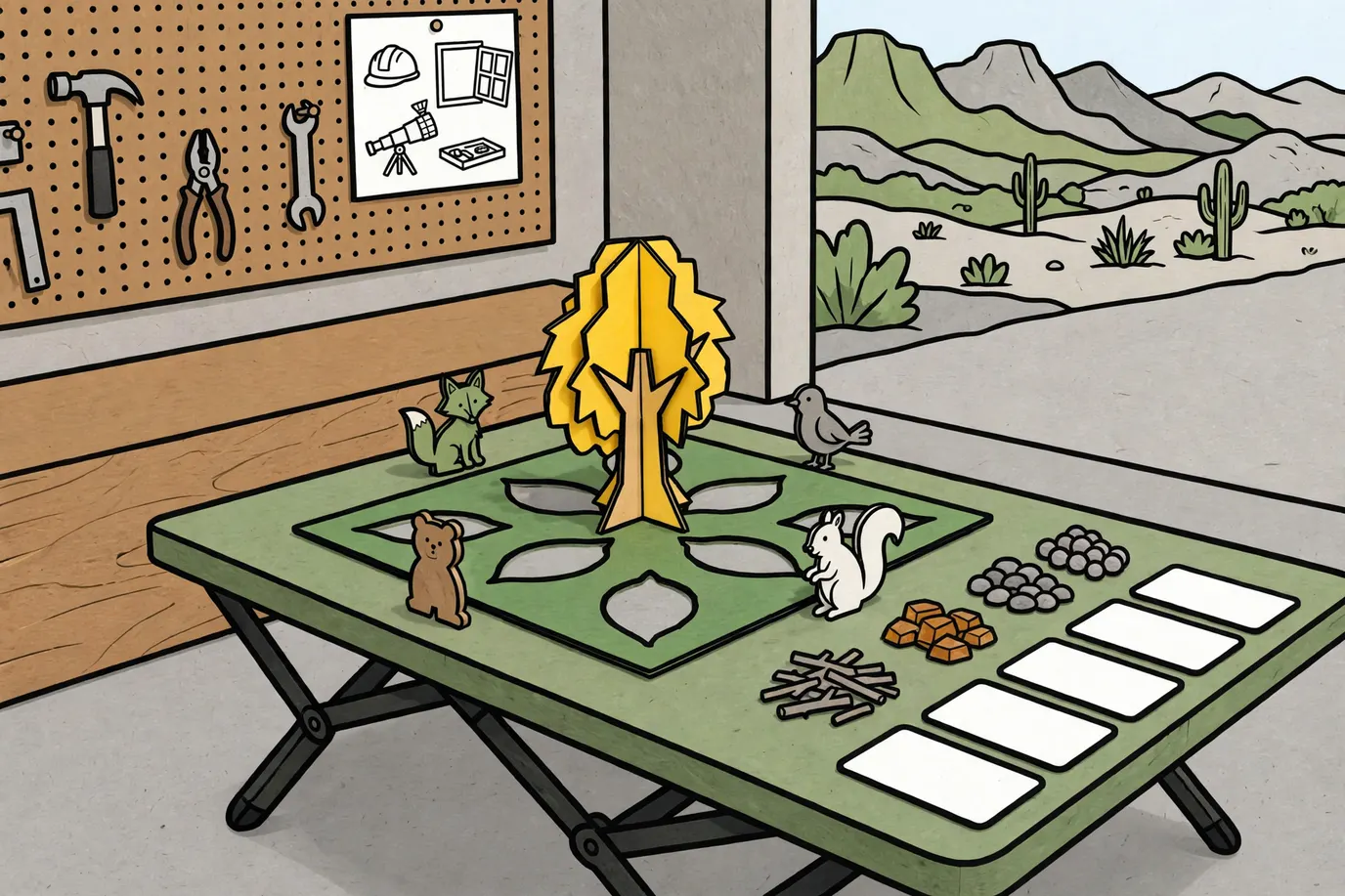
- Put the board on the table and set the cardboard Ever Tree on its stump.
- Pile the twigs, resin, pebbles and berries along the river, with point tokens nearby. Resources aren't meant to run out; if they do, use a substitute.
- Deal Forest cards face up onto the forest clearings (one fewer with 2 players).
- Lay out the 4 basic Events, and put 4 special Events on the tree.
- Shuffle the Critters and Constructions together, deal 8 face up as the Meadow, and set the deck in the tree.
- Each player takes 2 workers in their color. The first player draws 5 cards, the second 6, the third 7, the fourth 8.
- Each player's other 4 workers wait on the tree's branches: 1 for spring, 1 for summer, 2 for autumn.
Then the rulebook says the most humble player goes first. I can already picture the silence at my house. Nobody wants to claim it, which, I suppose, is the test.
Your turn: one of three actions
Play goes clockwise. On your turn you do exactly one of these:
- Place a Worker. Put one of your workers on an open location and take what it gives right away: resources, cards, or a special action.
- Play a Card. Pay the resources shown on one card and add it to your city. The card can come from your hand or from the Meadow, the row of face-up cards on the board.
- Prepare for Season. Only when all your workers are out. Bring them all home, get new workers and take the next season's bonus.
That's the whole turn. It's short, and that's the appeal. Most of the thinking happens while other players take theirs.
Locations: exclusive and shared
Most locations are exclusive: one worker fits, and once it's taken, nobody else can go there until that worker comes home. A few locations are shared, and any number of workers can visit. The board shows the difference with closed and open rings.
One rule I like a lot: you can't place a worker just to block someone. You have to be able to use some or all of the location's action. The rulebook says this outright, and I wish more of life came with that sentence.
Some cards in your city are locations too. If another player visits an open location in your city, you get point tokens for it.
Changing seasons
When you've placed all your workers and you can't or won't play a card, you prepare for the next season. Here's what each one gives, per the rulebook:
- Spring: 1 new worker, and every green Production card in your city produces again.
- Summer: 1 new worker, and you can draw up to 2 cards from the Meadow. No production this time.
- Autumn: 2 new workers, and green Production cards produce again.
Players don't change seasons at the same time. Your neighbor can be deep in summer while you're still finishing spring. In Las Cruces that's just October.
June wanted to know why autumn hands out two workers when spring only gives one. I said that's how harvest works. She wasn't convinced, and between us, neither was I. It's a good rule anyway: the last season is your biggest push.
How it ends and who wins
Autumn is the last season you can prepare for. When you've placed every worker in autumn and can't do anything more, you pass. Players who are still going keep playing until everyone has passed. A passed player's workers stay where they are, and they can still collect point tokens when others visit their city.
Then you add up:
- the base points printed on each card in your city
- point tokens
- bonuses from purple Prosperity cards
- Journey points
- Events you achieved
Most points wins. On a tie, the player with more Events wins, and after that, the most leftover resources.
Lucho's take: "Twigs, resin, pebbles and berries. That's my tía's garden in El Paso, minus the chile." He says she'd win on resources. She has never played.
Everdell editions on Amazon US right now
Our data for this page lists 7 Everdell listings on Amazon US as of October 2026, all from Starling Games. The table above shows what each listing states. A dash means the listing left that field out. The editions fall into three groups.
The main game: three boxes
- Everdell Old Edition: the listing gives the most facts: ages 10+, 1 to 4 players, 40 to 80 minutes, solo mode. The name says "old," and the listing doesn't say what changed since. I won't guess.
- Everdell Standard Edition: 1 to 4 players and a solo mode, edition named "Standard." The publisher's shop sells a Standard Edition too, and its web address calls it the 3rd edition.
- Everdell Collector's Edition: 1 to 4 players and a solo mode, edition named "Collector's." The listing doesn't spell out how its parts differ from the Standard box.
All three are the same game under the rulebook above. None of the three listings explains the differences in components, so the clearest choice is between the edition names themselves: Standard as the current everyday box, Collector's when the person you're buying for wants the fancier set, and Old Edition if that's the listing in stock.
Stand-alone games in the Everdell world
- Everdell Farshore Collector's Edition: a separate game, not an expansion. The listing says 1 to 4 players with solo mode, and names plastic ships, a 3D lighthouse, 155 cards and 300+ pieces. The publisher's page says Farshore is built on Everdell's gameplay and adds sailing, tides, map tiles and buried treasure.
- Everdell Duo: the listing says 1 to 2 players with a solo mode. The publisher calls it a stand-alone game made for two, with head-to-head play, a full co-op mode and a 15-chapter campaign.
- Welcome to Everdell: the family version. The listing says ages 6+, 2 to 4 players, 30 minutes, strategy. The publisher's page says it uses child versions of Everdell characters, simpler rules, and punchboard resource pieces instead of resin and wood.
The expansion
- Everdell: Bellfaire: the one true expansion in our data. The listing names Everdell as the base game required and lists 15 player power cards. The publisher's page adds that it takes Everdell to 5 or 6 players, with modules you can mix in: player powers, Garland Awards, special events and a market board.
Which Everdell fits your table
My one opinion for this page: the age on the box works in both directions. Everdell's Old Edition listing says 10+, and that's about planning a whole year of workers and resources, not about reading. A 7-year-old at a 10+ game will place workers happily and then wonder why their city is smaller. That's what Welcome to Everdell at 6+ is for. Going the other way, a 6+ family box at a strategy night for adults is a short warm-up, not the main event.
A few quick matches, from the listings and the publisher:
- A first copy for a 10-and-up table: Everdell Standard Edition
- A family with younger kids: Welcome to Everdell, ages 6+, 30 minutes
- A two-person household: Everdell Duo, made for 1 to 2
- Someone who owns Everdell already: Bellfaire for more players and modules, or Farshore for a new stand-alone game
- Five or six at the Sunday table: the base game plus Bellfaire
Who should skip Everdell
Skip it if your group wants a game under half an hour, unless you pick Welcome to Everdell. The main game's only listed time is 40 to 80 minutes, and a first game with the rulebook open will run long.
Skip it if your players don't enjoy losing a spot they wanted. Exclusive locations mean somebody will take the space you were saving a worker for. That's the game working, but it stings for some kids.
And skip the main game for anyone under 10, the age on the one listing that states it. Welcome to Everdell exists for that table.
If you like Everdell, look at these
Pages chosen by what they share with Everdell: a 1-to-4 table, a solo mode or a strategy game with an engine to build.
- Wingspan: another strategy game for a small table, with its own page here
- Dune: Imperium: worker placement mixed with deck-building
- Splendor: another strategy pick for the same group size
- Azul: another strategy game for a family table
- Strategy board games: the wider shelf
Plan for autumn. It comes sooner than you think.
Related
Questions people ask
How many players can play Everdell?
The Everdell Old Edition, Standard Edition and Collector's Edition listings in our data all say 1 to 4 players, with a solo mode. The publisher's Bellfaire page says that expansion takes Everdell to 5 or 6 players. Everdell Duo is its own game for 1 to 2. Welcome to Everdell lists 2 to 4.
How long does Everdell take to play?
The Everdell Old Edition listing says 40 to 80 minutes, and it's the only main-game listing in our data that gives a time. Welcome to Everdell lists 30 minutes. The Standard and Collector's Edition listings don't state a play time, so the table shows a dash rather than a guess.
What is Everdell Farshore?
Farshore is a stand-alone game set in the world of Everdell, not an expansion. The publisher's page says it's built on the same worker placement gameplay and adds sailing, tides, map tiles and buried treasure. The Farshore Collector's Edition listing in our data says 1 to 4 players with a solo mode and names plastic ships, a 3D lighthouse, 155 cards and 300+ pieces.
Do you need the base game for Everdell Bellfaire?
Yes. The Bellfaire listing names Everdell as the base game required, and the publisher's page says Bellfaire is an expansion, not a stand-alone product. It adds 15 player power cards (per the listing), Garland Awards, special events and a market board, and it's the publisher's route to 5- and 6-player games.
What's the difference between Everdell and Welcome to Everdell?
Welcome to Everdell is the family version. The listing says ages 6+, 2 to 4 players and 30 minutes, against 10+ and 40 to 80 minutes on the Everdell Old Edition listing. The publisher's page says it features child versions of Everdell characters, simpler rules and punchboard resources instead of resin and wood ones.
Sources
- Everdell: The Gilded Book, Complete Collection rulebook (PDF) — accessed 2026-10-23
- Everdell publisher shop: Everdell Standard Edition — accessed 2026-10-23
- Everdell publisher shop: Everdell Bellfaire — accessed 2026-10-23
- Everdell publisher shop: Everdell Farshore Collector's Edition — accessed 2026-10-23
- Everdell publisher shop: Everdell Duo — accessed 2026-10-23
- Everdell publisher shop: Welcome to Everdell — accessed 2026-10-23