Board & Card Games · Type
Outfoxed Board Game: The Co-op Whodunit for Kids 5 and Up
Outfoxed is a cooperative whodunit for 2 to 4 players, ages 5+ on Gamewright's box: a fox stole a pot pie, and the whole table works together to find which of 16 suspects did it before the thief reaches its den. You roll dice to move, peek at clues through a little decoder and cross off suspects. Everybody wins or loses together, which changes the mood at a table with a 5-year-old on it.
We earn a commission if you buy through our links, at no cost to you. Disclosure
| Model | Recommended age | Players (max) | Play time (min) | Amazon |
|---|---|---|---|---|
Gamewright OutfoxedKids & preschool games | 5+ yearslisting | 4listing | 15 minlisting | Check price |
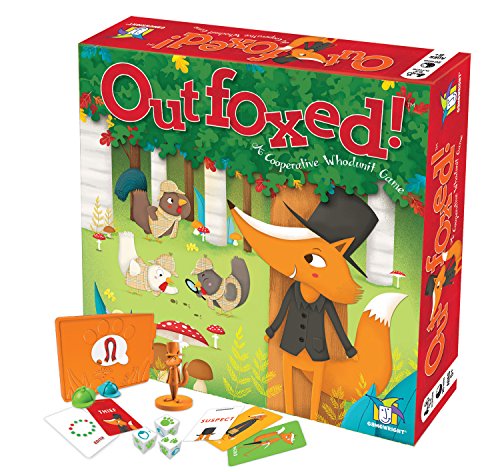
What’s in this listEditions and versions of Outfoxed sold on Amazon US, matched by the name on the listing. Players, age and play time come from the box or listing. “—” means neither the maker nor the Amazon listing states it.
What the Outfoxed board game is
Outfoxed is a cooperative deduction game for young kids. A fox has stolen Mrs. Plumpert's pot pie and is running for its den. Sixteen fox suspects are lined up around the board. The players are a team of detectives, and they have to work out which suspect is the thief before it gets away.
You do that two ways. You gather clues, which tell you what the thief is or isn't wearing. And you reveal suspects, so you can see who's wearing what. Put the two together and suspects start dropping off the list.
Box facts, from Gamewright's product page and our listing data:
- Players: 2 to 4 (Gamewright); maximum 4 on the listing
- Ages: 5+
- Play time: about 20 minutes (Gamewright); the listing starts at 15
- Co-op or competitive: cooperative, everyone wins or loses together
- Expansion needed: no, it's a complete game
- Designer: Department of Recreation, per the rules sheet
Gamewright lists 16 suspect cards, 16 thief cards, 12 clue markers, 4 detective hat pawns, 3 custom dice, a fox figurine, a clue decoder and the board.
How Outfoxed plays
The rules below are in my own words, from Gamewright's Outfoxed Rules of Play sheet (the 2015 edition printed on it). Nothing here is copied; for the exact wording, the sheet is a free download from Gamewright.
Setup
- Put the board in the middle of the table.
- Each player puts a detective pawn in the center of the board.
- Put the fox on the start space at the edge of its path.
- Spread the 16 suspect cards face down around the board, four per side, and turn any two face up.
- Shuffle the thief cards and, without looking, slide one into the clue decoder. Put the rest back in the box.
- Stack the 12 clue markers face down.
- Put the three dice where everyone can reach.
That decoder step is the only fiddly part. The thief card goes in hidden, and nobody sees it until the end. A grown-up should load it the first few times.
The clue decoder
The decoder is the clever object in the box. The thief card sits inside, out of sight. When you load a clue marker and slide the decoder open, a small window shows one color, green or white, for that one item. You learn a single fact about the thief and nothing else. No one has to keep a secret, and no grown-up has to play referee. The box keeps the answer for everybody.
Who goes first
The rules sheet says the player who most recently ate pie goes first. That's the best start-player rule I've seen in a while, and it's on theme. At our table, it means whoever had dessert last night, and there's always a short investigation about that too.
A turn: call it, then roll
Before you roll, you say out loud what you're going for: search for clues or reveal suspects.
Then you roll all three dice. You get up to three rolls. After each roll, set aside any die that matches your choice and roll the rest.
- Searching for clues: you want footprints on all three dice.
- Revealing suspects: you want eyes on all three dice.
If all three match by the third roll, you get your action. If they don't, the fox moves 3 spaces closer to its den, and your turn ends.
That miss rule is the timer. Every bad roll walks the fox home, and everyone can see it happen. It's the clearest stakes in any kids' game I know.
Searching for clues
Count the footprints on the dice and move your detective up to that many spaces, straight up, down or sideways, not diagonally. You may walk anywhere, including across the fox's path.
If you end on a paw-print space, draw the top clue marker and load it into the decoder. Slide the decoder open and look at the little window. Green means the thief is wearing that item. White means the thief is not.
Then check the face-up suspects. If the clue came up white, every face-up suspect wearing that item is cleared and goes back in the box. If it came up green, every face-up suspect who isn't wearing it is cleared. Close the decoder and leave the clue marker face up on the space where you stopped.
Revealing suspects
Flip two face-down suspects. Then look at all the face-up clues already on the board and remember which ones came up green. Any suspect who doesn't fit gets cleared. This is the part of the game that runs on memory, and it's where the team talks most.
Marisol's take: "A window that shows one of two colors is a yes-or-no instrument. That's my favorite kind. Nobody argues with it."
How the game ends
There are three ways out, per the rules sheet:
- You make a guess. If the team feels sure, name the suspect out loud and check the thief card in the decoder. Right, and you win. Wrong, and the fox escapes, and you lose.
- One suspect is left. Clear every other suspect, then check the thief card. If it matches, you win.
- The fox reaches the den. It escapes, and everybody loses together.
Option one is a real choice. A team that guesses early can win fast or lose fast. Waiting gives the fox more time to walk home. That's a small, honest lesson in risk for a kid, and you don't have to explain it. The fox explains it.
When to search and when to reveal
This part isn't spelled out in the rules, but it follows from them. A clue only clears suspects you can see. Early in the game, with just two suspects face up, a clue may clear nobody. Later, with most suspects revealed, one clue can clear several at once.
So a natural rhythm is to reveal suspects early and search for clues once the board is full of faces. The dice will interfere, of course. Each turn, you're choosing between two kinds of progress and hoping the fox stays put.
The decision to guess works the same way. With three suspects left, a guess is right about one time in three. With two left, it's a coin flip. A team that waits for one suspect never guesses at all, but it has to beat the fox to that point.
The official variant
Once your team wins regularly, the rules sheet suggests moving the fox 4 spaces on a miss instead of 3. For experts, 5. That's the only variant printed. Everything below in "house rules" is mine.
What a game looks like
A typical first game goes like this. Early turns reveal faces, because a clue clears nobody until there are suspects to compare. Then the team starts searching, and the board fills with clue markers that say yes or no about one item each. The middle of the game is talking: which face-up suspects still fit every green clue? The fox, meanwhile, inches along its path every time somebody misses a roll. The end comes down to one question the whole table answers together: guess now, or roll once more?
Outfoxed editions on Amazon US right now
Our data for this page lists one Outfoxed listing on Amazon US as of October 2026: Gamewright's Outfoxed, listed for ages 5+, a maximum of 4 players and play time starting at 15 minutes. The table above shows what the listing states.
There are no expansions or alternate editions in our data. If you see another box with Outfoxed in the name, check that Gamewright is the maker before you buy.
House rules for younger detectives
These are house rules, not Gamewright's, and they're optional:
- One player keeps the decoder. Rotate the job each game so everyone gets to slide it open.
- Say the clue out loud. Naming the item and its color helps the youngest player keep up when it's time to reveal suspects.
- No early guesses in the first game. Let a new team play until one suspect is left, so they see how the deduction works before they risk a guess.
Small parts
The game has small pieces: dice, pawns, clue markers and a fox figurine. Check the age label on the listing. Toys with small parts are a choking hazard for children under 3. If the box is going to a house with a baby and a 5-year-old, play at the table and pack it up after.
Who should skip Outfoxed
My one opinion for this page: for a kid's first deduction game, cooperative beats competitive. The reason is in the rules. Everyone wins or loses together, so nobody loses alone, and the strongest reader at the table can't simply outplay the youngest. The rules sheet itself says the game is about working together.
That cuts the other way, too. Skip Outfoxed if your group is all adults looking for a real puzzle. With 16 suspects and 12 clue markers, it's built for a 5+ table, and grown-ups on their own will likely find it light. Look at Clue or Mysterium instead.
Skip it for a child under 5. The box says 5+, and that's the age to go by.
And skip it if one player tends to run the whole team. In any co-op game, a confident older player can end up taking every turn for everybody. Let the youngest call their own roll.
If you like Outfoxed, look at these
Pages chosen by what they share with Outfoxed: deduction, short games and young players.
- Guess Who: yes-or-no questions to narrow down a face
- Clue: the grown-up whodunit, 8+ on the box
- Mysterium: cooperative mystery with picture clues; Mysterium Kids starts at 6+
- Family board games: the wider shelf for mixed ages
- Murder mystery games: party kits and case files, mostly for adults
See the Gamewright brand page for the rest of its lineup.
Call your roll, watch the fox, and save the pie for whoever goes first next time.
Brands in this list
Related
Questions people ask
How do you play Outfoxed?
On your turn, say out loud whether you'll search for clues or reveal suspects, then roll three dice up to three times, keeping matches. All footprints lets you move and maybe pick up a clue. All eyes lets you flip two suspects. Miss, and the fox moves 3 spaces. Catch the right fox before it escapes and the team wins.
What age is Outfoxed for?
Gamewright's page and the Amazon listing in our data both say ages 5+. Each clue is about an item a suspect is or isn't wearing, checked by color in the decoder. Gamewright says the game reinforces cooperation, deductive reasoning and visual discrimination. The box has small pieces, so keep it away from children under 3.
How many players can play Outfoxed?
Gamewright lists 2 to 4 players, and the listing in our data gives a maximum of 4. The box has 4 detective pawns. Since it's cooperative, it doesn't need a minimum the way a competitive game does, but the rules sheet is written for 2 to 4 players.
How long does Outfoxed take?
Gamewright says about 20 minutes. The Amazon listing in our data starts its play time at 15 minutes. The game ends in one of three ways, so a lucky early guess can make it much shorter, and a run of bad rolls can let the fox get home first.
Who makes Outfoxed?
Gamewright publishes it. The rules sheet credits the game to Department of Recreation and the illustrations to Mélaine Grandgirard, and carries a 2015 Gamewright copyright. Gamewright's product page lists it as stock number 418. The one Outfoxed listing in our data is from Gamewright.
Is there a harder version of Outfoxed?
Yes, in the rules sheet itself. Gamewright's variant moves the fox 4 spaces instead of 3 on a failed roll once your group knows the game, and 5 spaces for experts. That's the only official variant on the sheet. Anything else is a house rule.
Sources
- Gamewright: Outfoxed — accessed 2026-10-23
- Gamewright: Outfoxed Rules of Play (PDF) — accessed 2026-10-23
- CPSC: Small Parts for Toys and Children's Products — accessed 2026-10-23