Board & Card Games · Type
Hues and Cues: The Color Board Game, Explained
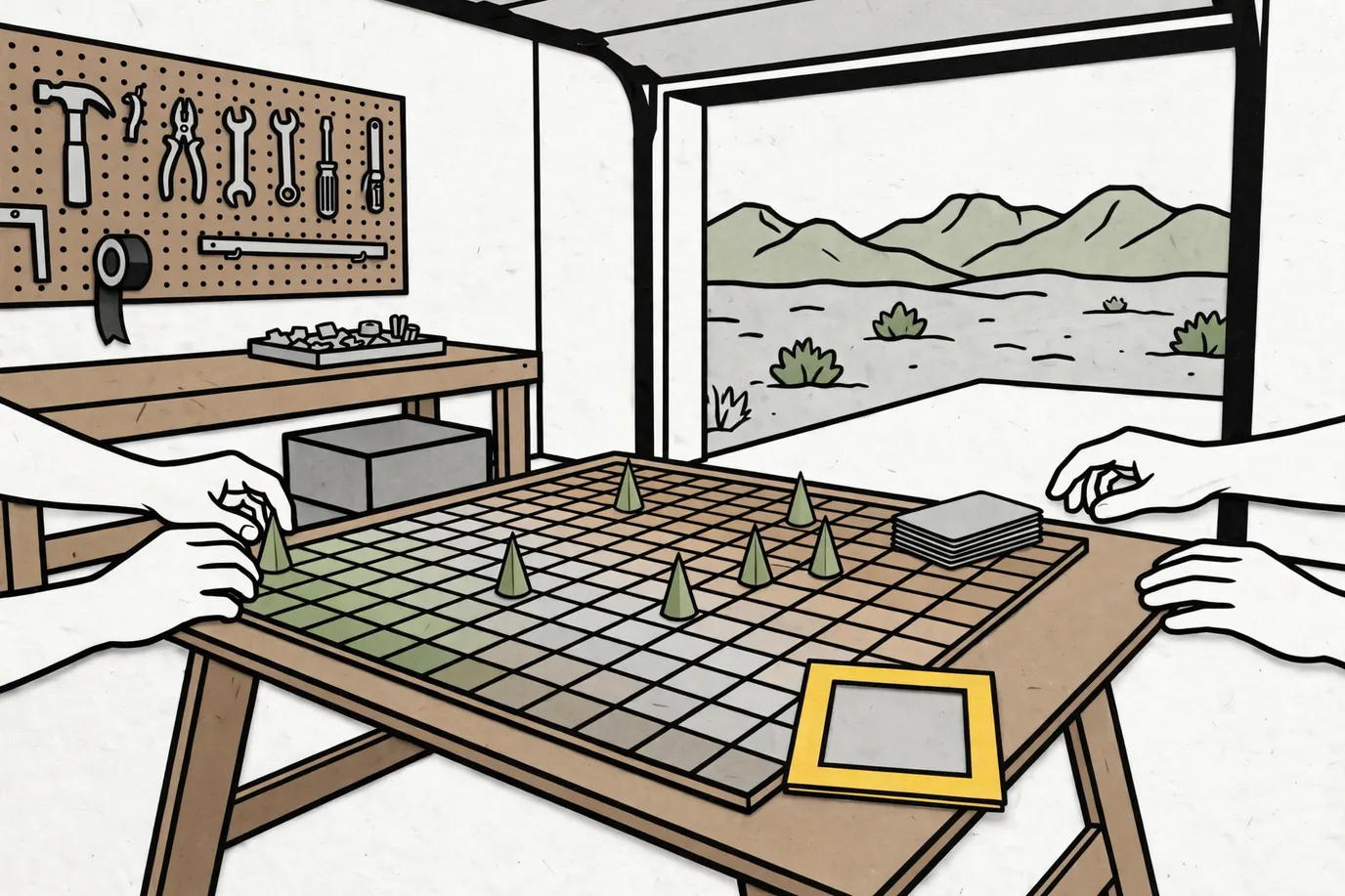
Hues and Cues is a party game about describing one color out of 480 on a big board, for 3 to 10 players, ages 8+ on the box. One player gives a one-word clue, then a two-word clue, and everyone else tries to land on the exact square. Two editions are listed on Amazon US right now. I'll admit the first thing I checked was whether the board has coordinates. It does.
We earn a commission if you buy through our links, at no cost to you. Disclosure
| Model | Amazon |
|---|---|
USAopoly Hues and CuesParty, trivia, drinking & social deduction games More specs
| Check price |
USAopoly Hues and Cues MultilingualParty, trivia, drinking & social deduction games More specs
| Check price |


What’s in this listEditions and versions of Hues And Cues sold on Amazon US, matched by the name on the listing. Players, age and play time come from the box or listing. “—” means neither the maker nor the Amazon listing states it.
What the Hues and Cues board game is
Hues and Cues is a guessing game where the thing you guess is a color. The board is a grid of 480 shades, laid out so each one sits next to its closest neighbors. One player, the cue giver, draws a card, picks one color on it, and describes that color in words. Everyone else tries to place a piece on that exact square.
The game was designed by Scott Brady and published by The Op (USAopoly) in 2020, per the rulebook. The Op's own page puts the whole idea in one line: people see colors differently, so the clues start conversations. That's a polite way to say the table will argue about teal.
Here are the box facts, from The Op's product page and the rulebook:
- Players: 3 to 10
- Ages: 8+
- Play time: about 30 minutes
- Contents: 1 game board, 100 color cards, 30 player pieces (3 each in 10 colors), 1 scoring frame
- Type: competitive party game; everybody scores for themselves
- Expansion: no, both listed editions are complete games
There's no team mode and no co-op mode in the rulebook. Every guess earns points for the guesser and for the cue giver at the same time, which is the clever part, and I'll get to it below.
How Hues and Cues plays
Everything in this section is in my own words, from The Op's 2020 Hues and Cues rulebook. It's a short rulebook, two pages, and most of it is pictures of the scoring frame. Read it once before your first game; it takes about as long as making coffee.
Setting up the board
Put the board in the middle of the table. Each player takes three pieces of one color. One piece goes next to the score track that runs around the edge of the board, and you keep the other two for guessing. Shuffle the color cards into a face-down pile, and set the scoring frame aside.
The first time you open the box, you assemble the scoring frame from four plastic pieces. After that, the rulebook says you can store it assembled. The frame is the whole scoring system, so don't lose it in the box insert.
The rulebook picks the first cue giver by asking who's wearing the most colorful outfit. I own four gray sweaters. I have made peace with going last.
A round, start to finish
- The cue giver draws the top card and looks at it in secret. The card shows several colors, each with its letter-and-number spot on the board. The cue giver picks one.
- The cue giver says one word to describe it.
- Going clockwise, every other player puts one piece on the square they think matches. Each square can hold only one piece, so if someone takes your square first, you have to choose a neighbor.
- The cue giver now gives a two-word clue. They can also pass, or give another one-word clue instead.
- Going counterclockwise this time, everyone places their second piece on any empty square.
- The cue giver reveals the color by setting the scoring frame on the board, centered on the right square.
The direction flip in step 5 is a small rule that does a lot of work. Whoever guessed last in the first round guesses first in the second, so nobody is stuck picking from leftovers every time.
What you can't say
The clue rules are the heart of the game. Per the rulebook, a clue can't be:
- A common color name, like blue, red, green or yellow
- A reference to where the color sits on the board, or its letter and number
- The name of an object in the room
Abstract color names are allowed. Lavender, golden and chartreuse are all fair. So a cue giver looking at a deep orange can't say "orange," but can say "pumpkin," or "traffic cone," or "sunset." Three people will then point at three different sunsets. That's the game working, not failing.
How scoring works
The scoring frame is a square that covers a 3-by-3 block of the board, with the secret color in the center. The rulebook scores it like this:
- A piece on the exact color: 3 points
- A piece inside the frame but not on the exact color: 2 points
- A piece on a square just outside the frame, touching it, including diagonally: 1 point
- The cue giver: 1 point for every piece inside the frame
So the cue giver can score up to 9 in a round, and one guesser can score up to 5, according to the rulebook: 3 for the exact square and 2 for the second piece inside the frame. Scores move along the track around the board.
Marisol stopped by during a demo game and looked at the frame for a long time. Her take: "A color without coordinates is an opinion. With coordinates, it's a point." She is a county surveyor, and I've never seen her approve of a party game faster.
Passing the second clue
There's one rule people skip and shouldn't. If the cue giver likes where the first-round pieces landed, they can pass on the second clue. Then nobody places a second piece, and scoring happens right away. It's a real decision. A great one-word clue that pulls everyone close might score better than a two-word clue that sends people wandering off to the wrong shade of green.
How the game ends
How long you play depends on the group. With 4 to 6 players, the game ends after everyone has been the cue giver twice. With 7 or more, once each. Highest score wins. If two players tie, the rulebook gives the win to whichever of them was the cue giver most recently. The rulebook covers 4 to 6 and 7 or more by name; a game with exactly 3 isn't spelled out, so we play it like the smaller group, twice around. That's our house rule, not The Op's.
The variant for younger players
The rulebook includes one official variant. Instead of drawing a card, the cue giver can pick any color on the board, write down its letter and number in secret, and then give clues. The rulebook suggests it for younger players who struggle to find words for the colors on a card. It also helps anyone stuck with a card full of browns.
Hues and Cues editions on Amazon US right now
Our data for this page lists 2 Hues and Cues editions on Amazon US as of October 2026, both from USAopoly. The table above shows what each listing states.
- Hues and Cues. The standard box. The listing says 3 to 10 players, ages 8+, and describes 480 color squares. It's a complete game, not an expansion.
- Hues and Cues Multilingual. The listing also says 3 to 10 players and ages 8+, and it's also a complete game.
That's honestly where the listed facts run out. The Multilingual listing doesn't say which languages are in the box or whether the cards or rulebook differ from the standard edition. I won't guess. If you're buying for a household that plays in more than one language, open that listing and read the details before you buy. If not, the standard box matches The Op's own product page and the rulebook described above.
Neither listing names an expansion, and our data doesn't show any Hues and Cues add-ons on Amazon US right now. The game doesn't need one. A hundred cards with several colors each is a lot of rounds.
Who Hues and Cues suits
My one opinion for this page: buy for your usual group size, not the biggest number on the box. Hues and Cues says 3 to 10, and the rulebook backs that range with a real rule change at 7 players. That's a game built for a crowd.
A few quick matches, from the box facts:
- A big family gathering. At 7 to 10 players, each person gives clues once, and the game still lists about 30 minutes.
- A mixed-age table, 8 and up. No reading is needed to guess. Clues are one or two words, and the board does the rest.
- A group that likes word games but not trivia. Nobody needs to know facts. You need to know what "avocado" looks like to the person across from you.
- Teachers and art-minded kids. The board is a color grid with letters and numbers, so it doubles as a lesson on coordinates if you want it to. You don't have to.
The clue rules also make it a good game for people who usually stay quiet at party games. There's no acting, no drawing and no time limit in the rulebook. You say one word. If it's a good word, people land near it.
Who should skip Hues and Cues
Skip it if you usually play with two. The rulebook has no two-player game, and the 3-player minimum on the box is real: the cue giver needs at least two guessers for the scoring to make sense.
Skip it, too, if anyone at your table has trouble telling colors apart and would rather not play a game built entirely on that. The rulebook doesn't include a variant for color vision differences. A word game like Codenames or a drawing game like Telestrations keeps the party-game feel without leaning on color.
And skip it if your group wants a strategy game with a long arc. Every round is self-contained. You can't build an engine or plan four turns ahead. The plan is "say 'butter' and hope."
Check the age label on the listing. Toys with small parts are a choking hazard for children under 3, and the Hues and Cues rulebook carries that warning for its player pieces.
If you like Hues and Cues, look at these
Pages chosen by what they share with Hues and Cues: a big group, short rounds and clue-giving.
- Party games: the wider shelf of games for a crowd
- Codenames: one-word clues, two teams
- Telestrations: drawing and guessing, passed around the table
- Taboo: describing a word without the obvious words
- Pictionary: drawing for a team, against a timer
A few table notes
Some practical things the rulebook doesn't say, from how games like this tend to go:
- Light matters. Colors on a printed board look different under a warm kitchen bulb and in daylight. Play under the same light all game, and don't move the board halfway through.
- Seat the board so everyone sees it right side up, or close. With 10 players, someone will be looking at it sideways. That's fine; the letters and numbers keep the squares honest.
- Keep the score track tidy. Pieces on the track get bumped when people reach across the board to guess. A quick check at the end of each round saves an argument later.
None of that is a rule. It's just what keeps a 10-player game moving.
Pick a color. Then pick your words more carefully.
Related
Questions people ask
How many players can play Hues and Cues?
The box and both Amazon US listings in our data say 3 to 10 players. The rulebook changes the length with the group: with 4 to 6 players, everyone gives clues twice; with 7 or more, everyone gives clues once. It has no two-player mode in the rulebook, so a table of two should look at a different game.
How long does a game of Hues and Cues take?
The Op's product page and the rulebook cover both list about 30 minutes. The game ends when every player has been the cue giver once or twice, depending on the group size, so a big table doesn't have to mean a long night. The rulebook rule on passing your second clue can make some rounds even shorter.
What age is Hues and Cues for?
Ages 8+ on the box and on both listings. The rulebook also carries a choking-hazard warning for small parts and says the game is not for children under 36 months. For younger players who are old enough for the label, the rulebook suggests a variant where the cue giver picks any color on the board and writes down its letter and number.
What can't you say when giving a clue in Hues and Cues?
Per the rulebook, your clue can't be a common color name like blue, green or orange, though abstract names like lavender or chartreuse are allowed. You can't point to the color's position on the board or use its letter and number. And you can't name an object in the room. Everything else is fair, as long as it's one word first and two words second.
What is the difference between Hues and Cues and Hues and Cues Multilingual?
On the Amazon US listings in our data, the two share the same facts: 3 to 10 players, ages 8+, and neither is an expansion. The Multilingual listing doesn't say which languages it covers or how its contents differ. If language matters at your table, read the listing details for that box before you buy.
Sources
- The Op: Hues and Cues product page — accessed 2026-10-23
- The Op / USAopoly: Hues and Cues rulebook (2020, PDF) — accessed 2026-10-23
- CPSC: Small Parts for Toys and Children's Products — accessed 2026-10-23