Board & Card Games · Type
Charades Game: How It Plays and the Boxed Sets
A charades game needs no box at all: one player acts out a word or title without speaking, and their team guesses it. A boxed set adds the part people run out of, which is ideas. Three are listed on Amazon US in our data, from a 5+ family box with 750 prompts to a pocket tin of 200. Charades is also the only game in my closet that gets harder the more snacks you've had.
We earn a commission if you buy through our links, at no cost to you. Disclosure
| Model | Recommended age | Amazon |
|---|---|---|
Buffalo Games Chuckle & Roar Classic CharadesParty, trivia, drinking & social deduction games More specs
| 5+ yearslisting | Check price |
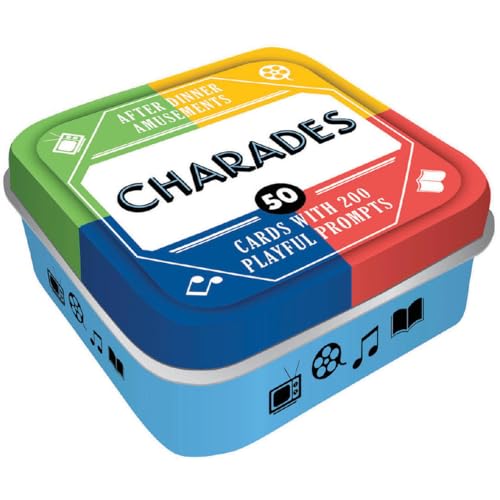
Chronicle Books After Dinner Amusements: CharadesParty, trivia, drinking & social deduction games More specs
| — | Check price |
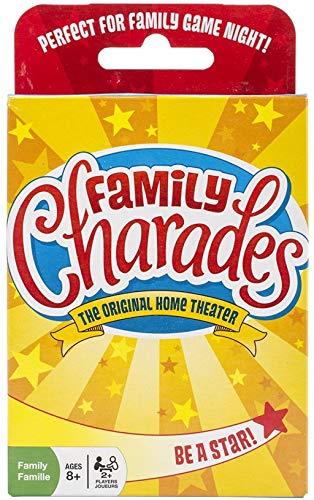
Outset Media Family CharadesParty, trivia, drinking & social deduction games More specs
| 8+ yearslisting | Check price |

What’s in this listEditions and versions of Charades sold on Amazon US, matched by the name on the listing. Players, age and play time come from the box or listing. “—” means neither the maker nor the Amazon listing states it.
What a charades game is
Charades is a guessing game played with your body. One player gets a prompt, usually a title or a phrase. They act it out in silence. Their team shouts guesses until someone says it, or until time runs out. Then the other team takes a turn.
That's it. There's no board, no score pad unless you want one, and no pieces to lose under the couch. The game itself is older than any box sold for it. What a box adds is a stack of prompts someone else thought up, sorted by difficulty, so nobody has to invent "the name of a movie" at 9 p.m. with a blank mind.
I couldn't open a publisher rulebook for any of the three boxed sets in our data. So this page describes how the game works from what publishers say on their own product pages, plus house rules that I label as house rules. Chronicle Books, which makes one of the sets here, describes charades on its Classic Charades page as teams racing to guess titles acted out without speaking: books, films, songs, TV shows and plays.
The short version, from that description and the listings:
- Players: no count stated on any listing in our data
- Teams: usually two, per the publisher's description
- Ages: 5+ and 8+ on the two listings that state one
- What's in a box: prompt cards, from 200 to 750 prompts
- Talking: none from the actor
How charades plays
Setup
- Split into two teams. Seat each team together so guessers can see the actor.
- Put the prompts where the actor can draw one without the others seeing.
- Pick who acts first. It works best when the first actor is the bravest person in the room.
A turn, start to finish
- The actor draws a prompt and reads it silently.
- The actor faces their own team and starts acting. No words, no mouthing, no sounds.
- The team calls out guesses as fast as they like.
- The actor nods, points or gestures to steer them toward the answer.
- When someone says the exact prompt, the team scores a point.
- The next turn goes to the other team, with a new actor.
The actor can't speak, but the guessers can talk as much as they want. A good team guesses out loud constantly, because every wrong guess tells the actor what to try next. A quiet team is the hardest audience in the game.
Scoring and timing
The publisher's description is a race, so most groups use a timer. These are house rules, not printed rules from the boxes in our data:
- Timer: one or two minutes a turn; a phone timer works
- Points: one point per prompt guessed in time
- End: play until everyone has acted twice, or to a target score you set first
- Steals: if time runs out, the other team gets one guess to steal the point
That last one keeps the other team watching, which keeps them from planning their own turn while you're mid-act.
House rules: the classic charades signals
Most groups use a set of hand signals that tell the team what kind of prompt it is and how many words it has. None of the boxes in our data print these as rules, so they're house rules. Agree on them before the first turn, because a signal nobody else knows is just waving.
- Number of words: hold up that many fingers
- Which word you're acting: hold up fingers again, then act that word
- Syllables: lay fingers on your forearm to show how many
- "Sounds like": tug an earlobe, then act a rhyming word
- Whole thing at once: sweep your arms in a big circle
- Close, keep going: pull your hand toward you
- A short word like "a" or "the": pinch two fingers close together
Common category signals, also house rules: crank an old film camera for a movie, open your hands like a book for a book, and sing silently with a hand on your chest for a song.
I once tugged my ear at a family party, and my aunt asked if I needed an aspirin. Teach the signals first.
Marisol's take: "Two fingers means two words. That's a count. Count it right." She holds up fingers like she's reading a level.
How to act a prompt so your team gets it
These are table habits, not rules from any box, but they win more points than talent does:
- Signal the category first. Movie, book or song cuts the guesses down before you act a thing.
- Try the whole prompt once. If one big action could get it in five seconds, do that before you break it into words.
- Go for the easiest word next. Skip "the" and "of." Act the one word you can show clearly.
- Point at the right guess. When someone says a word that's close, point at them hard, then pull your hand toward you.
- Change the action, not the speed. If a gesture isn't landing, doing it faster won't help. Try a different one.
Agree on one more house rule before you start: no props. Pointing at a lamp to get "light" is a fair clue in some houses and a scandal in others.
Charades games on Amazon US right now
Our data for this page lists 3 boxed charades sets on Amazon US as of October 2026. None is an expansion, and none is marked adults only. The table above shows what each listing states.
Chuckle & Roar Classic Charades (Buffalo Games)
- Listed for ages 5+
- 750 charades ideas, per the listing
- No player count or play time in our data
This is the biggest prompt count of the three and the youngest starting age. If you're shopping for charades for kids, start here: it's the only set in our data listed below 8. With 750 ideas, it's also the box least likely to repeat a prompt across a few family nights.
Outset Media Family Charades
- Listed for ages 8+
- 355 charades on 71 cards, per the listing
- No player count or play time in our data
That works out to 5 prompts a card. Five per card means one draw gives the actor a choice, or the group can use the card for five quick turns in a row. The 8+ label fits a family where the youngest can read a card alone.
After Dinner Amusements: Charades (Chronicle Books)
- No age stated on the listing in our data
- 50 cards with 200 prompts, per the listing
- The publisher's page says each card has four prompts, from easy to difficult, drawn from books, movies, TV shows and songs
- It comes in a small tin; the publisher lists it at 2.4 by 2.4 inches
This is the travel set. The publisher says most cards include at least one kid-friendly prompt, but the listing doesn't give a starting age, so I won't name one for it. Its prompts are all titles, so it suits players who already know a lot of movies and songs. It's the one I'd pack for a cabin weekend, because it fits in a jacket pocket.
Charades for kids: house rules that help
Young kids love charades, and they also break it, in the best way. These house rules are ours, not from any box:
- Act things, not titles. For kids under 8, use animals, sports and everyday actions. "Brushing teeth" beats "a movie from 1994."
- No timer for the youngest. A timer makes a 5-year-old freeze. Let them act until someone gets it.
- Pair up. Let a younger kid act with an older partner who whispers ideas before the turn starts.
- Everyone guesses. Skip teams with small kids. First person to guess right acts next.
- Whisper the prompt. If a kid can't read the card yet, an adult reads it quietly into their ear.
June writes her own prompt slips now. They're harder than anything in a box. One just said "Tuesday." Nobody got it, including June, who acted it out with great confidence for a full two minutes.
Check the age on the listing before you buy for a child. The youngest listed age in our data is 5+, on the Chuckle & Roar set.
Which charades set fits your group
My one opinion for this page doesn't need a box: charades works best when the prompts match the room. A box is only as good as how many of its prompts your group actually knows. Movie titles from forty years ago stump teenagers. Today's cartoon characters stump grandparents. A box with a spread of difficulty, like the Chronicle tin's easy-to-difficult cards, handles a mixed room better.
A few quick matches, from the listings:
- A family with kids 5 and up: Chuckle & Roar Classic Charades at 5+
- A family where the youngest reads on their own: Outset Media Family Charades at 8+
- Travel, or a pocket-size gift: After Dinner Amusements: Charades in its tin
- A party with no time to shop: paper slips in a bowl
Who should skip charades
Skip it if your group doesn't like standing up in front of people. Every player acts, and there's no way to hide in charades. A shy guest may spend the night dreading their turn. A drawing game like Pictionary or a talking game like Catch Phrase puts less of a spotlight on one person.
Skip the boxed sets if you already play often and have a good bowl of slips going. A box mainly saves you the writing.
And skip the Outset Media set for a child under 8. It's listed 8+. Look at the Chuckle & Roar set at 5+ instead.
If you like charades, look at these
Pages chosen by what they share with charades: acting or describing, teams, and a crowd.
- Catch Phrase: describe out loud instead of acting, with a buzzer
- Pictionary: draw the prompt instead of acting it
- Hedbanz: guess the card on your own head
- Taboo: describe a word without the obvious clues
- Party games: the wider shelf for groups
Clear the coffee table. Charades needs elbow room more than it needs a box.
Related
Questions people ask
How do you play charades?
Split into two teams. One player draws a prompt and acts it out without speaking while their team guesses. Chronicle Books describes it as teams racing to guess titles acted out in silence, with books, films, songs, TV shows and plays as the usual subjects. Many groups add a timer and the classic hand signals as house rules.
What are good charades for kids?
Look at the age on the box first. The Chuckle & Roar Classic Charades listing says ages 5+, the youngest in our data, with 750 charades ideas. Outset Media Family Charades says 8+. For young kids, pick prompts they can act with their whole body, like animals and everyday actions, and skip the title signals until they're older.
How many people do you need for charades?
None of the three listings in our data state a player count. Two teams of two is a practical floor, so one person acts and one guesses. You can also play with three people and no teams: everyone guesses, and the first correct guess earns the point. Big groups work too; the wait between turns just gets longer.
What are the hand signals in charades?
They're traditions, not rules printed on these boxes, so treat them as house rules. Common ones: hold up fingers for the number of words, then fingers again for which word you're acting; tap fingers on your forearm for syllables; tug your ear for 'sounds like.' Agree on your table's signals before the first turn.
Can you make your own charades cards?
Yes. Charades only needs prompts, so paper slips in a bowl work fine. Have each player write five, fold them, and mix them up. The boxed sets in our data save you that step and give you a spread of difficulty: the Chronicle Books tin puts four prompts on each card, from easy to difficult, per the publisher.
Sources
- Chronicle Books: Classic Charades — accessed 2026-10-23
- Chronicle Books: After Dinner Amusements: Charades — accessed 2026-10-23