Board & Card Games · Type
The Axis and Allies Game: Axis & Allies 1941, Explained
The Axis and Allies game is a World War II strategy board game where each player runs one or more of five powers and fights for control of the map. The edition on Amazon US in our data is Axis & Allies 1941, listed for 2 to 5 players and 120 minutes. You buy plastic units with your income, move them, roll dice for battles and try to take enemy capitals. Clear a big table and an afternoon before you open the box.
We earn a commission if you buy through our links, at no cost to you. Disclosure
| Model | Players (min) | Players (max) | Play time (min) | Play time (max) | Amazon |
|---|---|---|---|---|---|
Wizards of the Coast Axis and Allies 1941Strategy & hobby games More specs
| 2listing | 5listing | 120 minlisting | 120 minlisting | Check price |

What’s in this listEditions and versions of Axis And Allies sold on Amazon US, matched by the name on the listing. Players, age and play time come from the box or listing. “—” means neither the maker nor the Amazon listing states it.
What the Axis and Allies game is
Axis and Allies is a strategy board game set in World War II. The board is a map of the world, split into land territories and numbered sea zones. Each player controls one or more of five world powers. Germany and Japan are the Axis. The Soviet Union, the United Kingdom and the United States are the Allies.
On your turn you spend money on new military units, move your forces, fight battles with dice, and collect income from the territories you hold. The more territory you control, the more you can build. The goal is to capture enemy capitals.
There have been several versions of the game over the years. The one listed on Amazon US in our data is Axis & Allies 1941. The rulebook's designer's notes, by Larry Harris, describe 1941 as a lean, stripped-down version of the game and a handy way to bring new players into the line.
The box facts, from the listing:
- Players: 2 to 5
- Play time: 120 minutes
- Age: the listing doesn't say (the current publisher lists 12+)
- Competitive, two sides, with teammates on the same side
- Base game, not an expansion
What's in the box, per the 1941 rulebook: a game board, a battle strip, a casualty strip, 160 plastic miniatures (32 for each power), 34 unit stacking counters, 50 national control markers, 4 dice and the rulebook with setup charts. The miniatures cover infantry, tanks, fighters, bombers, submarines, battleships, destroyers, transports and aircraft carriers.
How Axis and Allies 1941 plays
The rules below are in my own words, from the Axis & Allies 1941 rulebook published by Renegade Game Studios. Renegade's page says this rulebook was updated based on errata and FAQs. The listing in our data is the Wizards of the Coast box, so a few small rulings may be worded differently in the rulebook you find inside. The shape of the game is the same.
Pick your powers
Decide who plays which power. With 5 players, each person runs one. With fewer, some players run two or three, and those must all be on the same side. If you run more than one power, you keep their money and units separate and play them one at a time.
Setup
- Each power takes its plastic pieces in its own color.
- Use the setup chart on the back of the rulebook to place every starting unit on the map. Each chart lists territories and sea zones by name and number.
- Each power starts with income listed in the rulebook, counted in IPCs, which stands for Industrial Production Credits. That's the game's money. The Soviet Union starts with the least, and the United States with the most.
- Put a control marker on the national production chart at your starting income.
- Pick one player to be the banker and track everyone's IPCs on paper.
That last step tells you a lot about the game. There's no paper money in the box. The rulebook just says to write it down or use any method your group agrees on.
Turn order
Each round, the powers go in a fixed order: Soviet Union, Germany, United Kingdom, Japan, United States. At the end of each round, check whether a side has won.
The six phases of a turn
- Purchase units. Spend IPCs on new units from the chart printed on the board. New units wait in the mobilization zone on the board. You can't use them this turn.
- Combat move. Move units into hostile spaces you want to attack. Each unit moves up to its move value. Most units stop when they enter a hostile space.
- Conduct combat. Fight every battle where your units and enemy units share a space. Dice decide the results.
- Noncombat move. Move units that didn't fight, and land your planes in a safe place.
- Mobilize new units. Place the units you bought this turn at factories you've held since the start of your turn. Each factory can place only as many units as its territory's income value.
- Collect income. Take IPCs equal to your current production level. If an enemy holds your capital, you collect nothing.
You must collect income if you can. The other phases are yours to use or skip.
How a battle works
Units go on the battle strip, attacker on one side, defender on the other. Each unit has an attack value and a defense value. You roll one die per unit. A roll equal to or lower than the unit's value is a hit. The other side picks which of its own units are lost, moves them behind the casualty strip, and they still fire back that round. Then the attacker can press on with another round or retreat.
The dice math is easy to see once you've played a battle. A unit with a value of 2 hits on a 1 or a 2, which is 2 chances in 6, or one roll in three. A 3 hits half the time. I teach seventh-grade math, and this is the only game I own that turns a fraction into a decision about a tank.
Some units have special rules. The rulebook gives each one a profile. A few highlights:
- Tanks can blitz: move through an empty enemy territory, capture it, and keep going one more space.
- Submarines can slip through sea zones with enemy warships unless an enemy destroyer is there, and they get a surprise strike before the main roll.
- Fighters and bombers have to save enough movement to land in a friendly territory after the battle. A fighter can also land on a friendly aircraft carrier. Planes that can't land safely are lost.
- Transports carry land units across the water for an amphibious assault, which you have to announce during the combat move.
- Factories, called industrial complexes, can't fight or move, but they can be captured with the territory they sit in.
The map has a few quirks
The board wraps around left to right. Territories on the far right edge are next to territories on the far left. The top and bottom edges don't wrap.
Some territories are neutral. You can't attack them, move through them or fly over them. The rulebook also marks two canals, Panama and Suez, which your ships can only use if your side controls the land around them.
Marisol looked at the board once and had a ruling: "A map that wraps around is just being honest. The planet does that." She then asked who measured the sea zones. Nobody had an answer that satisfied her.
How the war is won
In the standard game, the Allies win if they hold both Berlin and Tokyo at the end of Japan's turn. The Axis win if they hold any two of the Allied capitals, London, Moscow and Washington, at the end of the United States turn.
The rulebook also offers an optional shorter game. If everyone agrees at the start, one enemy capital is enough. The Allies need Berlin or Tokyo. The Axis need Washington or London. That's the version I'd suggest for a first game, or any game that has to end before dinner.

Axis and Allies on Amazon US right now
Our data for this page lists 1 Axis and Allies edition on Amazon US as of October 2026: Axis & Allies 1941 from Wizards of the Coast. The listing says 2 to 5 players and 120 minutes, and it isn't an expansion. It doesn't state an age.
There isn't another edition in our data to compare it to. Other titles in the line, including the Anniversary Edition people search for, aren't among the current listings we track. I won't describe boxes we can't point you to.
What I can tell you is what the 1941 box is for, from its own rulebook. It's the shortest path into the series. One map, five powers, nine unit types, and a turn you can learn in one sitting. If you're buying your first Axis and Allies game, 1941 is a reasonable place to start. If you already own a bigger version, 1941 is the one you bring out when you have a new player and one afternoon.
Setting up your table for it
This is a big game in a physical sense, so plan the space.
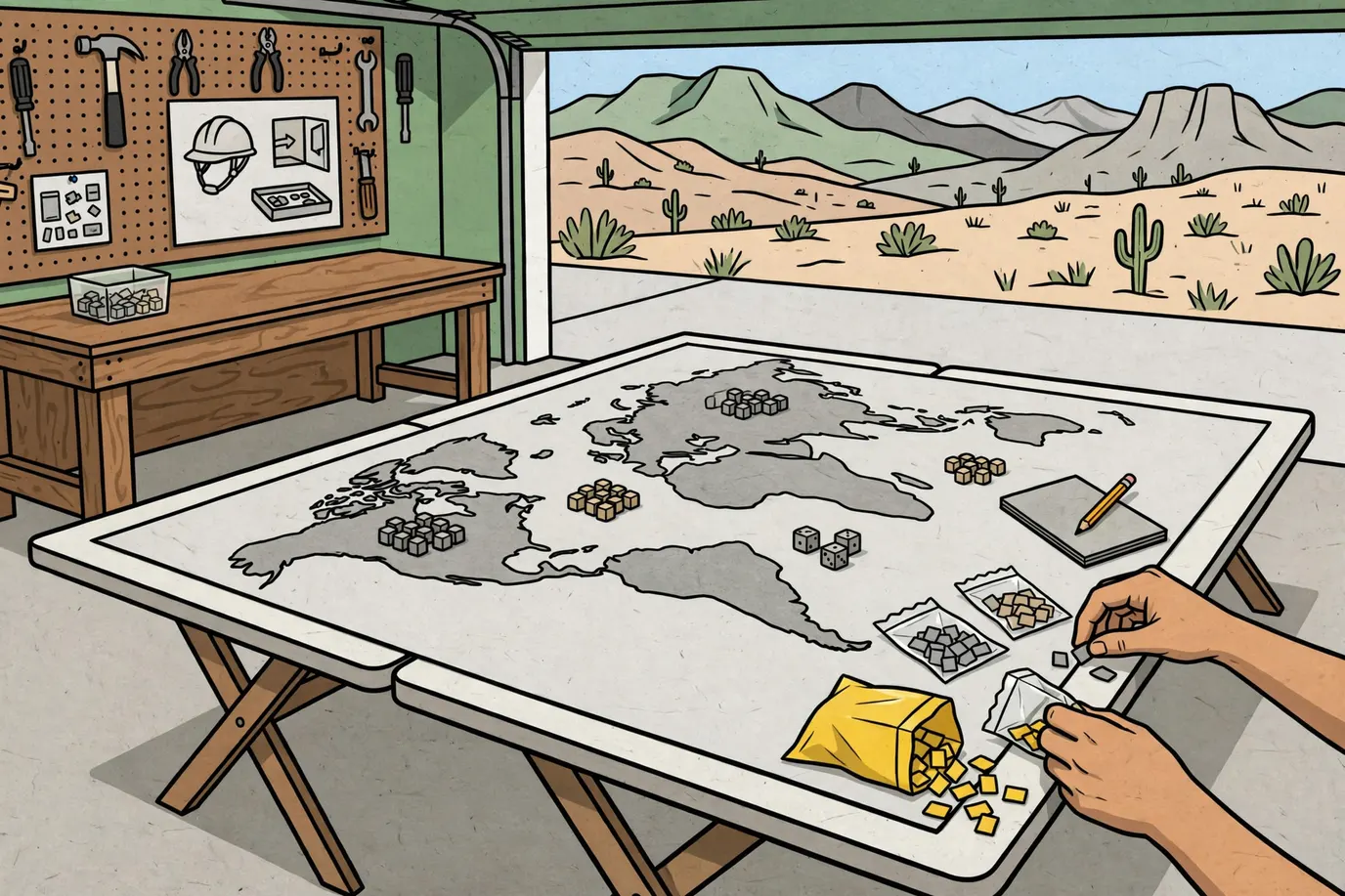
- Two tables. The board is large, and you'll want room for the battle strip, the casualty strip and the banker's notepad.
- A banker who likes numbers. Every power's IPCs change every turn. Pick someone who'll keep a tidy column.
- Small bags or a tray. The rulebook notes 160 miniatures, and the current publisher's page says the new printing includes resealable bags. Sorting by power and by unit type before the game saves a lot of hunting later.
- A plan for breaks. The listing says 120 minutes. Players running two powers have two turns per round and less downtime than everyone else.
Here's the table version of a fair split for fewer than 5 players, from the rulebook's rule that each player's powers must be on one side. With 2 players, one plays both Axis powers and the other plays all three Allies. With 3, the Allies can be split two and one. With 4, one Allied player takes two powers.
Who Axis and Allies suits
- Groups of 2 to 5 who like long strategy games
- Players 12 and up, by the current publisher's age label
- History fans who enjoy a map and an economy more than fast rounds
- Families with a teen who has outgrown shorter war-themed board games and wants more decisions per turn
It also suits two players surprisingly well, since each person simply runs a whole side.
Who should skip Axis and Allies
Skip it if your game nights are usually under an hour. The listing says 120 minutes, the publisher says 1 to 3 hours, and even the shorter-game option takes real time to set up and put away.
Skip it if your group doesn't want a game with a war theme. Every unit is a plane, a ship, a tank or infantry, and the goal is to capture capitals.
Skip it if you want a light rules load. Six phases, nine unit types and their special rules make for a thick rulebook. The 1941 edition is the lean one, and it's still the biggest rulebook in many family closets.
And skip it for younger kids. The listing doesn't give an age, but the current publisher lists 12+.
Check the age label before buying for a household with small children. Toys with small parts are a choking hazard for children under 3, and this box holds 160 small plastic miniatures plus dice and counters.
If you like Axis and Allies, look at these
Pages chosen by what they share with Axis and Allies: a map, armies, dice battles and a long strategy game.
- Risk: conquer territories on a world map, with dice battles
- Strategy board games: the wider shelf of games that reward planning
- Stratego: a two-player battle board game
- Twilight Imperium: an even longer strategy game, for groups with a whole day
- Board game tables: if the big map keeps losing to your dining table
Sort the little planes before the guests arrive.
Related
Questions people ask
How do you play Axis and Allies?
Each power takes a turn in a fixed order: Soviet Union, Germany, United Kingdom, Japan, United States. A turn has six phases: buy units, make combat moves, fight battles, make noncombat moves, place your new units at your factories, and collect income. Battles are settled with dice. In the standard 1941 game, a side wins by holding two enemy capitals at the end of a round.
How many players can play Axis and Allies 1941?
The listing says 2 to 5 players, and the 1941 rulebook agrees. There are five powers: Germany and Japan on the Axis side, and the Soviet Union, United Kingdom and United States on the Allied side. With 5 players, everyone runs one power. With fewer, some players run more than one, always on the same side.
How long does Axis and Allies 1941 take?
The listing says 120 minutes. The publisher of the current printing, Renegade Game Studios, lists 1 to 3 hours. The rulebook also includes an optional shorter game where taking a single enemy capital wins, which is the version to try if you want to finish in one evening.
Is the Axis and Allies Anniversary Edition on Amazon?
Not in our data right now. The only Axis and Allies listing we track on Amazon US as of October 2026 is Axis & Allies 1941. We don't list editions we can't find, and we won't guess at when another one might come back. If it shows up on a listing later, this page will show it.
What age is Axis and Allies 1941 for?
The listing in our data doesn't state an age. Renegade Game Studios, which publishes the current printing, lists ages 12+ on its page and the rulebook shows 12+ as well. The game asks players to track income, plan moves across a world map and follow a six-phase turn, so 12+ is a fair starting point.
Sources
- Renegade Game Studios: Axis & Allies 1941 — accessed 2026-10-23
- Renegade Game Studios: Axis & Allies 1941 rulebook (PDF) — accessed 2026-10-23
- CPSC: Small Parts for Toys and Children's Products — accessed 2026-10-23