Board & Card Games · Type
7 Wonders Duel: The Two-Player Game, the Rules and the Boxes
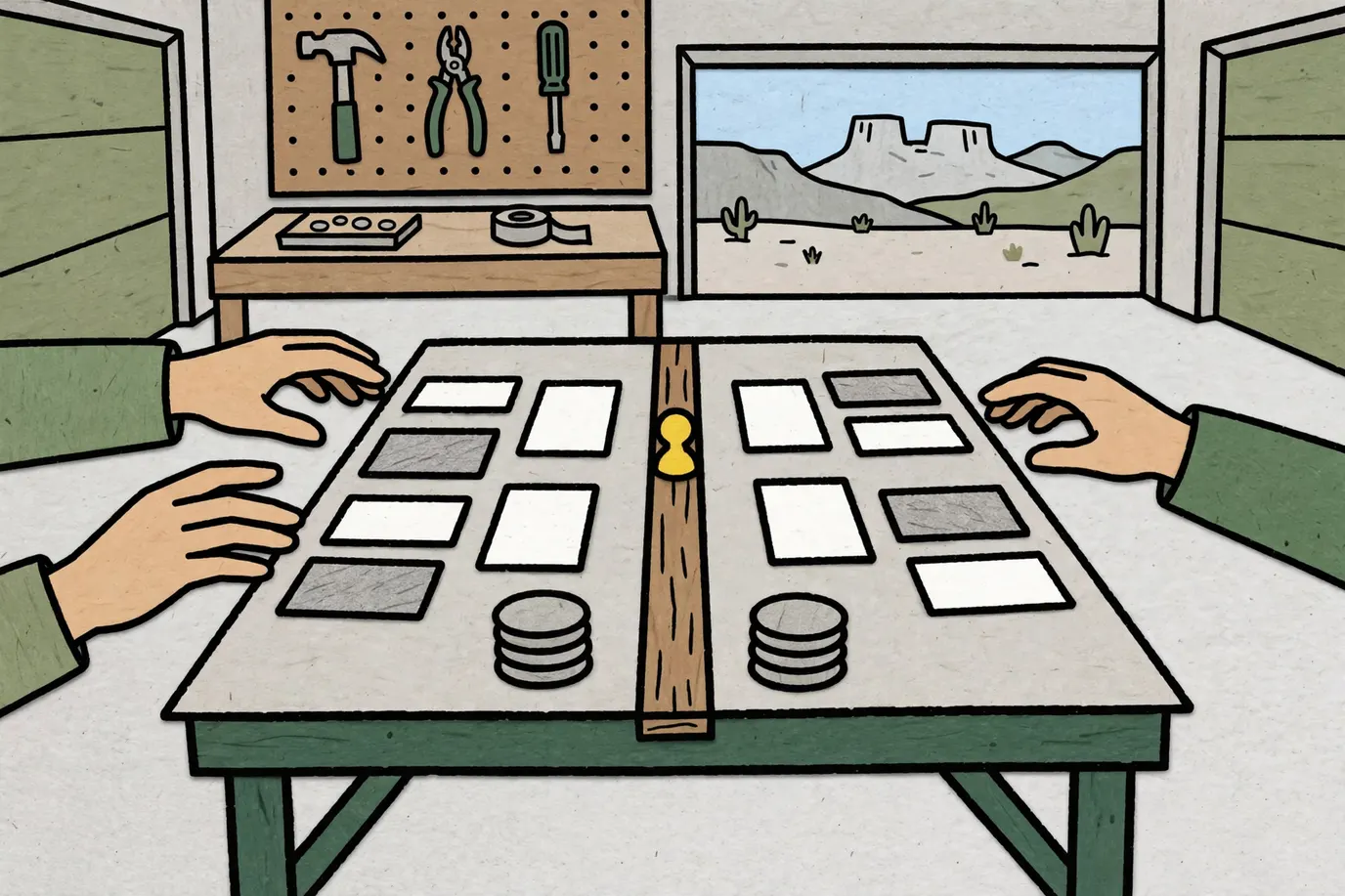
7 Wonders Duel is a card game for exactly 2 players, ages 10+ and about 30 minutes on the listing. You draft cards from a shared layout, build a city over three Ages, and can win by points, by army or by science. On Amazon US you'll find the base game, the Pantheon expansion, a box with both, and a two-game bundle. Most of the fun is taking the card your opponent needed. Most of the pain is uncovering the one they wanted next.
We earn a commission if you buy through our links, at no cost to you. Disclosure
| Model | Recommended age | Play time (min) | Play time (max) | Amazon |
|---|---|---|---|---|
Asmodee 7 Wonders DuelStrategy & hobby games More specs
| 10+ yearslisting | 30 minlisting | 30 minlisting | Check price |
Asmodee 7 Wonders Duel: PantheonStrategy & hobby games More specs
| 10+ yearslisting | 30 minlisting | 30 minlisting | Check price |
CATAN Rivals for Catan + 7 Wonders Duel bundleStrategy & hobby games More specs
| 10+ yearslisting | — | — | Check price |
Repos Production 7 Wonders Duel + PantheonStrategy & hobby games More specs
| — | — | — | Check price |


What’s in this listEditions and versions of 7 Wonders Duel sold on Amazon US, matched by the name on the listing. Players, age and play time come from the box or listing. “—” means neither the maker nor the Amazon listing states it.
What the 7 Wonders Duel game is
7 Wonders Duel is a two-player card game about building an ancient city. Each card is a building. You take cards one at a time from a layout in the middle of the table, pay for them, and add them to your side. Over three rounds, called Ages, your city grows. So does your opponent's, right across from you, using the cards you didn't take.
The designers are Antoine Bauza and Bruno Cathala, and the publisher is Repos Production. The rulebook describes it as a game in the world of 7 Wonders that borrows some of its main ideas but is built for one-on-one play. That's the key fact for a buyer. This isn't the big-table game cut down to two. It was made for two from the start.
The box facts from the listing:
- Players: 2, no more, no less
- Ages: 10+
- Play time: 30 minutes
- Competitive, no co-op mode
- Base game: doesn't need anything else
What's in the base box, per Repos Production's rulebook: a game board, 23 Age I cards, 23 Age II cards, 20 Age III cards, 7 Guild cards, 12 Wonder cards, 4 Military tokens, 10 Progress tokens, 1 Conflict pawn, 31 coins, a scorebook, a rulebook and a helpsheet.
How 7 Wonders Duel plays
The rules below are in my own words, from Repos Production's US English rulebook for 7 Wonders Duel, the base game. If you buy a box with Pantheon, the expansion adds its own rules on top of these. I'm not covering those here.
Setup in five minutes
- Put the board between you, with the Conflict pawn on the middle space.
- Set the 4 Military tokens face up on their spots.
- Shuffle the 10 Progress tokens, put 5 face up on the board, and box the rest.
- Each player takes 7 coins from the bank.
- Draft Wonders. Lay out 4 at random. The first player takes 1, the second player takes 2, and the first player gets the last one. Then do it again with 4 more, and this time the second player picks first. Each of you ends up with 4 Wonders.
- Return 3 random cards from each Age deck to the box without looking. Shuffle 3 random Guild cards into the Age III deck.
For a first game, the rulebook gives you a fixed set of 4 Wonders for each player so you can skip the draft. I'd take that offer. The draft is a good part of the game, but it's a better part once you know what the Wonders do.
The card layout is the board
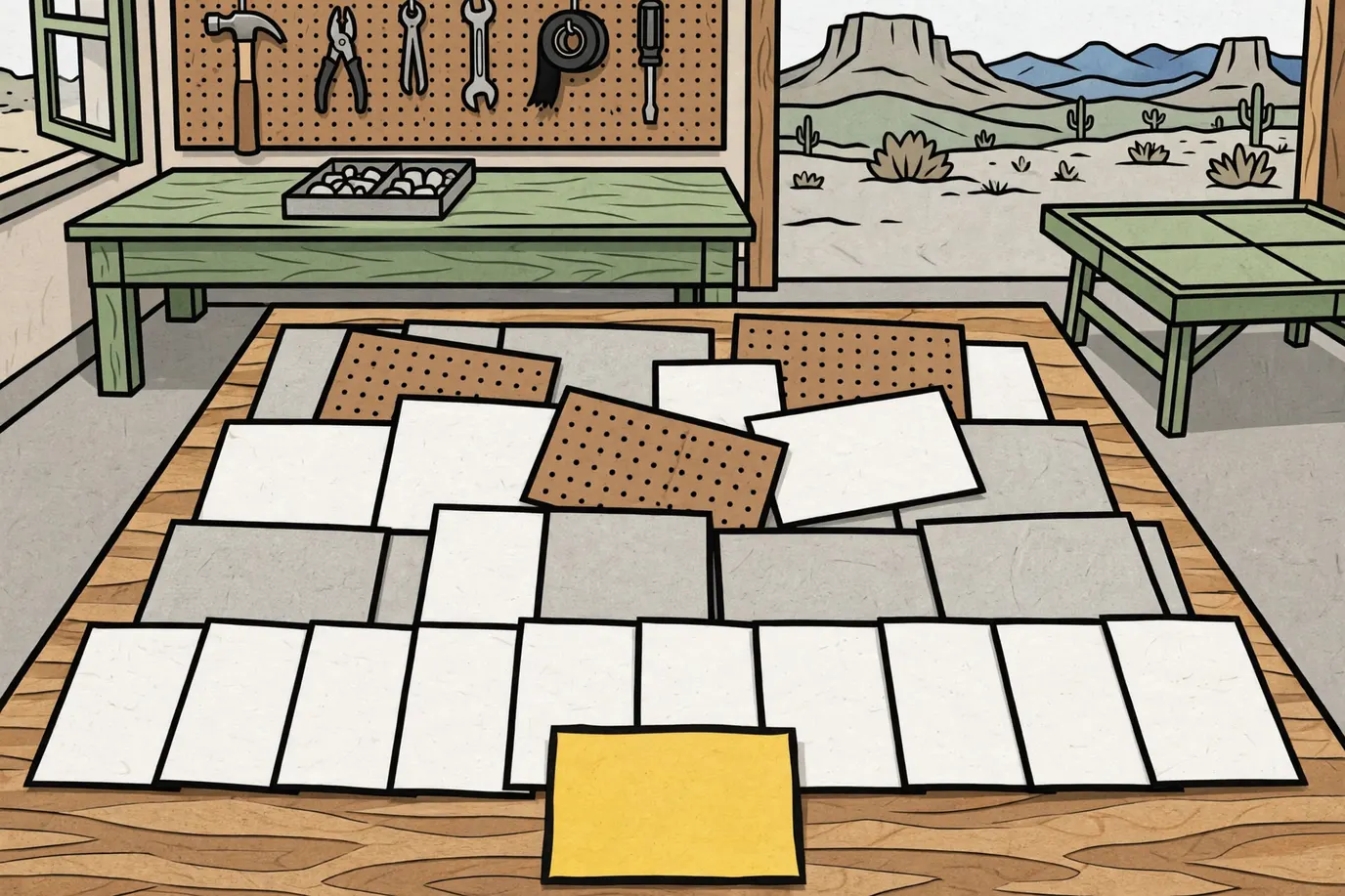
At the start of each Age, you deal 20 cards into a set pattern. Some rows are face up and some are face down, and the rows overlap. The rulebook's last page shows the shape for each Age.
Here's the rule that makes the whole game work. You can only take a card that isn't partly covered by another card. When you take one, any face-down card that is now uncovered gets flipped over. So every pick does two things. It gives you a card, and it shows your opponent what they can take next.
This is the part of Duel I'd explain to a new player first. You aren't just asking "what do I want?" You're asking "what am I handing over?" The card you need is often sitting right under a card that helps the other side.
A turn: pick one card, do one thing
On your turn, take one available card and use it one of three ways:
- Build it. Pay its cost and put it in your city. Some cards are free. Some cost coins. Most cost resources like wood, stone, clay, glass or papyrus.
- Sell it. Discard it for 2 coins, plus 1 more coin for each yellow card in your city.
- Build a Wonder with it. Pay the cost printed on one of your Wonders and tuck the card under it face down. The card itself does nothing. It just marks the Wonder as built.
Resources aren't spent when you build. If you produce one stone, you have one stone every turn for the rest of the game. That surprised me the first time I read it, and it changes how you value the brown and gray cards early on.
Buying what you don't have
If you're missing a resource, you can buy it from the bank. The price is 2 coins, plus 1 coin for each of that resource your opponent produces with their brown and gray cards. So if your opponent makes two stone, stone costs you 4 coins each. The money goes to the bank, not to them, but they still set your price.
That's my favorite rule in the box. You can make a card expensive for the other player just by building a quarry. Nobody gets paid. Somebody still gets annoyed.
Chains: build now, save later
Starting in Age II, some cards show a small symbol linked to a building from an earlier Age. If you already built that earlier building, you get the new one free. The rulebook's example is the Baths in Age I leading to a free Aqueduct in Age II. Planning a chain is how you stretch a small pile of coins across three Ages.
Only seven Wonders get built
You each draft 4 Wonders, so there are 8 between you. Only 7 can be built in one game. As soon as the seventh Wonder goes up, the last unbuilt one goes back in the box. Whoever is slower loses a Wonder. The name of the game turns out to be a rule.
The end of an Age
An Age ends when all 20 cards in the layout are gone. Then you deal the next Age's layout. The player with the weaker military, meaning the Conflict pawn is on their side, picks who starts the next Age. If the pawn is dead center, the player who took the last card makes that call.
Three ways to win 7 Wonders Duel
Most games run all three Ages and end on points. Two other wins can end the game early, on any turn.
Military supremacy
Red cards and some Wonders have shields. Each shield moves the Conflict pawn one space toward your opponent's capital. The track has 19 spaces split into zones. When the pawn enters certain zones, the player who pushed it there uses a Military token, which makes the opponent lose 2 or 5 coins. Push the pawn all the way to the other capital and you win on the spot.
It's a tug-of-war, and the rope only has so many spaces. Every red card your opponent builds is a reason to build one of your own.
Scientific supremacy
There are 7 different science symbols on the green cards and on one Progress token. Each time you collect a matching pair, you pick one of the Progress tokens on the board and keep it. Collect 6 different science symbols and you win immediately.
Civilian victory
If nobody wins by army or science, you score at the end of Age III. Add your military points (0, 2, 5 or 10, depending on where the pawn sits), points from your blue, green, yellow and purple cards, your Wonders, your Progress tokens, and 1 point for every 3 coins you have left. Highest total wins. On a tie, the player with more points from blue cards wins. If that's tied too, you share the win.
Repos Production's page sums up the four city paths the same way: red pushes the army, green chases science, yellow brings coins, blue brings points.
7 Wonders Duel boxes on Amazon US right now
Our data for this page lists 4 Duel boxes on Amazon US as of October 2026. The table above shows the players, age and play time each listing states. Where a listing leaves a field blank, the table shows a dash.
7 Wonders Duel (base game)
The Asmodee listing for the base game says 2 players, ages 10+ and 30 minutes, and it isn't an expansion. This is the box the rulebook above describes. Start here if you've never played.
7 Wonders Duel: Pantheon
Pantheon is an expansion. The listing names 7 Wonders Duel as the base game it needs and lists its parts: a Pantheon board, 2 Wonders, 3 Progress tokens and 5 Grand Temple cards. It also lists 2 players, ages 10+ and 30 minutes. The listing doesn't explain the new rules, so I won't guess at them here.
Repos Production's page names a second Duel expansion, Agora. It isn't among the listings in our data right now.
7 Wonders Duel + Pantheon
This Repos Production box puts the base game and Pantheon together. The listing says 2 players and isn't marked as an expansion, so it stands on its own. It doesn't state an age or a play time in our data. If you already know you want the expansion, this is the one-box route.
Rivals for Catan + 7 Wonders Duel bundle
This listing from CATAN bundles two separate two-player games: Rivals for Catan and 7 Wonders Duel. It lists 2 players and ages 10+, and it isn't an expansion. No play time is listed. If you want a shelf of games for two and you're curious about both, this covers two games with one search. If you only want Duel, the base box is the simpler buy.
Who 7 Wonders Duel suits
My one opinion for this page: buy for your usual group size, not for the game you wish you had. Duel is a strict 2-player game. That makes it a great fit for some houses and a dead box in others.
Good matches, from the box facts:
- Couples or roommates who play after dinner
- A parent and a kid who is 10 or older
- Two friends who want a full game in about 30 minutes
- Anyone who liked the idea of 7 Wonders but rarely has 3 people around
At my house, the two-player slot opens up a lot. Dana works night shifts, so some evenings it's one adult and one kid who's still awake. Dana's ruling on 2-player games is short: the loser shuffles. She says it builds character. I've built a lot of character.
Who should skip 7 Wonders Duel
Skip it if your table is usually 3 or more. There's no way to stretch it, and the third person ends up keeping score. The original 7 Wonders lists 3 to 7 players and fits that night better.
Skip it if you want a game with no reading of symbols. Every card has an icon for its cost and its effect, and the helpsheet gets passed back and forth for the first few games.
Skip it, for now, if your kid is under 10. The listing says 10+, and the game does ask you to track coins, costs and the other player's buildings every turn. A younger kid may like stacking coins. That's a different game.
Check the age label on the listing. Toys with small parts are a choking hazard for children under 3, and the coins, tokens and pawn in this box are small parts.
If you like 7 Wonders Duel, look at these
Pages chosen by what they share with Duel: strategy, cards or a two-player option.
- 7 Wonders: the same world for 3 to 7 players, with simultaneous card drafting
- Strategy board games: the wider shelf of games that reward planning
- Catan: the other half of the bundle above lives in this family
- Splendor: another game about building an engine from cards and gems
- Azul: drafting from a shared supply, with tiles instead of cards
Marisol watched me deal the Age II layout once and had one note. "Cards you can't reach aren't in play. That's the same as a survey. You can't stake a corner you can't get to." She's right, and it's the best one-line summary of the layout I've heard.
Take the card on top. The one you want is always underneath.
Related
Questions people ask
How many players can play 7 Wonders Duel?
Exactly 2. Every Duel listing in our data says 2 players minimum and 2 maximum, and Repos Production's rulebook calls it a game for 2 players. There's no solo mode in the rulebook and no way to add a third seat. If you usually have three or more people at the table, look at the original 7 Wonders, which lists 3 to 7.
How long does a game of 7 Wonders Duel take?
The base game and the Pantheon expansion both list 30 minutes, and the publisher's page says about 30 minutes too. A game can end sooner. A military or science win stops the game the moment it happens, so a lopsided match can wrap up before the third Age is over.
Do you need the base game to play Pantheon?
Yes. The Pantheon listing marks it as an expansion and names 7 Wonders Duel as the base game it needs. It lists a Pantheon board, 2 Wonders, 3 Progress tokens and 5 Grand Temple cards. If you don't own Duel yet, the 7 Wonders Duel + Pantheon box from Repos Production lists both in one, and that listing isn't marked as an expansion.
Is 7 Wonders Duel the same as 7 Wonders?
No. They share a world, card colors and some ideas, but Duel is its own game built for two. In 7 Wonders, 3 to 7 players pass hands of cards around the table. In Duel, two players take turns picking from a shared layout of face-up and face-down cards. Duel also adds a military track and two instant-win conditions.
What age is 7 Wonders Duel for?
The base game, the Pantheon expansion and the Rivals for Catan bundle all list ages 10+. The Repos Production two-in-one box doesn't state an age in our data. The game asks you to track coins, resource costs and your opponent's buildings every turn, which is why a 10+ label makes sense.
Sources
- Repos Production: 7 Wonders Duel — accessed 2026-10-23
- Repos Production: 7 Wonders Duel rulebook, US English (PDF) — accessed 2026-10-23
- CPSC: Small Parts for Toys and Children's Products — accessed 2026-10-23